Glencoe Math Course 2 Volume 1 Common Core Chapter 4 Rational Numbers
Glencoe Math Course 2 Volume 1 Chapter 4 Exercise 4.2 Solutions Page 271 Exercise 1 Problem 1
To add or subtract the fractions we see the denominator.
If the denominators are the same we only function with the numerator.
If the denominators are not the same we take the L.C.M of it.
Multiplication: Multiply the numerator with the numerator.
Multiply the denominator with the denominator.
Divide: Dividing a fraction by another fraction is the same as multiplying the fraction by the reciprocal (inverse) of the other.
Here we have shown the addition, subtraction, multiplication, and division of two fractions
Read and Learn More Glencoe Math Course 2 Volume 1 Common Core Student Edition Solutions
Common Core Chapter 4 Rational Numbers Exercise 4.2 Answers Glencoe Math Course 2 Page 271 Exercise 1 Problem 2
The Greek letter π (pi) represents the nonterminating and nonrepeating number whose first few digits are 3.14.….
This number is an irrational number.
Using the internet we have to find the value of π
The fractional value of π is \(\frac{22}{7}\)
We divide them
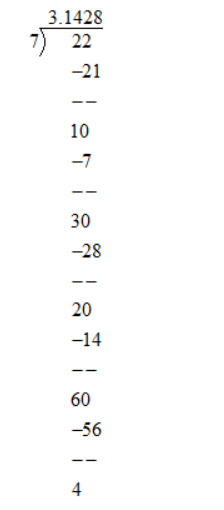
The value of π is 3.1428… and so on. Because the value of π is an irrational number, it is an irrational number.
The value of π is presented as 3.14159, whose ration is unknown when it is originally introduced in the earlier lessons.
The most common estimate is in the form of a rational number, such as 227=3.1428571428571 which is the closest but not exact approximation to the actual value of π
Therefore, the value of π: is 3.1428. The non-terminating and non-repeating decimal expansion ofπ makes it an irrational number.
Step-By-Step Guide For Exercise 4.2 Chapter 4 Rational Numbers In Glencoe Math Course 2 Page 272 Exercise 1 Problem 3
Given: \(\frac{5}{6}\) ◯ \(\frac{7}{9}\)
To find – Fill in the ◯ with <, > or=
We know that
\(\frac{5}{6}\) ◯ \(\frac{7}{9}\)
The LCD of the denominators 6 and 9 is 18
\(\frac{5}{6}\) = \(\frac{5×3}{6×3}\)
⇒ \(\frac{15}{18}\)
\(\frac{7}{9}\) = \(\frac{7×2}{9×2}\)
⇒ \(\frac{14}{18}\)
Since, \(\frac{15}{18}\) > \(\frac{14}{18}\), \(\frac{5}{6}\) > \(\frac{7}{9}\)
Finally, We compare the numerators of each fraction and order them from least to largest or greatest to least. \(\frac{15}{18}\) > \(\frac{14}{18}\), \(\frac{5}{6}\) > \(\frac{7}{9}\)
Given: \(\frac{1}{5}\) ◯ \(\frac{7}{50}\)
To find – Fill in the ◯ with <, > or =
\(\frac{1}{5}\) ◯ \(\frac{7}{50}\)
The LCD of the denominators 5 and 50 is 50
\(\frac{1}{5}\) = \(\frac{1×10}{5×10}\)
⇒ \(\frac{10}{50}\)
⇒ \(\frac{1}{5}\)
\(\frac{7}{50}\) = \(\frac{7×1}{50×1}\)
⇒ \(\frac{7}{50}\)
\(\frac{10}{50}\)>\(\frac{7}{50}\), \(\frac{1}{5}\)>\(\frac{7}{50}\)
Finally, We compare the numerators of each fraction and order them from least to largest or greatest to least. \(\frac{10}{50}\)>\(\frac{7}{50}\), \(\frac{1}{5}\)>\(\frac{7}{50}\)
Given: − \(\frac{9}{16}\) ◯ −\(\frac{7}{10}\)
To find – Fill in the◯ with <,>, or =
We know that
\(\frac{9}{16}\) ◯−\(\frac{7}{10}\)
The LCD of the denominators 16 and 10 is 80
\(\frac{9}{16}\) = \(\frac{−9×5}{16×5}\)
⇒ −\(\frac{45}{50}\)
−\(\frac{7}{10}\)= −\(\frac{7×8}{10×8}\)
⇒ −\(\frac{56}{80}\)
Since, −\(\frac{45}{50}\)>\(\frac{56}{80}\),−\(\frac{9}{16}\)> −\(\frac{7}{10}\)
Finally, We compare the numerators of each fraction and order them from least to largest or greatest to least. −\(\frac{45}{50}\)>\(\frac{56}{80}\),−\(\frac{9}{16}\)> −\(\frac{7}{10}\)
Given:
In a second-period class,37.5% of students like to bowl. In a fifth-period class, 12 out of 29 students like to bowl.
Convert the given percentage to decimal and then find which class does a greater fraction of the students like to bowl
In the second period class which means 5 th period37.5% of students like to bowl.
37.5% = 0.375
12 out of 29. Which means
\(\frac{12}{29}\) = 0.1413.
While comparing both the value.
0.375 < 0.413.
Hence, in the fifth-period class the fraction of students who like to bowl is greater than the second-period class of students.
Given:
{23%,0.21,\(\frac{1}{4}\)\(\frac{1}{5}\)}
First, convert % to decimal Then convert the fractions to decimal and then arrange them from least to greatest.
Convert % to a decimal. 23% = 0.23
This number is already in decimal. 0.21
Convert fractions to decimals.
\(\frac{1}{4}\) = 0.25
\(\frac{1}{5}\) = 0.2
The order from least to greatest is 0.2,0.21,0.23,0.25
Exercise 4.2 Solutions For Chapter 4 Rational Numbers Glencoe Math Course 2 Volume 1 Page 274 Exercise 1 Problem 4
Given: The fraction −\(\frac{4}{5}\), −\(\frac{1}{5}\)
To find – Make the true sentence
Since we can write
−4 < −1
And since the denominator are the same, we know that
−\(\frac{4}{5}\)<−\(\frac{1}{5}\)
The value of true sentence is −\(\frac{4}{5}\)<−\(\frac{1}{5}\)
Examples Of Problems From Exercise 4.2 Chapter 4 Rational Numbers In Glencoe Math Course 2 Page 274 Exercise 2 Problem 5
Given:
Two fractions are : 1\(\frac{3}{4}\), 1\(\frac{5}{8}\)
To find – Make the true sentence
Since 0.75>0.625
And since the denominator are the same, we know that
\(\frac{3}{4}\) = 0.75 >\(\frac{5}{8}\)
= 0.625
Add 1 to both sides of the inequality
1\(\frac{3}{4}\) > 1\(\frac{5}{8}\)
0.75 > 0.625
True sentence of this fraction is 1\(\frac{3}{4}\) > 1\(\frac{5}{8}\), 0.75 > 0.625
Common Core Exercise 4.2 Chapter 4 Rational Numbers Detailed Solutions Glencoe Math Course 2 Page 274 Exercise 3 Problem 6
Given: Elliot saves the goals \(\frac{3}{4}\)
Shanna saves the goals\(\frac{7}{11}\)
To find – Better average
Since we can write
0.75 > 0.636
And since the denominator are the same, we know that
\(\frac{3}{4}\) = 0.75 > \(\frac{7}{11}\) = 0.636
0.75 > 0.636
Elliot saves the goal better than Shanna, Elliot > Shanna.
Student Edition Glencoe Math Course 2 Chapter 4 Rational Numbers Exercise 4.2 Solutions Guide Page 274 Exercise 4 Problem 7
Given:
The insects inches are 0.02, \(\frac{1}{8}\) , 0.1, \(\frac{2}{3}\)
To find – List the insects from least to greatest
Since 0.02, \(\frac{1}{8}\) = 0.125, 0.1, \(\frac{2}{3}\) = 0.667
The length of four insects from least to greatest is
0.02<0.1<0.125<0.667
The length of four insects from least to greatest is 0.02 < 0.1 < 0.125 < 0.667, 0.02 < 0.1 < \(\frac{1}{8}\) < \(\frac{2}{3}\).
Page 274 Exercise 5 Problem 8
Add the fractions to the number line, the fraction that is the most to the right is the greatest fraction.
Hence we can compare two fractions by using the above method.
Step-by-step answers for Exercise 4.2 Chapter 4 Rational Numbers In Glencoe Math Course 2 Volume 1 Page 275 Exercise 3 Problem 9
Given: The fractions 6\(\frac{2}{3}\) , 6\(\frac{1}{2}\)
To find – Make a true sentence
Since we can write
4>3
And since the denominator are the same, we know that
\(\frac{2}{3}\) = \(\frac{4}{6}\)>\(\frac{3}{6}\) = \(\frac{1}{2}\)
Add 6 to both sides of the inequality
The fraction value is 6\(\frac{2}{3}\)>6\(\frac{1}{2}\)
Page 275 Exercise 4 Problem 10
Given: −\(\frac{17}{24}\) and − \(\frac{11}{12}\)
Make the denominators the same for both the fractions and then relate them with <,> or =
Make the denominators of the two fractions the same by multiplying and dividing with the appropriate number.
−\(\frac{17}{24}\) and − \(\frac{11}{12}\)
−\(\frac{17}{24}\)× \(\frac{12}{12}\) > − \(\frac{11}{12}\)× \(\frac{24}{24}\)
−\(\frac{288}{24}\) > −\(\frac{264}{288}\)
The true sentence is −\(\frac{17}{24}\) > − \(\frac{11}{12}\).
The true sentence is −\(\frac{17}{24}\) > − \(\frac{11}{12}\).
Page 275 Exercise 5 Problem 11
Given: Meg answered in the first quiz is 92%, next quiz is
\(\frac{27}{30}\) First, convert the decimal to percentage and find which quiz she answered the better score
The number of questions answered in the second quiz is 27 out of 30
Then, \(\frac{27}{30}\) = 0.9
Convert to percentage
= 0.9 × 100
= 90 %
Therefore, Meg answered 90 % of the questions correctly in the second quiz.
But in the First quiz, Meg answered 92 % of the questions correctly. 92 %>90%
So, the First quiz is better than the second quiz.
Meg answered the First quiz better than the second quiz.
Page 275 Exercise 6 Problem 12
Given: The sets are 0.23,19
To find – Set least to greatest 0.23,19%, \(\frac{1}{5}\)
Since Percentage converted into number is divided by hundreds
0.23, \(\frac{19}{100}\) = 1.9, \(\frac{1}{5}\) = 0.2
And since set least to greatest is
0.2 < 0.23 < 1.9
Sets least to greatest is 0.2< 0.23<1.9, \(\frac{1}{5}\) < 0.23 < 19
Step-by-step answers for Exercise 4.2 Chapter 4 Rational Numbers in Glencoe Math Course 2 Volume 1 Page 275 Exercise 7 Problem 13
Given: Sets of numbers
To find – Least to the greatest
Since The value of −\(\frac{5}{8}\)
= −0.625
And since the value arranged from least to greatest is given below
{−0.625<−0.62<−0.615}
Sets arrange least to greatest is {−0.625<−0.62<−0.615} , {−\(\frac{5}{8}\) <−0.62<−0.615}
Page 275 Exercise 8 Problem 14
Given:
The sixth-graders have raised 52 % of their goal amount. The seventh- and eighth-graders have raised 0.57 and \(\frac{2}{5}\) of their goal amounts, respectively
Convert the percentage to decimal and find the order of least to greatest of their goal amounts.
The amount raised by the eighth graders = \(\frac{2}{5}\) of their goal amount.
= 0.4 of their goal amount.
The amount raised by sixth graders =52 % of their goal amount
\(\frac{52}{100}\)= 0.52
The amount raised by seventh graders = 0.57
Compare the amount raised by the sixth, seventh, and eighth graders
Arranging, the least to greatest is:
0.4 < 0.52 > 0.57
The classes in order from least to greatest of their goal amounts is Eighth grade < Sixth grade < seventh grade.
Page 275 Exercise 9 Problem 15
Given: Two mixed fraction
1\(\frac{7}{12}\) gallons, 1\(\frac{5}{8}\)
Make the denominators of the two fractions the same by multiplying and dividing with the appropriate number.
1\(\frac{7}{12}\)< 1\(\frac{5}{8}\)
\(\frac{7}{12}\) × \(\frac{8}{8}\) < \(\frac{5}{8}\) × \(\frac{12}{12}\)
\(\frac{56}{96}\) < \(\frac{60}{96}\)
1\(\frac{7}{12}\) < 1\(\frac{5}{8}\)
The True sentence is 1\(\frac{7}{12}\) < 1\(\frac{5}{8}\)
Page 275 Exercise 10 Problem 16
Given: Two mixed fraction
To find – The greater number between two fractions
Since we have two different times but one in a fraction
We 2\(\frac{5}{6}\) = \(\frac{12+5}{6}\)
\(\frac{17}{6}\) = 2.83
⇒ 2.83 > 2.8
2\(\frac{5}{6}\)> 2.8
The fraction is greater than number
True sentence is 2\(\frac{5}{6}\)> 2.8.
Page 276 Exercise 11 Problem 17
According to the graphic novel frame, the total width of the closet organizer is
69 \(\frac{1}{8}\) = \(\frac{553}{8}\)
= 69.125
The total width of the closet organizer is
69\(\frac{3}{4}\) = \(\frac{279}{4}\)
= 69.75
69.125 < 69.75
That is total width of the closet<total width of the closet
That means the closet can fit into the organizer.
Finally, we concluded That the closet can fit into the organizer.
Page 276 Exercise 12 Problem 18
Here it is given that
12 out of 15 ⇒ \(\frac{12}{15}\) = 0.8
0.08 ≠ 0.8
80% = \(\frac{80}{100}\)
= 0.8
\(\frac{4}{5}\) = 0.8
The ratio that does not have the same value as the other three is \(\frac{4}{5}\) = 0.8
The ratio that does not have the same value as the other three is 0.08.
Page 277 Exercise 15 Problem 19
Given: Two simple fractions
To find – True sentence or sign
Since denominators are same easily put the value-based in numerators −\(\frac{5}{7}\)<\(\frac{2}{7}\)
The symbol of this statement is <
The true sentence of this fraction is −\(\frac{5}{7}\)<\(\frac{2}{7}\)
Page 277 Exercise 16 Problem 20
Given:
Two simple fractions : −3\(\frac{2}{3}\) and −3\(\frac{2}{3}\)
To find – True sentence or sign
Denominators are different so take simple fractions in cross multiplication method
\(\frac{2}{3}\) × \(\frac{6}{6}\)= \(\frac{12}{18}\)
\(\frac{4}{6}\) × \(\frac{3}{3}\)
= \(\frac{12}{18}\)
\(\frac{12}{18}\) = \(\frac{12}{18}\)
\(\frac{2}{3}\) = \(\frac{4}{6}\)
The values are same so we put an equal sign
The values are same so we put an equal sign \(\frac{2}{3}\) = \(\frac{4}{6}\)
Page 277 Exercise 17 Problem 21
Given:
Two simple fractions : \(\frac{4}{7}\)and \(\frac{5}{8}\)
To find – True sentence or sign
\(\frac{4}{7}\) = \(\frac{4×8}{7×8}\)
= \(\frac{32}{56}\)
\(\frac{5}{8}\) = \(\frac{5×7}{8×7}\)
= \(\frac{35}{56}\)
\(\frac{32}{56}\) < \(\frac{35}{56}\)
\(\frac{4}{7}\) < \(\frac{5}{8}\)
The sign of this fraction is <
The true sentence of this fraction is \(\frac{4}{7}\) < \(\frac{5}{8}\)
Page 277 Exercise 18 Problem 22
Given:
Two mixed fractions : 2\(\frac{3}{4}\) and 2\(\frac{2}{3}\)
To find – True sentence or sign
Since denominators are different we take cross multiplication
2\(\frac{3}{4}\) = \(\frac{3×3}{4×3}\)
= \(\frac{9}{12}\)
2\(\frac{2}{3}\) = \(\frac{2×4}{3×4}\)
= \(\frac{8}{12}\)
\(\frac{9}{12}\)>\(\frac{8}{12}\)
= 2\(\frac{3}{4}\)> 2\(\frac{2}{3}\)
Hence the true value of the sign is
Hence the true value of sign is 2\(\frac{3}{4}\) > 2\(\frac{2}{3}\).
Page 277 Exercise 19 Problem 23
Given:
Garcia made − \(\frac{4}{15}\)
Jim missed− \(\frac{6}{16}\)
To find – a greater fraction of the time
Garcia and Jim throw different values we find who made free throw a greater fraction
\(\frac{4}{15}\) = \(\frac{4×16}{15×16}\)
= \(\frac{64}{240}\)
\(\frac{6}{16}\) = \(\frac{6×15}{16×15}\)
= \(\frac{90}{240}\)
⇒ \(\frac{64}{240}\)<\(\frac{90}{240}\)
⇒ \(\frac{4}{15}\)<\(\frac{6}{16}\)
Jim throws better than Garcia \(\frac{4}{15}\)<\(\frac{6}{16}\).
Page 277 Exercise 20 Problem 24
Given:
Sets of numbers fraction : {7.49,7\(\frac{49}{50}\),7.5}
To find – Least to the greatest
Since we convert fractions into numbers
7\(\frac{49}{50}\) = \(\frac{350+49}{50}\)
= 7.98
{0.75 < 7.49 < 7.98}
The order of a set of fractions from least to greatest {0.75 < 7.49 < 7.98}
Page 277 Exercise 21 Problem 25
Given:
Sets of numbers fraction : {-1.4,−1\(\frac{1}{25}\)-1.25}
To find- Least to the greatest
Since we convert mixed fractions into numbers
−1\(\frac{1}{25}\) = −\(\frac{25+1}{25}\)
− 1.04
{−1.25<−1.4<−1.04}
{−1.25<−1.4<−1\(\frac{1}{25}\)}
The sets of value least to greatest is {−1.25<−1.4<−1\(\frac{1}{25}\)}
Page 277 Exercise 22 Problem 26
Given:
The four mammals’ length in the table is :
Eastern Chipmunk − \(\frac{1}{3}\)
European Mole − \(\frac{5}{12}\)
Masked Shrew − \(\frac{1}{6}\)
Spiny Pocket Mouse − 0.25
To find – Which animal is the smallest mammal
Since we have different animals’ lengths in tables, now we can find which animal length is small in size,
(\(\frac{1}{3}\) = 0.33),(\(\frac{5}{12}\) = 0.416), (\(\frac{1}{6}\) = 0.166), (0.25)
0.166 < 0.25 < 0.33 <0.416
Since 0.166 ft
The masked shrew is the smallest mammal in this table The length is 0.166ft
Given:
The four mammals’ length in the table is :
Eastern Chipmunk − \(\frac{1}{3}\)
European Mole − \(\frac{5}{12}\)
Masked Shrew − \(\frac{1}{6}\)
Spiny Pocket Mouse − 0.25
To find – Which animal is smaller than the European mole and larger the spiny pocket mouse
Since we have four different animals’ length
European mole length is
\(\frac{5}{12}\) = 0.416ft
Spiny pocket mouse length is
0.25ft
And since all length
0.416>0.33>0.25>0.166
In between the length of mammal is
0.33ft
The eastern chipmunk is smaller than the European mole and larger than a spiny pocket mouse.
Given:
The four mammals’ length in the table is :
Eastern Chipmunk − \(\frac{1}{3}\)
European Mole − \(\frac{5}{12}\)
Masked Shrew − \(\frac{1}{6}\)
Spiny Pocket Mouse − 0.25
To find – Order the animals from greatest to least size
Since we have four different animals in different size, we order the animal’s length in greater to the smallest
European mole length is
\(\frac{5}{12}\) = 0.416 ft
Spiny pocket mouse length is
0.25ft
And since we order in greatest to smallest is
0.416>0.33>0.25>0.166
Order the animals in greatest to smallest is 0.416>0.33>0.25>0.166.
Page 278 Exercise 23 Problem 27
Given: Four points in the line
To find – Which point located in \(\frac{7}{2}\)
Since we have four points in that line, The value of \(\frac{7}{2}\) = 3.5
This value is located at point C in the line
\(\frac{7}{2}\) = 3.5
This value is located at point C in the line.
Page 278 Exercise 24 Problem 28
Given: we have four list of numbers in order
To find – Order the list which is in least to greatest
Since we have four list of number in different values
4\(\frac{1}{4}\) = \(\frac{16+1}{4}\)
\(\frac{17}{4}\) = 4.25
\(\frac{1}{4}\) = 0.25
Since percentage converted into number is given below
4%= \(\frac{4}{100}\) = 0.04
0.04<0.25<0.4<4.25.
The list of numbers is order from least to greatest is 0.04<0.25<0.4<4.25.
Page 278 Exercise 25 Problem 29
Given: Price changes list in every day
To find – which day the price decrease from the greatest amount
Since every day price change
On Thursday is + 0.45 price increased then next day decreased, so on Friday−1.15 the price decreased from the greatest amount
Friday is the price decreased from the greatest amount.
Page 278 Exercise 26 Problem 30
Given:
Two different numbers are −2 and 2.
To find- Make a true sentence
Since the negative value is smallest than the positive value so we put a greater sign in the positive side
−2<2
The true sentence of this value is −2<2.
Page 278 Exercise 28 Problem 31
Given:
Two values in different signs: −20 and 20
To find- Make a true sentence
Since the value of number is same but the sign is different so we put greater sign in the positive side
−20<20
The true sentence is −20<20.
Page 278 Exercise 30 Problem 32
Given:
Two different values in same negative sign: −10 and −1
To find- The number that is greater
Both sides are negative sign so when dealing with negative numbers, the number closer to zero is the bigger number.
−10<−1
The true sentence of the value is −10<−1.
Page 278 Exercise 31 Problem 33
Given:
Two different values in different signs: 50 and −100
To find- The number that is greater
Since the sign are different negative is smaller than positive
50>−100
The true sentence of this value is 50>−100.
Page 278 Exercise 32 Problem 34
Given: Three students read books and spend money for this
To find – The student who has read least amount
Three student spend the value of money given in the fraction
Victoria − \(\frac{2}{5}\) = 0.4
Cooper − \(\frac{1}{5}\) = 0.2
Diego − \(\frac{3}{5}\) = 0.6
Since Cooper has read the least amount \(\frac{1}{5}\) = 0.2
Cooper has read the least amount \(\frac{1}{5}\) = 0.2.
Page 281 Exercise 1 Problem 35
Given: \(\frac{1}{5}\)+\(\frac{2}{5}\)
First, divide the number line into fifths.
Since we don’t know if our answer is negative or positive include fractions to left and to right of zero.
Graph\(\frac{1}{5}\) on number line.

Move 2 units to the right to show adding of \(\frac{2}{5}\)

So, \(\frac{1}{5}\)+\(\frac{2}{5}\)= \(\frac{3}{5}\)
The final solution of\(\frac{1}{5}\)+\(\frac{2}{5}\)= \(\frac{3}{5}\).
Page 281 Exercise 2 Problem 36
Given: −\(\frac{3}{7}\)+(−\(\frac{1}{7}\))
To find – Addition of fractions
First, divide the number line into sevenths.
Since we don’t know if our answer is negative or positive include fractions to left and to right of zero.
Graph −\(\frac{3}{7}\) on number line.
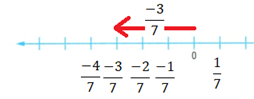
Move 1 unit to the left to show subtraction of \(\frac{1}{7}\)
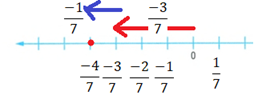
So, −\(\frac{3}{7}\)+(−\(\frac{1}{7}\)) is –\(\frac{4}{7}\)
The final solution of −\(\frac{3}{7}\) + (−\(\frac{1}{7}\)) is –\(\frac{4}{7}\)
Page 281 Exercise 3 Problem 37
Given:
Here it is − \(\frac{3}{8}\) + \(\frac{5}{8}\)
To find- Addition of fractions
First, divide the number line into eighths.
Since we don’t know if our answer is negative or positive include fractions to left and to right of zero.
Graph-\(\frac{3}{8}\)on number line.

Move 5 units to the right to show adding of \(\frac{5}{8}\)

So, − \(\frac{3}{8}\)+\(\frac{5}{8}\) is \(\frac{2}{8}\)
The final solution of –\(\frac{3}{8}\)+\(\frac{5}{8}\) is \(\frac{2}{8}\)
Page 281 Exercise 4 Problem 38
Given: \(\frac{8}{12}\) – \(\frac{4}{12}\)
To find – Subtraction of fractions
First, divide the number line into twelfths.
Since we don’t know if our answer is negative or positive include fractions to left and to right of zero.
Graph \(\frac{8}{12}\) on number line.
Move 4 units to the left to show subtraction of \(\frac{4}{12}\)
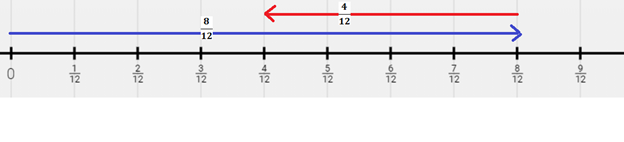
So, \(\frac{8}{12}\)–\(\frac{4}{12}\) = \(\frac{4}{12}\)
The final solution of \(\frac{8}{12}\)–\(\frac{4}{12}\) is \(\frac{4}{12}\).
Page 281 Exercise 5 Problem 39
Given: \(\frac{4}{9}\)+\(\frac{5}{9}\)
To find – Addition of fractions
First, divide the number line into nineths.
Since we don’t know if our answer is negative or positive include fractions to left and to right of zero.
Graph − \(\frac{4}{9}\)
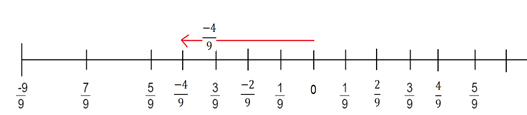
Move 5 units to the right to show addition of \(\frac{5}{9}\)
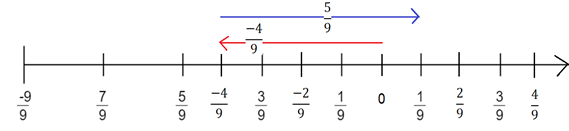
So, −\(\frac{4}{9}\) + \(\frac{5}{9}\)
= \(\frac{1}{9}\)
The final solution of −\(\frac{4}{9}\) + \(\frac{5}{9}\) is \(\frac{1}{9}\)
Page 282 Exercise 10 Problem 40
Using only numerators:
For like fractions, take the numerators separately.
Do the operations such as addition or subtraction for numerators.
Using number line:
Plot the fraction intervals on number line.
For addition operation, move to right, and for subtraction operation, move to left.
Rules for addition and subtraction: Add the numerators and place the sum over the common denominator.
Fraction subtraction: Subtract the numerators and place the difference over the common denominator.
The rules for addition and subtraction of like fractions are add the numerators and place the sum over the common denominator and Subtract the numerators and place the difference over the common denominator.