
Glencoe Math Course 3 Volume 2 Chapter 8 Exercise 8.1 Solutions Page 593 Exercise 1, Problem1
We are provided with the following figure.
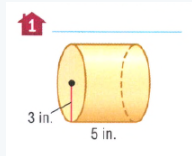
From the figure, we can clearly say that the total figure has a height of 5 in and a radius as 3 in.
We can calculate the volume of the figure.
As per the formula;
V=3.14×3×3×5
=32.97
V ≈33.0 in3
After the calculations, the volume of the figure is found to be 33.0 in3.
Page 593 Exercise 2, Problem1
We are provided with the following figure.
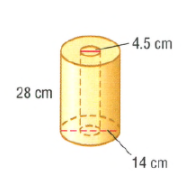
From the figure, we can clearly say that the total figure has a height of 28 cm and the radius as 7,2.25 cm.
We can calculate the volume of the roll by substracting the volume of the smaller cylinder from the larger cylinder.
As per the formula;
The volume of a large cylinder \(V=\pi \times 7^2 \times 28\)
The volume of the smaller cylinder \(V^{\prime}=\pi \times 2.25^2 \times 28\)
Required volume = \(\left(\pi \times 7^2 \times 28\right)-\left(\pi \times 2.25^2 \times 28\right)\)
= \(28 \pi\left(7^2-2.25^2\right)\)
= \(28 \times 3.14 \times 43.9375\)
Required volume = 3862.985 approx 3863.0 \(\mathrm{~cm}^3\)
After the calculations, the volume of the figure is found to be 3863.0 cm3.
Read and Learn More Glencoe Math Course 2 Volume 1 Common Core Student Edition Solutions
Page 593 Exercise 3, Problem1
We are provided with the following figure.
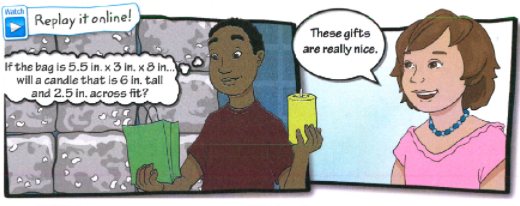
From the figure, we can clearly say that the total figure has a height of 6in and the radius as 1.25 in.
Similarly, the dimensions of the cuboid are 5.5×3×8 in.
We can calculate the volume of the figure.
As per the formula;
The volume of the bag
The volume of the candle
We are provided with the following figure.
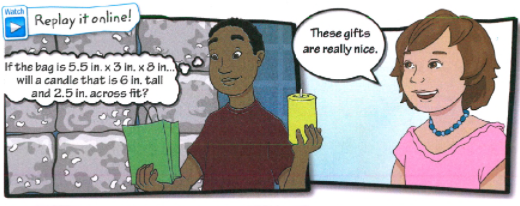
From the figure, we can clearly say that the total figure has a height of 6in and a radius as 1.25 in.
Similarly, the dimensions of the cuboid are 5.5 × 3 ×8 in.
We can calculate the volume of the figure. The difference between them gives us the required answer.
As per the previous calculations;
The volume of the bag=132 in3
The volume of the candle=28.3 in3
The total volume of packing material required is given by;
V=132−28.3
V =103.7in3
After the calculations, the volume of packing material in the bag is found to be 103.7 in3.
Page 593 Exercise 2, Problem3
We are provided with the following figure.
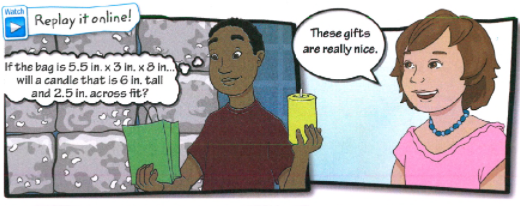
From the figure, we can clearly say that the total figure has a height of 6in and the radius as 1.25 in.
Similarly, the dimensions of the cuboid are 5.5 × 3 × 8 in.
We can calculate the volume of the figure.
As per the previous calculations;
The volume of packing material in each bag = 575 in3
Total number of teachers = 70
The total amount of packing material = 70×575
=40250 in3
After the calculations, the total volume of packing material in the bags is found to be 40250 in3.
Page 594 Exercise 1, Problem1
We are provided with the following figure.
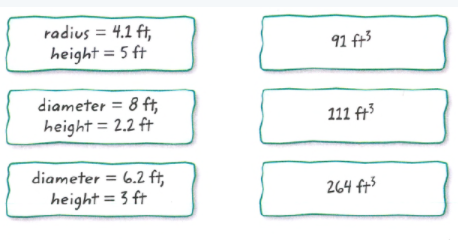
From the figure, we can clearly say that the total figures are provided with different dimensions. We can calculate the volume of the figure.
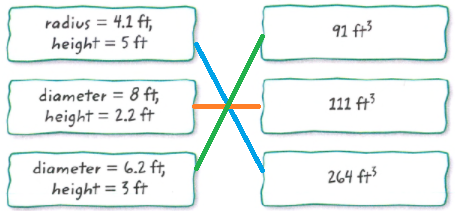
After the calculations, we can say that they match the following as shown:
“Step-By-Step Solutions For Exercise 8.1 Chapter 8 Volume And Surface Area In Glencoe Math Course 3 Page 594 Exercise 2, Problem1
We are provided with the following figure.
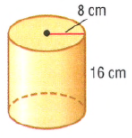
We have to draw a cylinder with more radius but less volume.
As we can observe that both the height and radius are directly proportional to the volume, so a cylinder with a smaller height should be our required figure. This figure is drawn as follows.
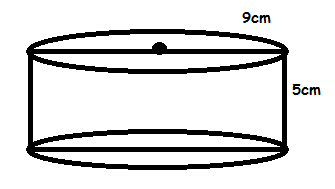
After further deductions, the final figure is constructed to be as shown.
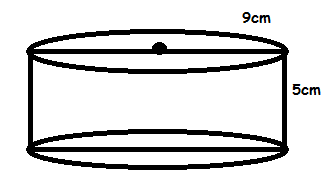
Page 594 Exercise 3, Problem1
We are provided with the following figure.
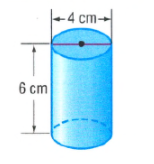
From the figure, we can clearly say that the total figure has a height of 6 cm and the radius as 2 cm.
We can calculate the volume of the figure.
As per the formula
V = 3.14×2×2×6
V = 75.36 cm2
The volume of wax in the mould is found out to be 75.36≈75.4 cm2.
Exercise 8.1 Solutions For Chapter 8 Volume and Surface Area Glencoe Math Course 3 Volume 2 Page 595 Exercise 1, Problem1
We are provided with the following figure.
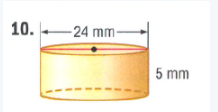
From the figure, we can clearly say that the total figure has a height of 5mm and the radius as 12mm.
We can calculate the volume of the figure.
As per the formula
V=3.14×12×12×5
V =2260.8mm3
After the calculations, the volume of the figure is found to be 2260.8 mm3
Examples of problems from Exercise 8.1 Chapter 8 Volume and Surface Area in Glencoe Math Course 3″ Page 595 Exercise 2, Problem1
We are provided with the following figure.
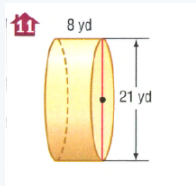
From the figure, we can clearly say that the total figure has a height of 8yd and a radius as 10.5 yd.
We can calculate the volume of the figure.
As per the formula;
V=3.14×10.5×10.5×8
V =2769.48yd3
V =2769.5yd3
After the calculations, the volume of the figure is found to be 2769.5 yd3.
Page 595 Exercise 3, Problem1
We are provided with the following figure.
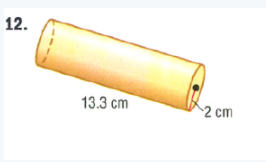
From the figure, we can clearly say that the total figure has a height of 13.3cm and the radius as 2cm.
We can calculate the volume of the figure.
As per the formula;
V=3.14×13.3×2×2
V =167.048
V =167.5cm3
After the calculations, the volume of the figure is found to be 167.5 cm3.
Page 595 Exercise 4, Problem1
We are provided with the following figure.
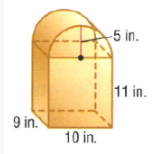
Clearly, the figure is a combination of a cuboid and half a cylinder. From the figure, we can clearly say that the cylinder figure has a height of 9in and the radius as 5in.
Similarly, for the cuboid region, the length, breadth, and height are found as 9,10,11 in.
We can calculate the volume of the figure.
The volume of the cuboid region is found as
v=l × b × h
V =9×10×11
V =990 in3
The volume of the half-cylinder is found as;
v′=12×π×r2×h
=12×3.14×52×9
=353.25 in3
Total volume = 990+353.25
=1043.25in3
After the calculations, we can say that the total volume of the mailbox is 1043.2 in3.
Page 595 Exercise 5, Problem1
We are provided with the following figure.
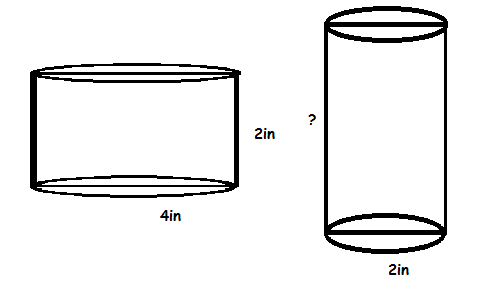
From the figure, we have to find the height of the second cylinder so that both their volumes are same.
We can calculate the volume of the figure.
The volume of the first cylinder
V = 3.14×4×4×2
V = 100.48in3
The volume of the second cylinder
V′ = 3.14×2×2×h
= 12.56h in3
∴V=V′
⇒ 12.56h=100.48
⇒ h=100.48
12.56
⇒h=8 in
After the calculations, we can say that the height of the cylinder is 8 in.
Page 595 Exercise 6, Problem1
We are provided with the following figure.
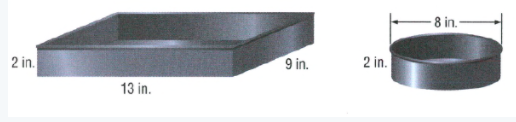
We have to find which figure has more volume. We can calculate the volume of the figures using the formula.
The volume of the cuboid container is found as
=13×9×2
=234 in3
The volume of the cylinder is found as;
=3.14×2×4×4
=100.48in3
Volume of 2 cylinder pans=200.1in3
Clearly, the cuboid has more volume.
After the calculations, we can say that the cuboid will hold more than two circular pans as it has more volume.
Page 595 Exercise 7, Problem1
We are provided with the following table.
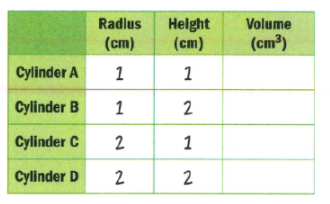
We have to write the equation to find the volume for each cylinder. We can do so as shown.
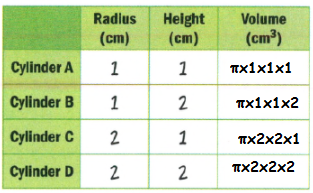
After the calculations, the table is completed as shown.
Page 595 Exercise 7, Problem2
We are provided with the following table.
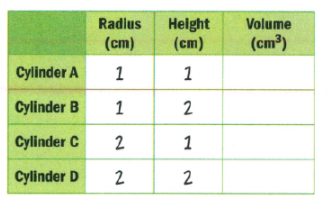
We have to compare the dimensions for each cylinder. We can clearly see that cylinders A and B have the same radius but different heights same as cylinders C and D.
So we can say that cylinder B is the double of cylinder A and similar for cylinder D and C.
After the deductions, we can say that cylinders B and D are double the cylinders A and C as per heights.
Page 595 Exercise 7, Problem3
We are provided with the following table.
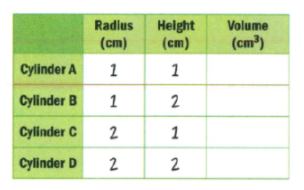
We have to complete the table by finding the volume for each cylinder. We can do so as shown.
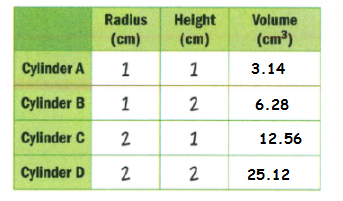
After the calculations, the table is completed as shown.
Page 595 Exercise 7, Problem4
We are provided with the following table.
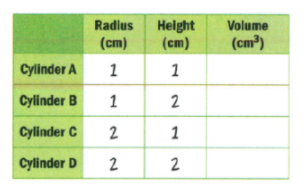
After completion, the table is found as shown.
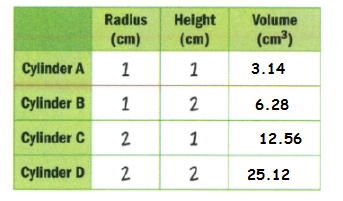
Clearly, we can see as the dimension increases the volumes keeps increasing.
After the calculations, the table is completed as it is deduced that with the increase of dimensions, the volume of the figure keeps increasing.
Page 596 Exercise 1, Problem1
We are provided with the following figure.
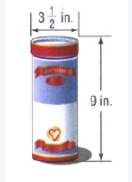
From the figure, we can clearly say that the total figure has a height of 9in and the radius as 1.75in.
We can calculate the volume of the figure.
As per the formula;
V=3.14×9×1.75×1.75
V =86.54 in3
After the calculations, the volume of the figure is found to be 86.54in3.
Page 596 Exercise 2, Problem1
We are provided with the following figure.
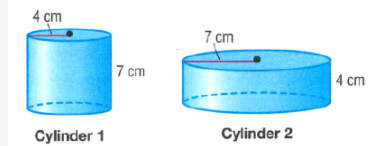
From the figure, we have to find the volume of both the cylinder and find the relation between them. We can calculate the volume of the figure using the formula.
The volume of the first cylinder = 3.14×4×4×7
= 351.68 cm3
The volume of the second cylinder = 3.14×7×7×4
= 651.44 cm3
Clearly, the volume of Cylinder 2 is greater than the volume of Cylinder 1.
After the calculations, we deduce that the volume of Cylinder 2 is greater than the volume of Cylinder 1.
Page 596 Exercise 3, Problem1
The given circle is
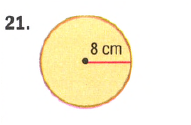
We have to determine the area of this circle.
The radius of the given circle is 8cm. We apply the formula A=πr2 to find the area.
We have a circle of radius 8 cm
Since we know that the area of a circle of radius 8 cm is A=πr2
where A is the area and r is the radius of the circle.
So, we can write, A=π(8) 2
⇒ A = 64π
⇒A = 64×22/7
⇒A ≈ 201.1 cm2.
Therefore, the approximated area of the given circle is 201.1 cm2.
Page 596 Exercise 4, Problem1
The given circle is
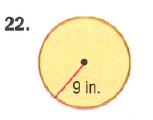
We have to determine the area of this circle.
The radius of the given circle is 9 in. We apply the formula A=πr2 to find the area.
We have a circle of radius 9 cm
Since we know that the area of a circle of radius 9 in. is A=πr2
where A is the area and r is the radius of the circle.
So, we can write, A = π(9) 2
⇒ A=81π
⇒ A = 81×22/7
⇒ A ≈ 254.5in2.
Therefore, the approximated area of the given circle is 254.5 in2.
Finally, we can conclude that the approximated area of the circle with a radius of 9 in. is 254.5 in2.
Page 596 Exercise 5, Problem1
The given circle is
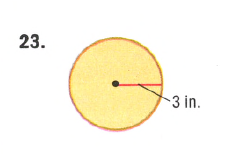
We have to determine the area of this circle.
The radius of the given circle is 3 in. We apply the formula A=πr2 to find the area.
We have a circle of radius 3 in
Since we know that the area of a circle of radius 3 in. is A=πr2
where A is the area and r is the radius of the circle.
So, we can write, A = π(3) 2
⇒ A = 9π
⇒ A ≈ 28.3in2.
Therefore, the approximated area of the given circle is 28.3in2.
Finally, we can conclude that the approximated area of the circle with a radius of 3 in. is 28.3 in2.
Page 596 Exercise 6, Problem1
The given circle is
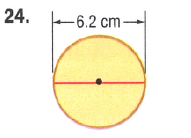
We have to determine the area of this circle.
The diameter of the given circle is 6.2 cm. We apply the formula A=πr2 to find the area.
We have a circle of diameter 6.2 cm
Now, the radius of the circle is (6.2)/2 =3.1cm.
Since we know that the area of a circle of radius 3.1 cm is A=πr2
where A is the area and r is the radius of the circle.
So, we can write, A = π(3.1) 2
⇒ A=9.61π
⇒ A = 9.61×22/7
⇒ A ≈ 30.2 cm2.
Therefore, the approximated area of the given circle is 30.2 cm2.
Finally, we can conclude that the approximated area of the circle with a diameter of 6.2 cm is 30.2 cm2.
Page 596 Exercise 7, Problem1
The given circle is
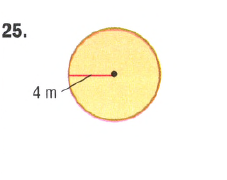
We have to determine the area of this circle.
The radius of the given circle is 4 m. We apply the formula A=πr2 to find the area.
We have a circle of radius 4m
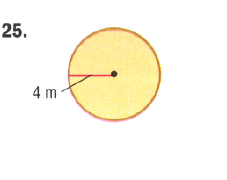
Since we know that the area of a circle of radius 4m is A = πr2
where A is the area and r is the radius.
So, we can write, A = π(4) 2
⇒A=16π
⇒A≈50.3m2.
Therefore, the approximated area of the given circle is 50.3 m2.
Finally, we can conclude that the approximated area of the circle with a radius of 4 m is 50.3m2.
Page 596 Exercise 8, Problem1
The given prism is
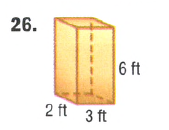
We have to determine the volume of the prism.
The three dimensions of the prism are 2ft, 3ft, and 6ft. We apply the formula V = l × d × h to find the volume.
We have a prism of length 3 ft, width 2 ft, and height 6 ft
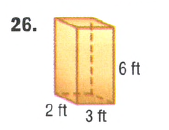
Since we know that the volume of a prism of dimensions 2ft, 3ft, and 6ft is V = l × d × h.
So, we can write V = 2×3×6
⇒ V = 36ft3.
Therefore, the determine d volume of the prism is 36ft3.
Finally, we can conclude that the determined volume of the prism is 36ft3.