Glencoe Math Course 3 Volume 2 Student 1st Edition Chapter 5 Triangles And The Pythagorean Theorem
Glencoe Math Course 3 Volume 2 Chapter 5 Exercise 1.1 Solutions Page 371 Exercise 1, Problem1
As per the given instruction, we have to justify how can algebraic concepts be applied to geometry. From the concept of algebra and geometry, we can say algebra has to do with equations and formulas, and geometry has to do with objects and shapes.
Now we will assume an equation and we will plot this in a graph. Let’s assume an equation that isy=4x+3 and we plot the equation in the graph. The graph is shown below
The graph of the equationy=4x+3 is a straight line.This illustrates a relationship between an algebraic concept (an equation) and a geometric concept (a line).
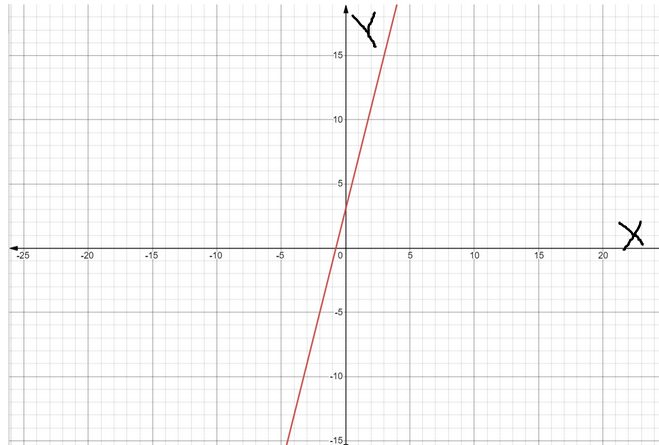
Finally, we can determine that algebra has to do with equations and formulas, and geometry has to do with objects and shapes. And if we graph an equation that is an algebraic concept we can make it a geometric concept.
Read and Learn More Glencoe Math Course 2 Volume 1 Common Core Student Edition Solutions
Glencoe Math Course 3 Volume 2 Student 1st Edition Chapter 5 Page 371 Exercise 1 Problem2
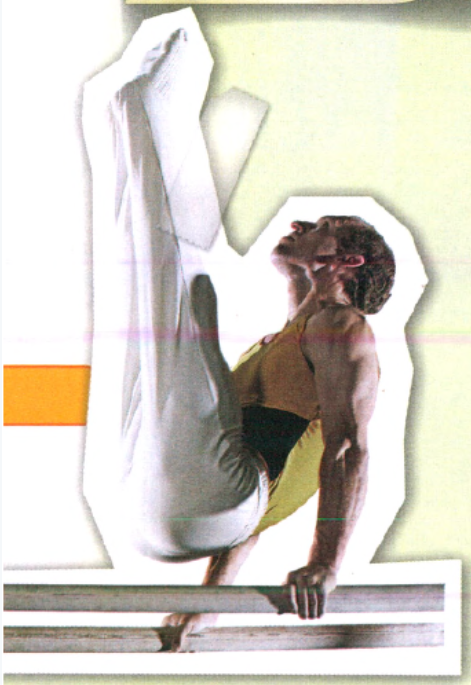
Here a gymnastic event in the Summer Olympics involves the parallel bars and we have to circle the parallel lines shown in the photo.
We know that parallel lines are the lines that never intersect each other at any point even on extending up to infinity, on either side.

Parallel lines are the lines that never intersect each other at any point even on extending up to infinity, on either side. So as per the given instruction, the marked parallel lines are shown.
Glencoe Math Course 3 Volume 2 Student 1st Edition Chapter 5 Page 373 Exercise 1 Problem1
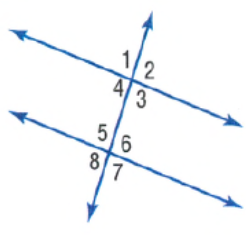
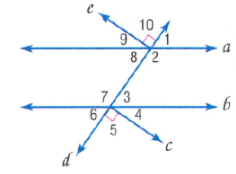
We have to find the relationship between∠4 and∠6.
If we give a closer look at the given diagram we can say∠4 and∠6 are the alternate interior angles as here a transversal intersects two coplanar lines.The above-mentioned alternate interior angles are shown in the figures below
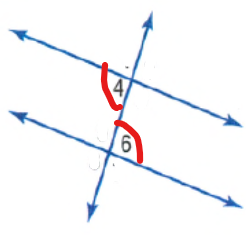
Hence, as a transversal intersects two coplanar lines and∠4and∠6are formed so the relationship between them is they are alternate interior angles.
From the figure, we can easily observe that the verticle line has divided the horizontal line or 180o into exactly two equal halves. Therefore, the angle m∠4 is a right angle and has a value of 90o.
Finally, we can conclude that the angle m∠4=90o.
Glencoe Math Course 3 Volume 2 Student 1st Edition Chapter 5 Page 374 Exercise2 Problem1
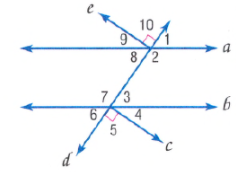
We have to find the measure of the angle∠9.
It can be found using the equality of corresponding and alternate angles
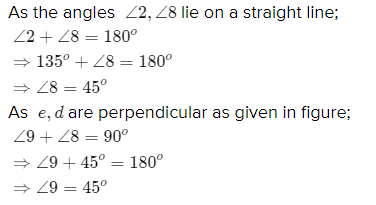
Finally, we can determine that the angle is found to be∠9=45o.
Glencoe Math Course 3 Volume 2 Student 1st Edition Chapter 5 Page 374 Exercise3 Problem1
We have to find the measure of the angle∠7.
It can be found using the equality of corresponding and alternate angles.
As the angles ∠2,∠7 are alternate angles;∠2=∠7
∴∠7=135o.
Finally, we can determine that the final angle is found to be∠7=135°.
Page 374 Exercise4,Problem1
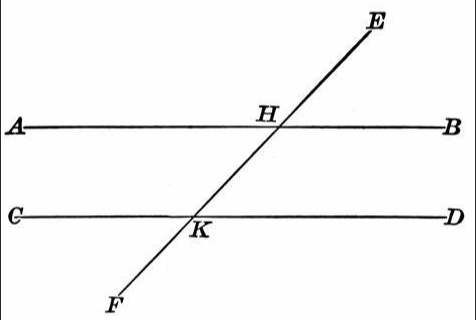
For the set of lines AB,CD with traversal asEF ; corresponding angles are always equal to each other, like∠EHB=∠EKD. Also similarly, alternate angles are also equal to each other, like∠EHB=∠FCK.
Corresponding and alternate angles are always equal for each set of parallel lines cut by a traversal.
Glencoe Math Course 3 Volume 2 Student 1st Edition Chapter 5 Page 375 Exercise2 Problem1
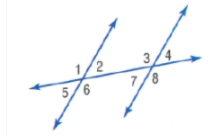
If the angles match the same corners of the parallel lines, they are corresponding angles, or else they are alternate angles.
As they don’t match the identical corners of the set of parallel lines, they are related as alternate angles.
Also as the angles are in the exterior side of the parallel lines, hence they are related as exterior alternate angles.
Finally, we can determine that the angles are related by exterior alternate angles.
Chapter 5 Exercise 1.1 Answers Triangles And Pythagorean Theorem Glencoe Math Course 3 Volume 2 Page 375 Exercise3,Problem1
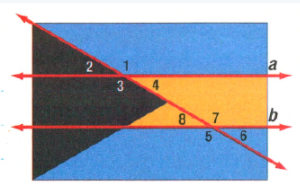
We have to find the measure of the angle∠4,∠7.
It can be found using the equality of corresponding and alternate angles.
It is given that,
∠1=150°
As∠1,∠4 lie on a straight line,∠1+∠4=180o
⇒∠4=(180−150)°
⇒∠4=30°
Similarly,∠1,∠7 are corresponding angles.
Hence,∠7=150°.
Finally, the measurement of the angles were found as∠4=30o; ∠7=150°.
Glencoe Math Course 3 Volume 2 Student 1st Edition Chapter 5 Page 375 Exercise4 Problem1
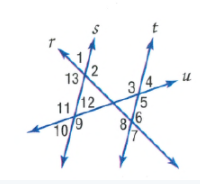
We have to find the measure of the angle∠7
where it is given that∠2=110o;∠11=137°.
It can be found using the equality of corresponding and alternate angles.
For the set of parallel lines with traversal as r;∠1+∠2=180°
[As they lie on a straight line]
⇒∠1=(180−110)°
⇒∠1=70°
Also, ∠1,∠7are alternate exterior angles.
∴∠1=∠7
∠7=70°
Finally, we can determine that the angle is found to be70o.
Step-by-step guide for Exercise 1.1 Chapter 5 Triangles and Pythagorean Theorem Glencoe Math Course 3 Page 375 Exercise6,Problem1
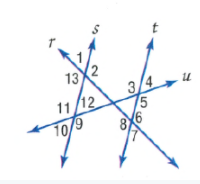
We have to find the measure of the angle∠3
where it is given that∠2=110o;∠11=137°.
It can be found using the equality of corresponding and alternate angles.
For the set of parallel lines with traversal as u;∠11=∠3
[As they are corresponding angles]
∴∠3=137°.
Finally, we can determine that the angle is found to be∠3=137°.
Glencoe Math Course 3 Volume 2 Student 1st Edition Chapter 5 Page 375 Exercise7 Problem1
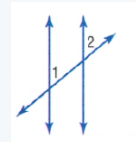
We have to find the measure of the angle∠2
where it is given that∠1=45°
It can be found using the equality of corresponding and alternate angles.
As given in the question;
∠1,∠2
are corresponding angles. Hence, they are equal to each other.
∴∠1=∠2
⇒x+25=45
⇒x=45-25
⇒x=20
Finally, we can determine that the value of x is 20.
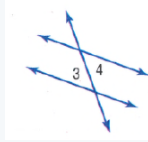
We have to find the measure of the angle∠3
where it is given that∠4=80°.
It can be found using the equality of corresponding and alternate angles.
As given in the question; are alternate angles. Hence, they are equal to each other.
As given in the question; ∠3,∠4 are alternate angles. Hence, they are equal to each other.
∴∠3=∠4
⇒2x=80
⇒x=80/2
⇒x=40
Finally, we can determine that the value of x is 40.
Glencoe Math Course 3 Volume 2 Student 1st Edition Chapter 5 Page 375 Exercise8 Problem1
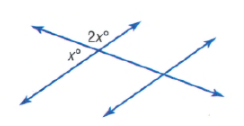
We have to find the measure of the angles represented by variables. The sum of angle in a straight line is always180°.
As we can see that the denoted angles lie on a straight line;
∴x+2x=180°
⇒3x=180
⇒ x=180/3
⇒x=60
∴2x=120
Finally, the value of the angles x and 2x were found as 60° and 120° .
Step-By-Step Guide For Exercise 1.1 Chapter 5 Triangles And Pythagorean Theorem Glencoe Math Course 3 Page 376 Exercise9, Problem1
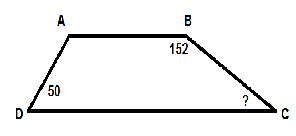
We have to find the measure of the angle∠C where it is given that∠D=50°;∠B=152°.
It can be found by extending the parallel set of lines and using the other sides as traversals and finally using the equality of corresponding and alternate angles.
It was found that the following problem can be solved It can be found by extending the parallel set of lines and using the other sides as traversals and finally using the equality of corresponding and alternate angles.
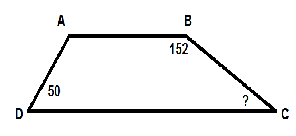
We have to find the measure of the angle∠C
where it is given that∠D=50°
;∠B=152°
It can be found by extending the parallel set of lines and using the other sides as traversals and finally using the equality of corresponding and alternate angles.
As given in the question;
∠B=152
If we extend the line DC and AB which are parallel lines and considering BC as traversal;
We can observe that ∠B,∠C
are interior angles that sum up to180 as it is the complement of the corresponding angle of ∠B.
∠B+∠C=180°
⇒∠C=(180−152)°
⇒∠C=28°
The final angle was found to be∠C=28°.
Glencoe Math Course 3 Volume 2 Student 1st Edition Chapter 5 Page 376 Exercise10 Problem1
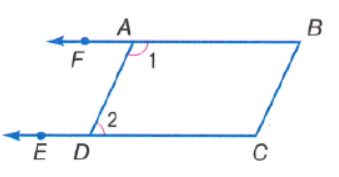
We need to make a conjecture about the relationship of ∠1 and ∠2.
Then justify our reasoning.
Given, that the quadrilateral ABCD is a parallelogram. So, we can say that lines AB and DC are parallel to each other, and segment AD is a transversal line. Therefore, m∠1 and m∠2
are interior angles on the same side of the transversal and therefore, their sum should be equal to 180 degree.
We can prove this reasoning with the help of alternate interior and supplementary angles, as shown below.
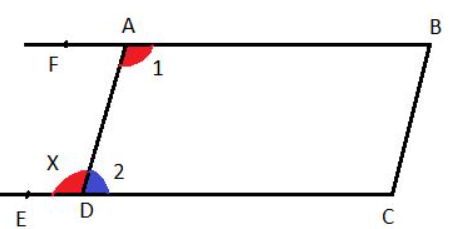
In the figure, we can see that m∠1 and m∠x are the alternate interior angles, therefore both should be equal.
m∠1=m∠x
Also, m∠x and m∠2 are supplementary angles and therefore their sum should be equal to 180 degree.
⇒m∠x+m∠2=180
⇒(m∠1)+m∠2=180 (replacing m∠x with m∠1)
⇒m∠1+m∠2=180
Therefore, our reasoning is correct, the sum of the interior angles on the same side of the transversal line is equal to 180 degree.
With the help of alternate interior and supplementary angles, we proved that the sum of the interior angles on the same side of the transversal line is equal to 180 degree.
Glencoe Math Course 3 Volume 2 Student 1st Edition Chapter 5 Page 376 Exercise11 Problem1
We need to determine if two parallel lines are cut by a transversal, what relationship exists between interior angles that are on the same side of the transversal.
If two parallel lines are cut by a transversal, then the sum of interior angles on both the side of the transversal is equal to 180 degree.
According to the definition, supplementary angles are two angles whose measures add up to 180 degree.
Therefore, these are supplementary angles.
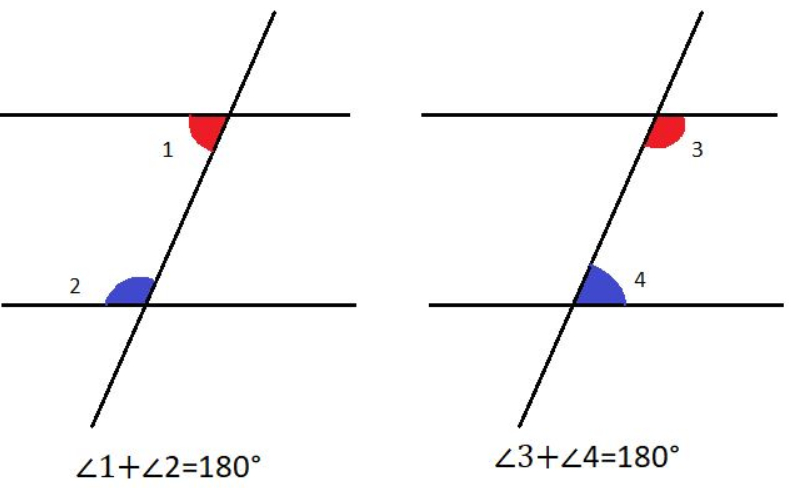
The relation between interior angles that are on the same side of the transversal is they are supplementary angles.
Exercise 1.1 Solutions For Chapter 5 Triangles And Pythagorean Theorem Glencoe Math Course 3 Volume 2 Page 377 Exercise13, Problem1
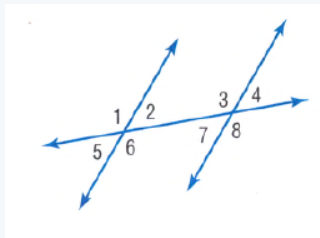
We need to classify the pair of angles ∠3 and ∠6.
∠3 and ∠6 are interior angles that lie on the opposite sides of the transversal. They are called alternate interior angles.
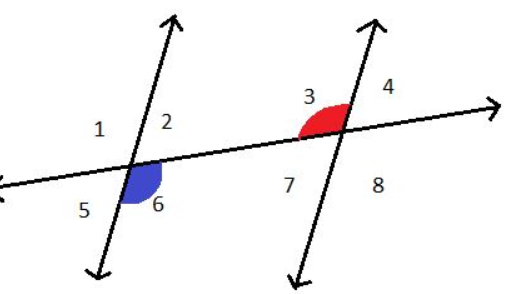
∠3 and ∠6 are alternate interior angles.
Glencoe Math Course 3 Volume 2 Student 1st Edition Chapter 5 Page 377 Exercise14 Problem1
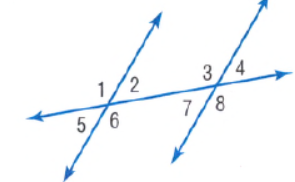
We need to classify the pair of angles ∠1 and ∠3.
∠1 and ∠3 are called corresponding angles, one is an exterior angle and one is interior and lie on the same side of the transversal and are not adjacent.
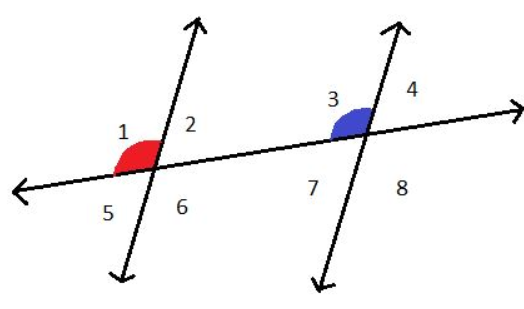
∠1 and ∠3are corresponding angles.
Examples Of Problems From Exercise 1.1 Chapter 5 Glencoe Math Course 3 Triangles And Pythagorean Theorem Page 377 Exercise15, Problem1
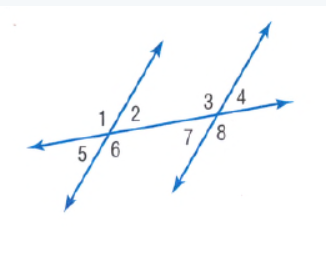
We need to classify the pair of angles ∠2 and ∠7.
∠2 and ∠7
are interior angles that lie opposite sides of the transversal. They are called alternate interior angles.
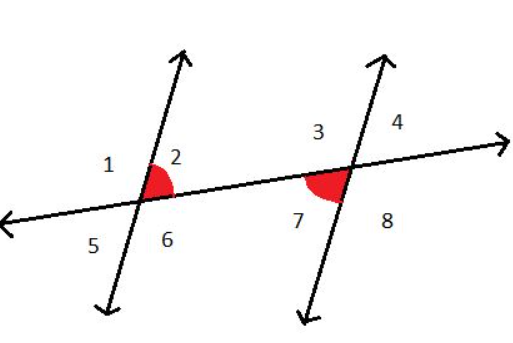
∠2 and ∠7 are alternate interior angles.
Glencoe Math Course 3 Volume 2 Student 1st Edition Chapter 5 Page 377 Exercise17 Problem1
Given, Line s is parallel to line t, m∠2 is 110∘and m∠11 is 137∘
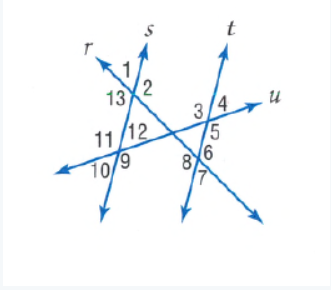
We need to find the measure of angle m∠6.
m∠2 and m∠6 are corresponding angles, and therefore they should be equal. It is given in the question that m∠2=110∘
⇒m∠2=m∠6=110∘
∴m∠6=110∘
The measure of the angle m∠6=110∘.
Common Core Chapter 5 Exercise 1.1 Triangles And Pythagorean Theorem Detailed SolutionsPage 377 Exercise18, Problem1
Given, Line s is parallel to line t, m∠2 is 110∘ and m∠11 is 137∘.
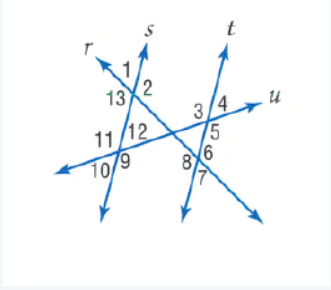
We need to find the measure of the angle m∠13.
m∠2 and m∠13 are opposite angles and hence be equal. Given that, m∠=110∘ then m∠13
should also be equal to 110∘
⇒m∠2=m∠13=110∘
∴m∠13=110∘
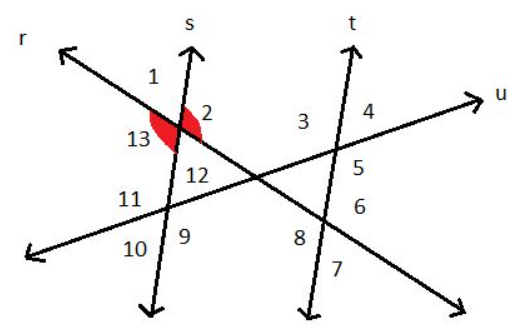
The measure of the angle m∠13=110∘
Glencoe Math Course 3 Volume 2 Student 1st Edition Chapter 5 Page 377 Exercise19 Problem1
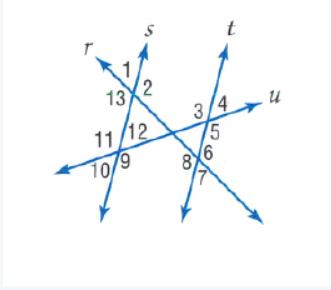
We need to find the measure of angle m∠4.
We are given in the equation that m∠11=137∘
. We can see that m∠11 and m∠3
are corresponding angles, so they should be equal.
⇒m∠11=m∠3=137∘
Now, m∠3 and m∠4 are adjacent supplementary angles.
⇒m∠3+m∠4=180∘
⇒137∘
+m∠4=180∘
⇒m∠4=180∘
−137∘
⇒m∠4=43∘
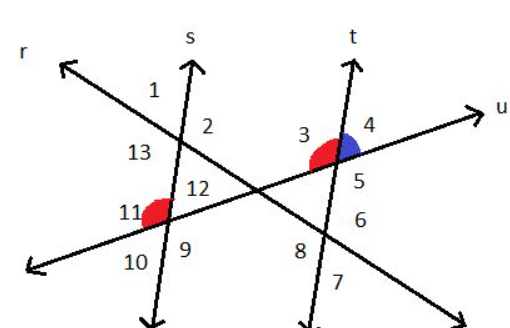
The measure of the angle is m∠4=43∘.
Glencoe Math Course 3 Volume 2 Student 1st Edition Chapter 5 Page 377 Exercise22 Problem1
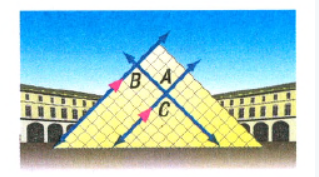
We need to find the false option out of the given options.
(F): The statement is false. We cannot be sure about the kind of these angles without measuring them. They seem to be right angles.
(G): The statement is true. The angles ∠A and ∠C
are vertical. They are opposite angles between two lines that intersect.
(H): The statement is true. The angles ∠A and ∠B
are alternate interior angles.
(I): The statement is true. The angles ∠A and ∠C
are congruent as vertical angles. As we know, vertical angles are congruent.
The statement (F) is false.
The statement F is false.
Glencoe Math Course 3 Volume 2 Student 1st Edition Chapter 5 Page 378 Exercise23 Problem1
Given, line x is parallel to line y and line z is perpendicular to AB. The measure of ∠1 is 50∘.
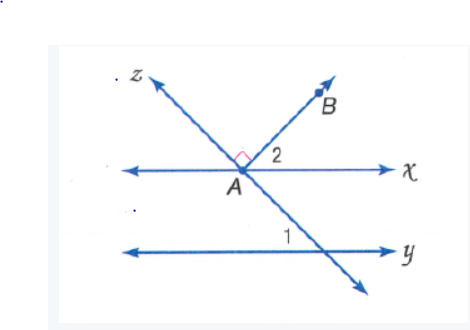
We need to find out the measure of ∠2.
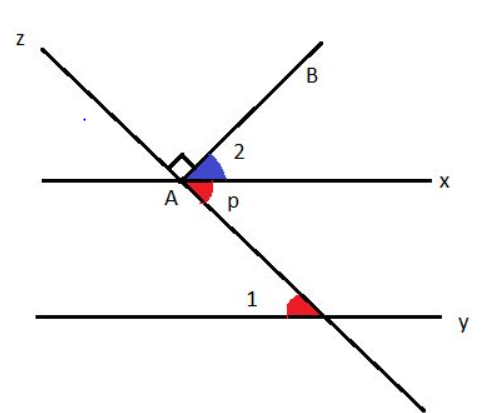
In the above case we can see that m∠1 and m∠p are corresponding angles, therefore, they should be equal. We are given that m∠1= 50∘
⇒m∠1=m∠p= 50∘.
Now, We can see that taken together, m∠p and m∠2are making a supplementary pair with 90∘
Therefore, the sum of all three should be equal to 180∘
⇒m∠p+m∠2+90∘
=180∘
⇒m∠p+m∠2+90∘
−90∘
=180∘
−90∘
⇒m∠p+m∠2=90∘
⇒50∘
+m∠2=90∘
⇒m∠2=90∘
−80∘
−50∘
⇒m∠2=40∘
Therefore, option A is correct, the measure of ∠2 is 40∘.
Option A is correct, the measure of ∠2 is 40∘
Glencoe Math Course 3 Volume 2 Student 1st Edition Chapter 5 Page 378 Exercise24 Problem1
Given, lines m and n are parallel and cut by the transversal p.
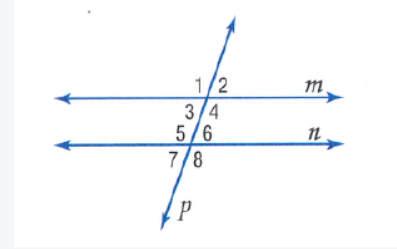
We will name all pairs of the corresponding angles.
When two parallel lines are intersected by a transversal line, then the angle in the same corner and on the same side of the transversal are called corresponding angles.
Each corresponding angles pair is shown in the same color, in the figure shown below.
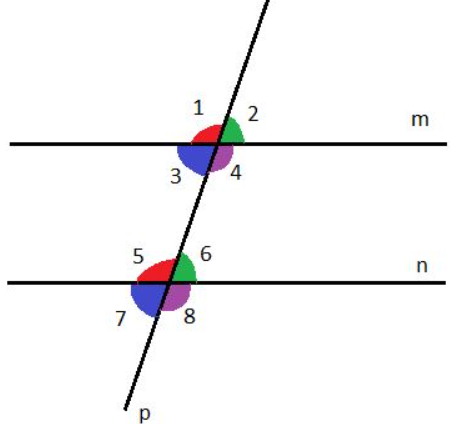
The corresponding angle pairs are as follows,
1) m∠1 and ∠5
2) m∠2 and ∠6
3) m∠3 and ∠7
4) m∠4 and ∠8
After carefully observing the figure, we find pairs of corresponding angles as follows,
1) m∠1 and ∠5
2) m∠2 and ∠6
3) m∠3 and ∠7
4) m∠4 and∠8
Student Edition Exercise 1.1 Chapter 5 Triangles And Pythagorean Theorem Solutions Guide Page 378 Exercise25, Problem1
We are given that the base is4
inches long and height that measures8
inches on putting these values into the equationsArea= 12
× base × height
=12
×4 inches× 8 inches.
= 2×8inches2
=16inches2
Finally, we can determine that the area of the poster is 16 inches2.
Glencoe Math Course 3 Volume 2 Student 1st Edition Chapter 5 Page 378 Exercise28 Problem1
The given angles are 32° & 58°. So, the sum of the given angles is 32°+58°=90°.
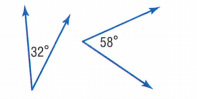
Therefore, these will go into the category of complementary.