
HMH Middle School Grade 7 Practice Fluency Workbook 1st Edition Chapter 1 Adding and Subtracting Integers
HMH Grade 7 Practice Fluency Workbook Chapter 1 Exercise 1.3 Solutions Page 5 Problem 1 Answer
A number line is given.

It is required to find the solution of 5−(−1). The presence of two minuses will make the second number positive.
In order to do so, first, find 5 on the number line and then move one interval to the right of 5.
On the number line, find 5.

It is required to find the solution of 5−(−1), so move one interval to the right of 5.
As 5−(−1)=5+1
Hence, the difference is concluded as 6.
Read and Learn More HMH Middle School Grade 7 Practice Fluency Workbook 1st Edition Solutions
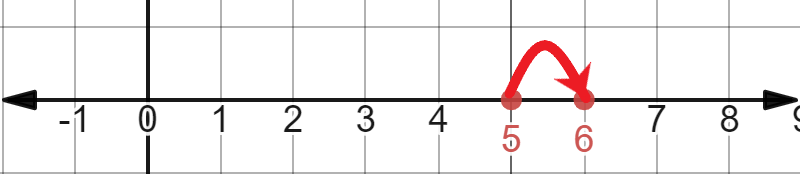
The difference is 6.
HMH Middle School Grade 7 Practice Fluency Workbook 1st Edition Chapter 1 Page 5 Problem 2 Answer
It is given an expression, −6−4.
It is required to find the solution of −6−4
The second is a negative number 4 which has to subtracted from a negative number −6.
The difference will take value of the greater number.
The given expression is −6−4.
Subtract 4 from −6
−6−4=−10
Thus, the difference is −10.
The difference is −10.
Adding And Subtracting Integers Exercise 1.3 Chapter 1 Answers HMH Grade 7 Workbook Page 5 Problem 3 Answer
It is given an expression −7−(−12).
It is required to find the solution of −7−(−12).
In order to do so, consider that the second is a negative number −12 which has to subtracted from a negative number −7.
The presence of two minuses will make the second number positive.
The difference will take value of the greater number.
The given expression is −7−(−12).
Subtract −12 from −7.
−7−(−12)=−7+12=5
Thus, the difference is 5.
The difference is 5.
HMH Middle School Grade 7 Practice Fluency Workbook 1st Edition Chapter 1 Page 5 Problem 4 Answer
It is given an expression 12−16.
It is required to find the solution of 12−16.
In order to do so, the second number is 16 which has to be subtracted from 12.
The difference will take value of the greater number.
The given expression is 12−16.
Subtract 12 from 16.
12−16=12−16=−4
Thus, the difference is −4.
The difference is −4.
Step-By-Step Solutions For Exercise 1.3 Adding and Subtracting Integers HMH Grade 7 Practice Workbook Page 5 Problem 5 Answer
It is given an expression 5−(−19).
It is required to find the solution of 5−(−19).
In order to do so, consider that the second is a negative number −19 which has to be subtracted from 5.
The presence of two minutes will make the second number positive.
The given expression is 5−(−19).
Subtract 5 from −19
5−(−19)=5+19=24
Thus, the difference is 24.
The difference is 24.
HMH Middle School Grade 7 Practice Fluency Workbook 1st Edition Chapter 1 Page 5 Problem 6 Answer
It is given an expression, −18−(−18).
It is required to find the solution of −18−(−18)
In order to do so, consider that the second is a negative number −18 which has to be subtracted from a negative number −18.
The presence of two minutes will make the second number positive.
The given expression is −18−(−18).
Subtract −18 from −18
−18−(−18)=−18+18
−18−(−18) =0
Thus, the difference is 0.
The difference is 0.
Exercise 1.3 Adding And Subtracting Integers Solutions For Hmh Middle School Grade 7 Workbook Page 5 Problem 7 Answer
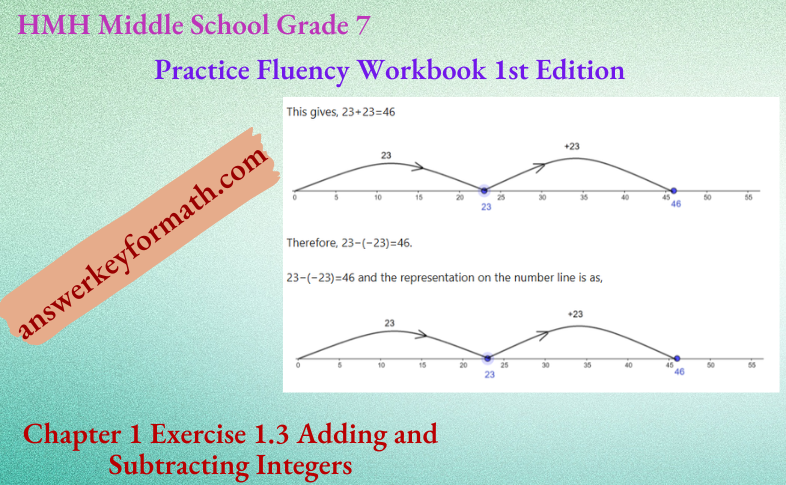
The given statement is 23−(−23).
It is required to show subtraction on number line and find the difference.
To do so, first add the opposite number to the difference to modify it. And then on a number line, simulate the sum.
Add the opposite number to the difference to modify it,23−(−23)=23+23.
Simulate the sum on a number line. Begin at 23 and advance 23 units to the right, as 23 is a positive number.
HMH Middle School Grade 7 Practice Fluency Workbook 1st Edition Chapter 1 Page 5 Problem 8 Answer
The given statement is,−10−(−9).
It is required to show subtraction on number line and find the difference.
To do so, first add the opposite number to the difference to modify it. And then on a number line, simulate the sum.
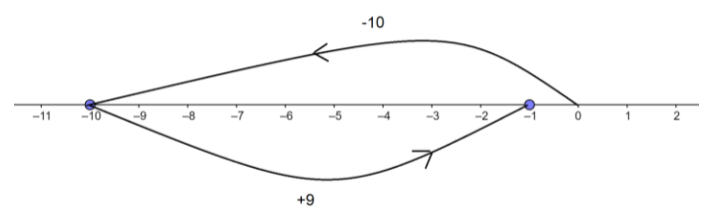
Add the opposite number to the difference to modify it,−10−(−9)=−10+9.
Simulate the sum on a number line. Begin at −10 and advance 9 units to the right, as 9 is a positive number.
This gives,−10+9=−1
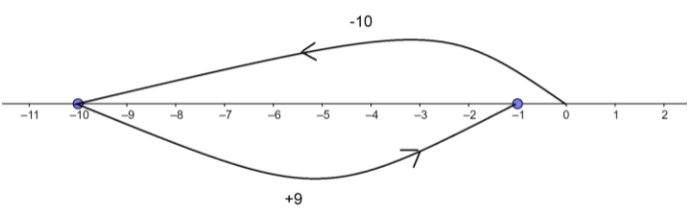
Therefore,−10−(−9)=−1.
−10−(−9)=−1 and the representation on number line is as,
HMH Middle School Grade 7 Practice Fluency Workbook 1st Edition Chapter 1 Page 5 Problem 9 Answer
The given statement is,29−(−13).
It is required to show subtraction on number line and find the difference.
To do so, first add the opposite number to the difference to modify it.
And then on a number line, simulate the sum.
Add the opposite number to the difference to modify it,29−(−13)=29+13.
Simulate the sum on a number line.
Begin at 29 and advance 13 units to the right, as 13 is a positive number.
This gives,29+13=42

Therefore,29−(−13)=42.
29−(−13)=42 and the representation on number line is as,

HMH Middle School Grade 7 Practice Fluency Workbook 1st Edition Chapter 1 Page 5 Problem 10 Answer
It is asked to find a difference 9−15.
To solve this question, first transfer the subtraction into addition by changing the sign of the second number.
Therefore, this will become the addition of two integers with different signs.
To solve that, determine the absolute values of both numbers.
Then subtract the number with a lower absolute value from the number with the higher absolute value.
Finally, assign the sign of the number with the higher absolute value to the answer.
Transfer the subtraction into addition by changing the sign of the second number and determine the absolute values of both numbers.
9−15=9+(−15)
9∣=9 and,∣−15∣=15.
Subtract the number with a lower absolute value from the number with the higher absolute value and assign the sign of the number with the higher absolute value to the answer.
Here, 15>9.
15−9=6
The larger number 15 has a negative sign and therefore,
9+(−15)=−6
9−15=−6
The value of the difference 9−15 is −6.
HMH Middle School Grade 7 Practice Fluency Workbook 1st Edition Chapter 1 Page 5 Problem 11 Answer
It is asked to find a difference −12−14.
To solve this question, first transfer the subtraction into addition by changing the sign of the second number.
Therefore, this will become the addition of two integers with same signs.
To solve that, determine the absolute values of both numbers.
Then add these absolute values of numbers and keep the same sign as that of both integers.
Transfer the subtraction into addition by changing the sign of the second number and determine the absolute values of both numbers.
−12−14=−12+(−14)
∣−12∣=12 and,∣−14∣=14.
Add these absolute values of numbers and keep the same sign as that of both integers.
12+14=26
Therefore,
−12+(−14)=−26
−12−14=−26
The value of the difference −12−14 is −26.
Examples of problems from Exercise 1.3 Adding and Subtracting Integers in HMH Grade 7 Workbook Page 5 Problem 12 Answer
It is asked to find a difference 22−(−8).
To solve this question, first transfer the subtraction into addition by changing the sign of the second number.
Therefore, this will become the addition of two integers with same signs.
To solve that, determine the absolute values of both numbers.
Then add these absolute values of numbers and keep the same sign as that of both integers.
Transfer the subtraction into addition by changing the sign of the second number and determine the absolute values of both numbers.
22−(−8)=22+8
∣22∣=22 and,∣8∣=8.
Add these absolute values of numbers and keep the same sign as that of both integers.
22+8=30
Therefore, 22−(−8)=30
The value of the difference 22−(−8) is 30.
HMH Middle School Grade 7 Practice Fluency Workbook 1st Edition Chapter 1 Page 5 Problem 13 Answer
It is asked to find a difference −16−(−11).
To solve this question, first transfer the subtraction into addition by changing the sign of the second number.
Therefore, this will become the addition of two integers with different signs.
To solve that, determine the absolute values of both numbers.
Then subtract the number with a lower absolute value from the number with the higher absolute value.
Finally, assign the sign of the number with the higher absolute value to the answer.
Transfer the subtraction into addition by changing the sign of the second number and determine the absolute values of both numbers.
−16−(−11)=−16+11
∣−16∣=16 and,∣11∣=11.
Subtract the number with a lower absolute value from the number with the higher absolute value and assign the sign of the number with the higher absolute value to the answer.
Here, 16>11.
16−11=5
The larger number 16 has a negative sign and therefore,
−16+11=−5
−16−(−11)=−5
The value of the difference −16−(−11) is −5.
HMH Middle School Grade 7 Practice Fluency Workbook 1st Edition Chapter 1 Page 5 Problem 14 Answer
It is given that the temperature in Minneapolis changed from −7∘F at 6A.M. to 7∘F at noon.
It is asked to determine the increase in temperature,
To solve this question, determine the difference 7−(−7).
For this, first transfer the subtraction into addition by changing the sign of the second number.
Therefore, this will become the addition of two integers with same signs.
To solve that, determine the absolute values of both numbers.
Then add these absolute values of numbers and keep the same sign as that of both integers.
Transfer the subtraction into addition by changing the sign of the second number and determine the absolute values of both numbers.
7−(−7)=7+7
∣7∣=7
Add these absolute values of numbers and keep the same sign as that of both integers.
7+7=14
Therefore, 7−(−7)=14
Thus, the increase in temperature is 14∘F.
The increase in temperature form 6A.M. to noon is 14∘F.
HMH Middle School Grade 7 Practice Fluency Workbook 1st Edition Chapter 1 Page 5 Problem 15 Answer
It is given that Friday’s high temperature was −1∘C and low temperature was −5∘C.
It is asked to determine the temperature between high and low temperature.
To solve this question, determine the difference −1−(−5).
For this, first transfer the subtraction into addition by changing the sign of the second number.
Therefore, this will become the addition of two integers with different signs.
To solve that, determine the absolute values of both numbers.
Then subtract the number with a lower absolute value from the number with the higher absolute value.
Finally, assign the sign of the number with the higher absolute value to the answer.
Transfer the subtraction into addition by changing the sign of the second number and determine the absolute values of both numbers.
−1−(−5)=−1+5
∣−1∣=1 and,∣5∣=5.
Subtract the number with a lower absolute value from the number with the higher absolute value and assign the sign of the number with the higher absolute value to the answer.
Here, 5>1.
5−1=4
The larger number 5 has a positive sign and therefore,
−1+5=4
−1−(−5)=4
Thus, the difference between high and low temperature is 4∘C.
The difference between Friday’s high and low temperature is 4∘C.
HMH Middle School Grade 7 Practice Fluency Workbook 1st Edition Chapter 1 Page 5 Problem 16 Answer
It is given that the temperature changed from 5∘C at 6 A.M to −2∘C at midnight.
It is asked to determine the decrease in the temperature.
To solve this question, determine the difference 5−(−2).
For this, first, transfer the subtraction into addition by changing the sign of the second number.
Therefore, this will become the addition of two integers with same signs.
To solve that, determine the absolute values of both numbers.
Then add these absolute values of numbers and keep the same sign as that of both integers.
Transfer the subtraction into addition by changing the sign of the second number and determine the absolute values of both numbers.
5−(−2)=5+2
∣5∣=5 and,∣2∣=2.
Transfer the subtraction into addition by changing the sign of the second number and determine the absolute values of both numbers.
5−(−2)=5+2
∣5∣=5 and,∣2∣=2.
The decrease in temperature is 7∘C.
HMH Middle School Grade 7 Practice Fluency Workbook 1st Edition Chapter 1 Page 5 Problem 17 Answer
It is given that the day time high temperature on the moon can reach 130∘C and the night time low temperature can get as low as −110∘C.
It is asked to determine the difference between high and low temperature.
To solve this question, determine the difference 130−(−110).
For this, first, transfer the subtraction into addition by changing the sign of the second number.
Therefore, this will become the addition of two integers with same signs.
To solve that, determine the absolute values of both numbers.
Then add these absolute values of numbers and keep the same sign as that of both integers.
Transfer the subtraction into addition by changing the sign of the second number and determine the absolute values of both numbers.
130−(−110)=130+110
∣130∣=130 and,∣110∣=110
Add these absolute values of numbers and keep the same sign as that of both integers.
130+110=240
Therefore,
130−(−110)=240
Thus, the difference in high and low temperature is 240∘C.
The difference in high and low temperature on the moon is 240∘C.
HMH Middle School Grade 7 Practice Fluency Workbook 1st Edition Chapter 1 Page 6 Problem 18 Answer
Three cards 7, 13 and −8 are given and the total value of the cards is 12.
It is asked to determine what happens when the 7 card is taken away.
To solve this question, determine the difference 12−7.
For this, first, transfer the subtraction into addition by changing the sign of the second number.
Therefore, this will become the addition of two integers with different signs.
To solve that, determine the absolute values of both numbers.
Then subtract the number with a lower absolute value from the number with the higher absolute value.
Finally, assign the sign of the number with the higher absolute value to the answer.
Transfer the subtraction into addition by changing the sign of the second number and determine the absolute values of both numbers.
12−7=12+(−7)
12∣=12 and,∣−7∣=7.
Subtract the number with a lower absolute value from the number with the higher absolute value and assign the sign of the number with the higher absolute value to the answer.
Here, 12>7.
12−7=5
The larger number 12 has a positive sign and therefore,
12+(−7)=5
12−7=5
Thus, when the 7 card is taken away, the new value is 5.
When the 7 card is taken away, the new value is 5.
HMH Middle School Grade 7 Practice Fluency Workbook 1st Edition Chapter 1 Page 6 Problem 19 Answer
Three cards 7, 13 and −8 are given and the total value of the cards is 12.
It is asked to determine what happens when the 13 card is taken away.
To solve this question, determine the difference 12−13.
For this, first transfer the subtraction into addition by changing the sign of the second number.
Therefore, this will become the addition of two integers with different signs.
To solve that, determine the absolute values of both numbers.
Then subtract the number with a lower absolute value from the number with the higher absolute value.
Finally, assign the sign of the number with the higher absolute value to the answer.
Transfer the subtraction into addition by changing the sign of the second number and determine the absolute values of both numbers.
12−13=12+(−13)
12∣=12 and,∣−13∣=13.
Subtract the number with a lower absolute value from the number with the higher absolute value and assign the sign of the number with the higher absolute value to the answer.
Here, 13>12.
13−12=1
The larger number 13 has a negative sign and therefore,
12+(−13)=−1
12−13=−1
Thus, when the 13 card is taken away, the new value is −1.
When the 13 card is taken away, the new value is −1.
Common Core Chapter 1 Exercise 1.3 Adding and Subtracting Integers detailed solutions HMH Grade 7 Workbook Page 6 Problem 20 Answer
Three cards 7, 13 and −8 are given and the total value of the cards is 12.
It is asked to determine what happens when the −8 card is taken away.
To solve this question, determine the difference 12−(−8).
For this, first, transfer the subtraction into addition by changing the sign of the second number.
Therefore, this will become the addition of two integers with same signs.
To solve that, determine the absolute values of both numbers.
Then add these absolute values of numbers and keep the same sign as that of both integers.
Transfer the subtraction into addition by changing the sign of the second number and determine the absolute values of both numbers.
12−(−8)=12+8
∣12∣=12 and,∣8∣=8.
Add these absolute values of numbers and keep the same sign as that of both integers.
12+8=20
Therefore,12−(−8)=20
Thus, when the −8 card is taken away, the new value is 20.
When the −8 card is taken away, the new value is 20.
HMH Middle School Grade 7 Practice Fluency Workbook 1st Edition Chapter 1 Page 6 Problem 21 Answer
Given the expression −4−(−2).
It is asked if −4<−2, then the answer will be positive or negative.
To do so, find the absolute values of both the numbers.
Subtract the number with a lower absolute value from the number with a higher absolute value and the answer takes the sign of the higher absolute value.
Find the absolute values of the numbers.
∣−4∣=4 and,∣−2∣=2.
Subtract the number with a lower absolute value from the number with a higher absolute value and the answer takes the sign of the higher absolute value.
4−2=0
So, the expression−4−(−2), where −4<−2 becomes,−4+2=−2.
The answer will be negative.
Student Edition Chapter 1 Exercise 1.3 Adding and Subtracting Integers HMH Grade 7 Workbook guide Page 6 Problem 22 Answer
Given the expression −4−(−2).
It is required to find the value of ∣4∣−∣2∣.
To do so, find the absolute values of both the numbers in the integers in the expression.
Subtract the number with a lower absolute value from the number with a higher absolute value.
Find the absolute values of the numbers.
−4∣=4 and,∣−2∣=2.
Subtract the number with a lower absolute value from the number with a higher absolute value.
4−2=2
The expression can be written as ∣4∣−∣2∣=2.
The value of the expression is 2.
HMH Middle School Grade 7 Practice Fluency Workbook 1st Edition Chapter 1 Page 6 Problem 23 Answer
Given the expression−4−(−2).
It is required to find the value of the expression.
To do so, transfer the subtraction into an addition of the second number and find the absolute values for both the numbers.
Subtract the number with a lower absolute value from the number with a higher absolute value and the answer takes the sign of the higher absolute value.
Given the expression−4−(−2).
It is required to find the value of the expression.
To do so, transfer the subtraction into an addition of the second number and find the absolute values for both the numbers.
Subtract the number with a lower absolute value from the number with a higher absolute value and the answer takes the sign of the higher absolute value.
Subtract the number with a lower absolute value from the number with a higher absolute value and the answer takes the sign of the higher absolute value.
4−2=2
The expression −4+2 becomes,−4−(−2)=−2
The value of the expression is −2.
Page 6 Problem 24 Answer
Given the expression 31−(−9).
It is required to find the value of the expression.
To do so, transfer the subtraction into an addition of the second number and find the absolute values for both the numbers.
Then add the absolute values of the numbers and the answer takes the same sign as the numbers.
Transfer the subtraction into an addition of the second number and find the absolute values for both the numbers.
31−(−9)=31+9
The absolute values of the numbers are,∣31∣=31 and,∣9∣=9.
Add the absolute values of the numbers and the answer takes the same sign as the numbers.
31+9=40
The expression becomes,31−(−9)=40
The value of the expression is 40.
HMH Middle School Grade 7 Practice Fluency Workbook 1st Edition Chapter 1 Page 6 Problem 25 Answer
Given the expression 15−18.
It is required to find the value of the expression.
To do so, transfer the subtraction into an addition of the second number and find the absolute values for both the numbers.
Subtract the number with a lower absolute value from the number with a higher absolute value and the answer takes the sign of the higher absolute value.
Transfer the subtraction into an addition of the second number and find the absolute values for both the numbers.
15−18=15+(−18)
The absolute values of the numbers are,
∣15∣=15 and,∣−18∣=18.
Subtract the number with a lower absolute value from the number with a higher absolute value and the answer takes the sign of the higher absolute value.
18−15=3
The expression 15+(−18) becomes,15−18=−3
The value of the expression is −3.
Step-by-step answers for Exercise 1.3 Adding and Subtracting Integers HMH Grade 7 Practice Workbook Page 6 Problem 26 Answer
Given the expression −9−17.
It is required to find the difference given in expression.
To do so, transfer the subtraction into addition by changing the sign of the second number.
Determine the absolute values of both numbers.
Then add these absolute values of numbers and keep the same sign as that of both the integers.
Transfer the subtraction into addition by changing the sign of the second number and find the absolute values of both numbers.
−9−17=−9+(−17)
∣−9∣=9 and,∣−17∣=17.
Add these absolute values of numbers and keep the same sign as that of both numbers.
9+17=26
Therefore the expression −9+(−17) becomes,−9−17=−26
The difference of the given expression is −26.
HMH Middle School Grade 7 Practice Fluency Workbook 1st Edition Chapter 1 Page 6 Problem 27 Answer
Given the expression −8−(−8).
It is required to find the difference in the given expression.
To do so, transfer the subtraction into addition by changing the sign of the second number.
Determine the absolute value of both the numbers and then subtract the number with a lower absolute value from the number with a higher absolute value and the answer takes the sign of the higher absolute value.
Transfer the subtraction into addition by changing the sign of the second number and find the absolute values of both numbers.
−8−(−8)=−8+8
∣−8∣=8 and,∣8∣=8.
Subtract the number with a lower absolute value from the number with a higher absolute value and the answer takes the sign of the higher absolute value.
8−8=0
Therefore the expression −8−(−8) becomes, −8+8=0
The difference of the given expression is 0.
Page 6 Problem 28 Answer
Given the expression 29−(−2).
It is required to find the difference in the given expression.
To do so, transfer the subtraction into addition by changing the sign of the second number.
Determine the absolute value of both the numbers and then subtract the number with a lower absolute value from the number with a higher absolute value and the answer takes the sign of the higher absolute value.
Transfer the subtraction into addition by changing the sign of the second number and find the absolute values of both numbers.
29−(−2)=29+2
29∣=29 and,∣2∣=2.
Subtract the number with a lower absolute value from the number with a higher absolute value and the answer takes the sign of the higher absolute value.
29+2=31
Therefore the expression −29−(−2) becomes, 29+2=31
The difference of the given expression is 31.
HMH Middle School Grade 7 Practice Fluency Workbook 1st Edition Chapter 1 Page 6 Problem 29 Answer
Given the expression 13−18.
It is required to find the difference given in the expression.
To do so, transfer the subtraction into addition by changing the sign of the second number.
Determine the absolute value of both the numbers and then subtract the number with a lower absolute value from the number with a higher absolute value and the answer takes the sign of the higher absolute value.
Transfer the subtraction into addition by changing the sign of the second number and find the absolute values of both numbers.
13−18=13+(−18)
13∣=13 and,∣−18∣=18.
Subtract the number with a lower absolute value from the number with a higher absolute value and the answer takes the sign of the higher absolute value.
18−13=5
Therefore the expression 13+(−18) becomes,
13−18=−5
The difference of the given expression is −5.