
J.Susan Milton Introduction To Probability And Statistics Principles And Applications Chapter 5 Joint Distributions
Introduction To Probability And Statistics Chapter 5 Exercises Solutions Page 169 Exercise 1 Problem 1
In Given problem, is a hypergeometric distribution.
Hypergeometric distribution: A random variable X has a hypergeometric distribution with parameters N,n and r if its density is given by
f(x) = \(\frac{\left(\begin{array}{l}
r \\
x
\end{array}\right)\left(\begin{array}{l}
N-r \\
n-x
\end{array}\right)}{\left(\begin{array}{l}
N \\
n
\end{array}\right)}\)
Max [0,n−(N−r)] ≤ x ≤ min(n,r)
Given table
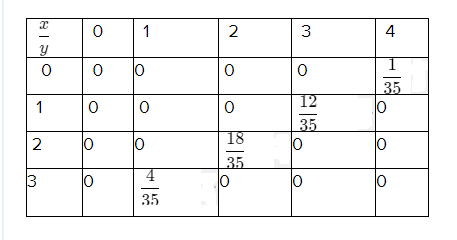
Find the probability for hypergeometric function
Using given statement to get a required probability such as, N = 7,r = 3
P(X = x) = \(\frac{\left(\begin{array}{l}
r \\
x
\end{array}\right)\left(\begin{array}{l}
N-r \\
n-x
\end{array}\right)}{\left(\begin{array}{l}
N \\
n
\end{array}\right)}\)
Putx = 0 in above equation
P(X = x) = \(\frac{\left(\begin{array}{l}
3 \\
0
\end{array}\right)\left(\begin{array}{l}
7-3 \\
4-0
\end{array}\right)}{\left(\begin{array}{l}
7 \\
4
\end{array}\right)}\)
P(X = x) = \(\frac{1}{35}\)
Therefore, the probability for a hypergeometric function value is \(\frac{1}{35}\) and the table values are verified.
Read and Learn More J Susan Milton Introduction To Probability And Statistics Solutions
J.Susan Milton Introduction To Probability And Statistics Principles And Applications Chapter 5 Page 169 Exercise 1 Problem 2
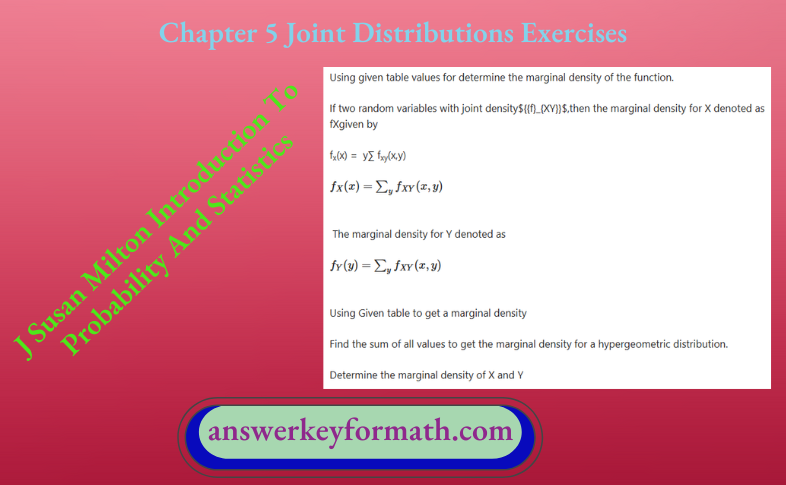
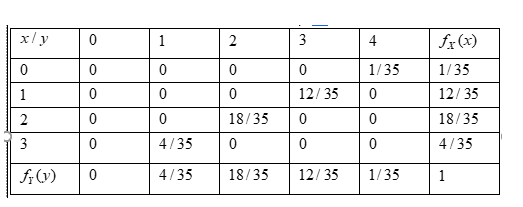
Hence, the marginal density was obtained and the variable Y is the Continuous Random Variable.
Therefore, the marginal density was obtained and the variable Y is the Continuous Random Variable.
J. Susan Milton Joint Distributions Chapter 5 Answers Page 169 Exercise 1 Problem 3
If two random variables are independent then it satisfies the following conditions,
1. P(x/y) = P(x)
2. P(x ∩ y) = P(x) ∗ P(y)
Also, the joint distribution of a function is fxy (x,y) = fx (x) fy(y)
Two random variables are independent, if the value of one variable does not change the probability value of another variable.
Therefore, If two random variables for independent then satisfies a condition 1. P(x∣y) = P(x) , 2. P(x∩y) = P(x)∗ P(y)
J.Susan Milton Introduction To Probability And Statistics Principles And Applications Chapter 5 Page 169 Exercise 2 Problem 4
Given problem, fxy(x,y) = 1/n2
If determine a function has to be joint density function satisfies the below condition,\(\sum_x \sum_y f_{X Y}(x, y)\) = 1
The values of X and Y between
x = 1,2,3 ,…., n
y = 1,2,3, …., n
Given: fxy(x,y) = 1/n2
Find joint density function
\(\sum_x \sum_y f_{X Y}(x, y)=\sum_{x=1}^n \sum_{y=1}^n \frac{1}{n^2}\)\(\sum_x \sum_y f_{X Y}(x, y)=\frac{1}{n^2} \sum_{x=1}^n \sum_{y=1}^n 1\)
\(\sum_x \sum_y f_{X Y}(x, y)=\frac{n}{n^2} \sum_{y=1}^n 1\)
\(\sum_x \sum_y f_{X Y}(x, y)=\frac{n}{n^2}(n)\)
\(\sum_x \sum_y f_{X Y}(x, y)\) = 1
Hence, a given function is discrete joint density function and the condition is satisfied.
Therefore, the function is a discrete joint density function and the condition x \(\sum_x \sum_y f_{X Y}(x, y)\) = 1 is satisfied.
Solutions To Joint Distributions Exercises Chapter 5 Susan Milton Page 169 Exercise 2 Problem 5
Given problem, fxy(x,y) = 1/n2
If determine a function has to be joint density function satisfies the below condition,\(\sum_x \sum_y f_{X Y}(x, y)\)= 1
The values of X and Y between
x = 1,2,3, …., n
y = 1,2,3, …., n
Given: fxy(x,y)=1/n2
Find joint density function
Using given function to get a marginal density
Find the marginal density of X
\(f_X(x)=\sum_y f_{X Y}(x, y)\)\(f_X(x)=\sum_1^n \frac{1}{n^2}\)
\(f_X(x)=\frac{1}{n^2} \sum^n 1\)
\(f_X(x)=\sum_1^n \frac{1}{n^2}\)
\(f_X(x)=\frac{1}{n^2} \sum_1^n 1\)
Determine the marginal density of Y
\(f_Y(y)=\sum_1^n \frac{1}{n^2}\)
\(f_Y(y)=\frac{1}{n^2} \sum_1^n 1\)
\(f_Y(y)=\frac{1}{n^2}(n)\)
\(f_Y(y)=\frac{1}{n}\)
Therefore, the marginal densities of a given function both X and Y is \(\frac{1}{n}\)
J.Susan Milton Introduction To Probability And Statistics Principles And Applications Chapter 5 Page 169 Exercise 2 Problem 6
If two random variables are independent then it satisfies the following conditions,
1. P(x∣y) = P(x)
2. P(x ∩ y) = P(x) ∗ P(y)
Also, the joint distribution of a function is
fxy(x,y) = fx(x) fy(y)
Two random variables are independent, if the value of one variable does not change the probability value of another variable.
Given problem,{{f}{XY}}(x,y) = 1/n2
The marginal densities of a given function both X
and Y is \(f_Y(y)=\frac{1}{n}\).
Hence, the values are independent.
Therefore, the given function marginal densities of both X and Y is \(f_Y(y)=\frac{1}{n}\) and independent.
Chapter 5 Joint Distributions Examples And Answers Susan Milton Page 169 Exercise 3 Problem 7
Given problem ,fxy(x,y) = 2/n(n+1)
If determine a function has to be joint density function satisfies the below condition \(f_Y(y)=\frac{1}{n}\).
The values of X and Y between
x = 1,2,3,….,n
y = 1,2,3,….,n
Given: fxy (x,y) = 2/n(n + 1)
Find joint density function
\(\sum_{y=1}^n \sum_{x=1}^n f_{X Y}(x, y)=\sum_{y=1}^n \sum_{x=1}^n \frac{2}{n(n+1)}\)\(\sum_{y=1}^n \sum_{x=1}^n f_{X Y}(x, y)=\frac{2}{n(n+1)} \sum_{y=1}^n \sum_{x=1}^n \)
Sum of first n integers is given by \(\frac{n(n+1)}{2}\)
\(\sum_{y=1}^n \sum_{x=1}^n f_{X Y}(x, y)=\frac{2}{n(n+1)} \times \frac{n(n+1)}{2}\)
\(\sum_{y=1}^n \sum_{x=1}^n f_{X Y}(x, y)\) = 1
Hence, a given function is discrete joint density function and the condition is satisfied.
Therefore, the function is a discrete joint density function and the condition \(\sum_{y=1}^n \sum_{x=1}^n f_{X Y}(x, y)\)= 1 is satisfied.
J.Susan Milton Introduction To Probability And Statistics Principles And Applications Chapter 5 Page 169 Exercise 3 Problem 8
Given problem, fxy (x,y) = 2/n(n + 1)
If determine a function has to be joint density function satisfies the below condition \(f_Y(y)=\frac{1}{n}\).
The values of X and Y between
x = 1,2,3,….,n
y = 1,2,3,….,n
Using given function to get a marginal density
Find the marginal density of X,
\(f_X(x)=\sum_y f_{X Y}(x, y)\)\(f_X(x)=\sum_{y=1}^n \frac{2}{n(n+1)}\)
\(f_X(x)=\frac{2}{n(n+1)} \sum_{y=1}^n 1\)
\(f_X(x)=\frac{2}{n(n+1)}(n)\)
\(f_X(x)=\frac{2}{(n+1)}\)
Determine the marginal density of Y
\(f_X(x)=\sum_y f_{X Y}(x, y)\)\(f_X(x)=\sum_{y=1}^n \frac{2}{n(n+1)}\)
\(f_X(x)=\frac{2}{n(n+1)} \sum_{y=1}^n 1\)
\(f_X(x)=\frac{2}{n(n+1)}(n)\)
\(f_X(x)=\frac{2}{(n+1)}\)
Therefore, the marginal densities of a given function both X and Y \(f_X(x)=\frac{2}{(n+1)}\)
J.Susan Milton Introduction To Probability And Statistics Principles And Applications Chapter 5 Page 169 Exercise 3 Problem 9
If two random variables are independent then it satisfies the following conditions,
1. P(x∣y) = P(x)
2. P(x∩y) = P(x) ∗ P(y)
Also, the joint distribution of a function is
fxy(x,y) = fx(x) fy(y)
Two random variables are independent, if the value of one variable does not change the probability value of another variable.
Given problem, fxy (x,y) = 2/n(n + 1)
The marginal densities of a given function both X and Y is \(f_X(x)=\frac{2}{(n+1)}\)
Hence, the values are independent.
Therefore, the given function marginal densities of both X and Y is \(f_X(x)=\frac{2}{(n+1)}\) and its independent.
Probability And Statistics J. Susan Milton Chapter 5 Solved Step-By-Step Page 170 Exercise 4 Problem 10
In Given table,X represents the number of syntax errors and Y represents the number of errors in logic.
Problem statement: Determine the probability for selected program have neither of these errors.
Given table
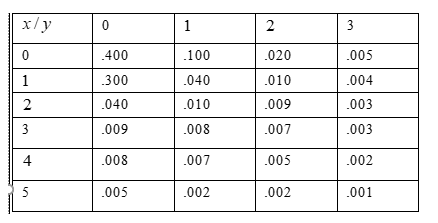
In above table,X represents the number of syntax errors and Y represents the number of errors in logic.
Find the probability
Using given statement to get a required probability such as, p(x = 0,y = 0)
Hence, the value of p(x = 0,y = 0) is 0.4
Hence, the probability that selected program have neither these types of errors as 0.4
Therefore, the probability that selected program have neither these types of errors as 0.4
J.Susan Milton Introduction To Probability And Statistics Principles And Applications Chapter 5 Page 170 Exercise 4 Problem 11
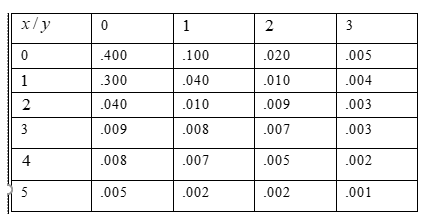
In Given table,X represents the number of syntax errors and Y represents the number of errors in logic.
Problem statement: Determine the probability for selected program at least one syntax error and at most one error in logic.
Given table,In above table,X represents the number of syntax errors and Y
Find the probability
Using given statement to get a required probability such as,
P[X ≥ 1 and Y ≤ 1]
P[X ≥ 1and Y ≤ 1]
[P(X = 1,Y = 0) + P(X = 2,Y = 0) + P(X = 3,Y = 0)
+ P(X = 4,Y = 0) + P(X = 5,Y = 0) + P(X = 1,Y = 1)
+ P(X = 1,Y = 2) + P(X = 1,Y = 3) + P(X = 1,Y = 4)
+ P(X = 1,Y = 5)]
P[X ≥ 1and Y ≤ 1] = 0.300 + 0.040 + 0.009 + 0.008 + 0.005 + 0.040 + 0.010+ 0.008 + 0.007 + 0.002
P[X ≥ 1and Y ≤ 1] = 0.429
Hence, the probability for selected at least one syntax error and at most one error in logic is 0.429
Therefore, the probability for selected at least one syntax error and at most one error in logic is 0.429
J.Susan Milton Introduction To Probability And Statistics Principles And Applications Chapter 5 Page 170 Exercise 4 Problem 12
Using given table values for determine the marginal density of the function.
If two random variables with joint density fXY then the marginal density for X denoted as fx given by
\(f_X(x)=\sum_y f_{X Y}(x, y)\)
The mariginal density for y denoted as
\(f_Y(y)=\sum_y f_{X Y}(x, y)\)
Given table
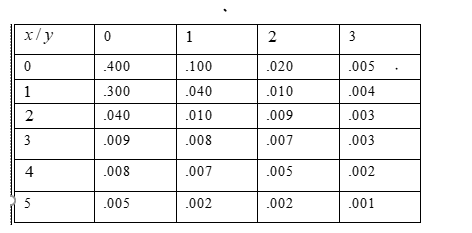
In above table, X represents the number of syntax errors and y represents the number of errors in logic.
Using Given table, sum all values for determine a marginal density
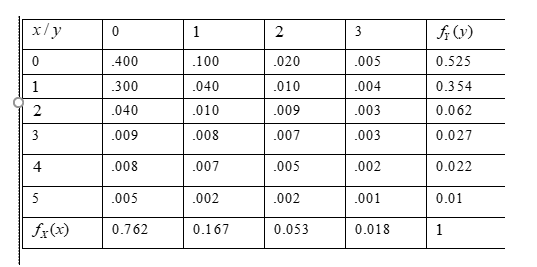
Hence, the marginal density was obtained
Therefore, the marginal density for both values are obtained in above table.
J.Susan Milton Introduction To Probability And Statistics Principles And Applications Chapter 5 Page 170 Exercise 5 Problem 13
On previous example to get a function is, fxy(x,y)= \(\frac{1.72}{x}\)
If determine a function has to be joint density function satisfies the below condition
\(\int_{-\infty}^{\infty} \int_{-\infty}^{\infty} f_{X Y}(x, y) d x d y=1\)
The values of $X$ and $Y$ between 27 ≤ y ≤ x ≤ 33
Given: \(f_{X Y}(x, y)=\frac{1.72}{x}\)
Use continuous joint density function to find the value of P[X ≤ 30 and Y ≤ 28]
P[X ≤ 30 and Y≤ 28]= \(\int_{27}^{30} \int_{27}^{28} f_{X Y}(x, y) d x d y\)
\(=\int_{27}^{30} \int_{27}^{28} \frac{1.72}{x} d x d y\)
Integrate depends on y and apply the limit values in given function
\( = 1.72 \int_{27}^{30} \frac{1}{x}[y]_{27}^{28} d x\)
\( = 1.72 \int_{27}^{30} \frac{1}{x} d x\)
Integrate depends on x and apply the limit values in given function
P[X ≤ 30 and Y≤28] = 1.72× \([\ln x]_{27}^{30}\)
P[X ≤ 30 and Y≤28] = 1.72(3.4012 − 3.2958)
P[X ≤ 30 and Y≤28] = 0.1813
Therefore, using previous example to find a function as fxy (x,y)= \(\frac{1.72x}{x}\) and the value of P[X ≤ 30 and Y ≤ 28] is 0.1813.
J.Susan Milton Introduction To Probability And Statistics Principles And Applications Chapter 5 Page 170 Exercise 6 Problem 14
On previous example to get a function is,f xy(x,y) = \(\frac{c}{x}\)
If determine a function has to be joint density function satisfies the below condition \(\int_{-\infty}^{\infty} \int_{-\infty}^{\infty} f_{X Y}(x, y) d x d y\) = 1
The values of X and Y between 27 ≤ y ≤ x ≤ 33
Given: fxy (x,y) = \(\frac{c}{x}\)
Use continuous joint density function to find the value of c
\(\int_{-\infty}^{\infty} \int_{-\infty}^{\infty} f_{X Y}(x, y) d y d x\) = 1
\(\int_{27}^{33} \int_{27}^x \frac{c}{x} d y d x\)= 1
Integrate depends on y and apply the limit values in given function
\(\int_{27}^{33}\left(\frac{c}{x} y\right)_{27}^x d x\) = 1
\(\int_{27}^{33}\left(c-\frac{c}{x}(27)\right) d x\) = 1
Integrate depends on x and apply the limit values in given function
\(\int_{27}^{33} c d x-27 \int_{27}^{33} \frac{c}{x} d x\)= 1
6c − 27c (ln(33)−3ln(3)) = 1
6c − 5.4181c = 1
c = \(\frac{1}{0.5819}\)
c = 1.72
Therefore, using previous example to find a function as f XY(x,y) = \(\frac{1.72}{x}\)with 27 ≤ y ≤ x ≤ 33 and the value of c is 1.72
Online Help For J. Susan Milton Joint Distributions Chapter 5 Exercises Page 170 Exercise 6 Problem 15
On previous example to get a function is \(f_{X Y}(x, y)=\frac{1.72}{x}\)
If determine a function has to be joint density function satisfies the below condition, \(f_X(x)=\int_{-\infty}^{\infty} f_{X Y}(x, y) d y\) 27 ≤ y ≤ x ≤ 33
Given: \(f_{X Y}(x, y)=\frac{1.72}{x}\)
Using given function to get a marginal density
Find the marginal density of X
\(f_X(x)=\int_{-\infty}^{\infty} f_{X Y}(x, y) d y\) \(f_X(x)=\int_{27}^{28} \frac{1.72}{x} d y\)
Integrate depends on Y and apply the limit values in given function
\(f_X(x)=1.72\left(\frac{1}{x}\right)[y]_{27}^{28}\)
\(f_X(x)=1.72\left(\frac{1}{x}\right)[28-27]\)
\(f_X(x)=1.72\left(\frac{1}{x}\right)\)
Therefore, Therefore, the marginal density for X and the value of P[X≤28] is \(f_{X Y}(x, y)=\frac{1.72}{x}\)
J.Susan Milton Introduction To Probability And Statistics Principles And Applications Chapter 5 Page 170 Exercise 7 Problem 16
Given problem, fxy (x,y) = c(4x + 2y + 1)
If determine a function has to be joint density function satisfies the below condition
\(\int_{-\infty}^{\infty} \int_{-\infty}^{\infty} f_{X Y}(x, y) d x d y\) = 1
The values of X and Y between
0 ≤ x ≤ 40
0 ≤ y ≤ 2
Given: fxy (x,y) = c(4x + 2y + 1)
Use continuous joint density function to find the value of c
\(\int_{-\infty}^{\infty} \int_{-\infty}^{\infty} f_{X Y}(x, y) d x d y\) = 1
\(\int_0^{40} \int_0^2 c(4 x+2 y+1) d x d y\) = 1
Integrate depends on y and apply the limit values in given function
\(c \int_0^{40}\left(4 x y+2 \frac{y^2}{2}+y\right)_0^2 d x\) = 1
\(c \int_0^{40}\left(4 x(2)+(2)^2+2\right) d x=\) 1
Integrate depends on x and apply the limit values in given function,
\(c \int_0^{40}(8 x+6) d x\)= 1
\(c\left(\frac{8 x^2}{2}+6 x\right)_0^{40}\)= 1
\(c\left(\frac{8(40)^2}{2}+6(40)\right)\)= 1
6640c = 1
c = \(\frac{1}{6640}\)
Therefore, the given function fXY (x,y)=c(4x+2y+1) and the value of c is \(\frac{1}{6640}\)= 1
Step-By-Step Guide To Joint Distributions Exercises Chapter 5 Milton Page 170 Exercise 7 Problem 17
To solve this, we need to integrate the PDF where X and Y defined as follow.
P(x > 20,y ≥ 1)
20 < x ≤ 0,1 ≤ y ≤ 2
P(x > 20,y ≥ 1) = 1 \(\int_1^2 \int_{20}^{40} \frac{1}{6640}(4 x+2 y+1) d x d y\)
P(x > 20,y ≥ 1) = \(\frac{1}{6640} \int_1^2\left(\frac{4 x^2}{2}+2 y x+x\right) \int_{20}^{40} d y\)
P(x > 20,y ≥ 1) = \(\frac{1}{6640} \int_1^2(40 y+2420) d y\)
P(x > 20,y ≥ 1) = \(\frac{1}{6640} \int_1^2(40 y+2420) d y\)
P(x > 20,y ≥ 1) = \(=\frac{1}{6640}(2480)\)
P(x > 20,y ≥ 1) = \(\frac{38}{83}\)
The probability of temperature is P(x > 20,y ≥ 1) =\(\frac{38}{83}\)
J.Susan Milton Introduction To Probability And Statistics Principles And Applications Chapter 5 Page 171 Exercise 8 Problem 18
Note that the integral of a valid joint density is equal to 1.
To verify joint density for a two-dimensional random variable.
f xy (x,y) = \([\frac{1}{x}\),o < y < x < 1
That the integral of a valid joint density is equal to 1.
1= \(1\iint_R f_{X, Y}(x, y), o<y<x<1\)
= \(\int_0^1 \int_0^x \frac{1}{x} d y d x\)
= \(\left.\int_0^1\left(\frac{y}{x}\right)\right|_0 ^x d x\)
= \(\left.(x)\right|_0 ^1\)
1 = 1
It is a joint density variable.
Exercise Solutions For Chapter 5 Susan Milton Joint Distributions Page 171 Exercise 8 Problem 19
We can get the probability by integrating it into the following regions.
To find P(X ≤ 0.5 and Y ≤ 0.25)
We can get the probability by integrating it on the following regions
0 < y ≤ 0.25
0.25≤ x < 0.5
Thus, we get that
P(X ≤ 0.5 and Y ≤ 0.25) = \(\int_{0.25}^{0.5} \int_0^{0.25} \frac{1}{x} d y d x\)
P(X ≤ 0.5 and Y ≤ 0.25) = \(\left.\int_{0.25}^{0.5}\left(\frac{y}{x}\right)\right|_0 ^{0.25} d x\)
P(X ≤ 0.5 and Y ≤ 0.25) = \(\left.0.25[\ln (x)]\right|_0 ^{0.25}\)
P(X ≤ 0.5 and Y ≤ 0.25) = 0.25 [(ln(0.5)] − [ln(0.25)]
P(X ≤ 0.5 and Y ≤ 0.25) = 0.1733
Hence, we have found the answer for P(X ≤ 0.5and Y ≤ 0.25) = 0.1733
J.Susan Milton Introduction To Probability And Statistics Principles And Applications Chapter 5 Page 171 Exercise 9 Problem 20
The marginal density distribution of a subset of a collection of random variables is the probability distribution.
To find the marginal densities for X and Y.
\(f_{X, Y}(x, y) = \frac{x^2 y^2}{16}, 0 \leq x, y \leq 2\)
To calculate the marginal density for X, by definition, we have to calculate the integral
\(\left.f_X(x)=\int \mathbb{r} f_{(} X, Y\right)(x, y) d y\)
By plugging in the values where y is defined and the expression for joint density function, we obtain.
\(f_X(x)=\int_0^2 \frac{x^3 y^3}{16} d y=\frac{x^3}{64}(16-0)=\frac{x^3}{4}\), 0 ≤ x ≤ 2
To calculate the marginal density for Y, by definition, we have to calculate the integral
\(\left.f_Y(y)=\int \mathbb{r} f_{(} X, Y\right)(x, y) d x\)
By plugging in the values where y is defined and the expression for joint density function, we obtain.
\(f_X(x)=\int_0^2 \frac{x^3 y^3}{16} d y\)
\(=\frac{x^3}{64}(16-0)\)
\(=\frac{x^3}{4}\), 0 ≤ x ≤ 2
\(\frac{x^3}{4}\) 0 ≤ x ≤ 2
\(\frac{x^3}{4}\) 0 ≤ x ≤ 2
⇒ \(f_Y(y)=\frac{y^3}{4}, 0 \leq y \leq 2\)
J.Susan Milton Introduction To Probability And Statistics Principles And Applications Chapter 5 Page 171 Exercise 9 Problem 21
The marginal density distribution of a subset of a collection of a random variables is the probability distribution.
To explain if X and Y are independent?
To check if X and Y are independent, we can simply check whether or not the following equation is fulfilled.
fx,y(x,y) = fx(x) fy(y)
By substituting the calculated expression , we obtain
\(f_{X, Y}(x, y)=\frac{x^3 y^3}{16}=\frac{x^3}{4} \frac{y^3}{4}=f_X(x) f_Y(y)\)
Hence X and Y are indeed independent.
Hence X and Y are indeed independent.
Page 171 Exercise 9 Problem 22
The marginal density distribution of a subset of a collection of random variables is the probability distribution.
To find P(X ≤ 1)
To find the probability P(X≤1), by definition, we have to calculate integral
P(X≤1) \(=\int_{-\infty}^1 f_X(x) d x\)
By substituting the given expression for the marginal density function and the values where x is defined, we proceed to calculate
P(X ≤ 1) \(\left.=\int_0^{\frac{x 3}{4}} d x=\frac{1}{16}-(1-0)=\frac{(}{1}\right)(16)\)
Therefore, the joint density for (X,Y) is given by \(\frac{1}{6}\)
J.Susan Milton Introduction To Probability And Statistics Principles And Applications Chapter 5 Page 171 Exercise 10 Problem 23
fx,y(x,y) = c, 20 < x < y < 40 The integral of the PDF should always be equal to l, where x and y is defined.
Thus we get
\(=\iint_R f_{X, Y}(x, y) d x d y\)
\(=\int_{20}^{40} \int_{20}^y c d x d y\)
\(=c \int_{20}^{40}(y-20) d y\)
= c (200)
= c\(\frac{1}{200}\)
The value of c is c\(\frac{1}{200}\)
Page 171 Exercise 10 Problem 24
The integral of the PDF should always be equal to l, where x and y are defined, then integrating the PDF.
To find the probability that the carrier will pay at least $25 per barrel and the refinery will pay at most $30 per barrel for the oil.
We can express the problem
P(X ≥ 25 and Y ≥ 30)
By integrating the PDF, we get that
P(X ≥ 25 and Y ≥ 30)
P(X ≥ 25 and Y ≥ 30\(=\int_{30}^{40} \int_{25}^y \frac{1}{200} d x d y\)
P(X ≥ 25 and Y ≥ 30) = \(\frac{1}{200} \int_{30}^{40}(y-25) d y\)
P(X ≥ 25 and Y ≥ 30)= \(\left.\frac{1}{200}\left(\frac{y^2}{2}-25 y\right)\right|_{30} ^{40}\)
P(X ≥ 25 and Y ≥ 30)= \(\left.\frac{1}{200}\left(\frac{y^2}{2}-25 y\right)\right|_{30} ^{40}\)
P(X ≥ 25 and Y ≥ 30)= \(\frac{1}{200}\)
P(X ≥ 25 and Y ≥ 30)= \(\frac{1}{2}\)
P(X ≥ 25 and Y ≥ 30) = \(\frac{1}{2}\)
J.Susan Milton Introduction To Probability And Statistics Principles And Applications Chapter 5 Page 171 Exercise 10 Problem 25
The integral of the PDF should always be equal to l, where x and y are defined, then integrating the PDF.
To find the probability that the price paid by the refinery exceeds that of the carrier by at least $10 per barrel.
We can express the problem
P(Y > X + 10)
Now if we graph the domain, we get
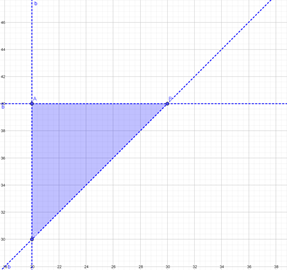
Where
Point A = (20,40)
Point B = (30,40)
Point C = (20,30)
CB = y − 10
By integrating the PDF
P(Y>X+10)= \(\int_{30}^{40} \int_{25}^y \frac{1}{200} d x d y\)
\(=\frac{1}{200} \int_{30}^{40}(y-10-20) d y\)
\(=\frac{1}{200} \int_{30}^{40}(y-30) d y\)
\(=\left.\frac{1}{200}\left(\frac{y^2}{2}-30 y\right)\right|_{30} ^{40}\)
= \(\frac{50}{200}\)
= 0.25
The probablity is P(Y > X + 10) = 0.25
J.Susan Milton Introduction To Probability And Statistics Principles And Applications Chapter 5 Page 172 Exercise 11 Problem 26
From Continuous Joint density we get that the three properties and identify a function as a density (X1,X2,X3,….. .Xn) f X1, X2, X3 ,. ….. Xn(x1,x2,x3, ….. .x1 )≥0]−∞<Xi< ∞
For all Xi where i is from 1 to n
\(\int_{-\infty}^{\infty} \int_{-\infty}^{\infty} \int_{-\infty}^{\infty} \cdots \cdots \int_{-\infty}^{\infty}\) f X1, X2, X3 ,…… X1 (x1 ,x2,x3,……x1 ) dx1 dx2 dx3……..
P[a ≤ X1 ≤ b,c ≤ X ≤ d,e ≤ X3 ≤ f,…..,g ≤ X1 ≤ h
\(\int_a^b \int_c^d \int_e^f \cdots \cdots \int_g^h\) f X1, X2, X3 ,…… X(x1,x2,x3,……xn) dx1dx2 dx3 ………..;. Where a, b, c, …., h are real
Hence, a, b, c, …., h is called the joint density for (X1 ,X2,X3,…..,Xn)