
Precalculus Textbook Mcgraw Hill Answers
Pre-Calculus 11 Student Edition Chapter 2 Trigonometry
McGraw Hill Pre Calculus 11 Chapter 2 Exercise 2.2 Solutions Page 88 Problem 1 Answer
Given: Point A(3,4)
To find in which quadrant A lies
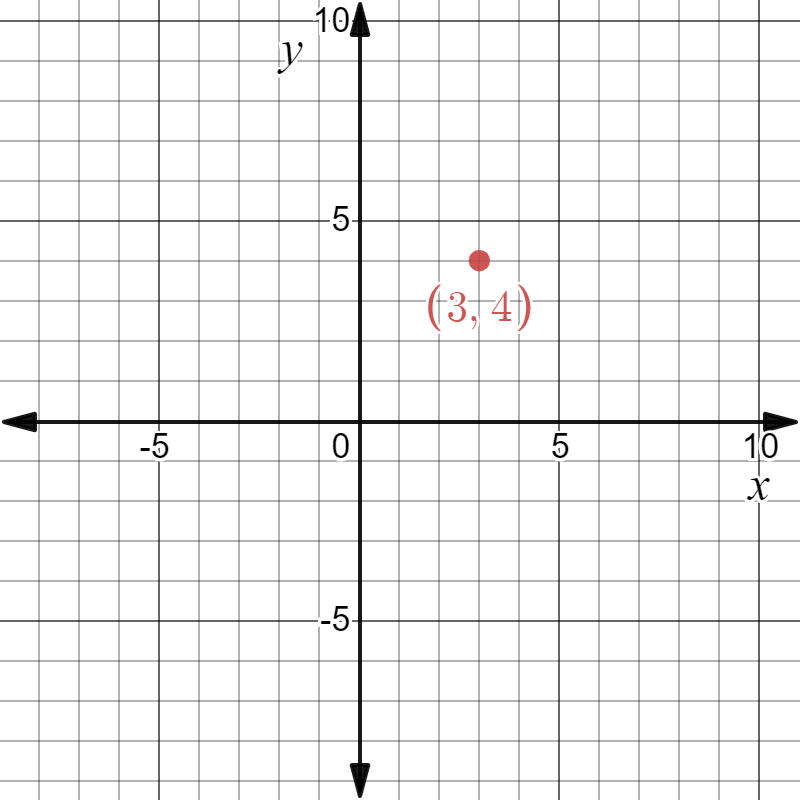
The point A(3,4) has the sign +ve for both abscissa and ordinate. Therefore, point lies in first Quadrant.
Therefore, the point A(3,4) lies in 1st quadrant.
McGraw Hill Pre Calculus 11 Chapter 2 Exercise 2.2 Solutions Page 88 Problem 2 Answer
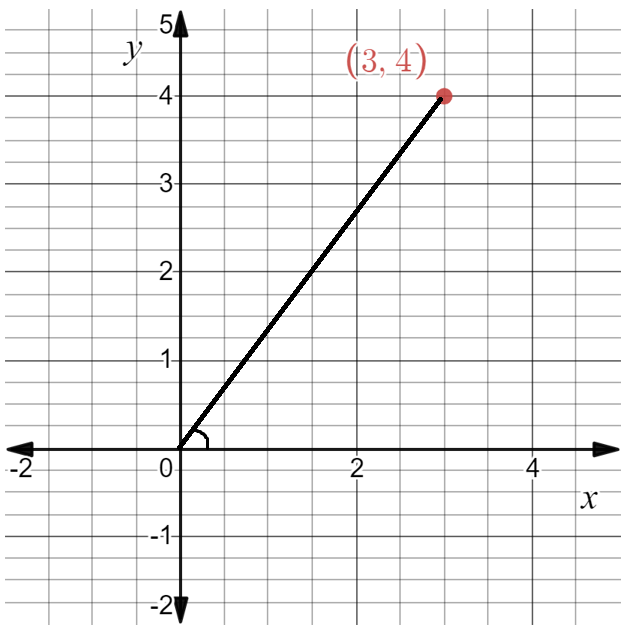
We need to draw the angle in standard position with terminal arm passing through point A(3,4).
McGraw Hill Pre Calculus 11 Chapter 2 Exercise 2.2 Solutions Page 89 Problem 3 Answer
Given that,
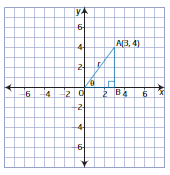
We need to describe how is each primary trigonometric ratio related to the coordinates of point A and the radius r.
For this, use the definition of primary trigonometric ratios in the right triangle.
Here,sinθ=4/5, cosθ=3/5 and tanθ=4/3.
So sine function is the ratio of y-coordinate of point A and r.
Cosine function is the ratio of x -coordinate of point A and r.
Read and Learn More Precalculus Textbook Mcgraw Hill Answers
Precalculus Textbook Mcgraw Hill Answers
Tangent function is the ratio of y-coordinate of point A and x-coordinate of point A.
Sine function is the ratio of y-coordinate of point A and r.
Cosine function is the ratio of x-coordinate of point A and r.
Tangent function is the ratio of y-coordinate of point A and x-coordinate of point A.
McGraw Hill Pre Calculus 11 Chapter 2 Exercise 2.2 Solutions Page 89 Problem 4 Answer
Given point A has coordinates (3,4) and y-axis is the axis to be considered as mirror.
To find the reflection of the point A that means coordinates of point C.
The graph which reflect point A is as follows:
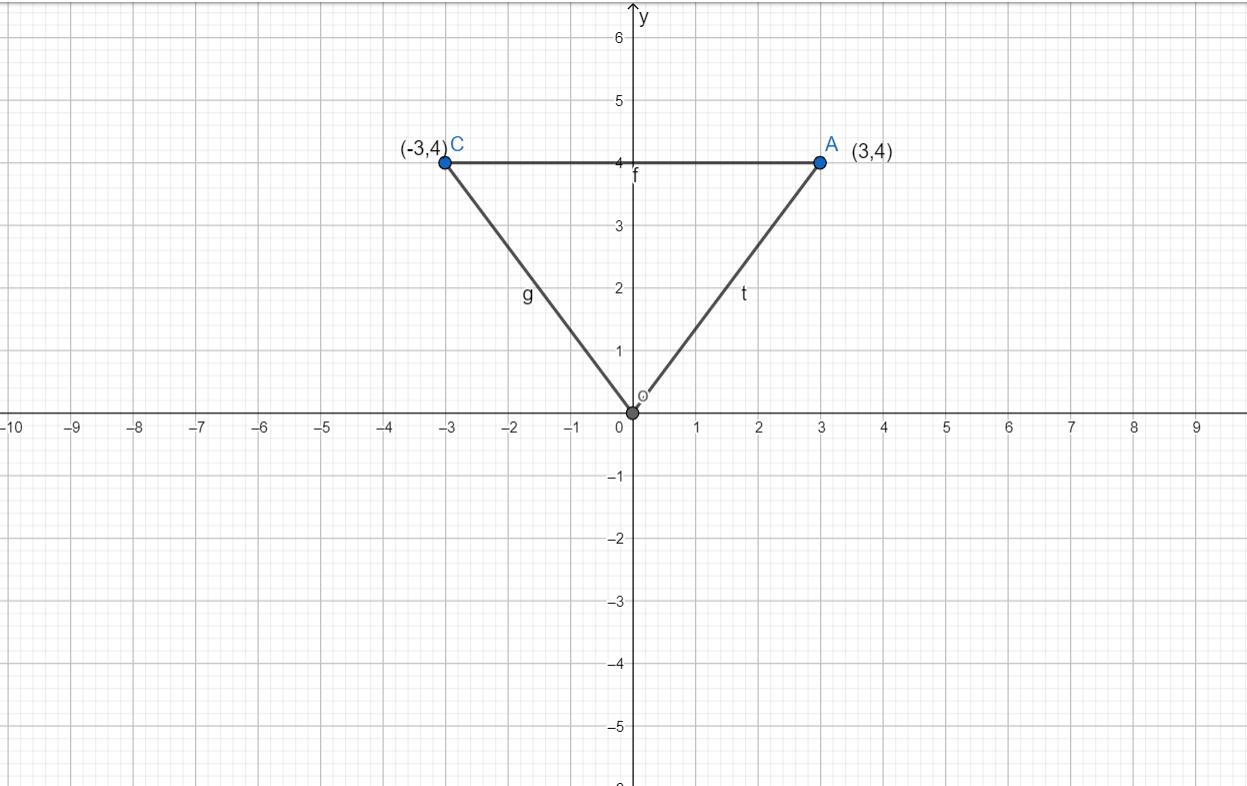
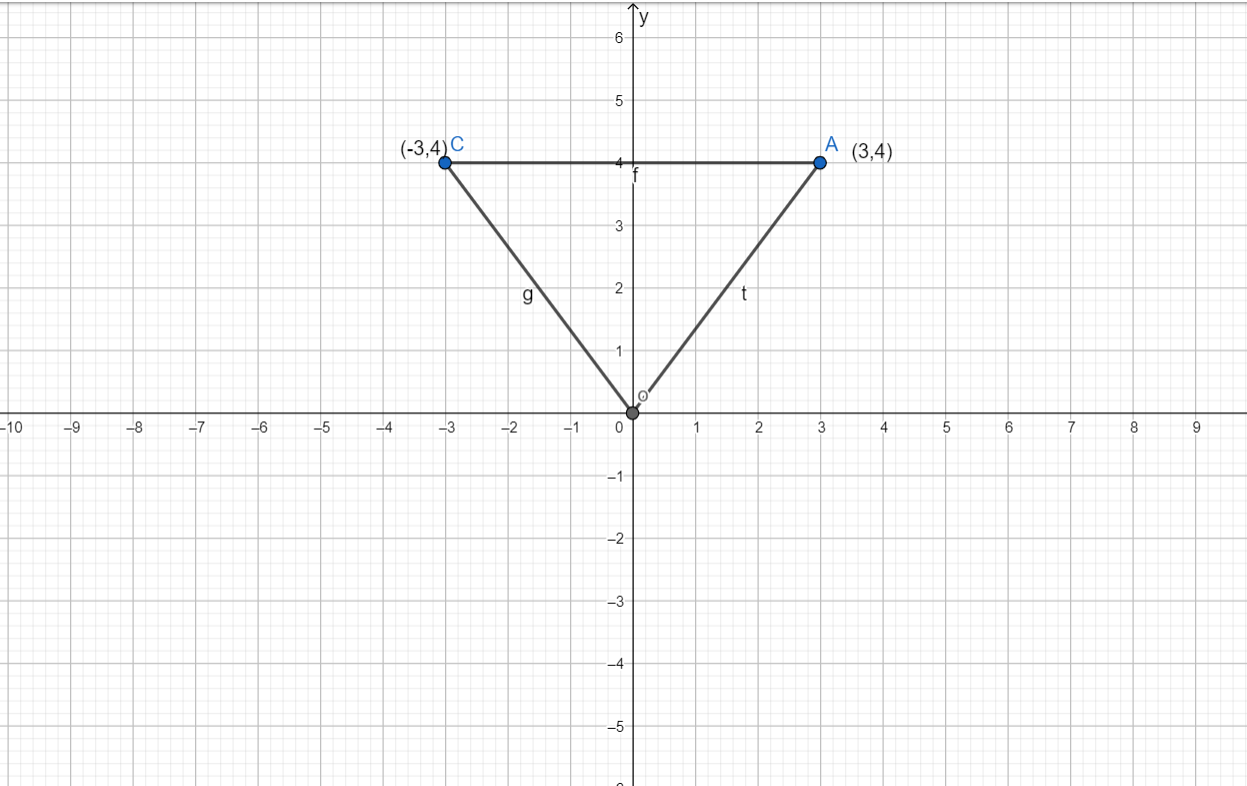
The coordinates of the point C considering Y-axis as a mirror will be(−3,4) as in 2nd quadrant x-coordinate is negative but y-coordinate is positive.
Therefore, the coordinates of point C are(−3,4)
Precalculus Textbook Mcgraw Hill Answers
Pre Calculus 11 Chapter 2 Exercise 2.2 Trigonometry Solved Problems Page 89 Problem 5 Answer
Given Point A has coordinates (3,4) and point C has coordinate(−3,4).
Firstly we have to draw a perpendicular from point C to x-axis.
Then we have to find the trigonometric ratios for ∠COB
Primary Trigonometric ratios aresinθ=Perpendicular
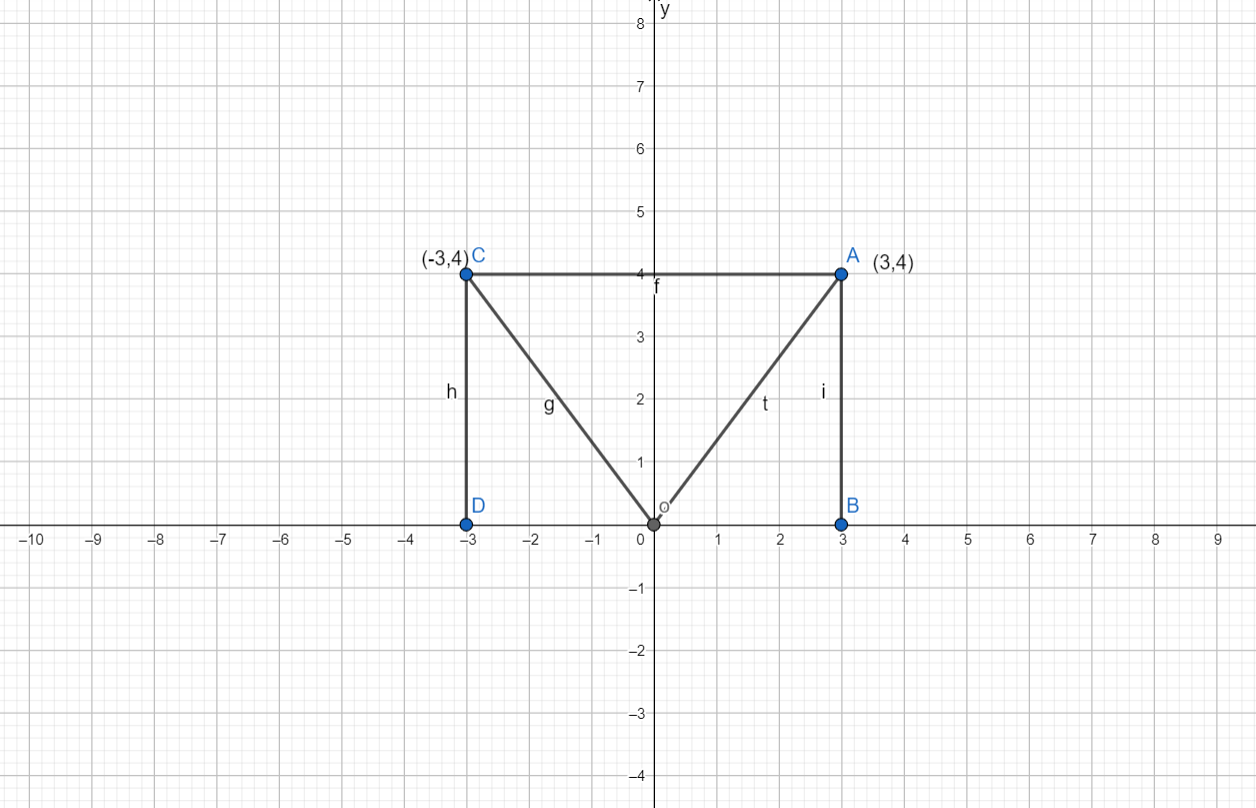
Hypotenuse=4/√52:cos θ=Base/Hypotenuse=−6/√52:tanθ=Perpendicular/Base=−4/6=−2/3
Therefore, the trigonometric ratios are 4/√52,−6/√52,−2/3
Pre Calculus 11 Chapter 2 Exercise 2.2 Trigonometry Solved Problems Page 89 Problem 6 Answer
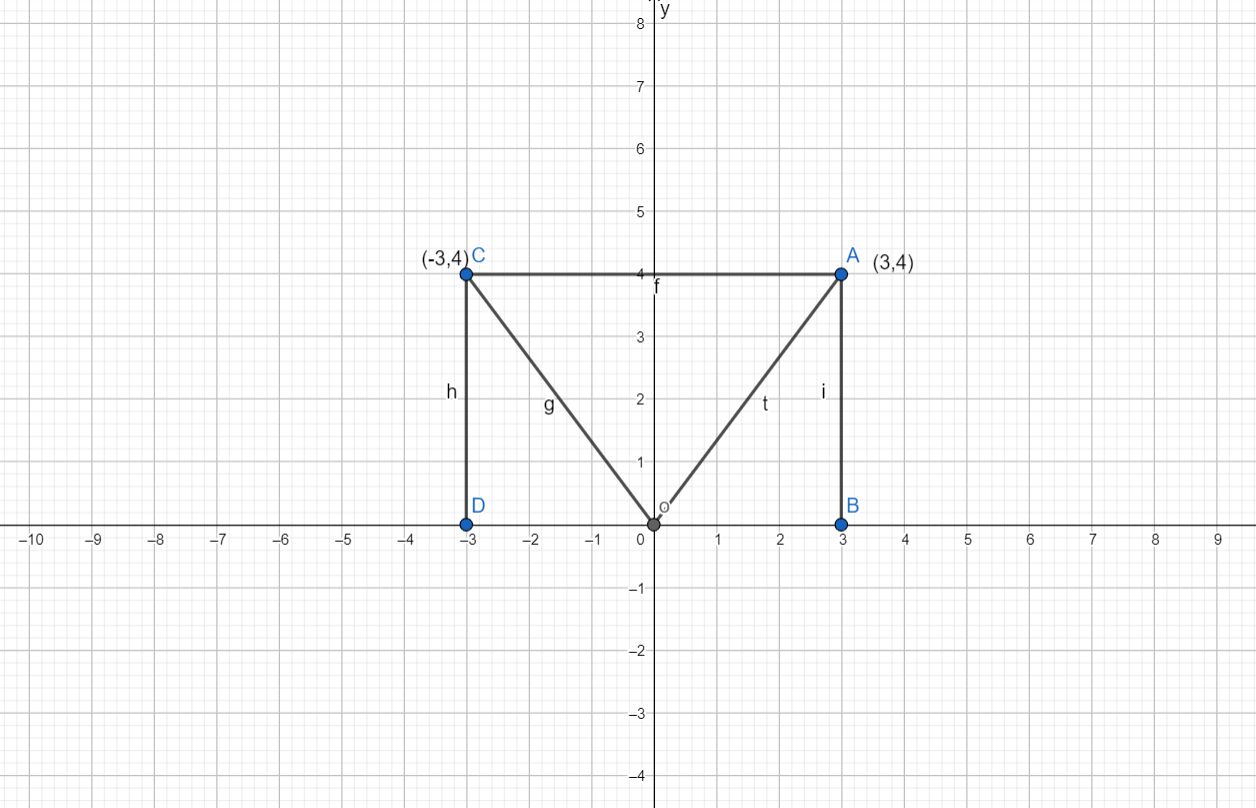
We know that the x-axis has a total angle of 180°.
Now, COD clearly forms a right angle triangle that means ∠COD=45°
So,∠COD+∠COB=180⟹45°+∠COB=180
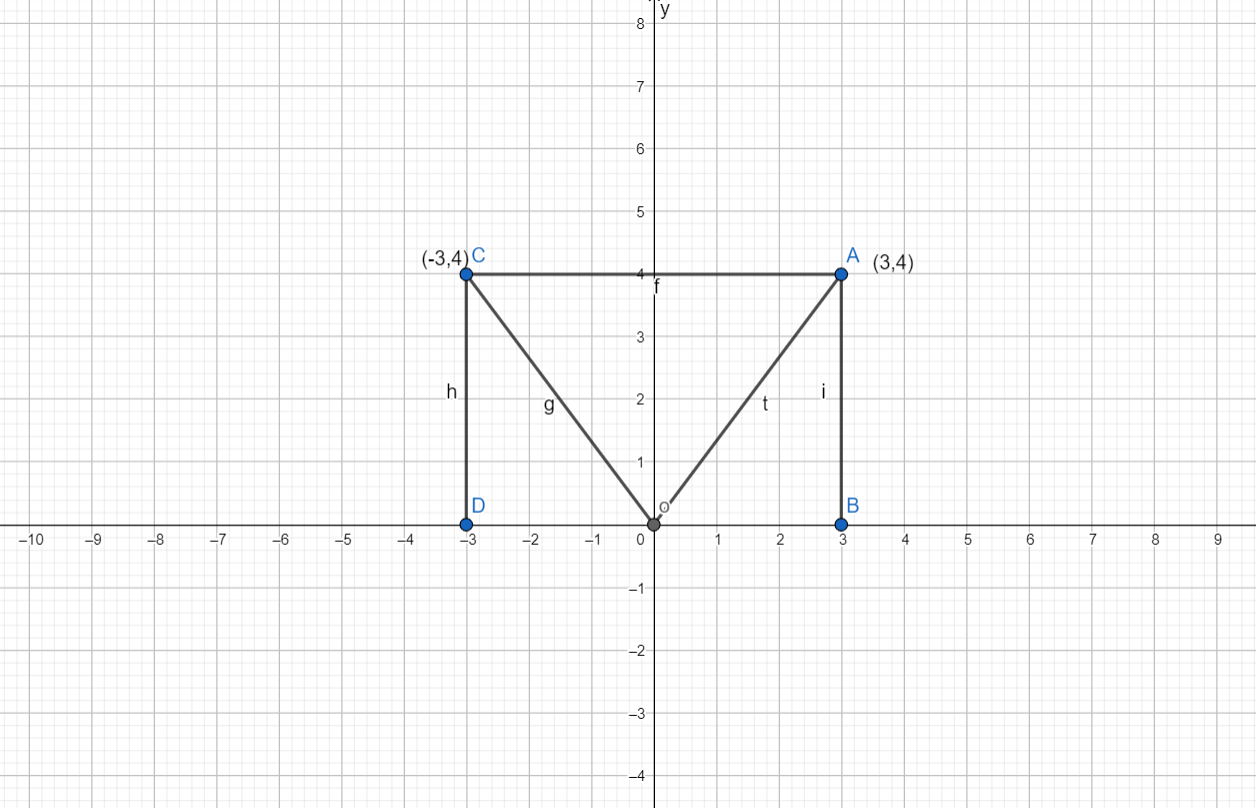
∠COB=180°−45°=135°
Therefore, measure of ∠COB is 135°.
Pre Calculus 11 Chapter 2 Exercise 2.2 Trigonometry Solved Problems Page 89 Problem 7 Answer
The angles∠COB and∠COD lie on the same axis( x-axis) and their sum is 180°.
The angles represent linear pair angles.
Precalculus Textbook Mcgraw Hill Answers
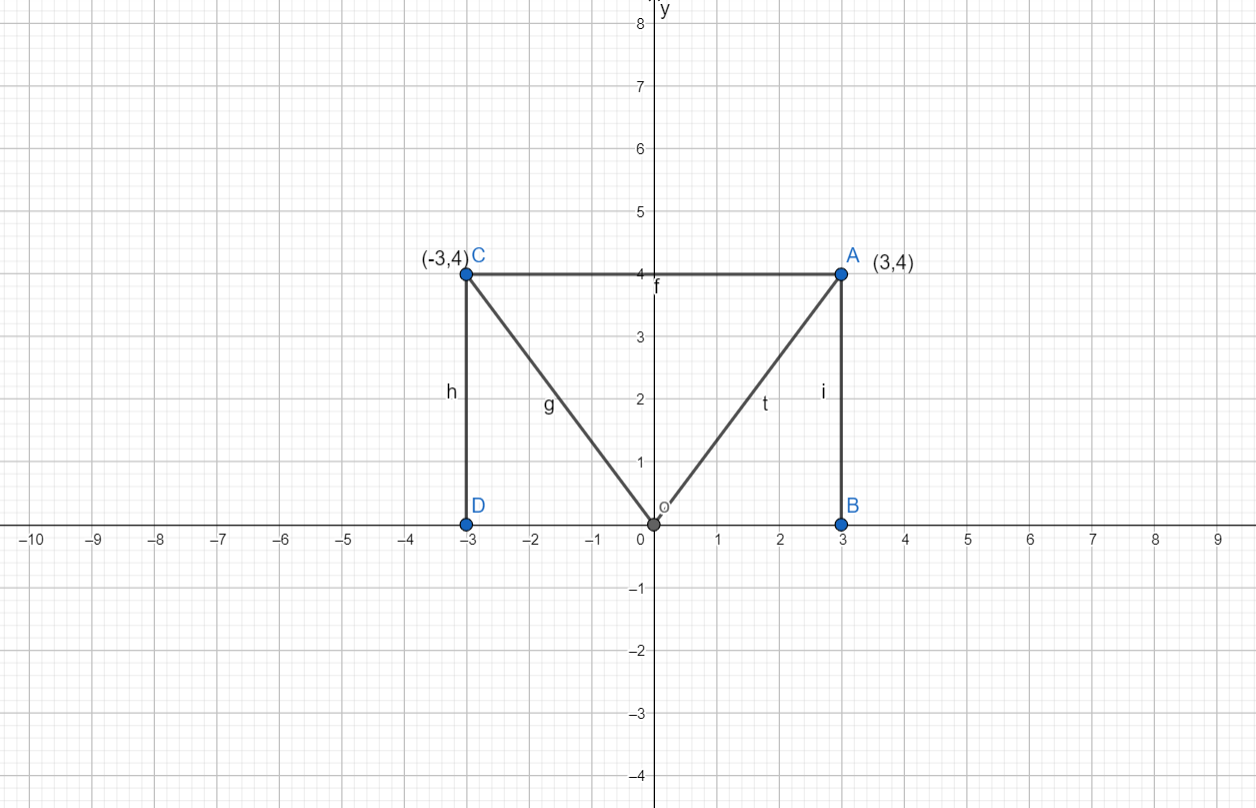
Therefore, the angles COB AND COD are Linear pair angles.
Pre Calculus 11 Chapter 2 Exercise 2.2 Trigonometry Solved Problems Page 91 Problem 8 Answer
Given: The point P(−5,−12) lies on the terminal arm of an angle, θ, in standard position
To find: The exact trigonometric ratios for sinθ,cosθ,tanθ
Plot the given point on a graphJoin the point with the origin to get the terminal arm of the required angle
Get the reference angleEvaluate the trigonometric ratios using the sides of the right-angled triangle formed
The given situation can be modelled as,
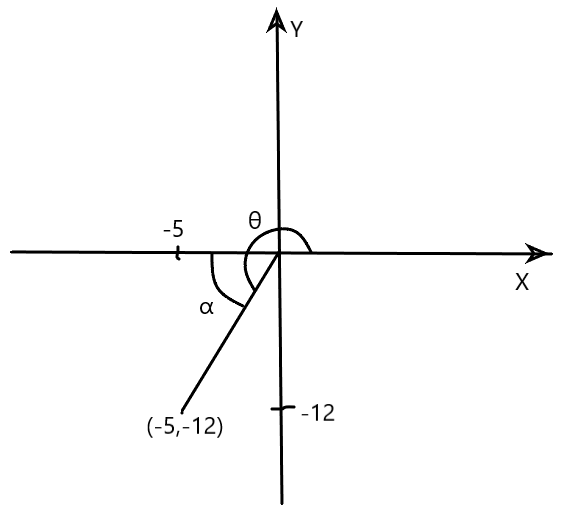
Now, consider the right-angled triangle formed by the origin, the given point and the point (−5,0).
Using the definitions of the trigonometric ratios in a right-angled triangle, we have,
sinα=perpendicular/hypotenuse
sinα =12/√122+52
sinα =12/√144+25
sinα =12/√169
sinα=12/13
cosα=base/hypotenuse=5/√122+52
cosα =5/√144+25
cosα =5/√169
cosα =5/13
tanα=perpendicular/base
tanα =12/5
Mcgraw Hill Precalculus Textbook Answers
Now, from the figure, it is clear, θ=π+α
Then,
sinθ=sin(π+α)=−sinα=−12/13
cosθ=cos(π+α)=−cosα=−5/13
tanθ=tan(π+α)=tanα=12/5
So, sin θ=−12/13,cos θ=−5/13,tanθ=12/5
It has been found that sin θ=−12/13,cos θ=−5/13,tanθ=12/5
Pre Calculus 11 Exercise 2.2 Step-By-Step Trigonometry Solutions Page 92 Problem 9 Answer
Given: θ is an angle in quadrant III and tanθ=1/5
To find: The exact values of sin θ, cos θ
Since θ is an angle in quadrant III, sin θ<0, cos θ<0
Use the trigonometric identities to find the exact value of sinθ,cosθ
Given: tanθ=1/5
We have, the trigonometric identity,
sec2 θ=1+tan2θ
Put tanθ=1/5 in the above identity to get,
sec2θ=1+(1/5)2 ⇒sec2
θ=1+1/25⇒sec2
θ=26/25⇒1/cos2θ
θ =26/25
⇒cos2θ=25/26
⇒cos θ=−5/√26 (Since cos θ<0)
Now, we have the identity,
Mcgraw Hill Precalculus Textbook Answers
sin2θ+cos2θ=1
Put cos2θ=25/26 in the above identity to get,
sin2θ+25/26=1
⇒sin2θ=1−25/26
⇒sin2θ=1/26
⇒sin θ=−1/√26 (Since sin θ<0)
So, sin θ=−1/√26 ,cos θ=−5/√26
It has been found that sin θ=−1/√26,cos θ=−5/√26
Pre Calculus 11 Exercise 2.2 Step-By-Step Trigonometry Solutions Page 93 Problem 10 Answer
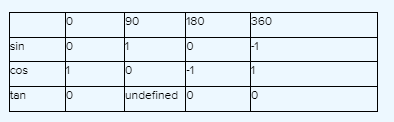
Given: A figure representing the angles 0°,90°,180°,270°
To find the sine, cosine and tangent values of these angles from the given figureIn a right angled triangle, the trigonometric ratios are ratios of lengths of its sides
For sin: sin0°=0,sin180°=0,sin270°=−1
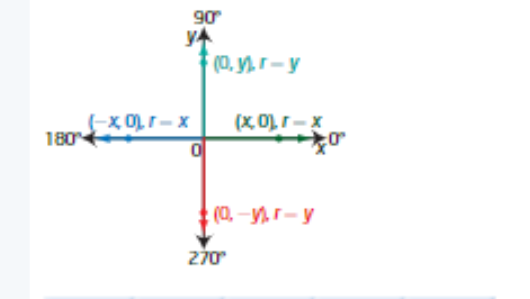
For cos:cos0°=1,cos180°=−1,cos360°=1
For tan:tan0°=0:tan180°=0:tan360°=0
Pre Calculus 11 Exercise 2.2 Step-By-Step Trigonometry Solutions Page 94 Problem 11 Answer
Given,sin θ=−1/√2,0°<θ<360°
To find the value of θ which satisfies the equation.
We know that the value of sin is negative in 3rd and 4th quadrant.
Also,sin45°=1/√2
So, sin(180+45)°=−1/√2=sin225° and sin(360−45)°=−1/√2=sin315°
Therefore,θ=225°,315° considering 0°<θ<360°
Therefore the value of θ is 225°,315°.
Mcgraw Hill Precalculus Textbook Answers
Pre Calculus 11 Exercise 2.2 Step-By-Step Trigonometry Solutions Page 96 Problem 12 Answer
We need to sketch the angle in standard position so that the terminal arm passes through the point (2,6).
The point (2,6) lies in first quadrant so that the terminal arm is in first quadrant.
Plot the point A(2,6) on the graph.
Draw the line joining the point A(2,6) to the origin O. This is the terminal arm.
The line from origin to the positive x-axis the initial arm.
The sketch of the angle in standard position is:
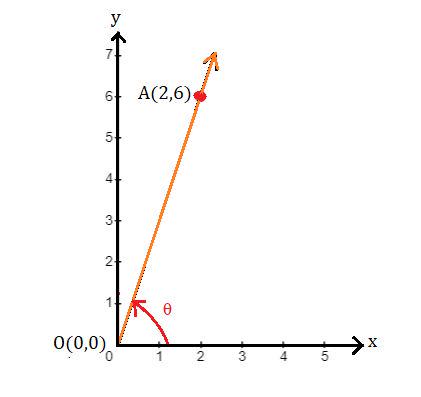
The sketch of angle in standard position so that the terminal arm passes through the point (2,6) is –
Pre Calculus 11 Exercise 2.2 Step-By-Step Trigonometry Solutions Page 96 Problem 13 Answer
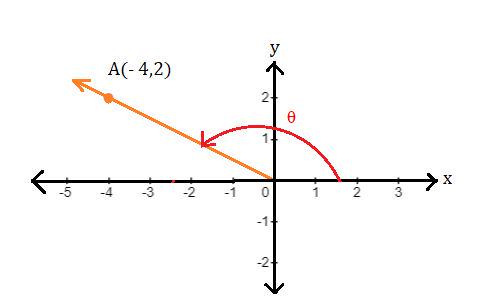
We need to sketch the angle in standard position so that the terminal arm passes through the point (−4,2).
The point (−4,2) lies in second quadrant, so that the terminal arm will be in second quadrant.
Plot the point A(−4,2) on the graph.
Mcgraw Hill Precalculus Textbook Answers
Join point (−4,2) with the origin, so that the line obtained will be the terminal arm.
The line from origin to the positive x-axis is the initial arm.
The sketch of angle in standard position is:
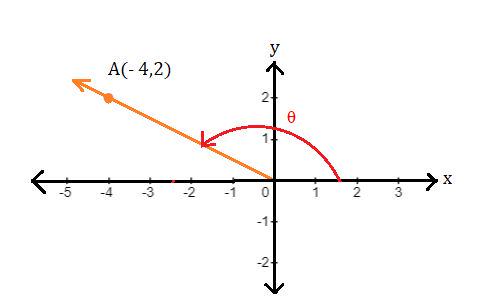
The sketch of angle in standard position so that the terminal arm passes through the point (−4,2) is:
Pre Calculus 11 Exercise 2.2 Step-By-Step Trigonometry Solutions Page 96 Problem 14 Answer
We need to sketch the angle in standard position so that the terminal arm passes through the point (−5,−2).
The point (−5,−2) lies in third quadrant, so that the terminal arm will be in third quadrant.
Plot the point A(−5,−2) on the graph.
Join the point(−5,−2) with the origin, so that the line obtained will be the terminal arm.
The line from origin to the positive x-axis is the initial arm.
Mcgraw-Hill Textbook Answers
The sketch of angle in standard position is:
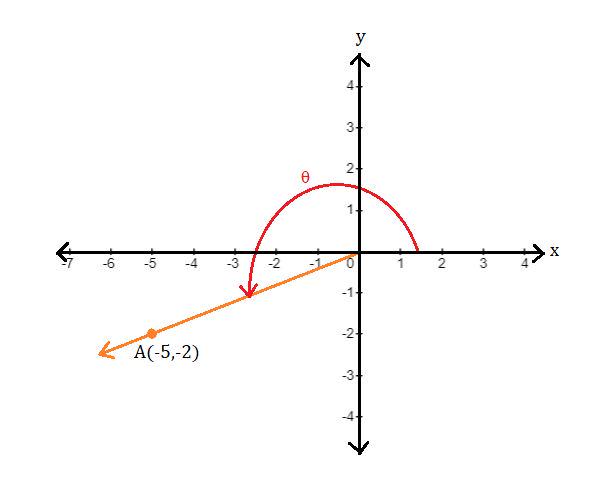
The sketch of angle in standard position so that the terminal arm passes through (−5,−2) is:
Solutions For Pre Calculus 11 Chapter 2 Exercise 2.2 Trigonometry Page 96 Problem 15 Answer
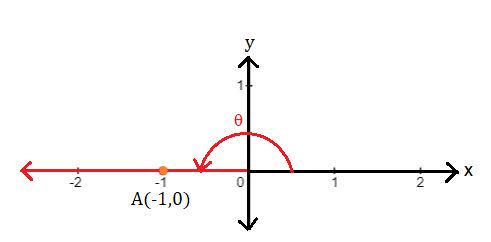
We need to sketch the angle in standard position so that the terminal arm passes through the point (−1,0).
The point (−1,0) lies on negative x-axis, so that the terminal arm will be on negative x-axis.
Plot the point A(−1,0) on the graph, so that we get the terminal line through A(−1,0).
The line from origin to the positive x-axis is the initial arm.
Mcgraw-Hill Textbook Answers
The sketch of angle in standard position is:
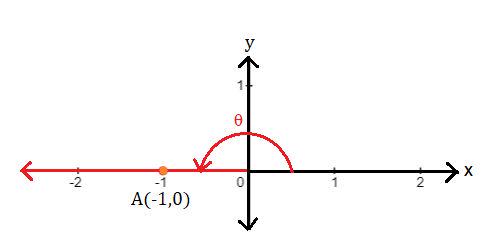
The sketch of angle in standard position so that the terminal arm passes through the point (−1,0) is:
Solutions For Pre Calculus 11 Chapter 2 Exercise 2.2 Trigonometry Page 96 Problem 16 Answer
Given figure is as follows –
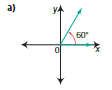
We have to find out the sine, cosine, and tangent of the given angles.
Given angle is as follows –
Θ=60°,cos(60°)=1/2, =0.5,sin(60°)=√3/2, =0.866,
tan(60°)=√3, =1.73210,
Mcgraw-Hill Textbook Answers
So, the exact values of the sine, cosine, and tangent ratios are 0.866,0.5, and, 1.73210.
Solutions For Pre Calculus 11 Chapter 2 Exercise 2.2 Trigonometry Page 96 Problem 17 Answer
Given figure is as follows –
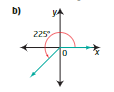
We have to find out the sine, cosine, and tangent of the given angles.
Given angle is as follows –
θ=225°,cos(225°)=cos(180°+45°), =−cos(45°), =−1/√2, =−0.707,
sin(225°)=sin(180°+45°), =−sin(45°), =−1/√2, =−0.707,
tan(225°)=tan(180°+45°), =tan(45°), =1.
So, the exact values of the sine, cosine, and the tangent of the given angle is −0.707,−0.707, and, 1 respectively.
Page 96 Problem 18 Answer
Given figure is as follows –
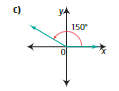
We have to find out the sine, cosine, and tangent of the given angles.
Given angle is as follows –
Θ=150°,cos(150°)=cos(180°−30°), =−cos(30°), =−√3/2, =−0.866,
sin(150°)=sin(180°−30°), =sin(30°), =1/2, =0.5,
tan(150°)=tan(180∘−30°), =−tan(30°), =−1/√3, =−0.577.
So, the sine, cosine, and, the tangent of the given angle is 0.5,−0.866, and, −0.577.
Pre Calculus 11 McGraw Hill Chapter 2.2 Solved Examples Page 96 Problem 19 Answer
Given figure is as follows –
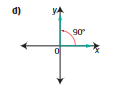
We have to find out the sine, cosine, and tangent of the given angles.
Given angle is as follows –
θ=90°,
cos(90°)=0,
sin(90°)=1,
tan(90°)=∞.
So, the sine, cosine, and the tangent of the given angle is 1,0, and, ∞.
Precalculus Glencoe Answers
Pre Calculus 11 McGraw Hill Chapter 2.2 Solved Examples Page 96 Problem 20 Answer
Given figure is as follows –
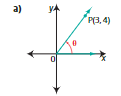
We have to find out the sine, cosine, and tangent of the given angles.
Given angle is as follows –
sinθ=Perpendicular/ Hypotenuse,
sinθ =4/√32+42,
sinθ =4/5,
sinθ =0.8,
cosθ=Base/Hypotenuse,
cosθ =3/√32+42,
cosθ =3/5,
cosθ =0.6.
tanθ=Perpendicular/Base,
tanθ =3/4,
tanθ=0.75.
So, the sine, cosine, and, the tangent of the given angle is 0.8,0.6, and, 0.75.
Pre Calculus 11 McGraw Hill Chapter 2.2 Solved Examples Page 96 Problem 21 Answer
It is given that
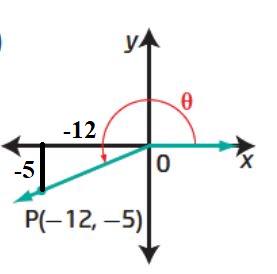
Then we need to find exact trigonometric ratios sin θ,cos θ&tanθ for each.
Sketch the reference triangle by drawing a line perpendicular to the x-axis through the point (-12, -5).
The point P(-12, -5) is in quadrant III, so the terminal arm is in quadrant III.
Precalculus Glencoe Answers
Use the Pythagorean Theorem to determine the distance,r, from P(-12, -5) to the origin, (0, 0).
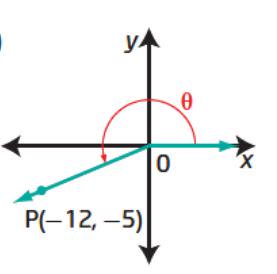
Pythagorean Theorem
r=√x2+y2
r=√(−12)2+(−5)2
r=√144+25
r=√169
r=13
The trigonometric ratios for θ can be written as follows:
Sin θ=opposite/hypotenuse
Sin θ =−5/13
Cos θ=adjacent/hypotenuse
Cos θ =−12/13
Cos θ =−12/13
tanθ=opposite/adjacent
tanθ =−5/−12
tanθ =5/12
The answer is sin θ=−5/13 cos θ=−12/13 tanθ=5/12
Precalculus Glencoe Answers
Understanding Chapter 2 Exercise 2.2 Trigonometry In Pre Calculus Page 96 Problem 22 Answer
It is given that
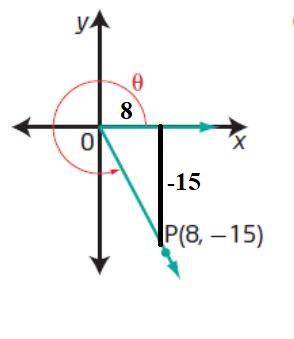
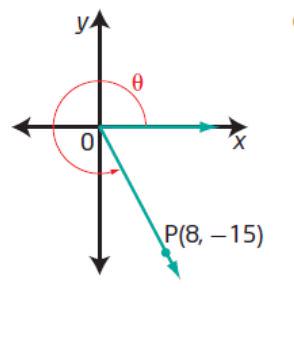
Then we need to find exact trigonometric ratios sin θ,cos θ&tan θ for each.
Sketch the reference triangle by drawing a line perpendicular to the x-axis through the point (8, -15).
The point P(8, -15) is in quadrant IV, so the terminal arm is in quadrant IV.
Use the Pythagorean Theorem to determine the distance,r, from P(-12, -5) to the origin, (0, 0).
Pythagorean theorem
r=√x2+y2
r=√(8)2+(−15)2
r=√64+225
r=√289
r=17
The trigonometric ratios for θ can be written as follows:
Sin θ=opposite/hypotenuse
Sin θ =−15/17
Sin θ =−15/17
Cos θ=adjacent/hypotenuse
Cos θ =8/17
tanθ=opposite/adjacent
tanθ =−15/8
tanθ =−15/8
The answer is sin θ=−15/17
Precalculus Glencoe Answers
Cos θ=8/17
tanθ=−15/8
Understanding Chapter 2 Exercise 2.2 Trigonometry In Pre Calculus Page 96 Problem 23 Answer
It is given that
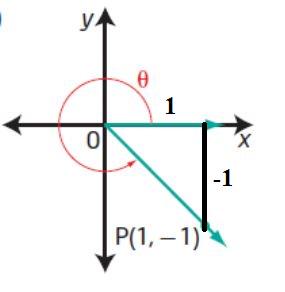
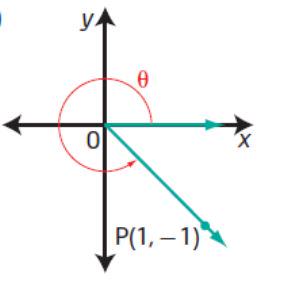
Then we need to find exact trigonometric ratios sin θ,cos θ & tan θ for each.
Sketch the reference triangle by drawing a line perpendicular to the x-axis through the point (1, -1).
The point P(1, -1) is in quadrant IV, so the terminal arm is in quadrant IV.
Use the Pythagorean Theorem to determine the distance,r, from P(1, -1) to the origin, (0, 0).
Pythagorean theorem
r=√x2+y2
r=√(1)2+(−1)2
r=√1+1
r=√2
The trigonometric ratios for θ can be written as follows:
Sin θ=opposite/hypotenuse
Sin θ =−1/√2
Sin θ =−1/√2
Cos θ=adjacent/hypotenuse
Cos θ=1/√2
tanθ=opposite/adjacent
Precalculus Glencoe Answers
tanθ =−1/1
tanθ =−1
The answer is
Sin θ=−1/√2
Cos θ=1/√2
tanθ=−1
Understanding Chapter 2 Exercise 2.2 Trigonometry In Pre Calculus Page 96 Problem 24 Answer
It is given that cos θ<0 and sin θ>0.
Then we need to find the quadrant in which the terminal arm of angle θ lie.
We know that
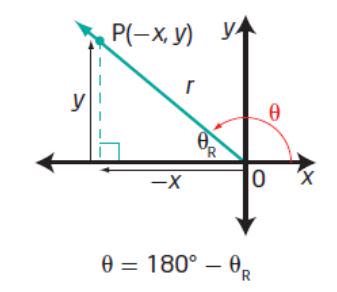
Sin θ=opposite/hypotenuse=y/r>0
Cos θ=adjacent/hypotenuse=−x/r=−x/r<0
Hence terminal arm will lie in second (II) quadrant.
The terminal arm will lie in the second (II) quadrant.
Understanding Chapter 2 Exercise 2.2 Trigonometry In Pre Calculus Page 96 Problem 25 Answer
It is given that cos θ>0 and tan θ>0.
Then we need to find the quadrant in which the terminal arm of angle θ lie.
We know that
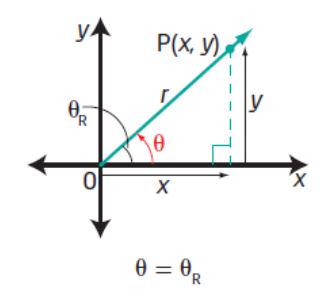
Cos θ=adjacent/hypotenuse=x/r=x/r>0
tanθ=opposite/adjacent=y/x>0
Hence terminal arm will lie in first (I) quadrant.
The terminal arm will lie in the first (I) quadrant.
Understanding Chapter 2 Exercise 2.2 Trigonometry In Pre Calculus Page 96 Problem 26 Answer
Given: sin θ<0 and cos θ<0
To specify that For each description, in which quadrant does the terminal arm of angle θ lie
We have sin θ<0 and cos θ<0
So the sine ratio and the cosine ratio are both negative in quadrant III.
Hence, the terminal arm of angle θ lie in quadrant III
Page 96 Problem 27 Answer
Given: tan θ<0 and cosθ>0
To specify that For each description, in which quadrant does the terminal arm of angle θ lie.
We have tan θ<0 and cos θ>0
So the tangent ratio is negative and the cosine ratio is positive in quadrant IV.
Hence, the terminal arm of angle θ lie in quadrant IV