
Power Series And Power Series Solutions Of Ordinary Differential Equations Exercise 2
1. Find the radius of convergence of the following series 1) \(\Sigma \frac{(n+1) x^n}{n(n+2)}\) 2) \(\Sigma \frac{2^n x^n}{n !}\) 3) \(\Sigma \frac{n^n x^n}{n !}\)
Solution:
1) Let the given series be \(\sum_{n=1}^{\infty} a_n x^n \text {. Then } a_n=\frac{n+1}{n(n+2)} \text { and } a_{n+1}=\frac{n+2}{(n+1)(n+3)}\)
∴ Radius of convergence
⇒ \(=\underset{n \rightarrow \infty}{{Lt}}\left|\frac{a_n}{a_{n+1}}\right|=\underset{n \rightarrow \infty}{{Lt}}\left|\frac{(n+1)^2(n+3)}{n(n+2)^2}\right|={Lt}_{n \rightarrow \infty}\left|\frac{(1+1 / n)^2(1+3 / n)}{(1+2 / n)^2}\right|=1 .\)
2) Let the given series be \(\sum_{n=1}^{\infty} a_n x^n \text {. Then } a_n=\frac{2^n}{n!} \text { and } a_{n+1}=\frac{2^{n+1}}{(n+1)!}\)
∴ Radius of convergence \(={ }_n L t>0\left|\frac{a_n}{a_{n+1}}\right|=L t_{n \rightarrow \infty}\left|\frac{2^n}{n!} \times \frac{(n+1)!}{2^{n+1}}\right|=\underset{n \rightarrow \infty}{L t}\left|\frac{n+1}{2}\right|=\infty .\)
3) Let The given Series Be \(\sum_{n=1}^{\infty} a_n x^n \text {. Then } a_n=\frac{n^n}{n!} \text { and } a_{n+1}=\frac{(n+1)^{n+1}}{(n+1)!}\)
∴ Radius of convergence \(=\underset{n \rightarrow \infty}{{Lt}}\left|\frac{a_n}{a_{n+1}}\right|=\underset{n \rightarrow \infty}{{Lt}}\left|\frac{n^n}{n!} \times \frac{(n+1)!}{(n+1)^{n+1}}\right|=\underset{n t \infty}{L t}\left|\frac{1}{(1+1 / n)^n}\right|=\frac{1}{e}\)
Ordinary Differential Equations Solved With Power Series Examples
2. Find the radius of convergence of the following series :
⇒1) \(\frac{x}{2}+\frac{1 \cdot 3}{2 \cdot 5} x^2+\frac{1 \cdot 3 \cdot 5}{2 \cdot 5 \cdot 8} x^3+\ldots\) 2) \(1+\frac{a \cdot b}{1 \cdot c}+\frac{a(a+1) b(b+1)}{1 \cdot 2 \cdot c(c+1)}+\ldots\)
Solution:
1) let the given series be donated by \(\sum^{\infty} a_n x^n\)
Then, here \(a_n=\frac{1 \cdot 3 \cdot 5 \ldots(2 n-1)}{2 \cdot 5 \cdot 8 \ldots(3 n-1)} \text { and } a_{n+1}=\frac{1 \cdot 3 \cdot 5 \ldots(2 n-1)(2 n+1)}{2 \cdot 5 \cdot 8 \ldots(3 n-1)(3 n+2)}\)
∴ Radius of convergence =\(\underset{n \rightarrow \infty}{{Lt}}\left|\frac{a_n}{a_{n+1}}\right|=L t\left|\frac{3 n+2}{2 n+1}\right|=L t\left|\frac{3+2 / n}{2+1 / n}\right|=\frac{3}{2} .\)
2) Omitting The First term, let the given series be donated by \(\).
Then, we have \(a_n=\frac{a(a+1) \ldots(a+n-1) b(b+1) \ldots(b+n-1)}{1 \cdot 2 \ldots n c(c+1) \ldots(c+n-1)}\)
and \(a_{n+1} \frac{a(a+1) \ldots(a+n-1)(a+n) b(b+1) \ldots(b+n-1)(b+n)}{1 \cdot 2 \ldots n(n+1) c(c+1) \ldots(c+n-1)(c+n)}\)
Radius of convergence
⇒ \(=\underset{n \rightarrow \infty}{L t}\left|\frac{a_n}{a_{n+1}}\right|=L t\left|\frac{(n+1)(c+n)}{(a+n)(b+n)}\right| \underset{n \rightarrow \infty}{=L t}\left|\frac{(1+1 / n)(1+c / n)}{(1+a / n)(1+b / n)}\right|=1\)
3. Find the radius of convergence and the exact interval of convergence of each of the following power series.
1) \(\Sigma \frac{3^n x^n}{n !}\)
2) \(\Sigma \frac{x^n}{n^3}\)
3) \(\Sigma \frac{x^n}{n^n}\)
Solution:
1) Let the given series be \(\sum a_n x^n\). Then we have \(a_n=\frac{3^n}{n!} \text { and } a_{n+1}=\frac{3^{n+1}}{(n+1)}\)
Radius of convergence.r \(=\underset{n \rightarrow \infty}{e{Lt}} \cdot\left|\frac{a_n}{a_{n+1}}\right|=L t t_{n \rightarrow \infty} \frac{3^n}{n!} \times \frac{(n+1)!}{3^{n+1}}=\underset{n \rightarrow \infty}{{Lt}} \frac{n+1}{3}=\infty .\)
The exact interval of convergence is [-1,1]
3) Let the given series of \(\Sigma a_n x^n \text { or } \Sigma u_n\)
If r=radius of convergences then \(\frac{1}{r}=L_{n \rightarrow \infty}\left(u_n\right)^{1 / n}=\underset{n \rightarrow \infty}{{Lt}} \frac{x}{n}=0 .\)
4. Find the radius of convergence and the exact interval of convergence of each of the following power series
1) \(\Sigma \frac{n x^n}{(n+1)^2}\)
2) \(\Sigma \frac{(n+1)}{(n+2)(n+3)} x^n\)
Solution:
1) let the given series be \(\Sigma a_n x^n \text { or } \Sigma u_n\)
Then \(a_n=\frac{n}{(n+1)^2} \text { and } a_{n+1}=\frac{n+1}{(n+2)^2}\)
∴ Radius of convergence, \(r=L t{ }_{n \rightarrow \infty}\left|\frac{a_n}{a_{n+1}}\right|=\underset{n \rightarrow \infty}{L t}\left|\frac{n(n+2)^2}{(n+1)^3}\right|=1\)
∴ Given Series Converges if \(|x|<1\) and diverges if \(|x|>1\).
If x=1 then \(u_n=\frac{n}{(n+1)^2}=\frac{1}{n(1+1 / n)^2} .\)
Let \(v_n=\frac{1}{n}\). Then \(\underset{n \rightarrow \infty}{{Lt}} \frac{u_n}{v_n}=\underset{n \rightarrow \infty}{{Lt}} \frac{1}{(1+1 / n)^2}=1 \neq 0 .\)
Now \(\Sigma v_n=\Sigma \frac{1}{n}\) is divergent. So by comparison test \(\Sigma u_n\) diverges for x=1.
If x = -1 then \(\Sigma u_n\) is an alternating series for which \(u_{n+1}<u_n\) for each natural number n and \(\underset{n \rightarrow \infty}{{Lt}} u_n=\underset{n \rightarrow \infty}{{Lt}} \frac{1}{n}=0\)
By Leibnitz’s test \(\Sigma u_n\) converges for x=-1
∴ The exact interval of convergence is [-1,1).
2. Let The given series be \(\Sigma a_n x^n \text { or } \Sigma u_n\)
Then, we have \(a_n=\frac{(n+1)}{(n+2)(n+3)} \text { and } a_{n+1}=\frac{(n+2)}{(n+3)(n+4)}\)
∴ r= radius of convergence \(=\underset{n \rightarrow \infty}{{Lt}}\left|\frac{a_n}{a_{n+1}}\right|=\underset{n \rightarrow \infty}{{Lt}} \frac{(n+1)(n+4)}{(n+2)^2}=1\)
Hence, the given series converges for \(|x|<1\) and diverges for \(|x|>1\)
we now investigate the nature of the given power series when \(|x|=1 \text {, i.e.., } x= \pm 1\)
For \(x=1, u_n=\frac{(n+1)}{(n+2)(n+3)}=\frac{1}{n} \times \frac{(1+1 / n)}{(1+2 / n)(1+3 / n)} \rightarrow \text { (1) }\)
Let Σvn be such that \(v_n=\frac{1}{n}\). Then \(\underset{n \rightarrow \infty}{{Lt}} \frac{u_n}{v_n}=1 \text {, }\), Which is finite and non zero.
Again, \(\Sigma v_n=\Sigma \frac{1}{n}\) is a divergent series. So by comparison test \(\Sigma u_n\) diverges for x=1.
Next, for x=-1, the given series in an alternating series for which \(u_{n+1}<u_n\) for each number n and \(\underset{2 \rightarrow \infty}{{Lt}} u=0 \text {, }\). hence, by Lebnitz’s test, the given series converges for x=-1. thus, the exact interval of convergence is [-1,1).
Power Series Method For Solving Ordinary Differential Equations
5. Find the radius of convergence and the exact interval of convergence of each of the following power series.
1) \(\Sigma \frac{(2 n) ! x^{2 n}}{(n !)^2}\)
2) \(\Sigma \frac{(n !)^2 x^{2 n}}{(2 n) !}\)
Solution:
Let \(u_n=\frac{(2 n)!x^{2 n}}{(n!)^2} \text {. Then } u_{n+1}=\frac{(2 n+2)!x^{2 n+2}}{[(n+1)!]^2}\)
⇒ \(L t_{n \rightarrow \infty}\left|\frac{u_{n+1}}{u_n}\right|=\underset{n \rightarrow \infty}{L t}\left|\frac{(2 n+2)!x^{2 n+2}}{[(n+1)!]^2} \times \frac{(n!)^2}{(2 n)!x^{2 n}}\right|=L t\left|\frac{(2 n+2)(2 n+1) x^2}{(n+1)^2}\right|\)
⇒ \(=\underset{n \rightarrow \infty}{L t}\left|\frac{(2+2 / n)(2+1 / n)}{(1+1 / n)^2} x^2\right|=4|x|^2 .\)
By S’ Alembert’s ration test \(\Sigma u_n\) Converges absolutely if \(4|x|^2<1 \text {. ie., }|x|<1 / 2\) Radius Of convergence. r=1/4.
2. Let \(u_n=\frac{(n!)^2 x^{2 n}}{(2 n)!} \text {. Then } u_{n+1}=\frac{[(n+1)!]^2 x^{2 n+2}}{(2 n+2)!}\)
⇒ \({Lt}_{n \rightarrow \infty}\left|\frac{u_{n+1}}{u_n}\right|={Lt}_{n \rightarrow \infty}\left|\frac{[(n+1)!]^2 x^{2 n+2}}{(2 n+2)!} \times \frac{(2 n)!}{(n!)^2 x^{2 n}}\right|=L t \frac{(n+1)^2 x^2}{(2 n+2)(2 n+1)}=\frac{x^2}{4}\)
∴ The radius of convergence, r=4. the interval of convergence is (-4,4).
6. Find the radius of convergence and the exact interval of convergence of each of the following power series.
1) \(\Sigma \frac{(-1)^n x^{2 n}}{(n !)^2 2^{2 n}}\)
2) \(\Sigma(-1)^n \frac{x^{2 n+1}}{(2 n+1) !}\)
3) \(\sum(-1)^n \frac{x^{2 n+1}}{(2 n+1)}\)
Solution:
Let \(u_n=\frac{(-1)^n x^{2 n}}{(n!)^2 2^{2 n}} \text {. Then } u_{n+1}=\frac{(-1)^{n+1} x^{2 n+2}}{[(n+1)!]^2 2^{2 n+2}}\).
⇒\(\mathrm{Lt}_{n \rightarrow \infty}\left|\frac{u_{n+1}}{u_n}\right|=\mathrm{Lt}_{n \rightarrow \infty}\left|\frac{x^{2 n+2}}{[(n+1)!]^2 2^{2 n+2}} \times \frac{(n!)^2 2^{2 n}}{x^{2 n}}\right|=\mathrm{Lt}_{n \rightarrow \infty} \frac{x^2}{\left(\sqrt{n+1)^2 2^2}\right.}=0\).
∴ Radius f convergence. r=∞.
2. Let \(u_n=\frac{(-1)^n x^{2 n+1}}{(2 n+1)!} \text {. Then } u_{n+1}=\frac{(-1)^{n+1} x^{2 n+3}}{(2 n+3)!}\)
∴ The radius of convergence r= ∞.
3. Let \(u_n=(-1)^n \frac{x^{2 n+1}}{2 n+1} \text {. Then } u_{n+1}=\frac{(-1)^{n+1} x^{2 n+3}}{2 n+3}\)
⇒ \(\underset{n \rightarrow \infty}{{Lt}}\left|\frac{u_{n+1}}{u_n}\right|=\underset{n \rightarrow \infty}{L t}\left|\frac{x^{2 n+3}}{2 n+3} \times \frac{2 n+1}{x^{2 n+1}}\right|=x^2\) ∴Radius of convergence. r=1.
∴ By ratio test Σun convergence if \(x^2<1\) and divergence if x2>1.
If x=\(\pm 1\) then un is an alternating series with \(u_{n+1}<u_n \text { and } L t u_{n \rightarrow \infty}=0 \text {. }\).
∴ By Leibnitz’s test [atex]\Sigma u_n[/latex] is converges for \(x= \pm 1\).
∴ The interval of convergence is [-1.1].
7. Find the radius of convergence and the exact interval of convergence of each power series.
1) \(\frac{(x-1)^n}{2^n}\)
2) \(\Sigma \frac{n !(x+2)^n}{n^n}\)
Solution:
1) Let the given series be \(\Sigma a_n\left(x-x_0\right)^n\). Then we have \(a_n=\frac{1}{2^n}, x_0=1\).
The radius of convergence, \(r=\underset{n \rightarrow \infty}{L t}\left|\frac{a_n}{a_{n+1}}\right|\)\(=\underset{n \rightarrow \infty}{L t}\left|\frac{2^{n+1}}{2^n}\right|=2\).
Interval of convergence =(1-2,1+2)=(-1,3).
2) Let the given series be \(\sum a_n\left(x-x_0\right)^n\).
Then we have \(a_n=\frac{n !}{n^n}, x_0=-2\), and \(a_{n+1}=\frac{(n+1) !}{(n+1)^{n+1}}\).
Radius of Convergence = \(r=\underset{n \rightarrow \infty}{L t}\left|\frac{a_n}{a_{n+1}}\right|\)\(=\underset{n \rightarrow \infty}{L t}\left|\frac{n !}{n^n} \times \frac{(n+1)^{n+1}}{(n+1) !}\right|\)\(=\underset{n \rightarrow \infty}{L t}\left|(1+1 / n)^n\right|=e\)
Interval of convergence =(-2-e,-2+e).
8. Find the radius of convergence and the exact interval of convergence of each of the following power series.
1) \(\Sigma\left\{\frac{(-1)^{n+1}}{n}(x-1)^n\right\}\)
2) \(\Sigma \frac{(-1)^n(x-1)^n}{2^n(3 n-1)}\)
Solution:
1. Let the given series be denoted by \(\Sigma a_n\left(x-x_0\right)^n\)
Then, we have \(a_n=\frac{(-1)^{n+1}}{n} \text { and } a_{n+1}=\frac{(-1)^{n+2}}{n+1}\)
∴ r = \(\underset{n \rightarrow \infty}{{Lt}}\left|\frac{a_n}{a_{n+1}}\right|=\underset{n \rightarrow \infty}{{Lt}}\left|-\frac{n+1}{n}\right|=1\)
Since the given power series is about the point x = x0 = 1, then interval of convergence is \(x_0-r<x<x_0+r \text {, i.e., }-1+1<x<1+1 \text {, i.e., } 0<x<2\)
For x = 2, the given series reduces to the alternating series
\(\Sigma \frac{(-1)^{n-1}}{n}\left(=\Sigma(-1)^{n-1} u_n \text {, say }\right)\) for which \(u_{n+1}<u_n\) for each natural number n and \(\underset{n \rightarrow \infty}{{Lt}} u_n=\underset{n \rightarrow \infty}{L t} \frac{1}{n}=0\)
Hence by Leibnitz’s test, the given series is convergent when x = 2.
Next, for x = 0, clearly, the given series divergences.
Hence, the exact interval of convergence is (0,2).
2. Let the given series be \(\Sigma a_n\left(x-x_0\right)^n\). Then we have \(a_n=\frac{(-1)^n}{2^n(3 n-1)}, x_0=1\)
Radius of convergence, r = \(\underset{n \rightarrow \infty}{L t}\left|\frac{a_n}{a_{n+1}}\right|=\underset{n \rightarrow \infty}{L t}\left|\frac{2^{n+1}(3 n+2)}{2^n(3 n-1)}\right|=2\)
Interval of convergence = (1-2, 1+2) = (-1,3).
Solved Problems On ODEs Using Power Series Expansion
9. Define the ordinary point and singular point of a differential equation.
Solution:
Ordinary point and singular point of a differential equation
A point \(x=x_0\) is said to be an ordinary point of the equation \(y^{\prime \prime}+P(x) y^{\prime}+Q(x) y=0 \rightarrow\)(1) if both the functions P(x) and Q(x) are analytic at \(x=x_0\). If the point \(x=x_0\) is not an ordinary point of the differential equation (1), then it is called a singular point of the differential equation (1).
10. Define a regular singular point and an irregular singular point.
Solution:
A regular singular point and an irregular singular point
A singular point \(\) of the differential equation \(y^{\prime \prime}+P(x) y^{\prime}+Q(x) y=0 \rightarrow\)(1) is said to be a regular singular point of the differential equation (1) if both \(\left(x-x_0\right) P(x) \text { and }\left(x-x_0\right)^2 Q(x)\) are analytic at \(x=x_0\). A singular point, which is not regular is called an irregular singular point.
11. Show that x=0 is an ordinary point of \(y^{\prime \prime}-x y^{\prime}+2 y=0\).
Solution:
Given equation is \(y^{\prime \prime}-x y^{\prime}+2 y=0 \rightarrow\) (1)
Comparing (1) with the standard equation \(y^{\prime \prime}+P(x) y^{\prime}+Q(x) y=0\), we have P(x)=-x, Q(x)=2.
Both P(x), and Q(x) are analytic at x=0. So x=0 is an ordinary point of (1).
12. Show that x=0 is an ordinary point \(\left(x^2+1\right) y^{\prime \prime}+x y^{\prime}-x y=0\).
Solution:
Given equation is \(\left(x^2+1\right) y^{\prime \prime}+x y^{\prime}-x y=0 \Rightarrow y^{\prime \prime}+\frac{x}{x^2+1} y^{\prime}-\frac{x}{x^2+1} y=0 \rightarrow\) (1)
Comparing (1) with standard equation \(y^{\prime \prime}+P(x) y^{\prime}+Q(x) y=0\), we have \(P(x)=\frac{x}{x^2+1}, Q(x)=\frac{-x}{x^2+1}\).
Now P(x), Q(x) are analytic at x=0. So x=0 is an ordinary point.
13. Show that x=0 is a regular singular point of \(x^2 y^{\prime \prime}+x y^{\prime}+\left(x^2-1 / 4\right) y=0\).
Solution:
Given equation is \(x^2 y^{\prime \prime}+x y^{\prime}+\left(x^2-\frac{1}{4}\right) y=0 \Rightarrow y^{\prime \prime}+\frac{1}{x} y^{\prime}+\frac{4 x^2-1}{x^2} y=0 \rightarrow \text { (1) }\)
Comparing (1) with the standard equation \(\), we have
⇒ \(y^{\prime \prime}+P(x) y^{\prime}+Q(x) y=0\)
⇒ \(P(x)=\frac{1}{x}, Q(x)=\frac{4 x^2-1}{x^2}\)
Since both P(x), Q(x) are undefined at x = 0, so both P(x), Q(x) are not analytic at x = 0
Thus x = 0 is not an ordinary point and so x = 0 is a singular point.
Now (x-0)P(x) = 1, (x-0)2 Q(x) = 4x2-1
⇒ (x-0)P(x), (x-0)2 Q(x) and analytic at x = 0
Thus x = 0 is a regular singular point.
Step-By-Step Guide To Solving ODEs With Power Series
14. Show that x=0 is a regular singular point of \(2 x^2 y^{\prime \prime}+x y^{\prime}-(x+1) y=0\).
Solution:
Given equation is \(2 x^2 y^{\prime \prime}+x y^{\prime}-(x+1) y=0 \Rightarrow y^{\prime \prime}+\frac{1}{2 x} y^{\prime}-\frac{x+1}{2 x^2} y=0 \rightarrow(1)\)
Comparing (1) with the standard equation \(y^{\prime \prime}+P(x) y^{\prime}+Q(x) y=0\), we have
⇒ \(P(x)=\frac{1}{2 x}, Q(x)=-\frac{x+1}{2 x^2}\)
Now both P(x), Q(x) are undefined at x = 0 and so P(x), Q(x) are not analytic at x = 0
Thus x = 0 is not an ordinary point and so x = 0 is a singular point
Now \((x-0) P(x)=\frac{1}{2},(x-0)^2 Q(x)=-\frac{x+1}{2}\) are analytic at x = 0 and hence x = 0 is a regular singular point.
15. Determine the nature of the point x=0 for the equations
1) \(x y^{\prime \prime}+y \sin x=0\)
2) \(x^3 y^{\prime \prime}+y \sin x=0\)
Solution:
1. Given equation is \(x y^{\prime \prime}+y \sin x=0 \Rightarrow y^{\prime \prime}+\frac{\sin x}{x} y=0 \rightarrow \text { (1) }\)
Comparing (1) with standard equation \(y^{\prime \prime}+P(x) y^{\prime}+Q(x) y=0\), we have
⇒ \(P(x)=0, Q(x)=\frac{\sin x}{x}\)
Now Q(x) is undefined at x = 0 and hence Q(x) is not analytic at x = 0
Thus x = 0 is not an ordinary point and so x= 0 is a singular point
Now (x-0) P(x) = 0, (x-0)2 Q(x) = x sin x are analytic at x = 0, and hence x = 0 is a regular singular point.
2. Given equation is \(x^3 y^{\prime \prime}+y \sin x=0 \Rightarrow y^{\prime \prime}+\frac{\sin x}{x^3} y=0 \rightarrow \text { (1) }\)
Comparing (1) with the standard equation \(y^{\prime \prime}+P(x) y^{\prime}+Q(x) y=0\), we have
⇒ \(P(x)=0, Q(x)=\frac{\sin x}{x^3}\)
Now Q(x) is undefined at x = 0 and so Q(x) is not analytic at x = 0
Thus x = 0 is not an ordinary point and so x = 0 is a singular point
Now \((x-0) P(x)=0,(x-0)^2 Q(x)=\frac{\sin x}{x}\)
(x-0)2 Q(x) is undefined at x = 0 and so (x – 0)2 Q(x) is not analytic at x = 0
Thus x = 0 is an irregular singular point
16. Determine whether x=0 is an ordinary point or regular singular point of the differential equation \(2 x^2 \frac{d^2 y}{d x^2}+7 x(x+1) \frac{d y}{d x}-3 y=0\).
Solution:
Given equation is \(2 x^2 \frac{d^2 y}{d x^2}+7 x(x+1) \frac{d y}{d x}-3 y=0\)
⇒ \(\frac{d^2 y}{d x^2}+\frac{7(x+1)}{2 x} \frac{d y}{d x}-\frac{3}{2 x^2} y=0 \rightarrow \text { (1) }\)
Comparing (1) with the standard equation \(y^{\prime \prime}+P(x) y^{\prime}+Q(x) y=0\), we have
⇒ \(P(x)=\frac{7(x+1)}{2 x} \text { and } Q(x)=-\frac{3}{2 x^2} \rightarrow \text { (2) }\)
Since both P(x) and Q(x) are undefined at x = 0, so both P(x) and Q(x) are not analytic at x = 0
Thus x = 0 is not an ordinary point and so x = 0 is a singular pint.
Also, \((x-0) P(x)=\frac{7(x+1)}{2} \text { and }(x-0)^2 Q(x)=-\frac{3}{2}\)
(x-0) P(x) and (x-0)2 Q (x) are analytic at x = 0
Therefore x = 0 is a regular singular point.
Applications Of Power Series In Solving Ordinary Differential Equations
17. Show that x=0 is an ordinary point of \(\left(x^2-1\right) y^{\prime \prime}+x y^{\prime}-y=0\), but x=1 is a regular singular point.
Solution:
Given equation is \(\left(x^2-1\right) y^{\prime \prime}+x y^{\prime}-y=0\)
⇒ \(\frac{d^2 y}{d x^2}+\frac{x}{(x-1)(x+1)} \frac{d y}{d x}-\frac{1}{(x-1)(x+1)} y=0 \rightarrow\)
Comparing (1) with the standard equation \(y^{\prime \prime}+P(x) y^{\prime}+Q(x) y=0\), we have
⇒ \(P(x)=\frac{x}{(x-1)(x+1)} \text { and } Q=-\frac{1}{(x-1)(x+1)}\)
Now both P(x) and Q(x) are undefined at x = 0, so x = 0 is an ordinary point of the given equation (1)\(\)
Since both P(x) and Q(x) are undefined at x = 1, so they are not analytic at x = 0
Thus x = 1 is not an ordinary point and so x = 1 is a singular point.
Also \((x-1) P(x)=\frac{x}{x+1} \text { and }(x-1)^2 Q(x)=-\frac{x-1}{x+1}\)
⇒ (x-1)P(x) and (x-1)2 Q(x) are analytic at x = 1
Therefore x = 1 is a regular singular point
18. Show that x=0 is an irregular singular point and x=-1 is a regular singular point of \(x^2(x+1)^2 y^{\prime \prime}+\left(x^2-1\right) y^{\prime}+2 y=0\).
Solution:
Dividing the given equation \(x^2(x+1)^2 y^{\prime \prime}+\left(x^2-1\right) y^{\prime}+2 y=0 \text { by } x^2(x+1)^2\), we get
⇒ \(\frac{d^2 y}{d x^2}+\frac{x-1}{x^2(x+1)} \frac{d y}{d x}+\frac{2}{x^2(x+1)^2} y=0 \rightarrow(1)\)
Comparing (1) with the standard equation \(y^{\prime \prime}+P(x) y^{\prime}+Q y=0\), we get
⇒ \(P(x)=\frac{x-1}{x^2(x+1)} \text { and } Q(x)=\frac{2}{x^2(x+1)^2}\)
Since both P(x) and Q(x) are undefined at x = 0 and x = -1, so they are not analytic at x = 0 and x = -1
Hence x = 0 and x = -1 are both singular points
Also \((x-0) P(x)=\frac{x-1}{x(x+1)} \text { and }(x-0)^2 Q(x)=\frac{2}{(x+1)^2}\)
Now P(x) is not analytic at x = 0 and so x= 0 is an irregular singular point.
Again, \((x+1) P(x)=\frac{x-1}{x^2} \text { and }(x+1)^2 Q(x)=\frac{2}{x^2}\)
(x+1) P(x) and (x+1)2 Q(x) are analytic at x = -1
Hence x = -1 is a regular singular point
19. Determine the singular points and their nature for the following differential equations 1) \(3 x y^{\prime \prime}+2 x(x-1) y^{\prime}+5 y=0\) 2) \(y^{\prime \prime}+(1-x) y^{\prime}+\left(1-x^2\right) y=0\).
Solution:
1. Given equation is
⇒ \(3 x y^{\prime \prime}+2 x(x-1) y^{\prime}+5 y=0 \Rightarrow y^{\prime \prime}+\frac{2}{3}(x-1) y^{\prime}+\frac{5}{3 x} y=0 \rightarrow(1)\)
Comparing (1) with the standard equation \(y^{\prime \prime}+P(x) y^{\prime}+Q(x) y=0\), we have
⇒ \(P(x)=\frac{2}{3}(x-1), Q(x)=\frac{5}{3 x}\)
Now Q(x) is undefined at x = 0 and hence Q(x) is not analytic at x = 0
Thus x = 0 is not an ordinary point and so x = 0 is singular point.
Now \((x-0) P(x)=\frac{2}{3} x(x-1),(x-0)^2 Q(x)=\frac{5 x}{3}\) are analytic at x = 0
Thus x = 0 is a regular singular point.
2. Given equation is \(y^{\prime \prime}+(1-x) y^{\prime}+\left(1-x^2\right) y=0 \rightarrow(1)\)
Comparing (1) with standard equation \(y^{\prime \prime}+P(x) y^{\prime}+Q(x) y=0\)
We have P(x) = 1-x, Q(x) = 1-x2
Now P(x), Q(x) are analytic at every point.
Thus every point is an ordinary point of (1)
∴ There is no singular point.
Exercises On Power Series Solutions Of ODEs With Answers
20. Discuss the singularities of the equation \(x^2 y^{\prime \prime}+x y^{\prime}+\left(x^2-n^2\right) y=0\) at x=0 and x=∞.
Solution:
Singularity at x = 0: Given equation is \(x^2 y^{\prime \prime}+x y^{\prime}+\left(x^2-n^2\right) y=0\)
⇒ \(y^{\prime \prime}+\left(\frac{1}{x}\right) y^{\prime}+\left(\frac{x^2-n^2}{x^2}\right) y=0 \rightarrow \text { (1) }\)
Comparing (1) with \(y^{\prime \prime}+P(x) y^{\prime}+Q(x) y=0\), we get \(P(x)=\frac{1}{x} \text { and } Q(x)=\frac{x^2-n^2}{x^2}\)
Now P(x) and Q(x) are undefined at x = 0 and so they are not analytic at x = 0. Hence x = 0 is a singular point. Hence (x-0) P(x) = 1 and (x-0)2 Q(x) = x2-n2
Now (x-0) P(x) and (x-0)2 Q(x) are analytic at x = 0
Therefore, x = 0 is a regular singular point.
Singularity at x = ∞ Put x = \(x=\frac{1}{t}\) then \(t=\frac{1}{x} \text { and } \frac{d t}{d x}=-\frac{1}{x^2} \rightarrow \text { (2) }\)
Now, \(y^{\prime}=\frac{d y}{d x}=\frac{d y}{d t} \frac{d t}{d x}=\frac{d y}{d t}\left(-\frac{1}{x^2}\right)=-t^2 \frac{d y}{d t} \rightarrow \text { (3) }\)
and \(y^{\prime \prime}=\frac{d^2 y}{d x^2}=\frac{d}{d x}\left(\frac{d y}{d x}\right)=\frac{d}{d t}\left(\frac{d y}{d x}\right) \frac{d t}{d x}=\frac{d}{d t}\left(-t^2 \frac{d y}{d t}\right)\left(-\frac{1}{x^2}\right)=\left(-t^2 \frac{d^2 y}{d t^2}-2 t \frac{d y}{d x}\right) \times\left(-t^2\right)\)
⇒ \(t^4 \frac{d^2 y}{d t^2}+2 t^3 \frac{d y}{d t} \rightarrow \text { (4) }\)
Using 3 and 4, the equation reduces to
⇒ \(\frac{1}{t^2}\left(t^4 \frac{d^2 y}{d t^2}+2 t^3 \frac{d y}{d t}\right)+\frac{1}{t}\left(-t^2 \frac{d y}{d t}\right)+\left(\frac{1}{t^2}-n^2\right) y=0 \Rightarrow t^2 \frac{d^2 y}{d t^2}+t \frac{d y}{d t}+\frac{1-n^2 t^2}{t^2} y=0\)
⇒ \(\frac{d^2 y}{d t^2}+\frac{1}{t} \times \frac{d y}{d t}+\frac{1-n^2 t^2}{t^4}=0 \rightarrow(5)\)
Comparing (5) with \(\frac{d^2 y}{d t^2}+P(t) \frac{d y}{d t}+Q(t) y=0\), we get \(P(t)=\frac{1}{t} \text { and } Q(t)=\frac{1-x^2 t^2}{t^4}\)
Then we have \((t-0) P(t)=1 \text { and }(t-0)^2 Q(t)=\frac{1-n^2 t^2}{t^2}\)
Since (t-0)22 Q(t) is not analytic at t = 0, so t = 0 is irregular singular point of (5)
∴ x = ∞ is an irregular singular point of the given equation.
21. Solve by power series method \(y^{\prime}-y=0\).
Solution:
Given equation is \(y^{\prime}-y=0 \rightarrow(1)\)
Let the solution of (1) is given by the power series
⇒ \(y=a_0+a_1 x+a_2 x^2+\cdots+a_n x^n+\cdots=\sum_{n=0}^{\infty} a_n x^n \rightarrow \text { (2) }\)
Differentiating (2), w.r.t. ‘x’, we get \(y^{\prime}=\sum_{n=1}^{\infty} n a_n x^{n-1}\)
Substituting the above values of y and y’ in (1), we get \(\sum_{n=1}^{\infty} n a_n x^{n-1}-\sum_{n=0}^{\infty} a_n x^n=0\)
⇒ \(\left(a_1+2 a_2 x+3 a_3 x^2+\cdots\right)-\left(a_0+a_1 x+a_2 x^2+\cdots\right)=0\)
⇒ \(\left(a_1-a_0\right)+\left(2 a_2-a_1\right) x+\left(3 a_3-a_2\right) x^2+\cdots=0 \rightarrow \text { (3) }\)
Since (3) is an identity, we must have
⇒ \(a_1-a_0=0,2 a_2-a_1=0,3 a_3-a_2=0 \rightarrow(4)\)
Solving (4), we get \(a_1=a_0, a_2=\frac{a_1}{2}=\frac{a_0}{2}, a_3=\frac{a_2}{3}=\frac{a_0}{3!} \ldots\)
Which is the required solution, a0 being an arbitrary constant
22. Find the power series solution of the equation \(\left(x^2-1\right) y^{\prime \prime}+x y^{\prime}-y=0\) near x=0.
Solution:
Given equation is \(\left(x^2-1\right) y^{\prime \prime}+x y-y=0 \rightarrow(1)\)
Let the solution in the power series be
⇒ \(y=a_0+a_1 x+a_2 x^2+\cdots a_n x^n+\cdots=\sum_{n=0}^{\infty} a_n x^n \rightarrow \text { (2) }\)
Differentiating (2) twice in succession, we get
⇒ \(y^{\prime}=\sum_{n=1}^{\infty} n a_n x^{n-1} \text { and } y^{\prime \prime}=\sum_{n=2}^{\infty} n(n-1) a_n x^{n-2} \rightarrow \text { (3) }\)
Substituting the value of y,y’, and y” in (1) we get
⇒ \(\left(x^2-1\right) \sum_{n=2}^{\infty} n(x-1) a_n x^{n-2}+x \sum_{n=1}^{\infty} n a_n x^{n-1}-\sum_{n=0} a_n x^n=0\)
⇒ \(\sum_{n=2}^{\infty} n(n-1) a_n x^n-\sum_{n=2}^{\infty} n(n-1) a_n x^{n-2}+\sum_{n=1}^{\infty} n a_n x^n-\sum_{n=0}^{\infty} a_n x^n=0\)
⇒ \(\sum_{n=2}^{\infty} n(n-1) a_n x^n-\sum_{n=0}^{\infty}(n+2)(n+1) a_{n+2} x^n+\sum_{n=1}^{\infty} n a_n x^n-\sum_{n=0}^{\infty} a_n x^n=0 \rightarrow \text { (4) }\)
Equating zero, the coefficient of various powers of x, in (4) we get
⇒ \(-2 a_2-a_0=0 \Rightarrow a_2=\frac{-a_0}{2} \rightarrow(5) \text {; }\)
⇒ \(-6 a_3+a_1-a_1=0 \Rightarrow a_3=0 \rightarrow \text { (6) }\)
⇒ \(2 a_2-12 a_4+2 a_2-a_2=0 \Rightarrow a_4=\frac{a_2}{4}=\frac{-a_0}{8} \rightarrow(7)\)
⇒ \(n(n-1) a_n-(n+2)(n+1) a_{n+2}+n a_n-a_n=0 \text { for } n \geq 3\)
⇒ \((n+2)(n+1) a_{n+2}+\left(n^2-1\right) a_n=0 \text { for } n \geq 3 \rightarrow \text { (8) }\)
Putting 3,4,5, ….. in (8) we get
⇒ \(20 a_5+8 a_3=0 \Rightarrow a_5=0,30 a_6+15 a_4=0 \Rightarrow a_6=-\frac{a_4}{2}=\frac{a_0}{16}\) and so on
Putting these values in (2), the required solution is
⇒ \(y=a_0+a_1 x-\frac{a_0}{2} x^2-\frac{a_0}{8} x^4+\frac{a_0}{16} \dot{x}^6+\cdots=a_0\left(1-\frac{x^2}{2}-\frac{x^4}{8}+\frac{x^6}{16}+\cdots\right)+a_1 x\)
Power Series Method Explained With ODE Solved Examples
23. Find the power series solution of the equation \(\left(x^2+1\right) y^{\prime \prime}+x y^{\prime}-x y=0\) about x=0
Solution:
Given equation is \(\left(x^2+1\right) y^{\prime \prime}+x y^{\prime}-x y=0 \rightarrow(1)\)
Dividing (1) by (x2+1), we get \(\frac{d^2 y}{d x^2}+\frac{x}{x^2+1} \frac{d y}{d x}-\frac{x}{x^2+1} y=0 \rightarrow(2)\)
Comparing (2) with y”+P(x)y’ + Q(x)y = 0, we get P(x) = \(\frac{x}{x^2+1}\) and
Q(x) = \(-\frac{x}{x^2+1}\) Now P(x) and Q(x) are analytic at x = 0 is an ordinary point.
Therefore, to solve (1), we take power series
⇒ \(y=a_0+a_1 x+a_2 x^2+a_3 x^3+\cdots=\sum_{n=0}^{\infty} a_n x^n \rightarrow \text { (3) }\)
Differentiating (3), twice in succession w.r.t. x, we get
⇒ \(y^{\prime}=\sum_{n=1}^{\infty} n a_n x^{n-1} \text { and } y^{\prime \prime}=\sum_{n=1}^{\infty} n(n-1) a_n x^{n-2} \rightarrow \text { (4) }\)
Substituting the above values of y,y’, and y” in (1), we get
⇒ \(\left(x^2+1\right) \sum_{n=2}^{\infty} n(n-1) a_n x^{n-2}+x \sum_{n=1}^{\infty} n a_n x^{n-1}-x \sum_{n=0}^{\infty} a_n x^n=0\)
⇒ \(\sum_{n=1}^{\infty} n(n-1) a_n x^n+\sum_{n=2}^{\infty} n(n-1) a_n x^{n-2}-\sum_{n=1}^{\infty} n a_n x^n-\sum_{n=0}^{\infty} C_n x^{n+1}=0\)
⇒ \(\sum_{n=2}^{\infty} n(n-1) a_n x^n+\sum_{n=0}^{\infty}(n+2)(n+1) a_{n+2} x^n+\sum_{n=1}^{\infty} n a_n-\sum_{n=1}^{\infty} a_{n-1} x^n=0\)
⇒ \(2 a_2+\left(6 a_3+a_1-a_0\right) x+\sum_{n=2}^{\infty}\left[n(n-1) a_n+(n+2)(n+1) a_{n+2}+n a_n-a_{n-1}\right] x^n=0 \rightarrow \text { (5) }\)
Since (5) is an identity, equating the constant term and the coefficient of various powers of x to zero, we get
2a2 = 0 so that a2 = 0 → 6
6a3 + a1 – a0 so that \(a_3=\frac{\left(a_0-a_1\right)}{6} \rightarrow(7)\)
⇒ \(n(n-1) a_n+(n+2)(n+1) a_{n+2}+n a_n-a_{n-1}=0 \text { for all } n \geq 2\)
⇒ \(a_{n+2}=\frac{a_{n-1}-n^2 a_n}{(n+1)(n+2)} \text {, for all } n \geq 2 \rightarrow \text { (8) }\)
The above relation (8) in known as a recurrence relation.
Putting n = 2 in (8) \(a_4=\frac{a_1-4 a_2}{12}=\frac{a_1}{12} \text {, as } a_2=0 \rightarrow(9)\)
Putting n = 3 in (8) \(a_5=-\frac{9 a_3}{20}=-\frac{9}{20}\left(\frac{a_0-a_1}{6}\right)=-\frac{3}{40}\left(a_0-a_1\right) \rightarrow(10)\)
Putting the above values of a2,a3,a4,a5, ….. etc. in (3), we have
⇒ \(y=a_0+a_1 x+a_2 x^2+a_3 x^3+a_4 x^4+a_5 x^5+\cdots \infty\)
⇒ \(y=a_\theta+a_1 x+\frac{1}{6}\left(a_0-a_1\right) x^3+\frac{1}{12} a_1 x^4-\frac{3}{40}\left(a_0-a_1\right) x^5+\cdots\)
⇒ \(y=a_0\left(1+\frac{1}{6} x^3-\frac{3}{40} x^5+\cdots\right)+a_1\left(x-\frac{1}{6} x^3+\frac{1}{12} x^4+\frac{3}{40} x^5-\cdots\right)\)
Legendre Equation Solved Using Power Series
24. Find the power series solution of the equation \(\left(2+x^2\right) y^{\prime \prime}+x y^{\prime}-(1+x) y=0\) near x=0.
Solution:
Given equation is \(\left(2+x^2\right) y^{\prime \prime}+x y^{\prime}-(1+x) y=0 \rightarrow(1)\)
Let the solution in the power series be
⇒ \(y=a_0+a_1 x+a_2 x^2+\cdots+a_n x^n+\cdots=\sum_{n=0}^{\infty} a_n x^n \rightarrow \text { (2) }\)
Differentiating (2), twice in succession we get
⇒ \(y^{\prime}=\sum_{n=1}^{\infty} n a_n x^{n-1} \text { and } y^{\prime \prime}=\sum_{n=2}^{\infty} n(n-1) a_n x^{n-2} \rightarrow \text { (3) }\)
Substituting the value of y,y’, and y” in (1), we get
⇒ \(\left(2+x^2\right) \sum_{n=2}^{\infty} n(n-1) a_n x^{n-2}+x \sum_{n=1}^{\infty} n a_n x^{n-1}-(1+x) \sum_{n=0}^{\infty} a_n x^n=0\)
⇒ \(\sum_{n=2}^{\infty} 2 n(n-1) a_n x^{n-2}+\sum_{n=2}^{\infty} n(n-1) a_n x^n+\sum_{n=1}^{\infty} n a_n x^n-\sum_{n=0}^{\infty} a_n x^n\)
⇒ \(-\sum_{n=0}^{\infty} a_n x^{n+1}=0\)
⇒ \(\sum_{n=0}^{\infty} 2(n+2)(n+1) a_{n+2} x^n+\sum_{n=2}^{\infty} n(n-1) a_n x^n+\sum_{n=1}^{\infty} n a_n x^n-\sum_{n=0}^{\infty} a_n x^n\)
⇒ \(-\sum_{n=1}^{\infty} a_{n-1} x^n=0 \rightarrow(4)\)
Equating zero, the coefficients of various powers of x, in (4) we get
⇒ \(4 a_2-a_0=0 \text { so that } a_2=\frac{1}{4} a_0 \rightarrow \text { (5) }\)
⇒ \(12 a_3+a_1-a_1-a_0=0 \text { so that } a_3=\frac{a_0}{12} \rightarrow(6)\)
⇒ \(24 a_4+2 a_2+2 a_2-a_2-a_1=0 \text { so that } a_4=\frac{-3 a_2+a_1}{24}=\frac{-a_0}{32}+\frac{a_1}{24} \rightarrow(7)\)
⇒ \(2(n+2)(n+1) a_{n+2}+n(n-1) a_n+n a_n-a_n-a_{n-1}=0 \text { for } n \geq 3\)
⇒ \(2(n+2)(n+1) a_{n+2}+\left(n^2-1\right) a_n-a_{n-1}=0 \text { for } n \geq 3 \rightarrow \text { (8) }\)
Putting n = 3,4,5, …. in (8) we get
⇒ \(40 a_5+8 a_3-a_2=0 \Rightarrow 40 a_5+8\left(\frac{a_0}{12}\right)-\frac{1}{4} a_0=0 \Rightarrow a_5=-\frac{a_0}{96}\)
⇒ \(60 a_6+15 a_4-a_3=0 \Rightarrow 60 a_6+15\left(-\frac{a_0}{32}+\frac{a_1}{24}\right)-\frac{a_0}{12}=0 \Rightarrow a_6=\frac{53}{5760} a_0-\frac{5}{8} a_1\)
Putting these values in (2), the required solution is
⇒ \(y=a_0+a_1 x+\frac{a_0}{4} x^2+\frac{a_0}{12} x^3+\left(-\frac{a_0}{32}+\frac{a_1}{24}\right) x^4-\frac{a_0}{96} x^5+\cdots\)
⇒ \(a_0\left(1+\frac{x^2}{4}+\frac{x^3}{12}-\frac{x^4}{32}+\cdots\right)+a_1\left(x+\frac{x^4}{24}+\cdots\right)\)
25. Find the solution in series of \(\frac{d^2 y}{d x^2}+x \frac{d y}{d x}+x^2 y=0\) about x=0.
Solution:
Given equation is \(y^{\prime \prime}+x y^{\prime}+x^2 y=0 \rightarrow(1)\)
Comparing (1) with y”+P(x)y’+Q(x)y = 0, we have P(x) = x and Q(x) = x2. Since \(\)
P(x) and Q(x) are both analytic at x = 0, it follows that x = 0 is an ordinary point.
To solve (1), we take y = \(a_0+a_1 x+a_2 x^2+a_2 x^3+\cdots=\sum_{n=0}^{\infty} a_n x^n \rightarrow \text { (2) }\)
Differentiating (2), twice in succession w.r.t. ‘x’,
⇒ \(y^{\prime}=\sum_{n=1}^{\infty} a_n n x^{n-1} \text { and } y^{\prime \prime}=\sum_{n=2}^{\infty} a_n n(n-1) x^{n-2} \rightarrow \text { (3) }\)
Putting the above values of y,y’, and y” is (1), we get
⇒ \(\sum_{n=2}^{\infty} a_n n(n-1) x^{n-2}+x \sum_{n=1}^{\infty} a_n n x^{n-1}+x^2 \sum_{n=0}^{\infty} a_n x^n=0\)
⇒ \(\sum_{n=2}^{\infty} a_n n(n-1) x^{n-2}+\sum_{n=1}^{\infty} a_n n x^n+\sum_{n=0}^{\infty} a_n x^{n+2}=0\)
⇒ \(\sum_{n=0}^{\infty} a_{n+2}(n+2)(n+1) x^n+\sum_{n=1}^{\infty} a_n n x^n+\sum_{n=2}^{\infty} a_{n-2} x^n=0\)
⇒ \(2 a_2+\left(6 a_3+a_1\right) x+\sum_{n=2}^{\infty}\left[(n+1)(n+2) a_{n+2}+n a_n+a_{n-2}\right] x^n=0 \rightarrow \text { (4) }\)
Since (4) is an identity, equating the constant term and the coefficients of various powers of x to zero, we get
⇒ \(2 a_2=0 \text { so that } a_2=0 \rightarrow(5) \text {, }\)
⇒ \(6 a_3+a_1=0 \text { so that } a_3=-\frac{1}{6} a_1 \rightarrow(6)\)
⇒ \((n+1)(n+2) a_{n+2}+n a_n+a_{n-2}=0 \text {, for all } n \geq 2 \rightarrow(7)\)
Putting n = 2 in (7) \(a_4=-\frac{2 a_2+a_0}{12}=-\frac{1}{12} a_0, \text { by }(5) \rightarrow(8)\)
Putting n = 3 in (7) \(a_5=-\frac{3 a_2+a_1}{20}=-\frac{3}{20}\left(-\frac{a_1}{6}\right)-\frac{a_1}{20}=-\frac{a_1}{40}, \text { by (6) }\)
Putting n = 4 in (7) \(a_6=-\frac{4 a_4+a_2}{30}=-\frac{-\left(a_0 / 3\right)}{30}=\frac{a_0}{90}, \text { by (8) }\) and so on.
Putting these values in (1), we get
⇒ \(y=a_0+a_1 x-\frac{1}{6} \times a_1 x^3-\frac{1}{12} \times a_0 x^4-\frac{1}{40} \times a_1 x^5+\frac{1}{90} \times a_0 x^6+\cdots\)
⇒ \(y=a_0\left(1-\frac{1}{12} x^4+\frac{1}{90} x^6-\cdots\right)+a_1\left(x-\frac{1}{6} x^3-\frac{1}{40} x^5-\cdots\right)\), which is the required general solution about x = 0, where a0 and a1 are arbitrary constants.
26. Solve \(y^{\prime \prime}-x y^{\prime}+x^2 y=0\) in powers of x.
Solution:
Given equation is \(y^{\prime \prime}-x y^{\prime}+x^2 y=0 \rightarrow(1)\)
Comparing (1) with y” + P(x)y’ + Q(x)y = 0, we have P(x) = -x and Q(x) = x2
Since P(x) and Q(x) are both analytic at x = 0, it follows that x = 0 is an ordinary point.
To solve (1), we take y = \(a_0+a_1 x+a_2 x^2+a_2 x^3+\cdots=\sum_{n=0}^{\infty} a_n x^n \rightarrow \text { (2) }\)
Differentiating (2), twice in succession w.r.t. ‘x’,
Putting the above values of y,y’, and y” is (1), we get
⇒ \(\sum_{n=2}^{\infty} a_n n(n-1) x^{n-2}-x \sum_{n=1}^{\infty} a_n n x^{n-1}+x^2 \sum_{n=0}^{\infty} a_n x^n=0\)
⇒ \(\sum_{n=2}^{\infty} a_n n(n-1) x^{n-2}-\sum_{n=1}^{\infty} a_n n x^n+\sum_{n=0}^{\infty} a_n x^{n+2}=0\)
⇒ \(\sum_{n=0}^{\infty} a_{n+2}(n+2)(n+1) x^n-\sum_{n=1}^{\infty} a_n n x^n+\sum_{n=2}^{\infty} a_{n-2} x^n=0\)
⇒ \(2 a_2+\left(6 a_3-a_1\right) x+\sum_{n=2}^{\infty}\left[(n+1)(n+2) a_{n+2}-n a_n+a_{n-2}\right] x^n=0 \rightarrow(4)\)
Since (4) is an identity, equating the constant term and the coefficients of various powers of x to zero,
we get \(2 a_2=0\) so that \(a_2=0 \rightarrow(5),\)
⇒ \(6 a_3-a_1=0\) so that \(a_3=\frac{1}{6} a_1 \rightarrow(6)\),
⇒ \((n+1)(n+2) a_{n+2}-n a_n+a_{n-2}=0, for all n \geq 2 \rightarrow (7)\)
Putting n=2 in (7), \(a_4=\frac{2 a_2-a_0}{12}=-\frac{1}{12} a_0, by (5) \rightarrow (8)\)
Putting n=3 in (7), \(a_5=\frac{3 a_3-a_1}{20}=\frac{3}{20}\left(\frac{a_1}{6}\right)-\frac{a_1}{20}=-\frac{a_1}{40}, \)by (6)
Putting n=4 in (7), \(a_6=\frac{4 a_4-a_2}{30}=\frac{-\left(a_0 / 3\right)}{30}=-\frac{a_0}{90}\), by (8) and so on.
Putting these values in (1), we get
⇒ \(y=a_0+a_1 x+\frac{1}{6} \times a_1 x^3-\frac{1}{12} \times a_0 x^4-\frac{1}{40} \times a_1 x^5-\frac{1}{90} \times a_0 x^6+\cdots\)
⇒ \(y=a_0\left(1-\frac{1}{12} x^4-\frac{1}{90} x^6-\cdots\right)+a_1\left(x+\frac{1}{6} x^3-\frac{1}{40} x^5-\cdots\right)\),
which is the required general solution about x=0, where \(a_0\) and \(a_1\) are arbitrary constants.
27. Find the series solution of \(\left(1-x^2\right) y^{\prime \prime}+2 y=0, y(0)=4, y^{\prime}(0)=5\).
Given equation is \(\left(1-x^2\right) y^{\prime \prime}+2 y=0 \rightarrow(1)\)
Let the solution in the power series be
⇒ \(y=a_0+a_1 x+a_2 x^2+\cdots+a_n x^n+\cdots=\sum_{n=0}^{\infty} a_n x^n \rightarrow \text { (2) }\)
Differentiating (2), twice in succession, we get
⇒ \(y^{\prime}=\sum_{n=1}^{\infty} n a_n x^{n-1} \text { and } y^{\prime \prime}=\sum_{n=2}^{\infty} n(n-1) a_n x^{n-2} \rightarrow \text { (3) }\)
Substituting the value of y,y’, and y” in (1), we get
⇒ \(\left(1-x^2\right) \sum_{n=2}^{\infty} n(n-1) a_n x^{n-2}+2 \sum_{n=0}^{\infty} a_n x^n=0\)
⇒ \(\sum_{n=2}^{\infty} n(n-1) a_n x^{n-2}-\sum_{n=2}^{\infty} n(n-1) a_n x^n+\sum_{n=0}^{\infty} 2 a_n x^n=0\)
⇒ \(\sum_{n=0}^{\infty}(n+2)(n+1) a_{n+2} x^n-\sum_{n=2}^{\infty} n(n-1) a_n x^n+\sum_{n=0}^{\infty} 2 a_n x^n=0 \rightarrow(4)\)
Equating to zero, the coefficients of various powers of x, we get
⇒ \(2 a_2+2 a_0=0 \Rightarrow a_2=-a_0 \rightarrow(5)\)
⇒ \(6 a_3+2 a_1=0 \Rightarrow a_3=-\frac{a_1}{3} \rightarrow(6)\)
⇒ \(12 a_4-2 a_2+2 a_2=0 \Rightarrow a_4=0 \rightarrow(7)\)
⇒ \((n+2)(n+1) a_{n+2}-n(n-1) a_n+2 a_n=0 \text { for } n \geq 3 \rightarrow(8)\)
Putting n = 3,4,5, …….. in (8), we get
⇒ \(20 a_5-6 a_3+2 a_3=0 \Rightarrow a_5=\frac{a_3}{5}=-\frac{a_1}{15}\)
⇒ \(30 a_6-12 a_4+2 a_4=0 \Rightarrow a_6=0\)
⇒ \(42 a_7-20 a_5+2 a_5=0 \Rightarrow a_7=\frac{3 a_5}{7}=-\frac{a_1}{35}\)
⇒ \((n+2)(n+1) a_{n+2}-n(n-1) a_n+2 a_n=0 \text { for } n \geq 3 \rightarrow \text { (8) }\)
Substituting these values in (2), the solution is
⇒ \(y=a_0+a_1 x-a_0 x^2-\frac{a_1}{3} x^3-\frac{a_1}{15} x^5-\frac{a_1}{35} x^7+\cdots=a_0\left(1-x^2\right)+a_1\left(x-\frac{x^3}{3}-\frac{x^5}{15}-\frac{x^7}{35}+\cdots\right)\)
y(0) = 4 ⇒ α0 = 4
y'(0) = 5 = α1 = 5
∴ The required solution is y = \(4\left(1-x^2\right)+5\left(x-\frac{x^3}{3}-\frac{x^5}{15}-\frac{x^7}{35}+\cdots\right)\)
⇒ \(y=4+5 x-4 x^2-\frac{5 x^3}{3}-\frac{x^5}{3}-\frac{x^7}{7}-\cdots\)
28. Find the series solution of \(\left(x^2-1\right) y^{\prime \prime}+3 x y^{\prime}+x y=0, y(0)=2, y^{\prime}(0)=3\).
Solution:
Given equation is \(\left(x^2-1\right) y^{\prime \prime}+3 x y^{\prime}+x y=0 \rightarrow(1)\)
Let the solution in the power series be
⇒ \(y=a_0+a_1 x+a_2 x^2+\cdots+a_n x^n+\cdots=\sum_{n=0}^{\infty} a_n x^n \rightarrow\)
Differentiating (2), twice in succession, we get
⇒ \(y^{\prime}=\sum_{n=1}^{\infty} n a_n x^{n-1} \text { and } y^{\prime \prime}=\sum_{n=2}^{\infty} n(n-1) a_n x^{n-2} \rightarrow \text { (3) }\)
Substituting the value of y,y’, and y” in (1), we get
⇒ \(\left(x^2-1\right) \cdot \sum_{n=2}^{\infty} n(n-1) a_n x^{n-2}+3 x \sum_{n=1}^{\infty} n a_n x^{n-1}+x \sum_{n=0}^{\infty} a_n x^n=0\)
⇒ \(\sum_{n=2}^{\infty} n(n-1) a_n x^n-\sum_{n=2}^{\infty} n(n-1) a_n x^{n-2}+\sum_{n=1}^{\infty} 3 n a_n x^n+\sum_{n=0}^{\infty} a_n x^{n+1}=0\)
⇒ \(\sum_{n=2}^{\infty} n(n-1) a_n x^n-\sum_{n=0}^{\infty}(n+2)(n+1) a_{n+2} x^n+\sum_{n=1}^{\infty} 3 n a_n x^n+\sum_{n=1}^{\infty} a_{n-1} x^n=0 \rightarrow \text { (4) }\)
Equating zero, the coefficients of various powers of x, we get
⇒ \(-2 a_2=0 \Rightarrow a_2=0 \rightarrow(5)\)
⇒ \(-6 a_3+3 a_1+a_0=0 \Rightarrow a_3=\frac{a_0}{6}+\frac{a_1}{2} \rightarrow(6)\)
⇒ \(2 a_2-12 a_4+6 a_2+a_1=0 \Rightarrow 12 a_4=a_1 \Rightarrow a_4=\frac{a_1}{12} \rightarrow \text { (7) }\)
⇒ \(n(n-1) a_n-(n+2)(n+1) a_{n+2}+3 n a_n+a_{n-1}=0 \text { for } n \geq 3 \rightarrow(8)\)
Putting n = 3,4,5, …… in (8), we get
⇒ \(6 a_3-20 a_5+9 a_3+a_2=0 \Rightarrow 20 a_5=15 a_3+a_2=15\left(\frac{a_0}{6}+\frac{a_1}{2}\right)+0 \Rightarrow a_5=\frac{a_0}{8}+\frac{3 a_1}{8}\)
⇒ \(12 a_4-24 a_6+12 a_4+a_3=0 \Rightarrow 24 a_6=24 a_4+a_3\)
⇒ \(a_6=a_4+\frac{a_3}{24}=\frac{a_1}{12}+\frac{1}{24}\left(\frac{a_0}{6}+\frac{a_1}{2}\right)=\frac{a_0}{144}+\frac{5 a_1}{48}\)
Putting these values in (2) we get
⇒ \(y=a_0+a_1 x+0 x^2+\left(\frac{a_0}{6}+\frac{a_1}{2}\right) x^3+\frac{a_1}{12} x^4+\left(\frac{a_0}{8}+\frac{3 a_1}{8}\right) x^5+\left(\frac{a_0}{144}+\frac{5 a_1}{48}\right) x^6+\cdots\)
⇒ \(y=a_0\left(1+\frac{x^3}{6}+\frac{x^5}{8}+\frac{x^6}{144}+\cdots\right)+a_1\left(x+\frac{x^3}{2}+\frac{x^4}{12}+\frac{3 x^5}{8}+\frac{5 x^6}{48}+\cdots\right)\)
⇒ \(y(0)=2 \Rightarrow a_0=2 . y^{\prime}(0)=3 \Rightarrow a_1=3 \text {. }\)
∴ Required solution is y = \(2\left(1+\frac{x^3}{6}+\frac{x^5}{8}+\cdots\right)+3\left(x+\frac{x^3}{2}+\frac{x^4}{12}+\frac{3 x^5}{8}+\cdots\right)\)
⇒ \(y=2+3 x+\frac{11 x^3}{6}+\frac{x^4}{4}+\frac{11 x^5}{8}+\cdots\)
29. Find the general solution of \(y^{\prime \prime}+(x-3) y^{\prime}+y=0\) near x=2.
Solution:
Given equation is y” + (x-3)y’ + y = 0 → (1)
Comparing (1) with y” +P(x)y’ +Q(x)y = 0, we have p(x) = x-3 and Q(x) = 1
Since both P(x) and Q(x) are analytic at x = 2, so x = 2 is an ordinary point of (1)
To find a solution near x = 2, we shall find a series solution in the power of (x-2)
Let y = \(a_0+a_1(x-2)+a_2(x-2)^2+a_3(x-2)^3+\cdots=\sum_{n=0}^{\infty} a_n(x-2)^2 \rightarrow(2)\)
Differentiating (2), twice in succession w.r.t. ‘x’, we get
⇒ \(y^{\prime}=\sum_{n=1}^{\infty} n a_n(x-2)^{n-1} \text { and } y^{\prime \prime}=\sum_{n=2}^{\infty} n(n-1) a_n(x-2)^{n-2} \rightarrow \text { (3) }\)
Putting the above values of y,y’, and y” in (1), we get
⇒ \(\sum_{n=2}^{\infty} n(n-1) a_n(x-2)^{n-2}+(x-3) \sum_{n=1}^{\infty} n a_n(x-2)^{n-1}+\sum_{n=0}^{\infty} a_n(x-2)^n=0\)
⇒ \(\sum_{n=2}^{\infty} n(n-1) a_n(x-2)^{n-2}+[(x-2)-1] \sum_{n=1}^{\infty} n a_n(x-2)^{n-1}+\sum_{n=0}^{\infty} a_n(x-2)^n=0\)
⇒ \(\sum_{n=2}^{\infty} n(n-1) a_n(x-2)^{n-2}+\sum_{n=1}^{\infty} n a_n(x-2)^n-\sum_{n=1}^{\infty} n a_n(x-2)^{n-1}\)
⇒ \(+\sum_{n=0}^{\infty} a_n(x-2)^n=0\)
⇒ \(\sum_{n=0}^{\infty}(n+2)(n+1) a_{n+2}(x-2)^n+\sum_{n=1}^{\infty} n a_n(x-2)^n-\sum_{n=0}^{\infty}(n+1) a_{n+1}(x-2)^n\)
⇒ \(+\sum_{n=0}^{\infty} C_n(x-2)^n=0 \rightarrow(4)\)
Equating to zero, the coefficients of various powers of (x-2), we get
⇒ \(2 a_2-a_1+a_0=0 \text { so that } a_2=\frac{a_1-a_0}{2} \rightarrow(5) \text {. }\)
⇒ \((n+2)(n+1) a_{n+2}+(n+1) a_n-(n+1) a_{n+1}=0 \text { for all } n \geq 1\)
⇒ \(a_{n+2}=\frac{a_{n+1}-a_n}{n+2} \text {, for all } n \geq 1 \rightarrow \text { (6) }\)
Putting n = 1,2,3, ….. in (6) and using (5) etc., we get
⇒ \(a_3=\frac{a_2-a_1}{3}=\frac{1}{3}\left[\frac{a_1-a_0}{2}-a_1\right]=-\frac{a_0+a_1}{6} \rightarrow(7)\)
⇒ \(a_4=\frac{a_2-a_2}{4}=\frac{1}{4}\left[-\frac{a_0+a_1}{6}-\frac{a_1-a_0}{2}\right]=\frac{1}{12} a_0-\frac{1}{6} a_1 \rightarrow \text { (8) }\) and so on
Putting these values in (2), the required solution near x = 2 is
⇒ \(y=a_0+a_1(x-2)+\left(\frac{a_1-a_0}{2}\right)(x-2)^2-\left(\frac{a_0+a_1}{6}\right)(x-2)^3+\left(\frac{1}{12} a_0-\frac{1}{6} a_1\right)(x-2)^4+\cdots\)
⇒ \(y=a_0\left[1-\frac{1}{2}(x-2)^2-\frac{1}{6}(x-2)^3-\frac{1}{12}(x-2)^4+\cdots \infty\right]\)
⇒ \(+a_1\left[(x-2)+\frac{1}{2}(x-2)^2-\frac{1}{6}(x-2)^3-\frac{1}{6}(x-2)^4+\cdots \infty\right]\)
30. Obtain power series solution of \(y^{\prime \prime}+(x-1) y^{\prime}+y=0\) in powers of (x-2).
Solution:
Given equation is y” + (x-1)y’ = y = 0 → (1)
Comparing (1) with y” + P(x)y’ + Q(x)y = 0, we have P(x) = x-1 and Q(x) = 1
Since both P(x) and Q(x) are analytic at x = 2, so x = 2 is an ordinary point of (1)
To find a solution near x = 2, we shall find a series solution in the power of (x-2)
Differentiating (2), twice in succession w.r.t ‘x’, we get
⇒ \(y^{\prime}=\sum_{n=1}^{\infty} n a_n(x-2)^{n-1} \text { and } y^{\prime \prime}=\sum_{n=2}^{\infty} n(n-1) a_n(x-2)^{n-2} \rightarrow(3)\)
Putting the above values of y,y’, and y” in (1), we get
⇒ \(\sum_{n=2}^{\infty} n(n-1) a_n(x-2)^{n-2}+(x-1) \sum_{n=1}^{\infty} n a_n(x-2)^{n-1}+\sum_{n=0}^{\infty} a_n(x-2)^n=0\)
⇒ \(\sum_{n=2}^{\infty} n(n-1) a_n(x-2)^{n-2}+[(x-2)+1] \sum_{n=1}^{\infty} n a_n(x-2)^{n-1}+\sum_{n=0}^{\infty} a_n(x-2)^n=0\)
⇒ \(\sum_{n=2}^{\infty} n(n-1) a_n(x-2)^{n-2}+\sum_{n=1}^{\infty} n a_n(x-2)^n+\sum_{n=1}^{\infty} n a_n(x-2)^{n-1}\)
⇒ \(+\sum_{n=0}^{\infty} a_n(x-2)^n=0\)
⇒ \(\sum_{n=0}^{\infty}(n+2)(n+1) a_{n+2}^{\infty}(x-2)^n+\sum_{n=1}^{\infty} n a_n(x-2)^n+\sum_{n=0}^{\infty}(n+1) a_{n+1}(x-2)^n\)
⇒ \(+\sum_{n=0}^{\infty} C_n(x-2)^n=0 \rightarrow \text { (4) }\)
In an equation to zero, the coefficients of various powers of (x-2), we get
⇒ \(2 a_2+a_1+a_0=0 \text { so that } a_2=-\frac{a_1+a_0}{2} \rightarrow(5) \text {. }\)
⇒ \((n+2)(n+1) a_{n+2}+(n+1) a_n+(n+1) a_{n+1}=0 \text { for all } n \geq 1\)
⇒ \(a_{n+2}=-\frac{a_{n+1}+a_n}{n+2} \text {, for all } n \geq 1 \rightarrow \text { (6) }\)
Putting n = 1,2,3, …. in (6) and using (5) etc., we get
⇒ \(a_3=-\frac{a_2+a_1}{3}=-\frac{1}{3}\left[-\frac{a_1+a_0}{2}+a_1\right]=\frac{a_0-a_1}{6} \rightarrow(7)\)
⇒ \(a_4=-\frac{a_2+a_2}{4}=-\frac{1}{4}\left[\frac{a_0-a_1}{6}-\frac{a_1+a_0}{2}\right]=\frac{1}{12} a_0+\frac{1}{6} a_1 \rightarrow \text { (8) }\) and so on:
Putting these values in (2), the required solution near x = 2 is
⇒ \(y=a_0+a_1(x-2)-\left(\frac{a_1+a_0}{2}\right)(x-2)^2+\left(\frac{a_0-a_1}{6}\right)(x-2)^3+\left(\frac{1}{12} a_0+\frac{1}{6} a_1\right)(x-2)^4+\cdots\)
⇒ \(y=a_0\left[1-\frac{1}{2}(x-2)^2+\frac{1}{6}(x-2)^3+\frac{1}{12}(x-2)^4+\cdots \infty\right]\)
⇒ \(+a_1\left[(x-2)-\frac{1}{2}(x-2)^2-\frac{1}{6}(x-2)^3+\frac{1}{6}(x-2)^4+\cdots \infty\right]\)
31. Find the series solution of \(\left(x^2+2 x\right) y^{\prime \prime}+(x+1) y^{\prime}-y=0\) near x=-1.
Solution:
Given equation is \(\left(x^2+2 x\right) y^{\prime \prime}+(x+1) y^{\prime}-y=0 \rightarrow(1)\)
Let the solution in power series near x = -1 be
⇒ \(y=a_0+a_1(x+1)+a_2(x+1)^2+a_3(x+1)^3+\cdots=\sum_{n=0}^{\infty} a_n(x+1)^n \rightarrow \text { (2) }\)
Differentiating (2), twice in succession, we get
⇒ \(y^{\prime}=\sum_{n=1}^{\infty} n a_n(x+1)^{n-1} \text { and } y^{\prime \prime}=\sum_{n=2}^{\infty} n(n-1) a_n(x+1)^{n-2} \rightarrow \text { (3) }\)
Substituting the value of y,y’, and y” in (1), we get
⇒ \(\left(x^2+2 x\right) \sum_{n=2}^{\infty} n(n-1) a_n(x+1)^{n-2}+(x+1) \sum_{n=1}^{\infty} n a_n(x+1)^{n-1}-\sum_{n=0}^{\infty} a_n(x+1)^n=0\)
⇒ \(\sum_{n=2}^{\infty} n(n-1) a_n(x+1)^n-\sum_{n=2}^{\infty} n(n-1) a_n(x+1)^{n-2}\)
⇒ \(+\sum_{n=1}^{\infty} n a_n(x+1)^n-\sum_{n=0}^{\infty} a_n(x+1)^n=0\)
⇒ \(\sum_{n=2}^{\infty} n(n-1) a_n(x+1)^n-\sum_{n=0}^{\infty}(n+2)(n+1) a_{n+2}(x+1)^n\)
⇒ \(+\sum_{n=1}^{\infty} n a_n(x+1)^n-\sum_{n=0}^{\infty} a_n(x+1)^n=0 \rightarrow \text { (4) }\)
Equating to zero, the coefficients of various powers of x+1, we get
⇒ \(-2 a_2-a_0=0 \Rightarrow a_2=-\frac{a_0}{2} \rightarrow(5)\)
⇒ \(-6 a_3+a_1-a_1=0 \Rightarrow a_3=\rightarrow \text { (6) }\)
⇒ \(2 a_2-12 a_4+2 a_2-a_2=0 \Rightarrow a_4=\frac{a_2}{4}=-\frac{a_0}{8} \rightarrow(7)\)
⇒ \(n(n-1) a_n-(n+2)(n+1) a_{n+2}+n a_n-a_n=0 \text { for } n \geq 3\)
⇒ \((n+2)(n+1) a_{n+2}=\left(n^2-1\right) a_n \text { for } n \geq 3 \rightarrow(8)\)
Putting n = 3,4,5, ….. in (8), we get \(20 a_5=8 a_3 \Rightarrow a_5=0\)
⇒ \(30 a_6=15 a_4 \Rightarrow a_6=\frac{a_4}{2}=-\frac{a_0}{16}\) and so on
Substituting these values in (2), the required solution is
⇒ \(y=a_0+a_1(x+1)-\frac{a_0}{2}(x+1)^2-\frac{a_0}{8}(x+1)^4-\frac{a_0}{16}(x+1)^6-\cdots\)
⇒ \(y=a_0\left[1-\frac{(x+1)^2}{2}-\frac{(x+1)^4}{8}-\frac{(x+1)^6}{16}-\cdots\right]+a_1(x+1)\)
32. Solve \(y^{\prime \prime}-2 x^2 y^{\prime}+4 x y=x^2+2 x+4\) in powers of x.
Solution:
Given equation is \(y^{\prime \prime}-2 x^2 y^{\prime}+4 x y=x^2+2 x+4 \rightarrow(1)\)
Clearly x = 0 is an ordinary point of (1)
To solve (1), let \(y=a_0+a_1 x+a_2 x^2+a_3 x^3+\cdots=\sum_{n=0}^{\infty} a_n x^n \rightarrow \text { (2) }\)
Differentiating (2), twice in succession w.r.t. ‘x’, we have
⇒ \(y^{\prime}=\sum_{n=1}^{\infty} n a_n x^{n-1} \text { and } y^{\prime \prime}=\sum_{n=2}^{\infty} n(n-1) a_n x^{n-2} \rightarrow \text { (3) }\)
Substituting these values of y,y’, and y” in (1), we have
⇒ \(\sum_{n=2}^{\infty} n(n-1) a_n x^{n-2}-2 x^2 \sum_{n=1}^{\infty} n a_n x^{n-1}+4 x \sum_{n=0}^{\infty} a_n x^n=x^2+2 x+4\)
⇒ \(\sum_{n=2}^{\infty} n(n-1) a_n x^{n-2}-\sum_{n=1}^{\infty} 2 n a_n x^{n+1}+\sum_{n=0}^{\infty} 4 a_n x^{n+1}-x^2-2 x-4=0\)
⇒ \(\sum_{n=0}^{\infty}(n+2)(n+1) a_{n+2} x^n-\sum_{n=2}^{\infty} 2(n-1) a_{n-1} x^n+\sum_{n=1}^{\infty} 4 a_n x^n-x^2-2 x-4=0\)
⇒ \(\left(2 a_2-4\right)+\left(6 a_3+4 a_0-2\right) x+\left(12 a_4+2 a_1-1\right) x^2\)
⇒ \(+\sum_{n=3}^{\infty}\left[(n+2)(n+1) a_{n+2}-2(n-1) a_{n-1}+4 a_{n-1}\right] x^n=0 \rightarrow(4)\)
Equating to zero the coefficients of powers of x in (4), we get
2a2 – 4 = 0 so that a2 = 2 → (5)
6a3 + 4a0 – 2 = 0 so that \(a_3=\frac{1}{3}-\frac{2}{3} a_0 \rightarrow(6)\)
12a3 + 4a0 – 2 = 0 so that \(a_4=\frac{1}{12}-\frac{a_1}{6} \rightarrow(7)\)
and \((n+2)(n+1) a_{n+2}-2(n-1) a_{n-1}+4 a_{n-1}=0 \text {, for all } n \geq 3 \rightarrow(8)\)
Putting n = 3,4,5, … in (8) and using (5),(6),(7), etc., we get
⇒ \(20 a_5-4 a_2+4 a_2=0 \text { so that } a_5=0 \rightarrow(9) \text {, }\)
⇒ \(30 a_6=2 a_3 \text { so that } a_6=\frac{1}{15}\left(\frac{1}{3}-\frac{2}{3} a_0\right)=\frac{1}{45}-\frac{2}{45} a_0 \text {, }\)
⇒ \(42 a_7=4 a_4\) so that \(a_7=\frac{2}{21}\left(\frac{1}{12}-\frac{1}{6} a_1\right)=\frac{1}{126}-\frac{1}{63} a_1\) and so on
Putting these values in (2) the required solution is
⇒ \(y=a_0+a_1 x+2 x^2+\left(\frac{1}{3}-\frac{2 a_0}{3}\right) x^3+\left(\frac{1}{12}-\frac{a_1}{6}\right) x^4+\left(\frac{1}{45}-\frac{2 a_0}{45}\right) x^6+\left(\frac{1}{126}-\frac{a_1}{63}\right) x^7+\cdots\)
⇒ \(y=a_0\left(1-\frac{2}{3} x^3-\frac{2}{45} x^6 \ldots\right)+a_1\left(x-\frac{1}{6} x^4-\frac{1}{63} x^7 \ldots\right)\)
⇒ \(+2 x^2+\frac{1}{3} x^3+\frac{1}{12} x^4+\frac{1}{45} x^6+\frac{1}{126} x^7+\cdots\)
33. Solve by power series method \(y^{\prime \prime}-x y^{\prime}=e^{-x}, y(0)=2, y^{\prime}(0)=-3\).
Solution:
Given equation is \(y^{\prime \prime}-x y^{\prime}=e^{-x} \rightarrow(1)\)
Let the solution is power series be
⇒ \(y=a_0+a_1 x+a_2 x^2+\cdots+a_n x^n+\cdots=\sum_{n=0}^{\infty} a_n x^n \rightarrow \text { (2) }\)
Differentiating (2) twice in succession, we get
⇒ \(y^{\prime}=\sum_{n=1}^{\infty} n a_n x^{n-1} \text { and } y^{\prime \prime}=\sum_{n=2}^{\infty} n(n-1) a_n x^{n-2} \rightarrow \text { (3) }\) substituting the value of y,y’ and y” in (1) we get
⇒ \(\sum_{n=2}^{\infty} n(n-1) a_n x^{n-2}-x \sum_{n=1}^{\infty} n a_n x^{n-1}=1-\frac{x}{1!}+\frac{x^2}{2!}-\frac{x^3}{3!}+\cdots\)
⇒ \(\sum_{n=0}^{\infty}(n+2)(n+1) a_{n+2} x^n-\sum_{n=1}^{\infty} n a_n x^n-\sum_{n=0}^{\infty} \frac{(-1)^n x^n}{n!}=0 \rightarrow \text { (4) }\)
Equating the zero, the coefficient of various powers of x we get
⇒ \(2 a_2-1=0 \Rightarrow a_2=\frac{1}{2} \rightarrow(5)\)
⇒ \(6 a_3-a_1+\frac{1}{1!}=0 \Rightarrow a_3=\frac{a_1-1}{6} \rightarrow \text { (6) }\)
⇒ \(12 a_4-2 a_2-\frac{1}{2!}=0 \Rightarrow 12 a_4=1+\frac{1}{2} \Rightarrow a_4=\frac{1}{8} \rightarrow(7)\)
⇒ \((n+2)(n+1) a_{n+2}-n a_n-\frac{(-1)^n}{n!}=0 \rightarrow(8)\)
Putting n = 3,4,5, …. in (8), we get
⇒ \(20 a_5-3 a_3+\frac{1}{3!}=0 \Rightarrow 20 a_5=3\left(\frac{a_4-1}{6}\right)-\frac{1}{6} \Rightarrow a_5=\frac{a_4}{40}-\frac{2}{3}\) and so on.
Substituting these values in (2), the solution is
⇒ \(y=a_0+a_1 x+\frac{1}{2} x^2+\frac{a_1-1}{6} x^3-\frac{1}{8} x^4+\left(\frac{a_1}{40}-\frac{2}{3}\right) x^5+\cdots\)
⇒ \(y(0)=2 \Rightarrow a_0=2 ; y^{\prime}(0)=-3 \Rightarrow a_1=-3\)
The required solution is y = \(2-3 x+\frac{1}{2} x^2-\frac{2}{3} x^3-\frac{1}{8} x^4-\frac{89}{120} x^5-\cdots\)
34. Show that x=0 is a regular point of \(\left(2 x+x^3\right) y^{\prime \prime}-y^{\prime}-6 x y=0\) and find its solution about x=0.
Solution:
Given equation is \(\left(2 x+x^3\right) y^{\prime \prime}-y^{\prime}-6 x y=0 \rightarrow(1)\)
Dividing (2x+x3), (1) can be put in the standard form \(y^{\prime \prime}-\frac{1}{2 x+x^8} y^{\prime}-\frac{6}{2+x^2} y=0\)
Comparing it with \(y^{\prime \prime}+P(x) y^{\prime}+Q(x) y=0\), we get P(x) = \(-\frac{1}{2 x+x^2}\) and
⇒ \(Q(x)=-\frac{6}{2+x^2} \text { so that } x P(x)=-\frac{1}{2+x^2} \text { and } x^2 Q(x)=-\frac{6 x^2}{2+x^2}\)
Since x P(x) and x2P(x) are both analytic at x = 0, so x = 0 is a regular singular point of (1)\(\)
Let series solution of (1) be y = \(x^k\left(a_0+a_1 x+a_2 x^2+\cdots\right)=\sum_{m=0}^{\infty} a_m x^{k+m} \rightarrow(2), a_0 \neq 0\)
∴ \(\dot{y}^{\prime}=\sum_{m=0}^{\infty}(k+m) a_m x^{k+m-1} \text { and } y^{\prime \prime}=\sum_{m=0}^{\infty}(k+m)(k+m-1) a_m x^{k+m-2} \rightarrow \text { (3) }\)
Putting the above value of y,y’ and y” in (1), we get
⇒ \(\left(2 x+x^2\right) \sum_{m=0}^{\infty}(k+m)(k+m-1) a_m x^{k+m-2}-\sum_{m=0}^{\infty}(k+m) a_m x^{k+m-1}\)
⇒ \(-6 x \cdot \sum_{m=0}^{\infty} a_m x^{k+m}=0\)
⇒ \(\sum_{m=0} 2(k+m)(k+m-1) a_m x^{k+m-1}+\sum_{m=0}^{\infty}(k+m)(k+m-1) a_m x^{k+m+1}\)
⇒ \(-\sum_{m=0}^{\infty}(k+m) a_m x^{k+m-1}-\sum_{m=0}^{\infty} 6 a_m x^{k+m+1}=0\)
⇒ \(\sum_{m=0}^{\infty}\{2(k+m)(k+m-1)-(k+m)\} a_m x^{k+m-1}\)
⇒ \(+\sum_{m=0}^{\infty}\{(k+m)(k+m-1)-6\} a_m x^{k+m+1}=0\)
⇒ \(\sum_{m=0}^{\infty}\left\{2(k+m)^2-3(k+m)\right\} a_m x^{k+m-1}+\sum_{m=0}^{\infty}\left\{(k+m)^2-(k+m)-6\right\} a_m x^{k+m+1}=0\)
⇒ \(\sum_{m=0}^{\infty}(k+m)(2 k+2 m-3) a_m x^{k+m-1}+\sum_{m=0}^{\infty}(k+m-3)(k+m+2) a_m x^{k+m+1}=0 \rightarrow \text { (4) }\)
Equating to zero the coefficient of the smallest power of x, namely xk-1, the above identity (4) gives the indicia equation, namely a0k(2k-3) so that k =0 and \(\frac{3}{2}\) as
a0 ≠ 0. Hence the difference of these roots = \(\frac{3}{2}-0=\frac{3}{2}\) ≠ not an integer.
Hence the difference of the power of x in (4) = (k+m+1)-(k+m-1) = 2
Hence we equal to zero the coefficient of xk in the identity (4) and obtain
a1(k+1)(2k-1) = 0 so that a1 = 0 for both k = 0 and x = 3/2
Next, equating to zero the coefficient of xk+m-1 in (4), we get
⇒ \((k+m)(2 k+2 m-3) a_m+(k+m-5)(k+m) a_{m-2}=0\)
⇒ \(a_m=-\frac{k+m-5}{2 k+2 m-3} a_{m-2} \rightarrow \text { (5) }\)
Putting m = 3,5,7, …. in (5) and noting that a1 = 0, we get
a1 = a3 = a5 = a7 = ….. = 0 → (6)
Next, putting m = 2,4,6, …. in (5), we have
⇒ \(a_2=-\frac{k-3}{2 k+1} a_0, a_4=-\frac{k-1}{2 k+5} a_2=\frac{(k-1)(k-3)}{(2 k+1)(2 k+5)} a_0 \rightarrow \text { (7) }\) and so on
Putting these values in (2), we have
y= \(a_0 x^k\left[1-\frac{k-3}{2 k+1} x^2+\frac{(k-1)(k-3)}{(2 k+1)(2 k+5)} x^4-\cdots\right] \rightarrow \text { (8) }\)
Putting k=0 and replacing \(a_0\) by a in (8), we get y = \(a\left[1+3 x^2+\frac{3}{5} x^4-\cdots\right]\) = au, say
Putting k= \(\frac{3}{2}\) and replacing a_0[/latex] by b in(8), we get y= \(x^{3 / 2}\left[1+\frac{3 x^2}{8}-\frac{3 x^4}{128}+\cdots\right]\) =b v, say.
Hence the required solution is y=a u+b v, a, b being arbitrary constants.
35. Find solution near x=0 of \(x^2 y^{\prime \prime}+\left(x+x^2\right) y^{\prime}+(x-9) y=0\).
Solution:
Given equation is \(x^2 y^{\prime \prime}+\left(x+x^2\right) y^{\prime}+(x-9) y=0 \rightarrow (1)\)
Dividing by \(x^2\), (1) can be put in standard form as \(y^{\prime \prime}+\frac{1+x}{x} y^{\prime}+\frac{x-9}{x^2} y=0\)
Comparing it with \(y^{\prime \prime}+P(x) y^{\prime}+Q(x) y=0\), we get P(x) = \(\frac{1+x}{x}\) and Q(x) = \(\frac{x-9}{x^2}\)
so that \(x P(\bar{x})=1+x\) and \(x^2 Q(x)=x-9\). Since both \(x P(x), x^2 Q(x)\) are analytic at x=0. hence x=0 is a regular singular point of (1).
Let the series solution of (1) be
y = \(x^k\left(a_0+a_1 x+a_2 x^2+\cdots\right)=\sum_{m=c}^{\infty} a_m x^{k+m} \rightarrow \text { (2), where } a_0 \neq 0\)
∴ \(y^{\prime}=\sum_{m=0}^{\infty}(k+m) a_m x^{k+m-1} \text { and } y^{\prime \prime}=\sum_{m=0}^{\infty}(k+m)(k+m-1) a_m x^{k+m-2} \rightarrow \text { (3) }\)
Putting the values of y, y’, and y” in (1), we have
⇒ \(x_{m=0}^2(k+m)(k+m-1) a_m x^{k+m-2}+\left(x+x^2\right) \sum_{m=0}^{\infty}(k+m) a_m x^{k+m-1}\)
⇒ \(+(x-9) \sum_{m=0}^{\infty} a_m x^{k+m}=0\)
⇒ \(\sum_{n=0}^{\infty}(k+m)(k+m-1) a_m x^{k+m}+\sum_{m=0}^{\infty}(k+m) a_m x^{k+m}+\sum_{m=0}^{\infty}(k+m) a_m x^{k+m+1}\)
⇒ \(+\sum_{m=0}^{\infty} a_m x^{k+m+1}-9 \sum_{m=0}^{\infty} a_m x^{k+m}=0\)
⇒ \(\sum_{m=0}^{\infty}\{(k+m)(k+m-1)+(k+m)-9\} a_m x^{k+m}+\sum_{m=0}^{\infty}\{(k+m)+1\} a_m x^{k+m+1}=0\)
⇒ \(\sum_{m=0}^{\infty}\left\{(k+m)^2-3^2\right\} a_m x^{k+m}+\sum_{m=0}^{\infty}(k+m+1) a_m x^{k+m+1}=0\)
⇒ \(\sum_{m=0}^{\infty}(k+m+3)(k+m-3) a_m x^{k+m}+\sum_{m=0}^{\infty}(k+m+1) a_m x^{k+m+1}=0 \rightarrow \text { (4) }\)
Equating to zero the coefficient of the smallest power of x, namely xk, the above identity
(4) gives the indicial equation (k+3)(k-3) a0 = 0 so that k=3,=3 as a0 ≠ 0. Next, equating to zero the coefficient of x^{k+m} in (4), we get
⇒ \((k+m+3)(k+m-3) a_m+(k+m) a_{m-1}=0\)
⇒ \(a_m=-\frac{(k+m)}{(k+m+3)(k+m-3)} a_{m-1} \rightarrow(5)\)
Putting m = 1,2,3, ….. in (5), we get \(a_1=-\frac{k+1}{(k+4)(k-2)} a_0\)
⇒ \(a_2=-\frac{(k+2)}{(k+5)(k-1)} a_1=\frac{(k+1)(k+2)}{(k-1)(k-2)(k+4)(k+5)} a_0\)
⇒ \(a_3=-\frac{(k+3)}{(k+6) k} a_2=-\frac{(k+1)(k+2)(k+3)}{k(k-1)(k-2)(k+4)(k+5)(k+6)} a_0\) and so on.
Putting these values in (2), we have
⇒ \(y=a_0 x^k\left[1-\frac{(k+1)}{(k-2)(k+4)} x+\frac{(k+1)(k+2)}{(k-1)(k-2)(k+4)(k+5)} x^2\right.\)
⇒ \(\left.-\frac{(k+1)(k+2)(k+3)}{k(k-1)(k-2)(k+4)(k+5)(k+6)} x^3+\cdots \infty\right] \rightarrow(6)\)
Putting k =3 and replacing a0 by a in (6), we have
⇒ \(y=a x^3\left[1-\frac{4}{2.7} x+\frac{4.5}{2 \cdot 1.7 .8} x^2+\frac{4.5-6}{3 \cdot 2 \cdot 1 \cdot 7 \cdot 8 \cdot 9} x^3-\cdots\right]=b v\), say
Putting k = -3 and replacing a0 by b in (6), we have y = \(y=b x^{-3}\left[1-\frac{2}{5} x+\frac{1}{20} x^3\right]=b v\), say
The required solution is y = au+bv, where a and b are arbitrary constants.
36. Solve in series \(x(1-x) y^{\prime \prime}-3 x y^{\prime}-y=0\) near x=0.
Solution:
Given equation is \(x(1-x) y^{\prime \prime}-3 x y^{\prime}-y=0 \rightarrow(1)\)
Dividing by x(1-x),(1) becomes \(\frac{d^2 y}{d x^2}-\frac{3}{1-x} \frac{d y}{d x}-\frac{1}{x(1-x)} y=0\)
Comparing it with \(y^{\prime \prime}+P(x) y^{\prime}+Q(x) y=0/\),
we have P(x) = \(\frac{3}{1-x}\) and Q(x) = \(-\frac{1}{x(1-x)}\) so that x P(x) = \(-\frac{3 x}{1-x}\) and \(x^2 Q(x) = -\frac{x}{1-x}\)
Since x P(x) and \(x^2 Q(x)\) are both analytic at x=0, so x=0 is a regular singular point of (1).
Let the series solution of (1) be y = \(\sum_{m=0}^{\infty} a_m x^{k+m} \rightarrow\) (2), where \(a_0 neq0\).
∴ \(y^{\prime}=\sum_{m=0}^{\infty} a_m(k+m) x^{k+m-1} \text { and } y^{\prime \prime}=\sum_{m=0}^{\infty} a_m(k+m)(k+m-1) x^{k+m-2} \rightarrow \text { (3) }\)
Putting the values of y, y’,y” in (1), we get
⇒ \(\left(x-x^2\right) \sum_{m=0}^{\infty} a_m(k+m)(k+m-1) x^{k+m-2}-3 x \sum_{m=0}^{\infty} a_m(k+m) x^{k+m-1}\)
⇒ \(-\sum_{m=0}^{\infty} a_m x^{k+m}=0\)
⇒ \(\sum_{m=0}^{\infty} a_m(k+m)(k+m-1) x^{k+m-1}-\sum_{m=0}^{\infty} a_m(k+m)(k+m-1) x^{k+m}\)
⇒ \(-3 \sum_{m=0}^{\infty} a_m(k+m) x^{k+m}-\sum_{m=0}^{\infty} a_m x^{k+m}=0\)
⇒ \(\sum_{m=0}^{\infty} a_m(k+m)(k+m-1) x^{k+m-1}-\sum_{m=0}^{\infty} a_m\{(k+m)(k+m-1)\)
⇒ \(+3(k+m)+1\} x^{k+m}=0\)
⇒ \(\sum_{m=0}^{\infty} a_m(k+m)(k+m-1) x^{k+m-1}-\sum_{m=0}^{\infty} a_m\left\{(k+m)^2+2(k+m)+1\right\} x^{k+m}=0\)
⇒ \(\sum_{m=0}^{\infty} a_m(k+m)(k+m-1) x^{k+m-1}-\sum_{m=0}^{\infty} a_m(k+m+1)^2 x^{k+m}=0 \rightarrow \text { (4) }\)
Which is an identity
∴ Equating to zero the coefficient of the smallest power of x, namely \(x^{k-1}\), (4) gives the
indicial equation \(a_0 k(k-1)=0 \Rightarrow k(k-1)=0\left[c_0 \neq 0\right]\)
which gives k=0 and k=1. These are unequal and differ by an integer.
Next, to find the recurrence relation we equate to zero the coefficient of
⇒ \(x^{k+m-1}\) and obtain \(a_m(k+m)(k+m-1)-a_{m-1}(k+m)^2=0 \Rightarrow a_m=\frac{k+m}{k+m-1} a_{m-1} \rightarrow (5)\)
Putting m=1 in (5) gives \(a_1=\frac{k+1}{k} a_0 \rightarrow (6)\)
Putting m=2 in (5) and using (6) gives \(a_2=\frac{k+2}{k+1} a_1=\frac{k+2}{k} a_0 \rightarrow (7)\)
Putting m=3 in (5) and using (7) gives \(a_3=\frac{k+3}{k+2} a_2=\frac{k+3}{k} a_0 \rightarrow (8)\) and so on.
Putting these values in (2), i.e., \(y=x^k\left(a_0+a_1 x+a_2 x^2+\cdots\right)\), gives
y = \(a_0 x^k\left[1+\frac{k+1}{k} x+\frac{k+2}{k} x^2+\frac{k+3}{k} x^3+\cdots\right] \rightarrow \text { (9) }\)
If we put k=0 in (9), we find that due to the presence of the factor k in their denominators, the coefficients become infinite.
To remove this difficulty, we write \(a_0=k d_0\) in (9).
Then (9) becomes \(y=d_0 x^k\left[k+(k+1) x+(k+2) x^2+(k+3) x^3+\cdots\right] \rightarrow(10)\)
Putting k=0 and replacing \(d_0\) by a in (10) gives
y = \(a\left(x+2 x^2+3 x^3+\cdots\right)=a u \rightarrow(11)\), say
To obtain a second solution, if we put k=1 in (9) we obtain
y = \(a_0\left(x+2 x+3 x^2+\cdots\right) \rightarrow (12)\) which is not distinct (i.e. not linearly independent because ratio of the two series in (11) and (12) is a constant) from (11).
Hence (12) will not serve the purpose of a second solution.
In such a case, the second independent solution is given by \(\left(\frac{\partial y}{\partial k}\right)_{k=0}\)
Differentiating (10) partially w.r.t. k, we get
⇒ \(\frac{\partial y}{\partial k}=d_0 x^k \log x\left[k+(k+1) x+(k+2) x^2+\cdots\right]+d_0 x^k\left[1+x+x^2+\cdots\right] \rightarrow \text { (13) }\)
Putting k=0 and replacing \(d_0\) by b in (13), we get
⇒ \(\left(\frac{\partial y}{\partial k}\right)_{k=0}=b \log x\left(x+2 x^2+3 x^3+\cdots\right)+b\left(1+x+x^2+\cdots\right)\)
⇒ \(\left(\frac{\partial y}{\partial k}\right)_{k=0}=b\left[u \log x+\left(1+x+x^2+\cdots\right)\right]=b v \rightarrow \text { (14), by (11) }\)
The required solution is y=a u+b v, where a and b are arbitrary constants.
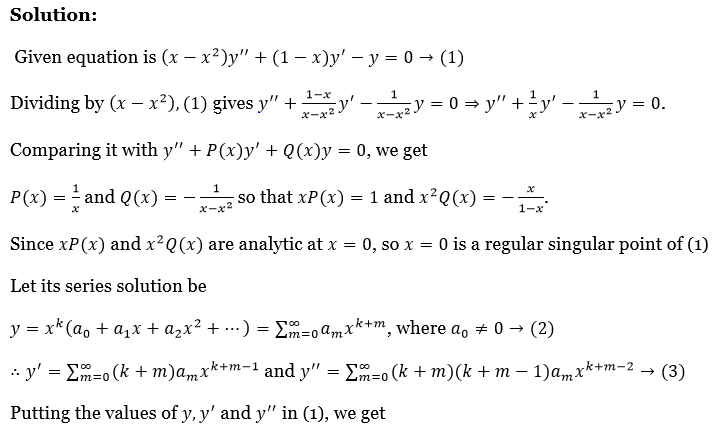
37. Find the series solution of \(\left(x-x^2\right) y^{\prime \prime}+(1-x) y^{\prime}-y=0\) near x=0.
Solution:
Given equation is \(\left(x-x^2\right) y^{\prime \prime}+(1-x) y^{\prime}-y=0 \rightarrow (1)\)
Dividing by \(\left(x-x^2\right)\), (1) gives \(y^{\prime \prime}+\frac{1-x}{x-x^2} y^{\prime}-\frac{1}{x-x^2} y=0 \Rightarrow y^{\prime \prime}+\frac{1}{x} y^{\prime}-\frac{1}{x-x^2} y=0\)
Comparing it with \(y^{\prime \prime}+P(x) y^{\prime}+Q(x) y=0\), we get
⇒ \(P(x)=\frac{1}{x}\) and \(Q(x)=-\frac{1}{x-x^2}\) so that x P(x)=1 and \(x^2 Q(x)=-\frac{x}{1-x}\)
Since x P(x) and \(x^2 Q(x)\) are analytic at x=0, so x=0 is a regular singular point of (1)
Let its series solution be
⇒ \( y=x^k\left(a_0+a_1 x+a_2 x^2+\cdots\right)=\sum_{m=0}^{\infty} a_m x^{k+m}, \text { where } a_0 \neq 0 \rightarrow \text { (2) }\)
⇒ \( y^{\prime}=\sum_{m=0}^{\infty}(k+m) a_m x^{k+m-1} \text { and } y^{\prime \prime}=\sum_{m=0}^{\infty}(k+m)(k+m-1) a_m x^{k+m-2} \rightarrow \text { (3) }\)
Putting the values of y, y’, and y” in (1), we get
⇒ \(\left(x-x^2\right) \sum_{m=0}^{\infty}(k+m)(k+m-1) a_m x^{k+m-2}+(1-x) \sum_{m=0}^{\infty}(k+m) a_m x^{k+m-1}\)
⇒ \(-\sum_{m=0}^{\infty} a_m x^{k+m}=0\)
⇒ \(\sum_{m=0}^{\infty}(k+m)(k+m-1) a_m x^{k+m-1}-\sum_{m=0}^{\infty}(k+m)(k+m-1) a_m x^{k+m}\)
⇒ \(+\sum_{m=0}^{\infty}(k+m) a_m x^{k+m-1}-\sum_{m=0}^{\infty}(k+m) a_m x^{k+m}-\sum_{m=0}^{\infty} a_m x^{k+m}=0\)
⇒ \(\sum_{m=0}^{\infty}[(k+m)(k+m-1)+(k+m)] a_m x^{k+m-1}\)
⇒ \(-\sum_{m=0}^{\infty}[(k+m)(k+m-1)+(k+m)+1] a_m x^{k+m}=0\)
⇒ \(\sum_{m=0}^{\infty}(k+m)^2 a_m x^{k+m-1}-\sum_{m=0}^{\infty}\left[(k+m)^2+1\right] a_m x^{k+m}=0 \rightarrow \text { (4) }\)
which is an identity is x
Equating to zero the coefficient of the smallest power of $x$, namely $x^{k-1}$ in (4), the indicial equation is $a_0 k^2=0$ so that $k=0,0$ as $a_0 \neq 0$.
Equating to zero the coefficient of $x^{k+m-1}$ in (4), we get
⇒ \((k+m)^2 a_m-\left\{(k+m-1)^2+1\right\} a_{m-1}=0, for all m \geq 1\)
⇒ \(a_m=\frac{(k+m-1)^2+1}{(k+m)^2} a_{m-1}$, for all m \geq 1 \rightarrow(5)\)
Putting m=1,2,3, ……. in (5), we have \(a_1=\frac{k^2+1}{(k+1)^2} a_0 \rightarrow (6)\)
⇒ \(a_2=\frac{(k+1)^2+1}{(k+2)^2} a_1=\frac{\left(k^2+1\right)\left\{(k+1)^2+1\right\}}{(k+1)^2(k+2)^2} a_0 \rightarrow(7)\)
⇒ \(a_3=\frac{(k+2)^2+1}{(k+3)^2} a_2=\frac{\left(k^2+1\right)\left\{(k+1)^2+1\right\}\left\{(k+2)^2+1\right\}}{(k+1)^2(k+2)^2(k+3)^2} a_0\) and so on.
Putting these values in (2), we have
⇒ \(y=a_0 x^k\left[\quad+\frac{k^2+1}{(k+1)^2} x+\frac{\left(k^2+1\right)\left\{(k+1)^2+1\right\}}{(k+1)^2(k+2)^2} x^2\right.\)
⇒ \(\left.+\frac{\left(k^2+1\right)\left\{(k+1)^2+1\right\}\left\{(k+2)^2+1\right\}}{(k+1)^2(k+2)^2(k+3)^2} x^3+\cdots\right] \rightarrow(8)\)
Differentiating (8) partially w.r.t k we have
⇒ \(\frac{\partial y}{\partial k}= a_0 x^k \log x\{1+\frac{k^2+1}{(k+1)^2} x+\frac{(k^2+1)[(k+1)^2+1]}{(k+1)^2(k+2)^2} x^2\)
⇒ \(\left.+\frac{\left(k^2+1\right)\left\{(k+1)^2+1\right\}\left\{(k+2)^2+1\right\}}{(k+1)^2(k+2)^2(k+3)^2} x^3+\cdots\right]\)
⇒ \(+a_0 x^k\{[ \frac { 2 k } { ( 2 k + 1 ) ^ { 2 } } – \frac { 2 ( k ^ { 2 } + 1 ) } { ( k + 1 ) ^ { 3 } } ] x[\frac{2 k\{(k+1)^2+1\}+2(k+1)(k^2+1)}{(k+1)^2(k+2)^2}\)
⇒ \(\left.\left.-\frac{2\left(k^2+1\right)\left\{(k+1)^2+1\right\}}{(k+1)^3(k+2)^2}-\frac{2\left(k^2+1\right)\left\{(k+1)^2+1\right\}}{(k+1)^2(k+2)^3}\right] x^2+\cdots\right\} \rightarrow(9)\)
Putting k=0 and replacing \(a_0\) by a in (8), \(y=a\left(1+x+\frac{2}{4} x^2+\frac{2 \cdot 5}{4 \cdot 9} x^3+\cdots\right)=a u\), say Putting k=0 and replacing \(a_0\) by b in (9), we get.
⇒ \(\left(\frac{\partial y}{\partial k}\right)_{k=0}=b \log x\left(1+x+\frac{2}{4} x^2+\frac{2 \cdot 5}{4 \cdot 9} x^3+\cdots\right)+b\left(-2 x-x^2-\cdots\right)\)
⇒ \(\left(\frac{\partial y}{\partial k}\right)_{k=0}=b\left[\log x\left(1+x+\frac{2}{4} x^2+\frac{2 \cdot 5}{4 \cdot 9} x^3+\cdots\right)+\left(-2 x-x^2-\cdots\right)\right]=b v, \text { say }\)
The required solution is y=a u+b v, a, b being arbitrary constants.
38. Find the power series solution of \(\left(1-x^2\right)\left(\frac{d^2 y}{d t^2}\right)-2 x\left(\frac{d y}{d x}\right)+6 y=0\) about x=∞.
Solution:
Given equation is \(\left(1-x^2\right)\left(\frac{d^2 y}{d x^2}\right)-2 x\left(\frac{d y}{d x}\right)+6 y=0 \rightarrow(1)\)
Let x = \(\frac{1}{t}\) or t= \(\frac{1}{x}\) so that \(\frac{d t}{d x}=-\frac{1}{x^2} \rightarrow (2)\)
Now, \(\frac{d y}{d x}=\frac{d y}{d t} \frac{d t}{d x}=\frac{d y}{d t}\left(-\frac{1}{x^2}\right)=-t^2 \frac{d y}{d t} \rightarrow(3)\)
and \(\frac{d^2 y}{d x^2}=\frac{d}{d x}\left(\frac{d y}{d x}\right)=\frac{d}{d t}\left(\frac{d y}{d x}\right) \frac{d t}{d x}=\frac{d}{d t}\left(-t^2 \frac{d y}{d t}\right) \times\left(-\frac{1}{x^2}\right)\), by (2) and (3).
⇒ \(\frac{d^2 y}{d x^2}=t^2 \frac{d}{d t}\left(t^2 \frac{d y}{d t}\right)=t^2\left(2 t \frac{d y}{d t}+t^2 \frac{d^2 y}{d t^2}\right) \rightarrow(4)\)
Using (2), (3) and (4), (1) is transformed to
⇒ \(\left(1-\frac{1}{t^2}\right)\left(2 t^3 \frac{d y}{d t}+t^4 \frac{d^2 y}{d t^2}\right)-\frac{2}{t}\left(-t^2 \frac{d y}{d t}\right)+6 y=0 \)
⇒ \( t^2\left(t^2-1\right) \frac{d^2 y}{d t^2}+2 t^3 \frac{d y}{d t}+6 y=0 \rightarrow \text { (5) }\)
Dividing by \(t^2\left(t^2-1\right)\), we get \(\frac{d^2 y}{d t^2}+\frac{2 t}{t^2-1} \frac{d y}{d t}+\frac{6}{t^2\left(t^2-1\right)} y=0\)
Comparing it with \(\frac{d^2 y}{d t^2}+P(t) \frac{d y}{d t}+Q(t) y=0\), we get
P(t) = \(\frac{2 t}{t^2-1}\) and \(Q(t)=\frac{6}{t^2\left(t^2-1\right)}\) so that \(t P(t)=\frac{2 t^2}{t^2-1}\) and \(t^2 Q(t)=\frac{6}{t^2-1}\)
Since t P(t) and \(t^2 Q(t)\) are both analytic at t=0, so t=0 is a regular singular point of(5). Let the series solution of (5) be
⇒ \(y=t^k\left(a_0+a_1 t+a_2 t^2+\cdots\right)=\sum_{m=0}^{\infty} a_m t^{k+m}, \text { where } a_0 \neq 0 \rightarrow(0)\)
∴ \(\frac{d y}{d t}=\sum_{m=0}^{\infty}(k+m) a_m t^{k+m-1} \text { and } \frac{d^2 y}{d t^2}=\sum_{m=0}^{\infty}(k+m)(k+m-1) a_m t^{k+m-2}\)
Putting these values of \(y, \frac{d y}{d t}\) and \(\frac{d^2 y}{d t^2}\) in (5), we get
⇒ \(\left(t^4-t^2\right) \sum_{m=0}^{\infty}(k+m)(k+m-1) a_m t^{k+m-2}+2 t^3 \sum_{m=0}^{\infty}(k+m) a_m t^{k+m-1}\)
⇒ \(+6 \sum_{m=0}^{\infty} a_m t^{k+m}=0\)
⇒ \(\sum_{m=0}^{\infty}(k+m)(k+m-1) a_m t^{k+m+2}-\sum_{m=0}^{\infty}(k+m)(k+m-1) a_m t^{k+m}\)
⇒ \(+\sum_{m=0}^{\infty} 2(k+m) a_m t^{k+m+2}+6 \sum_{m=0}^{\infty} a_m t^{k+m}=0\)
⇒ \(-\sum_{m=0}^{\infty}\{(k+m)(k+m-1)-6\} a_m t^{k+m}+\sum_{m=0}^{\infty}\{(k+m)(k+m-1)\)
⇒ \(+2(k+m)\} a_m t^{k+m+2}=0\)
⇒ \(\sum_{m=0}^{\infty}\left\{(k+m)^2-(k+m)-6\right\} a_m t^{k+m}-\sum_{m=0}^{\infty}\left\{(k+m)^2+(k+m)\right\} a_m t^{k+m+2}=0\)
⇒ \(\sum_{m=0}^{\infty}(k+m-3)(k+m+2) a_m t^{k+m}-\sum_{m=0}^{\infty}(k+m)(k+m \dot{+}) a_m t^{k+m+2}=0 \rightarrow(7)\)
which is an identity.
Equating to zero the coefficient of the smallest power of t, namely \(t^k,\)(7) gives the indicial equation \(a_0(k-3)(k+2)=0\) so that k=3 and k=-2 as \(a_0 \neq 0\)
The roots of the indicial equation are unequal and differ by an integer.
Next equating to zero the coefficient of \(t^{k+1}\) in (7), we get \((k-2)(k+3) a_1=0\) giving \(a_1=0\) for both k=3 and k=-2.
Finally, equating to zero the coefficients of \(t^{k+m}\) in (4), we get
⇒ \((k+m-3)(k+m+2) a_m-(k+m-2)(k+m-1) a_{m-2}=0\)
⇒ \(a_m=\frac{(k+m-2)(k+m-1)}{(k+m-3)(k+m+2)} a_{m-2} \rightarrow(8)\) for all \(m \geq 2\) Putting m=3,5,6, ….. in (8) and noting that \(a_1=0\), we get
⇒ \(a_1=a_3=a_5=a_7=\cdots=0 \rightarrow(9)\)
Next, putting m=2,4,6, …….. in (8), we have \(a_2=\frac{k(k+1)}{(k-1)(k+4)} a_0\)
⇒ \(a_4=\frac{(k+2)(k+3)}{(k+1)(k+6)} a_2=\frac{k(k+1)(k+2)(k+3)}{(k-1)(k+1)(k+4) \cdot(k+6)} a_0=\frac{k(k+2)(k+3)}{(k-1)(k+4)(k+6)} a_0 \ldots\)
⇒ \( y=t^k a_0\left[1+\frac{k(k+1)}{(k-1)(k+4)} x^2+\frac{k(k+2)(k+3)}{(k-1)(k+4)(k+6)} x^4+\cdots\right] \rightarrow \text { (11) }\)
Putting k=3 in (11) and replacing \(a_0\) by a, we get
⇒ \(y=a t^3\left[1+\frac{3.4}{2.7} t^2+\frac{3.5 .6}{2.7 .9} t^4+\cdots\right]=a u \text {. }\)
Putting k=-2 in (11) and replacing \(a_0\) by b, we get \(y=b t^{-2}\left[1-\frac{t^2}{3}\right]=b v\)
The required solution is y=a u+bv, i.e.
⇒ \(y=a t^3\left(1+\frac{3 \cdot 4}{2 \cdot 7} t^2+\frac{3 \cdot 5 \cdot 6}{2 \cdot 7 \cdot 9} t^4+\cdots\right)+\frac{b}{t^2}\left(1-\frac{t^2}{3}\right)\)
⇒ \(y=\frac{a}{x^3}\left(1+\frac{3 \cdot 4}{2 \cdot 7} \frac{1}{x^2}+\frac{3 \cdot 5 \cdot 6}{2 \cdot 7 \cdot 9} \frac{1}{x^4}+\cdots\right)+b x^2\left(1-\frac{1}{3 x^2}\right), \text { as } t=\frac{1}{x^2}\)