Primary Mathematics Chapter 1 Whole Numbers
Chapter 1 Whole Numbers Exercises 1.13 Solutions Page 35 Exercise 1.13 Problem 1
Given: 14 thousands 6 tens.
To write: The sentence in the standard form.
Use the strategy of BODMAS to simplify the thousands and tens separately.
Then add both tens and thousands with standard form.
Solve the sentence using parentheses wherever necessary.
Given sentence is written as
14 thousands = 14 × 1000
= 14000
6 tens = 6 × 10 = 60
Further adding both the solutions
14 thousands + 6 tens = 14000 + 60
14 thousands + 6 tens= 14 × 1000 + 6 × 10
14 thousands + 6 tens = (14 × 1000) + (6 × 10)
14 thousands + 6 tens = 14060
Therefore the standard form is 14060.
Hence, the standard form of 14 thousands and 6 tens is 14060.
Page 35 Exercise 1.13 Problem 2
Given: 32 thousands 5 hundreds 2 tens.
To write: The sentence in the standard form.
Use the strategy of BODMAS to simplify the thousands, hundreds, and tens separately.
Then add tens, hundreds, and thousands with standard form.
Solve the sentence using parentheses where ever necessary.
Given sentence is written as
32 thousands = 32 × 1000
= 32000
5 hundreds = 5 × 100
= 500
2 tens = 2 × 10
= 20
Further adding the standard forms
32 thousands + 5 hundreds + 2 tens = 32000 + 500 + 20
32 thousands + 5 hundreds + 2 tens = 32 × 1000 + 5 × 100 + 2 × 10
32 thousands + 5 hundreds + 2 tens =(32×1000) + (5 × 100) + (2 × 10)
32 thousands + 5 hundreds + 2 tens = 32520
Therefore the standard form is 32520.
Hence, the standard form of 32 thousands, 5 hundreds, and 2 tens is 32520.
Page 35 Exercise 1.13 Problem 3
Given: 4 hundred thousands 6 tens 9 ones
To write: The sentence in the standard form.
Use the strategy of BODMAS to simplify the hundred thousands, ones, and tens separately
Then add tens, hundred thousands, and ones with standard form.
Solve the sentence Using parentheses wherever necessary.
Given sentence is written as
4 hundred thousands = 4 × 100 × 1000
9 ones = 9 × 1
6 tens = 6 × 10
Further adding the standard forms
4 hundred thousands+6 tens+9 ones=4×100×1000+6×10+9×1
=(4 × 100 × 1000) + (6 × 10) + (9 × 1)
Therefore the standard form is (4 × 100 × 1000) + (6 × 10) + (9 × 1)
Hence, the standard form of 4 hundred thousands , 6 tens, and 9 ones is (4 × 100 × 1000) + (6 × 10) + (9 × 1)
Page 35 Exercise 1.13 Problem 4
Given: 55 thousands 3 hundred 82
To write: The sentence in the standard form.
Use the strategy of BODMAS to simplify the hundred , thousands, ones separately
Then add tens, hundred, thousands, and ones with standard form.
Solve the sentence Using parentheses wherever necessary.
Given sentence is written as
55 thousands = 55 × 1000
3 hundred = 3 × 100
Eighty two = 82
Further adding the standard forms
55 thousands + 3 hundred + 82 = 55 × 1000 + 3 × 100 + 82
55 thousands + 3 hundred + 82 = (55 × 1000) + (3 × 100) + 82
Therefore the standard form is (55 × 1000) + (3 ×1 00) + 82
Hence, the standard form of 55 thousands 3 hundred and 82 is (55 × 1000) + (3 × 100) + 82
Primary Mathematics 4A Chapter 1 Step-By-Step Solutions For Exercise 1.13 Page 35 Exercise 1.13 Problem 5
Given: 2 hundred thousands Twelve
To write: The sentence in the standard form.
Use the strategy of BODMAS to simplify the hundred thousand and twelve separately.
Then add twelve, hundred thousand with standard form.
Solve the sentence Using parentheses wherever necessary.
Given sentence is written as
2 hundred thousands = 2 × 100 × 1000
Twelve = 12
Further adding the standard forms
2 hundred thousands+twelve = 2 × 100 × 1000 + 12
= (2 × 100 × 1000) + 12
Therefore the standard form is (2 × 100 × 1000) + 12
Hence, the standard form of 2 hundred thousands twelve is (2 × 100 × 1000) + 12
Page 35 Exercise 1.13 Problem 6
Given: 12, 025
To write: The sentence in the expanded form.
Use the strategy of BODMAS to expand the hundreds thousands tens and ones separately
Then write the number in the sentence form as words in expanded form
Solve the sentence Using parentheses where ever necessary.
Expand the given number
12025 = 12000 + 25
= (12 × 1000) + 25
Further writing the number in expanded sentence forms as words
12025 = (12 × 1000) + 25
= Twelve thousand twenty-five
Therefore the expanded form is twelve thousand twenty-five
Hence, the expanded form of 12025 in words is twelve thousand twenty-five
Whole Numbers Exercise 1.13 Primary Mathematics Workbook 4A Answers Page 35 Exercise 1.13 Problem 7
Given: 500,006
To write: The sentence in the expanded form.
Use the strategy of BODMAS to expand the hundreds thousands tens and ones separately
Then write the number in the sentence form as words in expanded form
Solve the sentence Using parentheses where ever necessary.
Expand the given number
500,006 = 500000 + 6
= (5 × 100 × 1000) + 6
Further writing the number in expanded sentence forms as words
500,006 = (5 × 100 × 1000) + 6
= Five hundred thousand six
Therefore the expanded form is five hundred thousand six
Hence, the expanded form of 500,006 in words is five hundred thousand six
Page 35 Exercise 1.13 Problem 8
Given: 34,120.
To write: The sentence in the expanded form.
Use the strategy of BODMAS to expand the hundreds thousands tens and ones separately.
Then write the number in the sentence form as words in expanded form.
Solve the sentence using parentheses wherever necessary.
Expand the given number
34120 = 30000 + 4000 + 100 + 20
= 3 × 10,000 + 4 × 1000 + 1 × 100 + 2 × 10
Further writing the number in expanded sentence forms as words
34120 = 3 × 10,000 + 4 × 1000 + 1 × 100 + 2 × 10
= Thirty four thousand one hundred twenty
Therefore the expanded form is thirty-four thousand one hundred twenty
Hence, the expanded form of 34120 is 3 × 10,000 + 4 × 1000 + 1 × 100 + 2 × 10. In words it will bethirty four thousand one hundred twenty.
Common Core Primary Mathematics 4A Chapter 1 Solved Examples For 1.13 Page 36 Exercise 1.14 Problem 1
Given: 385,270
To write: The sentence in the expanded form.
Use the strategy of BODMAS to expand the hundreds thousands tens and ones separately
Then write the number in the sentence form as words in expanded form
Solve the sentence Using parentheses wherever necessary.
Check for the digit to fill the blank.
Expand the given number
385,270 = 300,000 + 85000 + 200 + 70
= 3 × 100 × 1000 + 85 × 1000 + 2 × 100 + 70
= (3 × 100 × 1000) + (8 × 10 × 000) + (5 × 1000) + (2 × 100) + 70
Further writing the number in expanded sentence forms as words
385,270 = (3 × 100 × 1000) + (8 × 10 × 000) + (5 × 1000) + (2 × 100) + 70
= Three hundred thousand eight-ten thousands five thousand two hundreds seventy
Referring to the expanded form the digit 8 in 385,270 stands for (8×10×000) that is eight-ten thousands
Hence, the digit 8 in 385,270 stands for (8×10×000) that is eight-ten thousands
Page 36 Exercise 1.14 Problem 2
Given: 396,048
To write: The sentence in the expanded form.
Use the strategy of BODMAS to expand the hundreds thousands tens and ones separately
Then write the number in the sentence form as words in expanded form
Solve the sentence Using parentheses wherever necessary.
Check for the digit to fill the blank.
Expand the given number
396,048 = 300,000 + 96000 + 40 + 8
= 3 × 100 × 1000 + 96 × 1000 + 40 + 8
= (3 × 100 × 1000) + (96 × 1000) + ( 4 × 10) + 8
Further writing the number in expanded sentence forms as words
396,048 = (3 × 100 × 1000) + (96 × 1000) + (4 × 10) + 8
= Three hundred thousands ninety-six thousands four tens eight
Referring to the expanded form the digit 3 in 396,048 stands for (3 × 100 × 000) that is three hundred thousands
Hence, the digit 3 in 396,048 stands for (3 × 100 × 000) that is three hundred thousands
Chapter 1 Whole Numbers Worked Solutions For Exercise 1.13 In 4A Page 36 Exercise 1.14 Problem 3
Given: 98,406
To write: The sentence in the expanded form.
Use the strategy of BODMAS to expand the hundreds thousands tens and ones separately
Then write the number in the sentence form as words in expanded form
Solve the sentence Using parentheses wherever necessary.
Check for the digit to fill the blank.
Expand the given number
98,406 = 90000 + 8000 + 400 + 6
= 9 × 10 × 1000 + 8 × 1000 + 400 + 6
= (9 × 10 × 1000) + (8 × 1000) + (4 × 100) + 6
Further writing the number in expanded sentence forms as words
98,406=(9 × 10 × 1000) + (8 × 1000) + (4 × 100) + 6
= Nine ten thousands eight thousands four hundreds six
Referring to the expanded form of 98,406 the blank is 8000 or (8 × 1000)
Hence, the missing number of the number 98,406 is 8000 or (8 × 1000)
Page 36 Exercise 1.14 Problem 4
Given: 10,501
To write: The sentence in the expanded form.
Use the strategy of BODMAS to expand the hundreds thousands tens and ones separately
Then write the number in the sentence form as words in expanded form
Solve the sentence Using parentheses wherever necessary.
Check for the digit to fill the blank.
Expand the given number
10,501= 10000 + 500 + 1
= 10 × 1000 + 5 × 100 + 1
= (10 × 1000) + (5 × 100) + 1
Further writing the number in expanded sentence forms as words
10,501= (10 × 1000) + (5 × 100) + 1
= 10,501
= Ten thousands five hundreds and one
Referring to the expanded form the blank is 10,501
Hence, the missing number is 10,501
How to solve Primary Mathematics 4A Chapter 1 Whole Numbers 1.13 problems Page 36 Exercise 1.14 Problem 5
Given: 67,014
To write: The sentence in the expanded form.
Use the strategy of BODMAS to expand the hundreds thousands tens and ones separately
Then write the number in the sentence form as words in expanded form
Solve the sentence Using parentheses wherever necessary.
Check for the digit to fill the blank.
Expand the given number
67014 = 67000 + 14
= 67 × 1000 + 14
Further writing the number in expanded sentence forms as words
67014 = (67 × 1000) + 14
= Sixty seven thousands fourteen
Referring to the expanded form of 67014 the blank is 67000 or (67 × 1000)
Hence, the missing number of the number 67014 is 67000 or (67 × 1000)
Primary Mathematics Workbook 4A Chapter 1 Exercise 1.13 Breakdown Page 36 Exercise 1.14 Problem 6
Given: 10,000 more than 46,952 is _____.
Question is to fill the blank with the number which is 10,000 more than 46,952
So, by adding 10,000 to 46,952 will give the required number.
⇒ 46,952 + 10,000 = 56,952
Hence the required number is obtained.
Therefore, it is found that 10,000 more than 46,952 is 56,952.
Exercise 1.13 Whole Numbers Primary Mathematics Workbook Step-By-Step Page 36 Exercise 1.14 Problem 7
Given:100,000 less than 999,998 is____.
Question is to fill the blank with the number which is 100,000 lesser than 999,998
So, finding difference between 999,998 and 100,000 will give the required number.
⇒ 999,998−100,000 = 899,998
Hence the required number is obtained.
Therefore, it is found that 100,000 less than 999,998 is 899,998.
Primary Mathematics Workbook 4A Common Core Edition 1.13 Practice Page 36 Exercise 1.14 Problem 8
Given: 79,049 is ____ less than 80,049
Question is to fill the blank with the number whose difference from 80,049 gives 79,049
So, finding the difference will give
80,049−x = 79,049
x = 80,049 − 79,049
x = 1000
Hence the required number is obtained.
Therefore, it is found that 79,049 is 1000 less than 80,049.
Common Core 4A Chapter 1 Whole Numbers 1.13 Solutions Page 36 Exercise 1.14 Problem 9
Given: 300,561 is _____more than 290,561
Question is to fill in the blank with the number whose addition to 290,561 will make it 300,561
So, adding x with 290,561 will give 300,561
290,561 + x = 300,561
x = 300,561 − 290,561
x = 10,000
Hence the required number is obtained.
Therefore, it is found that 300,561 is 10,000 more than 290,561.
Page 36 Exercise 1.14 Problem 10
Given: A number pattern _____ ; 48,615 ; 58,615 ; ______ ; 78,615
Question is to fill the blanks according to the pattern.
Identify the sequence that which mathematical operation is carried out through out the pattern and accordingly solve it.
The difference between the third number and second number can be found by 58,615 − 48,615 = 10,000
This difference must be the common factor in this sequence.
So, the sequence is designed in a manner that the succeeding number will be 10,000 more than the preceding number.
So, the first term will be 10,000 Less than the second term.
⇒ 48,615−10,000 = 38,615
And the fourth term will be 10,000 more than the third.
⇒ 58,615 + 10,000 = 68,615
Then, the pattern will be, 38,615; 48,615; 58,615; 68,615; 78,615
Therefore, the given number pattern is completed as 38,615; 48,615; 58,615;68,615; 78,615.
Page 36 Exercise 1.14 Problem 11
Given: A number pattern 103,840 ; 102,840 ; 101,840; _____ ; _______ ; _______
Question is to fill the blanks according to the pattern.
Identify the sequence that which mathematical operation is carried out through out the pattern and accordingly solve it.
The difference between the first number and second number can be found by
⇒ 103,840−102,840 = 1000
Similarly, the difference between the first number and second number can be found by
102,840 − 101,840 = 1000
So, the common difference is 1000
So, the sequence is designed in a manner that the succeeding number will be 1000 less than the preceding number.
So, the fourth term will be less than the third term.
101,840 − 1000 = 100,840
The third term will be less than the fourth term.
100,840 − 1000 = 99,840
And, the fourth term will be less than the sixth term.
99,840 − 1000 = 98,840
Then, the pattern will be, 103,840;102,840;101,840; 100,840;99,840; 98,840
Therefore, the given number pattern is completed as 103,840;102,840;101,840; 100,840; 99,840; 98,840.
Page 36 Exercise 1.14 Problem 12
Use the strategy of BODMAS wherever necessary.
Check LHS = RHS
Solve LHS and RHS by expanding them to thousands, hundreds, tens, and ones to identify the inequality.
Compare LHS and RHS to find the answer/solution.
Expand the numbers to identify the inequality
LHS = 85928
= 80000 + 5000 + 900 + 20 + 8
RHS = 85892
= 80000 + 5000 + 800 + 90 + 2
Further comparing LHS = RHS
Clearly, the hundreds place of 85928 is greater than 85892
So, 85928>85892
Hence, by comparing the both the numbers we conclude that 85928>85892
Page 36 Exercise 1.14 Problem 13
Use the strategy of BODMAS wherever necessary.
Check LHS = RHS
Solve LHS and RHS by expanding them to thousands, hundreds, tens, and ones to identify the inequality.
Compare LHS and RHS to find the answer/solution.
Expand the numbers to identify the inequality
LHS = 630,109
= 600,000 + 30,000 + 100 + 9
RHS = 603,901
= 600,000 + 3000 + 900 + 1
Further comparing LHS = RHS
Clearly, the thousands place of 630,109 is greater than 603,901
So, 630,109>603,901
Hence, by comparing the both the numbers we conclude that 630,109>603,901
Page 36 Exercise 1.14 Problem 14
Given data: 4569 − 999____3569 + 999
To write: <,> or = in each blank.
Calculate the L.H.S (left-hand side) of the blank as shown below
∴ 4569−999 = 3570
Again calculate the R.H.S (right-hand side) of the blank as shown below
∴ 3569 + 999 = 4568
It can be clearly observed that the term on R.H.S is greater than the term on the L.H.S and therefore the sign to be used is <.
Thus, it can be clearly concluded that 4569 − 999 < 3569 + 999.
Page 36 Exercise 1.14 Problem 15
Given data: 54100_____ 541 × 1000
To write: <,> more = in each blank.
Calculate the L.H.S (left-hand side) if necessary, of the blank as shown below
∴ 54100
Again calculate the R.H.S (right-hand side) of the blank as shown below
∴ 541 × 1000 = 541000
It can be clearly observed that the term on R.H.S is greater than the term on the L.H.S and therefore the sign to be used is <.
Thus, it can be clearly concluded that 54100<541 × 1000.
Page 36 Exercise 1.14 Problem 16
Given data: 42000 ÷ 7 ____ 3600 ÷ 6
To write: <,> or = in each blank.
Calculate the L.H.S (left-hand side) if necessary, of the blank as shown below
∴ 42000 ÷ 7 = 6000
Again calculate the R.H.S (right-hand side) of the blank as shown below
∴ 3600 ÷ 600
It can be clearly observed that the term on L.H.S is greater than the term on the R.H.S and therefore the sign to be used is >.
Thus, it can be clearly concluded that 42000 ÷ 7 > 3600 ÷ 6.
Page 36 Exercise 1.14 Problem 17
Given data: 50000 × 7 ____ 400000
To write:<,> or = in each blank.
Calculate the L.H.S (left-hand side) if necessary, of the blank as shown below
∴ 50000×7=350000
Again calculate the R.H.S (right-hand side) if necessary, of the blank as shown below
∴ 400000
It can be clearly observed that the term on R.H.S is greater than the term on the L.H.S and therefore the sign to be used is <.
Thus, it can be clearly concluded that 50000 × 7 < 400000.
Page 36 Exercise 1.14 Problem 18
Given data: 23000 + 40000 ___ 87000−24000
To write: <,> or, =, in each blank.
Calculate the L.H.S (left-hand side) if necessary, of the blank as shown below
∴ 23000 + 40000 = 63000
Again calculate the R.H.S (right-hand side) if necessary, of the blank as shown below
∴ 87000 − 24000 = 63000
It can be clearly observed that the term on L.H.S is equal to the term on the R.H.S and therefore the sign to be used is =.
Thus, it can be clearly concluded that 23000 + 40000 = 87000 − 24000.
Page 37 Exercise 1.15 Problem 1
Given data: $460000 + a = 480000$
To find – The missing number represented by each a.
Solve the equation as shown below
∴ 460000 + a = 480000
a = 480000 − 460000
a = 20000
Thus, it can be clearly concluded that the missing number represented by a, in the equation 460000 + a = 480000 is, 20000.
Page 37 Exercise 1.15 Problem 2
Given data: 48000 ÷ a = 6000
To find – The missing number represented by each a.
Solve the equation as shown below
∴ 48000 ÷ a = 6000
48000 ÷ 6000 = a
a = 8
Thus, it can be clearly concluded that the missing number represented by a, in the equation 48000 ÷ a = 6000 is, 8.
Page 37 Exercise 1.15 Problem 3
Given data: 48000 − a = 6000
To find – The missing number represented by each a.
Solve the equation as shown below
∴ 48000 − a = 6000
48000 − 6000 = a
a = 42000
Thus, it can be clearly concluded that the missing number represented by a, in the equation 48000 − a = 6000 is, 42000
Page 37 Exercise 1.15 Problem 4
Given data: 4000 × a = 32000
To find – The missing number represented by each a.
Solve the equation as shown below
∴ 4000 × a = 32000
a = \(\frac{32000}{4000}\)
a = 8
Thus, it can be clearly concluded that the missing number represented by a, in the equation 4000 × a = 32000 is, 8.
Page 37 Exercise 1.15 Problem 5
Given data: 22906,28609,82096,28069,8209
To arrange: The numbers in increasing order.
Observe that 8209 is the whole number which is the lowest in value and now on arranging it with increasing values, the following can be obtained as shown below
∴ 8209,226906,28069,28609,82096
Thus, it can be clearly concluded that the numbers, 22906,28609,82096,28069,and 8209 can be arranged in increasing order as 8209,22906,28069,28609,and 82096.
Page 37 Exercise 1.15 Problem 6
Given data: 435260,296870,503140,463540
To arrange: The numbers in increasing order.
Observe that 296870 is the whole number which is the lowest in value and now on arranging it with increasing values, the following can be obtained as shown below
∴ 296870,435260,463540,503140
Thus, it can be clearly concluded that the numbers 435260,296870,503140,and 463540 can be arranged in increasing order as 296870,435260,463540,and 503140.
Page 37 Exercise 1.15 Problem 7
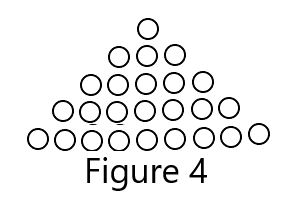
Given data: Some figures are given.
To fill – In Figure 4.
Observe that the number of circles in the first figure is 4, then 9, and then 16, and therefore, in the fourth figure it again increased to 25
Thus, in the fourth figure, one line of circles will increase like in the fourth line of figure 3 with 2 more circles in it.
Therefore, the fourth figure can be filled in as shown below
Thus, it can be clearly concluded that figure 4 can be filled in as shown below
Page 38 Exercise 1.16 Problem 1
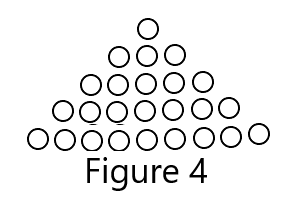
Given data: Some figures are given.
To find – The pattern that we notice in the number of circles.
Observe that the number of circles in the first figure is 4, then 9 and then 16 and therefore, in the fourth figure it again increased to 25
Thus, the difference in the number of circles is increasing by 2 after being 4 and 9 in the first and second figures respectively.
Thus, there is an increasing pattern with the number of circles in the nth figure being (n+1)2.
Thus, it can be clearly concluded that the pattern that we notice in the number of circles is an increasing pattern with the number of circles in the nth figure being (n+1)2.
Page 38 Exercise 1.16 Problem 2
Given data: The digits are 0,1,9,and 5,8.
To find – The greatest 5 -digit number that can be formed using all of the given five digits.
Observe that digit greatest in value, that is, 9, and now arrange the digits in order of decreasing values to obtain as shown below
Therefore,98510
Thus, it can be clearly concluded that the greatest 5 -digit number that can be formed using all of the given five digits that are, 0,1,9,5, and 8 is, 98510.
Page 38 Exercise 1.16 Problem 3
Given data: The multiples of 8.
To find – The first 5 multiples of 8.
Observe that the first five multiples of 8 are including 8 itself and as shown below
Therefore 8,16,24,32 and 40
Thus, it can be clearly concluded that the first 5 multiples of 8 are 8,16,24,32, and 40.
Page 38 Exercise 1.16 Problem 4
Given data: The common multiples of 4 and 5.
To find – The first2 common multiples of 4 and 5.
Observe that the first two common multiples of 4 and 5 can be calculated as shown below
Therefore
L.C.M = 2.2.5
= 20
[where L.C.M represents the lowest common multiple]
And also, 20.2 = 40
Thus, it can be clearly concluded that the first 2 common multiples of 4 and 5 are 20,and 40.
Page 38 Exercise 1.16 Problem 5
Given data: The given number is 4598.
To find – If 6 is a factor of 4598.
Observe that on dividing 4598 by 6, the following is obtained as shown below
Therefore \(\frac{4598}{6}\) = 766.334
Which shows that 6 is not a factor of 4598.
Thus, it can be clearly concluded that 6 is not a factor of 4598.
Page 38 Exercise 1.16 Problem 6
Given data: The given number is 54.
To find – All the factors of 54.
Observe that the various numbers which can be divided by 54 are obtained as shown below
Therefore; 1,2,3,6,9,18,27,54,−1,−2,−3,−6,−9,−18,−27,−54 are all factors of 54.
Thus, it can be clearly concluded that all the factors of 54 are 1,2,3,6,9,18,27,54,−1,−2,−3,−6,−9,−18,−27,−54.
Page 38 Exercise 1.16 Problem 7
Given data: The given numbers are 4,6,8, and 12.
To find – The common factor of 18 and 36 from these numbers.
Observe that the various numbers which can be divided by 18 and 36 are obtained as shown below
Therefore; 1,2,3,6,9,18,−1,−2,−3,−6,−9,−18 are all factors of 18.
1,2,3,4,6,9,12,18,36,−1,−2,−3,−4,−6,−9,−12,−18,−36 are all factors of 36.
Now, observe that the common factors of 18 and 36 are 1,2,3,6,9,18,−1,−2,−3,−6,−9,−18, and out of the given four numbers it is 6
Thus, it can be clearly concluded that the common factor of 18 and 36 from the numbers, 4,6,8, and 12 is 6.
Page 39 Exercise 1.17 Problem 1
Given data: The given numbers are 25 and 30.
To find – A prime number between 25 and 30.
Observe that a prime number between 25 and 30 is 29 as it is divisible by 1 and itself only.
Thus, it can be clearly concluded that a prime number between 25 and 30 is 29.
Page 39 Exercise 1.17 Problem 2
Given data: 5 × 24 = 5 × 6 × n
To find – The missing factor represented by each n.
Solve the equation as shown below
∴ 5×24 = 5 × 6 × n
\(\frac{5×24}{5×6}\) = n
n = 4
Thus, it can be clearly concluded that the missing factor represented by n, in the equation 5 × 24 = 5 × 6 × n is, 4.
Page 39 Exercise 1.17 Problem 3
Given data: 2 × 180 = 4 × n
To find – The missing factor represented by each n.
Solve the equation as shown below
∴ 2 × 180 = 4 × n
\(\frac{2×180}{4}\) = n
n = 90
Thus, it can be clearly concluded that the missing factor represented by n, in the equation 2 × 180 = 4 × n is, 90
Page 39 Exercise 1.17 Problem 4
Given data: 26 × 55 = 26 × n × 5
To find – The missing factor represented by each n.
Solve the equation as shown below
∴ 26 × 55 = 26 × n × 5
\(\frac{26×55}{26×5}\) = n
n = 11
Thus, it can be clearly concluded that the missing factor represented by n, in the equation 26×55 = 26×n×5, is 11.
Page 39 Exercise 1.17 Problem 5
Given data: 15 × 250 = 15 × 5 × n
To find – The missing factor represented by each n.
Solve the equation as shown below
∴ 15 × 250 = 15 × 5 × n
\(\frac{15×250}{15×5}\) = n
n = 50
Thus, it can be clearly concluded that the missing factor represented by n, in equation 15 × 250 = 15 × 5 × n is, 50.
Page 39 Exercise 1.17 Problem 6
Given data: 18 × 35 = 9 × 2 × n × 7
To find – The missing factor represented by each n.
Solve the equation as shown below
∴ 18 × 35 = 9 × 2 × n × 7
\(\frac{18×35}{9×2×7}\) = n
n = 5
Thus, it can be clearly concluded that the missing factor represented by n, in the equation 18 × 35 = 9 × 2 × n × 7 is, 5.
Page 39 Exercise 1.17 Problem 7
Given data: The given equation is 67−(100−52) = ____
To solve: The following equation that is given.
Solve the equation using the BODMAS (Bracket, Of, Division Multiplication Addition and Subtraction) rule as shown below
∴ 67−(100−52) = 67 − 100 + 52
67−(100−52) = 67−48
67−(100−52) = 19
Thus, it can be clearly concluded that the given equation that is, 67−(100−52) =_____can be solved as 67−(100−52) = 19.
Page 39 Exercise 1.17 Problem 8
Given data: The given equation is (84−32) ÷ 4 =_____.
To solve: The following equation that is given.
Solve the equation using the BODMAS (Bracket, Of, Division Multiplication Addition and Subtraction) rule as shown below
∴ (84−32) ÷ 4 = 52 ÷ 4
(84−32) ÷ 4 = 13
Thus, it can be clearly concluded that the given equation that is, (84−32) ÷ 4 =____can be solved as (84−32) ÷ 4 = 13.
Page 39 Exercise 1.17 Problem 9
Given data: The given equation is 72 ÷6 + 18 ÷ 3 =____.
To solve: The following equation that is given.
Solve the equation using the BODMAS (Bracket, Of, Division Multiplication Addition and Subtraction) rule as shown below
∴ 72 ÷ 6 + 18 ÷ 3 = 12 + 6
= 18
Thus, it can be clearly concluded that the given equation that is, 72 ÷ 6 + 18 ÷ 3=_____can be solved as 72 ÷ 6 + 18 ÷ 3 = 18.
Page 39 Exercise 1.17 Problem 10
Given data: The given equation is 47−28 ÷ 7 × 8 =____.
To solve: The following equation that is given.
Solve the equation using the BODMAS (Bracket, Of, Division Multiplication Addition and Subtraction) rule as shown below
∴ 47−28 ÷ 7 × 8 = 47 − 4 × 8
= 47−32
= 15
Thus, it can be clearly concluded that the given equation that is, 47 − 28 ÷ 7 × 8=____ can be solved as 47−28 ÷ 7 × 8 = 15.
Page 39 Exercise 1.17 Problem 11
Given data: (37−15) × (5 + 3)______ 22 × 9
To write: >,< or = in each blank.
Calculate the L.H.S (left-hand side) of the blank using BODMAS as shown below
∴ (37−15) × (5 + 3) = 22 × 8
= 176
Again calculate the R.H.S (right-hand side) of the blank using BODMAS as shown below
∴ 22 × 9 = 198
It can be clearly observed that the term on R.H.S is greater than the term on the L.H.S and therefore the sign to be used is <.
Thus, it can be clearly concluded that (37−15) × (5 + 3) < 22 × 9.
Page 39 Exercise 1.17 Problem 12
Given data: 40 ÷ (12−4) + 2_____ 40 ÷ 10
To write: >,< or = in each blank.
Calculate the L.H.S (left-hand side) of the blank using BODMAS as shown below
∴ 40 ÷ (12−4) + 2 = 40 ÷ 8 + 2
= 5 + 2
= 7
Again calculate the R.H.S (right-hand side) of the blank using BODMAS as shown below
∴ 40 ÷ 10 = 4
It can be clearly observed that the term on R.H.S is less than the term on the L.H.S and therefore the sign to be used is >.
Thus, it can be clearly concluded that 40 ÷ (12 − 4) + 2 > 40 ÷ 10.
Page 39 Exercise 1.17 Problem 13
Given data: 16 + 2×_____= 20
To fill: In the blank to make the equation true.
Let the blank or the missing value be represented by x
Solve the equation as shown below
Therefore
16 + 2×__ = 20
20−16 = 2x
\(\frac{4}{2}\) = x
2 = x (or) x = 2
Thus, it can be clearly concluded that the equation, that is, 16 + 2×___= 20 can be made true by filling in the blank with 2.
Page 39 Exercise 1.17 Problem 14
Given data: 48÷(4 × 2)−2 = 2×______
To fill: In the blank to make the equation true.
Let the blank or the missing value be represented by x
Solve the equation as shown below
∴ 48 ÷ (4 × 2) − 2 = 2 × x
48 ÷ 8 − 2 = 2x
6 − 2 = 2x
2 = x (or) x = 2
Thus, it can be clearly concluded that the equation, that is, 48 ÷ (4 × 2)−2 = 2×___can be made true by filling the blank with 2.
Page 39 Exercise 1.17 Problem 15
Given data: 18 − (10 − 6) = 10 +______
To fill: In the blank to make the equation true.
Let the blank or the missing value be represented by x
Solve the equation as shown below
∴ 18−(10−6) = 10 + x
18 − 4 − 10 = x
4 = x (or) x = 4
Thus, it can be clearly concluded that the equation, that is, 18−(10−6) = 10 +____can be made true by filling in the blank with 4.
Page 39 Exercise 1.17 Problem 16
Given data: (7 + 5) × (15−12) =_____× 12
To fill: In the blank to make the equation true.
Let the blank or the missing value be represented by x
Solve the equation as shown below
∴ (7 + 5) × (15−12) = x × 12
12 × 3 = x
\(\frac{12×3}{12}\) = x
3 = x (or) x = 3
Thus, it can be clearly concluded that the equation, that is, (7 + 5) × (15 − 12)=___× 12 can be made true by filling in the blank with 3.
Page 39 Exercise 1.17 Problem 17
Given data: 16 + 4 × 8 =______+ 32
To fill: In the blank to make the equation true.
Let the blank or the missing value be represented by x
Solve the equation as shown below
∴ 16 + 4 × 8 = x + 32
16 + 32−32 = x
16 = x (or) x = 16
Thus, it can be clearly concluded that the equation, that is, 16 + 4 × 8 =___+ 32 can be made true by filling in the blank with 16.
Page 39 Exercise 1.17 Problem 18
Given data: 9 + 12 ÷ 3 − 2 = 4+____
To fill: In the blank to make the equation true.
Let the blank or the missing value be represented by x
Solve the equation as shown below
∴ 9 + 12 ÷ 3 − 2 = 4 + x
9 + 4 − 2−4 = x
7=x (or) x = 7
Thus, it can be clearly concluded that the equation, that is, 9 + 12 ÷ 3 − 2 = 4 +___can be made true by filling in the blank with 7.
Page 39 Exercise 1.17 Problem 19
Given data: 12 − 3 × 2 + 9 = 15
To insert: Parentheses, where necessary, to make the given equation true.
Solve the equation by inserting the parentheses as shown below
∴ 12−3 × 2 + 9 = 15
Observe that no parentheses is required to be inserted in this equation as it is already true.
Thus, it can be clearly concluded that the equation, that is, 12 − 3 × 2 + 9 = 15 can be made true by inserting no parentheses as 12−3 × 2 + 9 = 15.
Page 39 Exercise 1.17 Problem 20
Given data: 12 − 3 × 2 + 9 = 99
To insert: Parentheses, where necessary, to make the given equation true.
Solve the equation by inserting the parentheses as shown below
∴ 12 − 3 × 2 + 9 = 99
⇒ (12−3) × (2 + 9) = 99
Thus, it can be clearly concluded that the equation, that is, 12 − 3 × 2 + 9 = 99 can be made true by inserting no parentheses as (12 − 3) × (2 + 9) = 99.