Primary Mathematics Chapter 1 Whole Numbers
Chapter 1 Whole Numbers Exercises 1.7 Solutions Page 21 Exercise 1.7 Problem 1
Given: Multiples of 6
To find – Several multiples of 6
Put different values of k to find different multiples
Given: Multiples of 6
Multiples of 6 can be written as 6k
For the first multiple of 6 (k=1)
⇒ 6 × 1
⇒ 6
For second multiple of 6( k = 2 )
⇒ 6 × 2
⇒ 12
For the third multiple of 6 (k = 3)
⇒ 6 × 3
⇒ 18
For the fourth multiple of 6 (k=4)
⇒ 6 × 4
⇒ 24
The first, second, third, and fourth multiple of 6 is 6,12,18, and 24.
Primary Mathematics 4A Chapter 1 Step-By-Step Solutions For Exercise 1.7 Page 21 Exercise 1.7 Problem 2
Given: Multiples of 7
To find – Several multiples of 7
Put different values of K to find different multiples
Given: Multiples of 7
Multiples of 7 can be written as 7k
For the first multiple of 7 (k = 1)
⇒ 7 × 1
⇒ 7
For the second multiple of 7 (k = 2)
⇒ 7 × 2
⇒ 14
For the third multiple of 7 (k = 3)
⇒ 7 × 3
⇒ 21
For the fourth multiple of 7 (k = 4)
⇒ 7 × 4
⇒ 28
For the fifth multiple of 7 (k = 5)
⇒ 7 × 5
⇒ 35
First, five multiples of 7 are 7,14,21,28,35.
Page 21 Exercise 1.7 Problem 3
Given: Multiples of 2,3,4,6,8,10
To find – Next five multiples of 2,3,4,6,8,10
Put different values of k to find different multiples
Multiples of 2
Multiples of 2 can be written as 2k
For the third multiple of 2 (k = 3)
⇒ 2 × 3
⇒ 6
For the fourth multiple of 2 (k = 4)
⇒ 2 × 4
⇒ 8
For the fifth multiple of 2 (k = 5)
⇒ 2 × 5
⇒ 10
For the sixth multiple of 2 (k=6)
⇒ 2 × 6
⇒ 12
For seventh multiple of 2(k = 7)
⇒ 2 × 7
⇒ 14
Multiples of 3
Multiples of 3 can be written as 3k
For the third multiple of 3 (k = 3)
⇒ 3 × 3
⇒ 9
For the fourth multiple of 3 (k = 4)
⇒ 3 × 4
⇒ 12
For the fifth multiple of 3 (k = 5)
⇒ 3 × 5
⇒ 15
For the sixth multiple of 3 (k = 6)
⇒ 3 × 6
⇒ 18
For the seventh multiple of 3 (k = 7)
⇒ 3 × 7
⇒ 21
Multiples of 4
Multiples of 4 can be written as 4k
For the third multiple of 4 (k = 3)
⇒ 4 × 3
⇒ 12
For the fourth multiple of 4 (k = 4)
⇒ 4 × 4
⇒ 16
For the fifth multiple of 4 (k = 5)
⇒ 4 × 5
⇒ 20
For the sixth multiple of 4 (k = 6)
⇒ 4 × 6
⇒ 24
For the seventh multiple of 4 (k = 7)
⇒ 4 × 7
⇒ 28
Multiples of 6
Multiples of 6 can be written as 6k
For the third multiple of 6 (k = 3)
⇒ 6 × 3
⇒ 18
For the fourth multiple of 6 (k = 4)
⇒ 6 × 4
⇒ 24
For the fifth multiple of 6 (k = 5)
⇒ 6 × 5
⇒ 30
For the sixth multiple of 6(k = 6)
⇒ 6 × 6
⇒ 36
For the seventh multiple of 6 (k = 7)
⇒ 6 × 7
⇒ 42
Multiples of 8
Multiples of 8 can be written as 8k
For the third multiple of 8 (k = 3)
⇒ 8 × 3
⇒ 24
For the fourth multiple of 8 (k = 4)
⇒ 8 × 4
⇒ 32
For the fifth multiple of 8 (k = 5)
⇒ 8 × 5
⇒ 40
For the sixth multiple of 8 (k = 6)
⇒ 8 × 6
⇒ 48
For the seventh multiple of 8 (k = 7)
⇒ 8 × 7
⇒ 56
Multiples of 10
Multiples of 10 can be written as 10k
For the third multiple of 10 (k = 3)
⇒ 10 × 3
⇒ 30
For the fourth multiple of 10 (k = 4)
⇒ 10 × 4
⇒ 40
For the fifth multiple of 10 (k = 5)
⇒ 10 × 5
⇒ 50
For the sixth multiple of 10 (k = 6)
⇒ 10 × 6
⇒ 60
For the seventh multiple of 10 (k = 7)
⇒ 10 × 7
⇒ 70
Therefore
The next five multiples of 2 is 6,8,10,12,14
The next five multiples of 3 is 9,12,15,18,21
The next five multiples of 4 is 12,16,20,24,28
The next five multiples of 6 is 18,24,30,36,42
The next five multiples of 8 is 24,32,40,48,56
The next five multiples of 10 is 30,40,50,60,70.
Whole Numbers Exercise 1.7 Primary Mathematics Workbook 4A Answers Page 22 Exercise 1.7 Problem 4
Given: Random digits and numbers
To check that digits are multiples of number
Check the pattern of numbers multiple and mark it YES or NO
Statement: 57 is a multiple of 3
Multiple of 3 have digits add up to multiple of 3.
Sum of digits of 57 is 12 which is a multiple of 3.
YES, 57 is a multiple of 3.
Statement: 57 is a multiple of 6
Multiple of 6 are even and have digits add up to multiple of 3.
Sum of digits of 57 is 12 which is a multiple of 3 but 57 is not even.
No, 57 is not a multiple of 6.
Statement: 78 is a multiple of 2
Multiple of 2 are even and have last digit as 0,2,4,6,8, last digit of 78 is 8
YES, 78 is a multiple of 2.
Statement: 33,450 is a multiple of 10
Multiple of 10 have 0 at the ones place. 33,450 has 0 at the ones place.
YES, 33,450 is a multiple of 10.
Statement: 452 is a multiple of 3
Multiple of 3 have 3 has digits add up to multiple of 3.
The sum of digits of 452 is 11 which is not a multiple of 3.
No, 452 is not a multiple of 3.
Statement: 4985 is a multiple of 2
Multiple of 2 have the last digit as 0,2,4,6,8.
The last digit of 4985 is 5.
No, 4985 is not a multiple of 2.
Statement: 4985 is a multiple of 5
Multiple of 5 have the last digit as 0,5.
Last digit of 4985 is 5.
YES, 4985 is a multiple of 5.
So, we can conclude the table as
YES, 57 is a multiple of 3.
No, 57 is not a multiple of 6.
YES, 78 is a multiple of 2.
YES, 33,450 is a multiple of 10.
No, 452 is not a multiple of 3.
No, 4985 is not a multiple of 2.
YES, 4985 is a multiple of 5.
Common Core Primary Mathematics 4A Chapter 1 Solved Examples For 1.7 Page 22 Exercise 1.7 Problem 5
Given: Multiple of 100.
To find – Rule for multiples of 100.
Check the pattern of the multiple.
Multiples of 100 can be written as 100k
⇒ 100 × k = k00
The first multiple of 100 is 100
The second multiple of 100 is 200 and so on.
Each multiple 100 of has 0 at its ones and tenth place.
Therefore, the rule of multiples of 100 is found that each multiple of 100 has 0 at its ones and tenth place.
Chapter 1 Whole Numbers Worked Solutions For Exercise 1.7 In 4A Page 23 Exercise 1.8 Problem 1
Given: Integer 20
To find- The factors of 20
Find the factors of 20 from the shown above.
Given: Integer 20
We know that
1 × 20 = 20
2 × 10 = 20
4 × 5 = 20
From this, we have Divisors of 20 are 1,2,4,5,10,20
Factors of 20 are divisors of 20 are 1,2,4,5,10,20
Therefore, the Factors of 20 are 1,2,4,5,10,20.
Page 23 Exercise 1.8 Problem 2
Given: Integer 12
To find – The factors of 12
Find the factors of 12 from the shown above.
Given: Integer 12
We know that
2 × 6 = 12
From this, we have Divisors of 12 are 2,6
Factors of 12 are divisors of 12 are 2,6
Therefore, the factors of 12 are 2,6.
Primary Mathematics Workbook 4A Chapter 1 Exercise 1.7 Breakdown Page 23 Exercise 1.8 Problem 3
Given: Integer 8
To find – The factors of 8
Find the factors of 8 from the shown above.
Given: Integer 8
We know that
1 × 8 = 8
From this, we have Divisors of 8 are 1,8
Factors of 8 are divisors of 8 are 1,8
Therefore the factors of 8 are 1,8.
Page 23 Exercise 1.8 Problem 4
Given: Integer 21
To find – The factors of 21
Find the factors of 21 from the shown above.
Given: Integer 21
We know that
3 × 7 = 21
From this, we have Divisors of 21 are 3,7
Factors of 21 are divisors of 21 are 3,7
Therefore, the factors of 21 are 3,7.
Exercise 1.7 Whole Numbers Primary Mathematics Workbook Step-By-Step Page 24 Exercise 1.8 Problem 5
Given: 2×__= 8
Question is to fill the blank
Find the value in blank using factors of 8
Given: 2×___= 8
Let the number be x, we have
2x = 8
Now, evaluating the value of x
2x = 8
x = 4
The value in the blanks is 4, 2 × − 4 = 8
Therefore, the value of the missing factor in the blanks is 4, 2× − 4 = 8
Page 24 Exercise 1.8 Problem 6
Given: __×6 = 18
Question is to fill the blank
Find the value in blank using factors of 18
Given: ___× 6 = 18
Let the number be x, we have
6x = 18
Now, evaluating the value of x
6x = 18
x = 3
The value in the blanks is 3, −3 × 6 = 18
Therefore, the value of the missing factor in the blank is 3, −3 × 6 = 18.
Primary Mathematics Workbook 4A Common Core Edition 1.7 Practice Page 24 Exercise 1.8 Problem 7
Given: 5 ×___= 45
Question is to fill the blank
Find the value in blank using factors of 45
Given: 5×___ = 45
Let the number be x, we have
5x = 45
Now, evaluating the value of x
5x = 45
x = 9
The value in the blanks is 9, 5×−9 = 45
Therefore, the value of the missing factor in the blanks is 9, 5×− 9 = 45.
Page 24 Exercise 1.8 Problem 8
Given: 6×___= 48
Question is to fill the blank
Find the value in blank using factors of 48
Given: 6 × ___= 48
Let the number be x, we have
6x = 48
Now, evaluating the value of x
6x = 48
x = 8
The value in the blanks is 8, 6 × 8 = 48
Therefore, the value of the missing factor in the blanks is 8, 6 × 8 = 48.
Page 24 Exercise 1.8 Problem 9
Given: 7×___ = 56
Question is to fill the blank
Find the value in blank using factors of 56
Given: 7 ×___= 56
Let the number be x, we have
7x = 56
Now, evaluating the value of x
7x = 56
x = 8
The value in the blanks is 8, 7 × 8 = 56
Therefore, the value of the missing factor in the blanks is 8, 7 × 8 = 56
Common Core 4A Chapter 1 Whole Numbers 1.7 Solutions Page 24 Exercise 1.8 Problem 10
Given: 9×__= 72
Question is to fill the blank
Find the value in blank using factors of 72
Given: 9 × __= 72
Let the number be x, we have
9x = 72
Now, evaluating the value of x
9x = 72
x = 9
The value in the blanks is 8, 9 × 8 = 72
Therefore, the value of the missing factor in the blanks is 8, 9×8 = 72
Page 24 Exercise 1.8 Problem 11
Given: ___×4 = 72
Question is to find the missing factors and then fill the blank
Find the value in blank using factors of 72.
Given: ___×4 = 72
Let the number be x, we have
4x = 72
Now, evaluating the value of x
4x = 72
x = 18
The value in the blanks is 18, 18 × 4 = 72.
Therefore, the value of the missing factor in the blanks is 18, 18 × 4 = 72.
Page 24 Exercise 1.8 Problem 12
Given: ___× 6 = 54
Question is to fill the blank
Find the value in blank using factors of 54
Given: ___ × 6 = 54
Let the number be x, we have
6x = 54
Now, evaluating the value of x
6x = 54
x = 9
The value in the blanks is 9, 9 × 6 = 54
Therefore, the value of the missing factor in the blanks is 9, 9 × 6 = 54
Page 24 Exercise 1.8 Problem 13
Given: ___× 7 = 70
Question is to fill the blank
Find the value in blank using factors of 70
Given: ___ × 7 = 70
Let the number be x, we have
7x = 70
Now, evaluating the value of x
7x = 70
x = 10
The value in the blanks is 10, 10 × 7 = 70
Therefore, the value of the missing factor in the blanks is 10, 10 × 7 = 70
Page 24 Exercise 1.8 Problem 14
Given: ___× 8 = 64
Question is to fill the blank
Find the value in blank using factors of 64
Given: ___× 8 = 64
Let the number be x, we have 8x=64
Now, evaluating the value of x
8x = 64
x = 8
The value in the blanks is 8, 8 × 8 = 64
Therefore, the value of the missing factor in the blanks is 8, 8 × 8 = 64
Detailed Solutions For Exercise 1.7 Primary Mathematics Workbook 4A Page 24 Exercise 8 Problem 15
Given:
8=1 × ___
8=2 × ___
Question is to fill the blanks and find the factors of 8
Find the value in blank using factors of 8
Given: 8 = 1×___
Let the number be x, we have
x = 8
8 = 1 × 8
Given: 8 = 2 × ___
Let the number be x, we have
2x = 8
8 = 2 × 4
Factors of 8 are 1,2,4,8
Therefore, the blank values are 8,4, 8 = 1 × 8, and 8 = 2 × 4. Factors of 8 are 1,2,4 and 8.
Page 24 Exercise 8 Problem 16
Given:
15 = 1×___
15 = 3×___
Question is to fill the blanks and find the factors of 15
Find the value in blank using factors of 15
Given: 15 = 1×___
Let the number be x, we have
x = 15
15 = 1 × 15
Given: 15 = 3 × ___
Let the number be x, we have
3x = 15
15 = 3 × 5
Factors of 15 are 1,3,5,15
Therefore, the blank values are 15,5 15 = 1 × 15 and 15 = 3 × 5. Factors of 15 are 1,3,5 and 15
Page 24 Exercise 8 Problem 17
Given: 16,27,13,19,21
To find – The prime numbers out of these five numbers
Check the number according to the definition of prime number
Given: 16
As we know
1 × 16 = 16
2× 8 = 16
4 × 4 = 16
It means the factor of 16 is 1,2,4,8,16. 16 is not a prime number.
Given: 27
As we know
1 × 27 = 27
3 × 9 = 27
It means the factor of 27 is 1,3,9,27. 27 is not a prime number.
Given: 13
As we know
1 × 13 = 13
It means the factor of 13 is 1,13. 13 is a prime number.
Given: 19
As we know
1 × 19 = 19
It means the factor of 19 is 1,19. 19 is a prime number.
Given: 21
As we know
1 × 21 = 21
3 × 7 = 21
It means factor of 21 is 1,3,7,21. 21
Therefore, the prime numbers out of 16,27,13,19,21 are 13 and 19.
Page 25 Exercise 1.9 Problem 1
Given: Is 2 a factor of 35
Question is to check the statement
Use the Divisor method to find the factors of 35 and check that 2 is a factor of 35
Given: Is 2 a factor of 35
Using Factors of 35 by divisor method
Dividing 35 by 1, we have
\(\frac{35}{1}\) = 35
1 is a factor of 35
Dividing 35 by 5, we have
\(\frac{35}{5}\) = 7
5 is a factor of 35
Dividing 35 by, we have
\(\frac{35}{7}\) = 5
7 is a factor of 35
Dividing 35 by 35, we have
\(\frac{35}{35}\) = 1
35 is a factor of 35
Factors of Number 35 are 1,5,7,35. If we divide the number 35 by any integer other than these the remainder will not be 0.
It means if we divide 35 by 2 the remainder will not be. Or we can say 2 is not a factor of 35.
Factors of Number 35 are 1,5,7,35. If we divide the number 35 by any integer other than these the remainder will not be 0 Or we can say 2 is not a factor of 35.
Page 25 Exercise 1.9 Problem 2
Given: Is 3 a factor of 45
Question id to check the statement
Use the Divisor method to find the factors of 45 and check that 3 is a factor of 45
Given: Is 3 a factor of 45
Using Factors of 45 by divisor method
Dividing 45 by 1, we have
\(\frac{45}{1}\) = 45
1 is a factor of 45
Dividing 45 by 3, we have
\(\frac{45}{3}\) = 15
3 is a factor of 45
Dividing 45 by 5, we have
\(\frac{45}{5}\)=9
9 is a factor of 5
Dividing 45 by 15, we have
\(\frac{45}{15}\)= 3
15 is a factor of 45
Dividing 45 by 45, we have
\(\frac{45}{45}\)=1
45 is a factor of 45
Factors of Number 45 are 1,3,5,9,15,45.
If we divide the number 45 by any integer other than these the remainder will not be 0.
It means if we divide 45 by 3 the remainder will be 0. Or we can say 3 is a factor of 45.
Factors of Number 45 are 1,3,5,9,15,45. If we divide the number 45 by any integer other than these the remainder will not be 0 Or we can say 3 is a factor of 45.
Page 25 Exercise 1.9 Problem 3
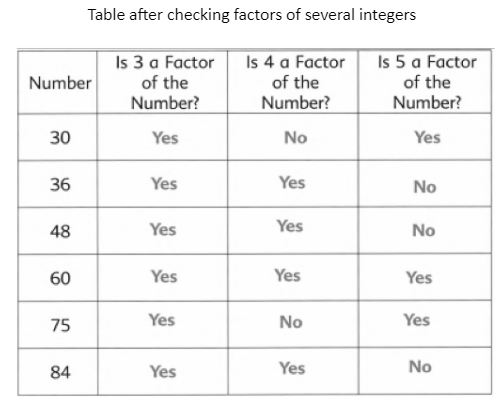
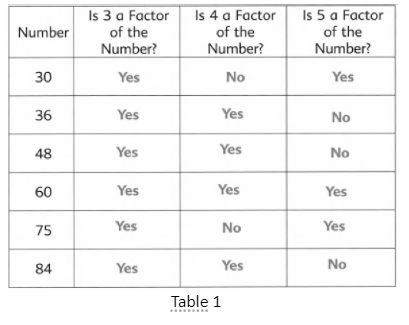
Given: 36,48,60,75,84 and digit 3,4,5
To check that integer from 36,48,60,75,84 has 3,4,5 as a factor of integer
Use condition for multiples of 3,4,5 and check it
Factors of 36
Sum of digits of 36 is 9 which is a multiple of 3 so 3 is a factor of 36
Integer 36 is an even number and its last two digits are divisible by 4 so 4 is a factor of 36.
Integer 36 has 6 at ones place so 5 is not a factor of 36.
Factors of 48
Sum of digits of integer 48 is 12 which is a multiple of 3 so 3 is a factor of 48
Integer 48 is an even number and its last two digits are divisible by 4 so 4 is a factor of 48.
Integer 48 has 8 at ones place so 5 is not a factor of 48.
Factors of 60
Sum of digits of integer 60 is 6 which is a multiple of 3 so 3 is a factor of 60
Integer 60 is an even number and its last two digits are divisible by 4 so 4 is a factor of 60.
Integer 60 has 0 at ones place so 5 is a factor of 60.
Factors of 75
Sum of digits of integer 75 is 12 which is a multiple of 3 so 3 is a factor of 75
Integer 75 is an odd number so 4 is not a factor of 75.
Integer 75 has 5 at ones place so 5 is a factor of 75.
Factors of 84
Sum of digits of integer 84 is 12 which is a multiple of 3 so 3 is a factor of 84
Integer 84 is an even number and its last two digits are divisible by 4 so 4 is a factor of 84.
Integer 84 has 4 at ones place so 5 is not a factor of 84.
Combining all the answers, we have
Therefore
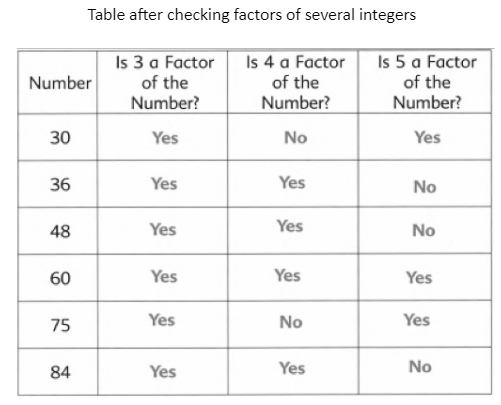
Integer 36 : 3 is a factor of 36, 4 is a factor of 36, and 5 is not a factor of 36.
Integer 48 : 3 is a factor of 48,4 is a factor of 48, and 5 is not a factor of 48.
Integer 60 : 3 is a factor of 60,4 is a factor of 60, and 5 is a factor of 60.
Integer 75 : 3 is a factor of 75,4 is not a factor of 75, 5 is a factor of 75.
Integer 84 : 3 is a factor of 84, 4 is a factor of 84, and 5 is not a factor of 84.
The combined answers of questions above are:
Page 25 Exercise 1.9 Problem 4
Given: Answer from above Question
To find – Common factor of all the integer
Observe the result of the above Question and find the common factor
Result of above Question
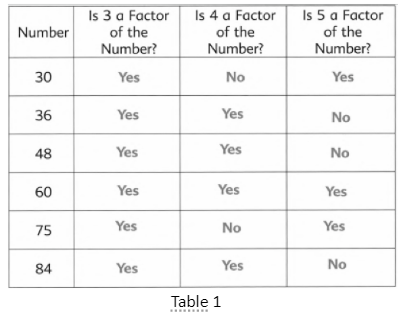
As we can see from the result of above Question, 3 is a common factor of all integers 30,36,48,60,75,84
As we can see from the result of above Question, 3 is a common factor of all integers 30,36,48,60,75,84.
Page 26 Exercise 1.9 Problem 5
Given: 64
To find all the factor of the given number.
We have to find all the numbers when multiplied is equal to 64
1 × 64 = 64
2 × 32 = 64
4 × 16 = 64
8 × 8 = 64
64 is a multiple of 1,2,4,8,16,32 and 64
Therefore, the factors of 64 are 1,2,4,8,16,32 and 64
The factors of 64 are 1,2,4,8,16,32 and 64.
Page 26 Exercise 1.9 Problem 6
Given: 72
To find all the factor of the given number.
We have to find all the numbers when multiplied is equal to 72
1 × 72 = 72
2 × 36 = 72
4 × 18 = 72
8 × 9 = 72
72 is a multiple of 1,2,4,8,9,18,36 and 72
Therefore, the factors of 72 are 1,2,4,8,9,18,36 and 72
The factors of 72 are 1,2,4,8,9,18,36 and 72
Page 26 Exercise 1.9 Problem 7
Given: 84
To find all the factor of the given number.
We have to find all the numbers when multiplied is equal to 84
1 × 84 = 84
2 × 42 = 84
4 × 21= 84
7 × 12 = 84
84 is a multiple of 1,2,4,7,12,21,42 and 84
Therefore, the factors of 84 are 1,2,4,7,12,21,42 and 84
The factors of 84 are 1,2,4,7,12,21,42 and 84
Page 26 Exercise 1.9 Problem 8
Given: 98
To find all the factor of the given number.
We have to find all the numbers when multiplied is equal to 98
1 × 98 = 98
2 × 49 = 98
14 × 7 = 98
98 is a multiple of 1,2,7,14,49, and 98
Therefore, the factors of 98 are 1,2,7,14,49, and 98
The factors of 98 are 1,2,7,14,49, and 98
Page 26 Exercise 1.9 Problem 9
Given: 60
To find all the factor of the given number.
We have to find all the numbers when multiplied is equal to 60
1 × 60 = 60
2 × 30 = 60
4 × 15 = 60
5 × 12 = 60
6 × 10 = 60
60 is a multiple of 1,2,4,5,6,10,12,15,30 and 60
Therefore, the factors of 60 are 1,2,4,5,6,10,12,15,30 and 60
The factors of 60 are 1,2,4,5,6,10,12,15,30 and 60
Page 27 Exercise 1.9 Problem 10
Given: 64 = 2 × 8 ×_____ × _____
To find – The missing factors.
We have to use prime numbers for the missing factors.
Solve for x.
Let the missing factor be x
64 = 2 × 8 × x
⇒ x = \(\frac{64}{16}\)
⇒ x = 4
Here, the missing factor should be of the form of prime numbers.
We know that 4 can be written as 4=2×2 and we also know that is a prime number.
Therefore, the missing factors are 2 and 2
64 = 2 × 8 × 2 × 2
Page 27 Exercise 1.9 Problem 11
Given: 84 = 6 ×_____ × _____
To find- The missing factors.
We have to use prime numbers for the missing factors.
Solve for x.
Let the missing factor be x
84 = 6 × x
⇒ x = \(\frac{84}{6}\)
⇒ x = 14
Here, the missing factor should be of the form of prime numbers.
We know that 14 can be written as 14 = 7 × 2 and we also know that 2 and 7 are prime number.
Therefore, the missing factors are 2 and 7
Hence, the missing factors are 84=6 × 2 × 7
Page 27 Exercise 1.9 Problem 12
Given: 45 =_____×_____×5
To find – The missing factors.
We have to use prime numbers for the missing factors.
Solve for x.
Let the missing factors be x
45 = x × 5
⇒ x = \(\frac{45}{5}\)
⇒ x = 9
Here, the missing factor should be of the form of prime numbers.
We know that 9 can be written as 9 = 3 × 3 and we also know that 3 and 3 are prime number.
Therefore, the missing factors are 3 and 3
Hence the factors are 45 = 3 × 3 × 5
Page 27 Exercise 1.9 Problem 13
Given: 72=_____×4×_____×_____
To find – The missing factors.
We have to use prime numbers for the missing factors.
Solve for x.
Let the missing factors be x
72 = x × 4
⇒ x = \(\frac{72}{4}\)
⇒ x = 18
Here, the missing factor should be of the form of prime numbers.
We know that 18 can be written as 18 = 2 × 3 × 3 and we also know that 2 and 3 are prime number.
Therefore, the missing factors are 2 ,3 and 3
Hence, the missing factors are 72 = 2 × 4 × 3 × 3
Page 27 Exercise 1.9 Problem 14
Given: 24 = 3 × 2 × n
To find – The missing factors n.
Solve the equation for n.
Simplifying the equation
24 = 3 × 2 × n
⇒ 24 = 6n
Dividing
⇒ n = \(\frac{24}{6}\)
⇒ n = 4
The missing factor is n = 4
Page 27 Exercise 1.9 Problem 15
Given: 18 = 3 × 2 × n
To find – The missing factors n.
Solve the equation for n.
Simplifying the equation
18 = 3 × 2 × n
⇒ 18 = 6n
Dividing
⇒ n = \(\frac{18}{6}\)
⇒ n = 3
Therefore the value of n in the expression 18=3×2×n will be n = 3
Page 27 Exercise 1.9 Problem 16
Given: 25 × 4 = 5 × n × 4
To find – The missing factors n.
Solve the equation for n.
Simplifying the equation
25 × 4 = 5 × n × 4
⇒ 25 × 4 = 20n
Dividing
⇒ n = \(\frac{25×4}{20}\)
⇒ n = 5
The value of n in the equation 25 × 4 = 5 × n × 4 will be n=5
Page 27 Exercise 1.9 Problem 17
Given: 21 × 20 = 21 × n × 2
To find- The missing factors n.
Solve the equation for n.
Simplifying the equation
21 × 20 = 21 × n × 2
⇒ 21 × 20 = 21 × 2 × n
Dividing
⇒ n = \(\frac{21×20}{21×2}\)
⇒ n = 10
The missing factors represented by n is 10.
Page 27 Exercise 1.9 Problem 18
Given: 3 × 32 = 6 × n
To find- The missing factors n.
Solve the equation for n.
Simplifying the equation
3 × 32 = 6 × n
⇒ n=\(\frac{3×32}{6}\)
Dividing
⇒ n= \(\frac{1×32}{2}\)
⇒ n = 16
The value of n in the equation 3 × 32 = 6 × n will be n = 16
Page 27 Exercise 1.9 Problem 19
Given: 16 × 2 = 4 × n
To find- The missing factors n.
Solve the equation for n.
Simplifying the equation
16 × 2 = 4 × n
⇒ n = \(\frac{16×1}{2}\)
n = 8
The value of n in the equation 16×2=4×n will be n = 8
Page 27 Exercise 1.9 Problem 20
Given: To find if 4 is a common factor of 36 and 60
To solve this question, 36 and 60 by divide 4
If it leaves a remainder, then 4 is not a factor.
If it doesn’t leave a remainder, then 4 is a factor
Divide 36 by divide 4
⇒ \(\frac{36}{4}\)
⇒ 9
When dividing 36 by 4, there is no reminder.
Therefore, 4 is a common factor of 36
Divide 60 by divide 4
⇒ \(\frac{60}{4}\)
⇒ 15
When divided 60 by 4, there is no reminder.
Therefore, 4 is a common factor of 60
4 is a common factor of 36 and 60.
Page 27 Exercise 1.9 Problem 21
Given: To find if 4 is a common factor of 48 and 90
To solve this question, 48 and 90 by divide 4
If it leaves a remainder, then 4 is not a factor.
If it doesn’t leave a remainder, then 4 is a factor
Divide 48 by divide 4
\(\frac{90}{4}\)⇒ 22.5
Since when we divide 90 by 4, the answer is of the decimal form. Therefore it has a reminder.
Therefore, 4 is not the common factor of 90
⇒ 90
4 is a common factor of 48 but not the common factor of 90.
Page 27 Exercise 1.9 Problem 22
Given: To find if 6 is a common factor of 30 and 78
To solve this question, 30 and 78 by divide 6
If it leaves a remainder, then 6 is not a factor.
If it doesn’t leave a remainder, then 6 is a factor
Divide 30 by divide 6
⇒ \(\frac{30}{6}\)
⇒ 5
When dividing 30 by 6, there is no reminder.
Therefore, 6 is a common factor of 30
Divide 78 by divide 6
⇒ \(\frac{78}{6}\)
⇒ 13
When dividing 78 by 6, there is no reminder.
Therefore, 6 is a common factor of 78
6 is a common factor of 30 and 78.
Page 28 Exercise 9 Problem 23
Given:
Multiple of 3: 3,6,9,12,15,18,…
Multiple of 2: 2,4,6,8,10,12,…
To find –The first two common multiples of 3 and 2
The numbers which are both the multiple of 3 and 2 are the common multiples of 3 and 2.
By observing the multiples of 3 and 2, 6 and 12 are both the multiple of 3 and 2.
Therefore, 6 and 12 are the first two common multiples of 3 and 2.
The first two common multiples of 3 and 2 are 6 and 12.
Page 27 Exercise 1.9 Problem 24
Given:
Multiple of 8: 8,16,24,32…….
Multiple of 4: 4,8,12,16,…
To find the first two common multiples of 8 and 4
The numbers which are both the multiple of 8 and 4 are the common multiples of 8 and 4.
By observing the multiples of 8 and 4, 8and 16are both the multiples of 8 and 4.
Therefore, 8 and 16 are the first two common multiples of 8 and 4.
The first two common multiples of 8 and 4 are 8 and 16.
Page 27 Exercise 1.9 Problem 25
To find – The first two common multiples of 9 and 6
The numbers which are both the multiple of 9 and 6 are the common multiples of 9 and 6.
First, find the multiples of 9 and 6
Then observe the multiples of 9 and 6 and find their first two common multiples.
Multiple of 9: 9,18,27,36,45…
Multiple of 6:6,12,18,24,30,36…
By observing the multiples of 9 and 6, 18 and 36 are both the multiples of 9 and 6.
Therefore, 9 and 6 are the first two common multiples of 18 and 36.
The first two common multiples of 9 and 6 are 18 and 36.
Page 27 Exercise 1.9 Problem 26
To find – The first two common multiples of 8 and 6
The numbers which are both the multiple of 8 and 6 are the common multiples of 8 and 6.
First, find the multiples of 8 and 6
Then observe the multiples of 8 and 6 and find their first two common multiples.
Multiple of 8: 8,16,24,32,40,48,56,…
Multiple of 6: 6,12,18,24,30,36,42,48,54,…
By observing the multiples of 8 and 6, 24 and 48 are both the multiple of 8 and 6.
Therefore, 8 and 6 are the first two common multiples of 24 and 48.
The first two common multiples of 8 and 6 are 24 and 48.
Page 29 Exercise 1.10 Problem 1
Given: 8 + 12 + 20
To find – The value of each of the given expressions.
Add the first two-term
⇒ 8 + 12 + 20
⇒ 20 + 20
Now add the remaining terms
Therefore, the value of the expression, 8 + 12 + 20 = 40
Page 29 Exercise 1.10 Problem 2
Given: 40 − 14 −9
To find – The value of each of the given expressions.
Add the terms that are of the same signs.
⇒ 40 − 14 − 9
⇒ 40 − 23
Now subtract the remaining terms (since the sign of the greatest number is positive, the answer also has a positive sign.)
⇒ 17
Therefore, the value of the expression, 40 − 14 − 9 = 17
Page 29 Exercise 1.10 Problem 3
Given: 26 + 8 − 9
To find – The value of each of the given expressions.
Add the terms that are of the same signs.
⇒ 26 + 8 − 9
⇒ 34 − 9
Now subtract the remaining terms (since the sign of the greatest number is positive, the answer also has a positive sign.)
⇒ 25
Therefore, the value of the expression, 26 + 8 − 9 = 25
Page 29 Exercise 1.10 Problem 4
Given: 21−5 + 8
To find – The value of each of the given expressions.
Add the terms that are of the same signs.
⇒ 21 − 5 + 8
⇒ 29 − 5
⇒ 24
Now subtract the remaining terms (since the sign of the greatest number is positive, the answer also has a positive sign.)
⇒ 24
Therefore, the value of the expression, 21−5 + 8 = 24
Page 29 Exercise 1.10 Problem 5
Given: 3 × 5 × 8
To find – The value of each of the given expressions.
First, multiply the first two terms.
⇒ 3 × 5 × 8
⇒ 15 × 8
Now multiply the remaining terms.
⇒ 120
Therefore, the value of the expression,3 × 5 × 8 = 120
Page 29 Exercise 1.10 Problem 6
Given: 36 ÷ 3 ÷ 4
To find – The value of each of the given expressions.
First, divide the first two terms.
⇒ 36 ÷ 3 ÷ 4
⇒ 12 ÷ 4
Now divide the remaining terms.
⇒ 3
Therefore, the value of the expression, 36 ÷ 3 ÷ 4 = 3
Page 29 Exercise 1.10 Problem 7
Given: 4 × 9 − 3
To find – The value of each of the given expressions.
Use BODMAS rule to find the value of the expression.
By BODMAS rule, first, multiply the first two terms.
⇒ 4 × 9 − 3
⇒ 36 − 3
Now subtract the remaining terms. (Since the sign of the greatest number is positive, the answer also has a positive sign.)
⇒ 36 − 3 = 33
Therefore, the value of the expression,4 × 9 − 3 = 33
Page 29 Exercise 1.10 Problem 8
Given: 64 ÷ 8 × 5
To find – The value of each of the given expressions.
By BODMAS rule, we have to first divide the given expression and then multiply.(since in the order of operations division is followed by multiplication)
First, divide the first two terms.
⇒ 64 ÷ 8 × 5
⇒ 8 × 5
Now multiply the remaining terms.
⇒ 40
Therefore, the value of the expression,64 ÷ 8 × 5 = 40
Page 29 Exercise 1.10 Problem 9
Given: 24 ÷ 6 × 8
To find – The value of each of the given expressions.
By BODMAS rule, we have to first divide the given expression and then multiply.(Since in the order of operations division is followed by multiplication)
First divide the first two terms.
⇒ 24 ÷ 6 × 8
⇒ 4 × 8
Now multiply the remaining terms.
⇒ 32
Therefore, the value of the expression, 24 ÷ 6 × 8 = 32
Page 29 Exercise 1.10 Problem 10
Given: 140 − 40 × 3
To find- The value of each of the given expressions.
By BODMAS rule, we have to first multiply the given expression and then subtract.(Since in the order of operations multiplication is followed by subtraction)
First, multiply the last two terms.
⇒ 140−40 × 3 = 140 − 120
Now subtract the remaining terms.
Here, since the greatest number is negative the answer holds a negative sign.
⇒ 140 − 120 = 20
Therefore, the value of the expression,140 − 40 × 3 = 20
Page 29 Exercise 1.10 Problem 11
Given: 46 + 32 ÷ 8
To find – The value of each of the given expression.
By BODMAS rule, we have to first divide the given expression and then add.(Since in the order of operations division is followed by addition)
First divide the last two terms.
⇒ 46 + 32 ÷ 8
⇒ 46 + 4
Now add the remaining terms.
⇒ 50
Therefore, the value of the expression,46 + 32 ÷ 8 = 50
Page 29 Exercise 1.10 Problem 12
Given: 100−60÷4
To find – The value of each of the given expressions.
By BODMAS rule, we have to first divide the given expression and then subtract.(Since in the order of operations division is followed by subtraction)
First divide the last two terms.
⇒ 100−60 ÷ 4
⇒ 100 −15
Now subtract the remaining terms. (since the sign of the greatest number is positive, the answer takes a positive sign.)
⇒ 85
Therefore, the value of the expression,100−60 ÷ 4 = 85
Page 29 Exercise 1.10 Problem 13
Given: 8 × 6 + 14
To find – The value of each of the given expressions.
By BODMAS rule, we have to first multiply the given expression and then add.(Since in the order of operations multiplication is followed by addition)
First multiply the first two terms.
⇒ 8 × 6 + 14
⇒ 48 + 14
Now add the remaining terms. (since the sign of the greatest number is positive, the answer takes a positive sign.)
⇒ 62
Therefore, the value of the expression,8 × 6 + 14 = 62
Page 29 Exercise 1.10 Problem 14
Given: 12 + 18 ÷ 6
To find – The value of each of the given expressions.
By BODMAS rule, we have to first divide the given expression and then add.(Since in the order of operations multiplication is followed by addition)
First divide the last two terms.
⇒ 12 + 18 ÷ 6
⇒12 + 3
Now add the remaining terms.
⇒15
Therefore, the value of the expression,12 + 18 ÷ 6 = 15
Page 29 Exercise 1.10 Problem 15
Given: 6 × 10 − 5
To find- The value of each of the given expressions.
By BODMAS rule, we have to first multiply the given expression and then subtract. (Since in the order of operations multiplication is followed by addition)
First multiply the first two terms.
⇒ 6 × 10 − 5
⇒ 60 − 5
Now subtract the remaining terms. (Since the sign of the greatest number is positive, the answer takes a positive sign.)
⇒ 55
Therefore, the value of the expression,6 × 10 − 5 = 55
Page 29 Exercise 1.10 Problem 16
Given: 72 + 6 × 6
To find – The value of each of the given expressions.
By BODMAS rule, we have to first multiply the given expression and then add.(Since in the order of operations multiplication is followed by addition)
First, multiply the last two terms.
⇒ 72 + 6 × 6
⇒ 72 + 36
Now add the remaining terms.
⇒ 108
Therefore, the value of the expression, 72 + 6 × 6 = 108
Page 30 Exercise 1.10 Problem 17
Given: 20 + 4 ÷ 4 − 4
To find the value of each of the given expressions.
By BODMAS rule, we have to first divide the given expression, then add and then subtract. (Since in the order of operations multiplication is followed by addition and then by subtraction)
First divide the middle two terms.
⇒ 20 + (4 ÷ 4) − 4
⇒ 20 + 1 − 4
Now add the first two terms and then subtract.(Since the sign of the greatest number is positive, the answer takes a positive sign.)
⇒ 21 − 4
⇒ 17
Therefore, value of the expression,20 + 4 ÷ 4 − 4 = 17
Page 30 Exercise 1.10 Problem 18
Given: 6 × 2−10 ÷ 5
To find – The value of each of the given expression.
By BODMAS rule, we have to first divide the given expression, then multiply and then subtract.(Since in the order of operations division is followed by multiplication and then by subtraction)
First divide the last two terms.
⇒ 6 × 2 − 10 ÷ 5
⇒ 6 × 2−2
Now multiply the first two terms and then subtract. (Since the sign of the greatest number is positive, the answer takes a positive sign.)
⇒ 12 − 2
⇒ 10
Therefore, the value of the expression,6 × 2−10 ÷ 5 = 10
Page 30 Exercise 1.10 Problem 19
Given: 80−36 ÷ 4 × 3
To find – The value of each of the given expressions.
By BODMAS rule, we have to first divide the given expression, then multiply and then subtract. (Since in the order of operations division is followed by multiplication and then by subtraction)
First divide the middle two terms.
⇒ 80 − (36÷4) × 3
⇒ 80−9 × 3
Now multiply the last two terms and then subtract.(Since the sign of the greatest number is positive, the answer takes a positive sign.)
⇒ 80 − 27
⇒ 53
Therefore, the value of the expression, 80−36 ÷ 4 × 3 = 53
Page 30 Exercise 1.10 Problem 20
Given: 32 + 8 + 10 × 2.
To find – The value of each of the given expression.
Use the strategy of BODMAS.
Thus, the first operation will be multiplication and then addition.
Referring to the question
32 + 8 + 10 × 2
Using BODMAS
32 + 8 + 20
= 60
Hence, the value of 32 + 8 + 10 × 2 is 60.
Page 30 Exercise 1.10 Problem 21
Given: 52−35 ÷ 7 − 7 × 2.
To find – The value of the given expression.
Use the strategy of BODMAS.
Thus, the first operation will be division, then multiplication, and then addition and subtraction.
Referring to the question
52 − 35 ÷ 7 − 7 × 2
Using BODMAS
52−5−14
= 33
Hence, the value of 52−35÷7−7 × 2 is 33.
Page 30 Exercise 1.10 Problem 22
Given: 9 × 8 − 6 × 10.
To find – The value of the given expression.
Use the strategy of BODMAS.
Thus, the first operation will be multiplication and subtraction.
Referring to the question
9 × 8−6 × 10
Using BODMAS
72 − 60
Hence, the value of 9 × 8−6 × 10 is 12.
Page 30 Exercise 1.10 Problem 23
Given: 7 × 8 + 24 ÷ 8.
To find – The value of the given expression.
Use the strategy of BODMAS.
Thus, the first operation will be division, then multiplication and then addition.
Referring to the question
7 × 8 + 24 ÷ 8
Using BODMAS
56 + 3
= 59
Hence, the value of 7 × 8 + 24 ÷ 8 is 59.
Page 30 Exercise 1.10 Problem 24
Given: 63÷9 + 20 ÷ 10.
To find – The value of the given expression.
Use the strategy of BODMAS.
Thus, the first operation will be division and then addition.
Referring to the question
63 ÷ 9 + 20 ÷ 10
Using BODMAS
7 + 2
= 9
Hence, the value of 63 ÷ 9 + 20 ÷ 10 is 9.
Page 30 Exercise 1.10 Problem 25
Given:
To find – The value of 12 + 49 ÷ 7 × 3.
Use the strategy of BODMAS.
Thus, the first operation will be division, then multiplication, and then addition.
Referring to the question
12 + 49 ÷ 7 × 3
Using BODMAS
12 + 21
= 33
Hence, the value of 12 + 49 ÷ 7 × 3 is 33.
Page 30 Exercise 1.10 Problem 26
Given: 5×8−32÷4+18.
To find – The value of the given expression.
Use the strategy of BODMAS.
Thus, the first operation will be division, then multiplication, and then addition and subtraction.
Referring to the question
5 × 8 − 32 ÷ 4 + 18
Using BODMAS
40 − 8 + 18
= 50
Hence, the value of 5 × 8 − 32 ÷ 4 + 18 is 50.
Page 31 Exercise 1. 11 Problem 1
Given: 9 + (26−15).
To find – The value of the given expression.
Use the strategy of BODMAS.
Thus, the first operation will be opening the brackets followed by addition and subtraction.
Referring to the question
⇒ 9 + (26 − 15)
Using BODMAS
⇒ 9 + 26 − 15
= 20
Hence, the value of 9 + (26−15) is 20.
Page 31 Exercise 1. 11 Problem 2
Given: 90−(4 + 6).
To find – The value of the given expression.
Use the strategy of BODMAS.
Thus, the first operation will be opening the brackets followed by addition and subtraction.
Referring to the question
⇒ 90− (4 + 6)
Using BODMAS
⇒ 90 − 4 − 6
= 80
Hence, the value of 90 − (4 + 6) is 80.
Page 31 Exercise 1. 11 Problem 3
Given: 12 − (10 − 8).
To find – The value of the given expression.
Use the strategy of BODMAS.
Thus, the first operation will be opening the brackets followed by addition and subtraction.
Referring to the question
⇒ 12 − (10 − 8)
Using BODMAS
⇒ 12 − 10 + 8
= 10
Hence, the value of 12−(10−8) is 10.
Page 31 Exercise 1. 11 Problem 4
Given: (31 − 20) − 8
To find – The value of the given expression.
Use the strategy of BODMAS.
Thus, the first operation will be opening the brackets followed by addition and subtraction.
Referring to the question
⇒ (31−20)−8
Using BODMAS
⇒ 31−20−8
= 3
Hence, the value of (31−20)−8 is 3.
Page 31 Exercise 1. 11 Problem 5
Given: 8 × (3 × 2).
To find – The value of the given expression.
Use the strategy of BODMAS.
Thus, the first operation will be opening the brackets followed by multiplication.
Referring to the question
⇒ 8 × (3 × 2)
Using BODMAS
⇒ 8 × 3 × 2
= 48
Hence, the value of 8 × (3 × 2) is 48.
Page 31 Exercise 1. 11 Problem 6
Given: 20 ÷ (4 ÷ 2).
To find – The value of the given expression.
Use the strategy of BODMAS. Thus, the first operation will be solving the operation in the bracket followed by division.
Referring to the question
⇒ 20 ÷ (4 ÷ 2)
Using BODMAS
⇒ 20 ÷ 2
= 10
Hence, the value of 20 ÷ (4 ÷ 2) is 10.
Page 31 Exercise 1. 11 Problem 7
Given: 9 × (15 ÷ 3)
To find – The value of the given expression.
Use the strategy of BODMAS. Thus, the first operation will be solving the operation in the bracket followed by multiplication.
Referring to the question
⇒ 9 × (15 ÷ 3)
Using BODMAS
⇒ 9 × 5
= 45
Hence, the value of 9 × (15 ÷ 3) is 45.
Page 31 Exercise 1. 11 Problem 8
Given: 15 ÷ (5 × 3).
To find – The value of the given expression.
Use the strategy of BODMAS.
Thus, the first operation will be solving the operation in the bracket followed by division.
Referring to the question
⇒ 15 ÷ (5 × 3)
Using BODMAS
⇒ 15 ÷ 15
= 1
Hence, the value of 15 ÷ (5 ×3 ) is 1.
Page 31 Exercise 1. 11 Problem 9
Given: (9+6)÷5
To find the value of the given expression.
Use the strategy of BODMAS.
Thus, the first operation will be solving the operation in the bracket followed by division.
Referring to the question
⇒ (9 + 6) ÷ 5
Using BODMAS
⇒ 15 ÷ 5
= 3
Hence, the value of (9 + 6) ÷ 5 is 3.
Page 31 Exercise 1. 11 Problem 10
Given: 2 × (9−4)
To find – The value of
Use the strategy of BODMAS.
Thus, the first operation will be solving the operation in the bracket followed by multiplication.
Referring to the question
⇒ 2 × (9−4)
Using BODMAS
⇒ 2 × 5
= 10
Hence, the value of 2 × (9−4) is 10.
Page 31 Exercise 1. 11 Problem 11
Given: 12 ÷ (8−6)
To find – The value of the given expression.
Use the strategy of BODMAS.
Thus, the first operation will be solving the operation in the bracket followed by division.
Referring to the question
⇒ 12 ÷ (8−6)
Using BODMAS
⇒ 12 ÷ 2
= 6
Hence, the value of 12 ÷ (8−6) is 6.
Page 31 Exercise 1. 11 Problem 12
Given: (4 + 6) × 5.
To find – The value of the given expression.
Use the strategy of BODMAS.
Thus, the first operation will be solving the operation in the bracket followed by multiplication.
Referring to the question
⇒ (4 + 6) × 5
Using BODMAS
⇒ 10 × 5
= 50
Hence, the value of (4 + 6) × 5 is 50.
Page 31 Exercise 1. 11 Problem 13
Given: 10 × (15 ÷ 5)
To find – The value of the given expression.
Use the strategy of BODMAS.
Thus, the first operation will be solving the operation in the bracket followed by multiplication.
Referring to the question
⇒ 10 × (15 ÷ 5)
Using BODMAS
⇒ 10 × 3
= 30
Hence, the value of 10 × (15 ÷ 5) is 30.
Page 31 Exercise 1. 11 Problem 14
Given: (51 − 44) ÷ 7
To find – The value of the given expression
Use the strategy of BODMAS.
Thus, the first operation will be solving the operation in the bracket followed by division.
Referring to the question
⇒ (51 − 44) ÷ 7
Using BODMAS
⇒ 7 ÷ 7
= 1
Hence, the value of (51− 44) ÷ 7 is 1.
Page 31 Exercise 1. 11 Problem 15
Given: 72 ÷ (9 − 3)
To find – The value of the given expression 72÷(9−3).
Use the strategy of BODMAS.
Thus, the first operation will be solving the operation in the bracket followed by division.
Referring to the question
⇒ 72 ÷ (9−3)
Using BODMAS
⇒ 72 ÷ 6
= 12
Hence, the value of 72 ÷ (9−3) is 12.
Page 31 Exercise 1. 11 Problem 16
Given: (28 − 18) × 10
To find – The value of the given expression.
Use the strategy of BODMAS.
Thus, the first operation will be solving the operation in the bracket followed by multiplication.
Referring to the question
⇒ (28−18) ×10
Using BODMAS
⇒ 10 × 10
= 100
Hence, the value of (28−18)×10 is 100.
Page 32 Exercise 1. 11 Problem 17
Given: 20 + (8 + 4) ÷ 3 .
To find – The value of the given expression.
Use the strategy of BODMAS.
Thus, the first operation will be solving the operation in the bracket followed by division and addition.
Referring to the question
⇒ 20 + (8 + 4) ÷ 3
Using BODMAS
⇒ 20 + 12 ÷ 3
⇒ 20 + 4
= 24
Hence, the value of 20+(8+4)÷3 is 24.
Page 32 Exercise 1. 11 Problem 18
Given: 16 + (9 − 3)× 5
To find – The value of the given expression.
Use the strategy of BODMAS.
Thus, the first operation will be solving the operation in the bracket followed by multiplication and addition.
Referring to the question
⇒ 16 + (9 − 3) × 5
Using BODMAS
⇒ 16 + 6 × 5
⇒ 16 + 30
= 46
Hence, the value of 16 + (9−3) × 5 is 46.
Page 32 Exercise 1. 11 Problem 19
Given: 3 × (4 + 2) ÷ 2
To find – The value of the given expression.
Use the strategy of BODMAS.
Thus, the first operation will be solving the operation in the bracket followed by division and then multiplication.
Referring to the question
⇒ 3 × (4 + 2) ÷ 2
Using BODMAS
⇒ 3 × 6 ÷ 2
⇒ 3 × 3
Hence, the value of 3 × (4 + 2) ÷ 2 is 9.
Page 32 Exercise 1. 11 Problem 20
Given: 7 × (13 − 6) −19
To find – The value of the given expression.
Use the strategy of BODMAS.
Thus, the first operation will be solving the operation in the bracket followed by multiplication and subtraction.
Referring to the question
⇒ 7 × (13 − 6) − 19
Using BODMAS
⇒ 7 × 7−19
⇒ 49 − 19
= 30
Hence, the value of 7 × (13−6)−19 is 30.
Page 32 Exercise 1. 11 Problem 21
Given: 60 + (18 + 7) ÷ 5
To find – The value of the given expression.
Use the strategy of BODMAS.
Thus, the first operation will be solving the operation in the bracket followed by division and addition.
Referring to the question
⇒ 60 + (18 + 7) ÷ 5
Using BODMAS
⇒ 60 + 25 ÷ 5
⇒ 60 + 5
= 65
Hence, the value of 60 + (18 + 7) ÷ 5 is 65.
Page 32 Exercise 1. 11 Problem 22
Given: 8 × (11 − 8) ÷ 6
To find – The value of the given expression.
Use the strategy of BODMAS.
Thus, the first operation will be solving the operation in the bracket followed by multiplication and division.
Referring to the question
⇒ 8 × (11− 8) ÷ 6
Using BODMAS
⇒ 8 × 3 ÷ 6
⇒ 24 ÷ 6
Hence, the value of 8 × (11− 8) ÷ 6 is 4.
Page 32 Exercise 1. 11 Problem 23
Given: 24 ÷ 6 + 3 × (6−4)
To find – The value of the given expression.
Use the strategy of BODMAS.
Thus, the first operation will be solving the operation in the bracket followed by division and multiplication, and then addition.
Referring to the question
⇒ 24 ÷ 6 + 3 × (6−4)
Using BODMAS
⇒ 24 ÷ 6 + 3 × 2
⇒ 4 + 6
= 10
Hence, the value of 24 ÷ 6 + 3 × (6−4) is 10.
Page 32 Exercise 1. 11 Problem 24
Given: 10 + (28 − 8) ÷ 5 × 2
To find – The value of the given expression.
Use the strategy of BODMAS.
Thus, the first operation will be solving the operation in the bracket followed by division and multiplication, and then addition.
Referring to the question
⇒ 10 + (28−8) ÷ 5 × 2
Using BODMAS
⇒ 10 + 20 ÷ 5 × 2
⇒ 10 + 4 × 2
⇒ 10 + 8
= 18
Hence, the value of 10 + (28−8) ÷ 5 × 2 is 18.
Page 32 Exercise 1. 11 Problem 25
Given: 15×(8+2)−25÷5
To find – The value of the given expression.
Use the strategy of BODMAS.
Thus, the first operation will be solving the operation in the bracket followed by division and multiplication, and then subtraction.
Referring to the question
⇒ 15 × (8 + 2)−25 ÷ 5
Using BODMAS
⇒ 15 × 10 − 25 ÷ 5
⇒ 150 − 5
= 145
Hence, the value of 15 × (8 + 2) − 25 ÷ 5 is 145.
Page 32 Exercise 1. 11 Problem 26
Given: 100−8 × (5 + 2) ÷ 4
To find – The value of the given expression.
Use the strategy of BODMAS.
Thus, the first operation will be solving the operation in the bracket followed by multiplication and division, and then subtraction.
Referring to the question
⇒ 100 − 8 × (5 + 2) ÷ 4
Using BODMAS
⇒ 100 − 8 × 7 ÷ 4
⇒ 100 − 14
=86
Hence, the value of 100−8 × (5 + 2) ÷ 4 is 86.
Page 33 Exercise 1. 12 Problem 1
Given: Total number of beads = 50
Number of beads used to make necklace = 32
Number of beads bought = 18
To Find: Number of beads left
Use the strategy of BODMAS.
Thus, the first operation will be solving the operation in the bracket followed by addition.
Referring to the question, the following is the required expression
⇒ (50−32) + 18
Using BODMAS
⇒ 18 + 18
= 36
Hence, the number of beads left is 36.
Page 33 Exercise 1. 12 Problem 2
Given: Total number of muffins = 20
Number of muffins eaten = 5
Number of muffins given away = 10
To Find: Number of muffins left
Use the strategy of BODMAS.
Thus, the first operation will be solving the operation in the bracket followed by subtraction.
Referring to the question, the following is the required expression
⇒ 20−(5 + 10)
Using BODMAS
⇒ 20 − 15
= 5
Hence, the number of muffins left with Patrick is 5.
Page 33 Exercise 1. 12 Problem 3
Given: Total number of baseball cards with Sean = 15
Number of baseball cards with Adam = twice the number of cards with Sean
Number of baseball cards Adam bought = 10
To Find: Number of baseball cards with Adam
Use the strategy of BODMAS.
Thus, the first operation will be solving the operation in the bracket followed by multiplication.
Referring to the question, the following is the required expression
⇒ (15 × 2) + 10
Using BODMAS
⇒ 30 + 10
= 40
Hence, the number of baseball cards that Adam has is 40
Page 34 Exercise 1. 12 Problem 4
To Check: 24 = 3 × 8
Use the strategy of BODMAS.
Compare the LHS and RHS.
Referring to the question
LHS = 24
Using BODMAS
RHS = 3 × 8
= 24
Therefore, LHS = RHS so the given equation is true.
Page 34 Exercise 1. 12 Problem 5
To Check: 9 × 11 = 88
Use the strategy of BODMAS.
Compare the LHS and RHS.
Referring to the question
RHS =88
Using BODMAS
LHS = 9 × 11
= 99
Therefore, LHS ≠ RHS so the given equation is false.
Page 34 Exercise 1. 12 Problem 6
To Check: 8 + 35 = (3 × 5) + 8
Use the strategy of BODMAS.
Compare the LHS and RHS.
Referring to the question and using BODMAS
LHS = 8 + 35
⇒ 43
Referring to the question and using BODMAS
RHS = (3 × 5) + 8
⇒ 15 + 8
⇒ 23
Therefore, LHS ≠ RHS so the given equation is false.
Page 34 Exercise 1. 12 Problem 7
To Check: 16−9 = (7 × 8) − 49
Use the strategy of BODMAS.
Compare the LHS and RHS.
Referring to the question and using BODMAS
LHS = 16 − 9
⇒ 7
Referring to the question and using BODMAS
RHS = (7 × 8) − 49
⇒ 56 − 49
⇒ 7
Therefore, LHS = RHS so the given equation is true.
Page 34 Exercise 1. 12 Problem 8
To find – The value of (1×5)×10=5×10
Use the strategy of BODMAS.
Thus, the first operation will be multiplication in the brackets.
Check LHS = RHS
Referring to the question and using BODMAS
LHS = (1 × 5) × 10
= 5 × 10
= 50
Further Simplifying the equation
RHS = 5 × 10
= 50
So, LHS = RHS
Therefore, the equation (1 × 5) × 10 = 5 × 10 is True as
LHS=RHS
Page 34 Exercise 1. 12 Problem 9
To find – The value of 8+6=(2×3)+(5×2)
Use the strategy of BODMAS.
Thus, the first operation will be multiplication in the brackets.
Check LHS = RHS
Referring to the question and using BODMAS
LHS = 8 + 6
=14
Further Simplifying the equation
RHS = (2 × 3) + (5 × 2)
= 6 + 10
= 16
So, LHS ≠ RHS
Therefore, the equation 8+6=(2×3)+(5×2) is False as LHS ≠ RHS
Page 34 Exercise 1. 12 Problem 10
To find – The value of (20÷5)+2=(2×4)−(1×2)
Use the strategy of BODMAS.
Thus, the first operation will be multiplication in the brackets.
Check LHS = RHS
Referring to the question and using BODMAS
LHS = (20 ÷ 5) + 2
= 4 + 2
= 6
Further Simplifying the equation
RHS = (2 × 4) − (1 × 2)
= 8 − 2
= 6
So, LHS = RHS
Therefore, the equation (20 ÷ 5) + 2 = (2 × 4) − (1 × 2) is True as LHS = RHS
Page 34 Exercise 1.12 Problem 11
To find – The value of the blank in 36−(20−7)=……..−13
Use the strategy of BODMAS.
Thus, the first operation will be subtraction in the brackets.
Check LHS=RHS
Solve LHS to find the blank.
Referring to the question and using BODMAS
LHS = 36 − (20 − 7)
= 36 −13
Further Simplifying and comparing the equation
RHS= ………−13
So, Comparing LHS and RHS the value of the blank is 36
Therefore, the value of the blank is 36 making the equation True.
Page 34 Exercise 1.12 Problem 12
To find – The value of the blank in (5+8)×(4+6)=……..×10
Use the strategy of BODMAS.
Thus, the first operation will be an addition in the brackets.
Check LHS = RHS
Solve LHS to find the blank.
Referring to the question and using BODMAS
LHS = (5 + 8) × (4 + 6)
= 13 × 10
Further Simplifying and comparing the equation
RHS=………×10
So, Comparing LHS and RHS the value of the blank is 13
Therefore, the value of the blank is 13 making the equation True.
Page 34 Exercise 1.12 Problem 13
To find – The value of the blank in 100×(9÷3)=……..×3
Use the strategy of BODMAS.
Thus, the first operation will be division in the brackets.
Check LHS=RHS
Solve LHS to find the blank.
Referring to the question and using BODMAS
LHS = 100 × (9 ÷ 3)
= 100 × 3
Further Simplifying and comparing the equation
RHS =………×3
So, Comparing LHS and RHS the value of the blank is 100
Therefore, the value of the blank is 100 making the equation True.
Page 34 Exercise 1.12 Problem 14
To find – The value of the blank in (26−11)÷5 × 4 =……..×4
Use the strategy of BODMAS.
Thus, the first operation will be division in the brackets.
Check LHS = RHS
Solve LHS to find the blank.
Referring to the question and using BODMAS
LHS = (26−11) ÷ 5 × 4
= 15 ÷ 5 × 4
= 3 × 4
Further Simplifying and comparing the equation
RHS =………×4
So, Comparing LHS and RHS the value of the blank is 3
Therefore, the value of the blank is 3 making the equation True.
Page 34 Exercise 1.12 Problem 15
To insert the parentheses in the given equation 2+4÷2=3
Use the strategy of BODMAS to insert the brackets.
Check LHS = RHS
Solve LHS using parentheses to make it true for the equation.
Adding the parentheses at the addition rule to make the equation true
LHS = 2 + 4 ÷ 2
= (2 + 4) ÷ 2
Further Simplifying and comparing the equation
RHS = 3
LHS = (2 + 4) ÷ 2
= 6 ÷ 2
= 3
So, the parentheses will be inserted at addition making LHS as (2 + 4) ÷ 2
Therefore, the parentheses will be inserted at addition making LHS as (2+4)÷2 making the equation True.
Page 34 Exercise 1.12 Problem 16
To insert the parentheses in the given equation 6−2×3=0
Use the strategy of BODMAS to insert the brackets.
Check LHS = RHS
Solve LHS using parentheses to make it true for the equation.
Adding the parentheses at the multiplication rule to make the equation true
LHS = 6 − 2 × 3
= 6 − (2 × 3)
Further Simplifying and comparing the equation
RHS = 0
LHS = 6 − (2× 3)
= 6−6
= 0
So, the parentheses will be inserted at multiplication making LHS as 6−(2 × 3)
Therefore, the parentheses will be inserted at multiplication making LHS as 6−(2×3) making the equation True.
Page 34 Exercise 1.12 Problem 17
To insert the parentheses in the given equation 2 × 4− 3 + 2 = 7
Use the strategy of BODMAS to insert the brackets.
Check LHS = RHS
Solve LHS using parentheses to make it true for the equation.
Adding the parentheses at the multiplication rule to make the equation true
LHS = 2 × 4 − 3 + 2
= (2 × 4) − 3 + 2
Further Simplifying and comparing the equation
RHS = 7
LHS = (2 × 4) − 3 + 2
=8 − 3 + 2
= 5 + 2
= 7
So, the parentheses will be inserted at multiplication making LHS as (2 × 4)−3 + 2
Therefore, the parentheses will be inserted at multiplication making LHS as (2 × 4)−3 + 2 making the equation True.
Page 34 Exercise 1.12 Problem 18
To insert the parentheses in the given equation 2 × 4− 3 + 2 = 4
Use the strategy of BODMAS to insert the brackets.
Check LHS = RHS
Solve LHS using parentheses to make it true for the equation.
Adding the parentheses at the addition rule to make the equation true
LHS = 2 × 4 − 3 + 2
= 2 × (4−3) + 2
Further Simplifying and comparing the equation
RHS = 4
LHS = 2 × (4 − 3) + 2
= 2 × 1 + 2
= 2 + 2
= 4
So, the parentheses will be inserted at subtraction making LHS as 2 × (4 − 3) + 2
Therefore, the parentheses will be inserted at subtraction making LHS as 2 × (4 − 3) + 2 making the equation True.
Page 34 Exercise 1.12 Problem 19
To insert the parentheses in the given equation 2 × 4 − 3 + 2 = 3
Use the strategy of BODMAS to insert the brackets.
Check LHS = RHS
Solve LHS using parentheses to make it true for the equation.
Adding the parentheses at the addition rule to make the equation true
LHS = 2 × 4 − 3 + 2
= 2 × 4 − (3 + 2)
Further Simplifying and comparing the equation
RHS = 3
LHS = 2 × 4−(3 + 2)
= 8 − 5
= 3
So, the parentheses will be inserted at addition making LHS as 2 × 4 − (3 + 2)
Therefore, the parentheses will be inserted at addition making LHS as 2 × 4 − (3 + 2) making the equation True.