Probability and Statistics for Engineering and the Sciences 8th Edition Chapter 3 Discrete Random Variables and Probability Distributions
Page 95 Problem 1 Answer
Given – A concrete beam may fail either by shear(S) or flexure(F). We also have that randomly3
failed beams are selected and the type of failure is determined for each one.
Here, X =the number of beams among the three selected that failed by shear.
We will obtain each outcome in the sample space along with the associated value of X.
We will construct a table to summarize the values obtained.
We have:
X= the number of beams among the three selected that failed by shear
S= shear
F= flexure
We will construct the table as follows :
| OUTCOME | BEAM 1 | BEAM 2 | BEAM 3 | X |
| Outcome 1 | S | S | S | 3 |
| Outcome 2 | S | S | F | 2 |
| Outcome 3 | S | F | S | 2 |
| Outcome 4 | F | S | S | 2 |
| Outcome 5 | S | F | F | 1 |
| Outcome 6 | F | S | F | 1 |
| Outcome 7 | F | F | S | 1 |
| Outcome 8 | F | F | F | 0 |
Hence, we obtained each outcome in the sample space along with the associated value of X.
We get a total of 8 outcomes in the sample space.
The values of X associated with the outcomes are listed below:
| OUTCOME | BEAM 1 | BEAM 2 | BEAM 3 | X |
| Outcome 1 | S | S | S | 3 |
| Outcome 2 | S | S | F | 2 |
| Outcome 3 | S | F | S | 2 |
| Outcome 4 | F | S | S | 2 |
| Outcome 5 | S | F | F | 1 |
| Outcome 6 | F | S | F | 1 |
| Outcome 7 | F | F | S | 1 |
| Outcome 8 | F | F | F | 0 |
Page 95 Problem 2 Answer
Given -X=the number of nonzero digits in a randomly selected 4-digit PIN that has no restriction on the digits.
We will find the possible values of X.We will also give three possible outcomes and their associated X values.
We note that U.S. zip codes can have 4 digit PIN.
The values of X can be: X = 0,1,2,3,4
This is because the pin can have at most 4 nonzero digits.
We have X= the number of nonzero digits in a PIN.
We are given that there is no restriction on the digits of a pin, the three possible outcomes will be-
9022,when X=3
2356, when X=4
1000, when X=1
Possible values of X are:
X = 0,1,2,3,4
Possible outcomes are :
9022, when X= 3
2356, when X=4
1000, when X= 1
Probability And Statistics For Engineering 8th Edition Solutions Exercise 3.1 Page 95 Problem 3 Answer
Given – The sample space S is an infinite set We have to find that if we have any random variable,X defined from S will have an infinite set of possible values or not.
We will assume any infinite set for the following case.
Here we will suppose that S is a sample space which is an infinite set, where a randomly a number has been selected from N which includes digits 1,3 or 5.
X={1 if a randomly selected number from N includes digits 1 or 3 or 5; 0 otherwise
We see that X has only two values, but the sample space is infinite.
So, it means that it is not necessary that if sample space is an infinite set, then any random variable X defined from that sample spaceS will have an infinite number of possible values.
If the sample space is an infinite set, it is not necessarily imply that any random variable X defined from S will have an infinite set of possible values.
Page 95 Problem 4 Answer
Given – The variable X is the number of unbroken eggs in a randomly chosen standard egg carton.
We will find the set of possible values for the variable.
We will also need to check whether they are discrete or not.
Generally, a standard egg carton contains a dozen of eggs(a dozen means 12).
It means that a standard egg carton has 12 eggs.
Hence, the number of unbroken eggs can be:
{0,1,2,3,4,5,6,7,8,9,10,11,12}
(at most12)(This is because we cannot take any negative or decimals values as it is not possible to have number of eggs in negative or decimal values).
Hence, we get the set of possible values as:
{0,1,2,3,4,5,6,7,8,9,10,11,12}.
We will now check whether the set is discrete or not.
We note that a variable is said to be discrete if it has a specific value and are restricted to separate values like integers or we can say if the variable has counts.
A variable is said to be continuous if it can have any value over a continuous range like decimals, real numbers, etc.
We know the unbroken eggs are restricted to separate values and cannot be a decimals (any value over a continuous range).
Hence, we can say that X is discrete or countable.
For number of unbroken eggs in a randomly chosen standard egg carton, the set of possible values are:{0,1,2,3,4,5,6,7,8,9,10,11,12}
The given variable is discrete as it has counts.
Page 95 Problem 5 Answer
Given -Y = the number of students on a class list for a particular course who are absent on the first day of classes.
We will find the set of possible values of students who were absent on the first day of classes and also check if the set is discrete or not.
We will check if the set is countable or not.
Clearly, the number of students will not be a negative integer because the count of students cannot be a negative or decimal value.
Hence, the set of possible values will be: {0,1,2,3,4,5,6,7,8,9,……….}
We would have been able to reduce the set to that particular number if we had known the exact number of students.
We know that a variable is said to be discrete if it has a specific value and is restricted to separate values like integers or we can say if the variable has counts.
Also, a variable is continuous if it can have any value over a continuous range like decimals, real numbers, etc.
Hence, the variable is discrete because it has specific values.
It means it has a countable number of possible values.
ForY = the number of students on a class list for a particular course who are absent on the first day of class, the set of possible values are:
{0,1,2,3,4,5,6,7,8,9,…………}
The variable is discrete because it has counts.
Chapter 3 Exercise 3.1 Discrete Random Variables Solved Examples Page 95 Problem 6 Answer
Given -U =the number of times a duffer has to swing at a golf ball before hitting it.
We will find the set of possible values of the number of times a duffer has to swing at a golf ball before hitting it and also determine if the set is discrete or not.
We will use the definition of discrete random variables.
We note that the number of swings have to be positive integer.
This is due to the fact that a negative or decimal number of swings will not make sense and also 0 is not possible.
The set of possible values is:N={1,2,3,4,5,6,7,…..}
We note that a variable is said to be discrete if it has a specific values and are restricted to separate values like integers or we can say if the variable has counts.
However, a variable is continuous if it can have any value over a continuous range like decimals, real numbers, etc.
Thus, the variable is discrete as it has counts.
ForU= the number of times a duffer has to swing at a golf ball before hitting it, the set of possible values is: N={1,2,3,4,5,6,7,…..}
The variable is discrete because it has counts.
Page 95 Problem 7 Answer
Given that X=the length of a randomly selected rattle snake We will find the set of possible values for the variable.
We will also need to check if it is discrete or not.
Clearly, the length will be positive because negative length is meaningless.
Also the length of a snake is always non zero.
The length will be any integral value and it may take on decimal values .
Hence any nonnegative integer real number can be the length of a snake.
Therefore, the set of possible values is:{x is a real number∣x>0}.
Now, we will check for discrete.
Using the definition, we have:
Discrete random variable are restricted to defined separated values for example integers or count.
Continuous random variable are not restricted to defined separated values but can occupy any value over a continuous range for example decimal, real or rational numbers.
Hence,X is continuous but not discrete .
This is due to the fact that the length of a snake can take decimal values as well.
ForX = the length of a randomly selected rattle snake, the set of possible values is:
{x is a real number∣x>0}
Here,x is continuous but not discrete as the length of a snake can take decimal values as well.
Probability And Statistics 8th Edition Chapter 3 Exercise 3.1 Walkthrough Page 95 Problem 8 Answer
Given that Z= the sales tax percentage for a randomly selected amazon.com purchase.
We will find the set of possible values for the variable and also need to check whether it is discrete or not.
We will use the definition of discrete random variables.
Clearly, the sales tax percentage has to be positive, because a negative sales tax percentage is pointless.
A sales tax= 0 can be possible when we do not have to pay any sales tax.
The sales tax percentage can be at most100%, hence the sales tax is between0−100 %.
The sales tax percentage can take on integer values ans decimal values .
Hence any real number between 0 and100 % is possible.
Therefore, the set of possible values are :
{x %∣ x is a real number and 0≤x≤100}
We will now check whether the set is discrete or not.
We know that a variable is said to be discrete if it has a specific values and are restricted to separate values like integers or we can say if the variable has counts.
However, a variable is continuous if it can have any value over a continuous range like decimals, real numbers, etc.
Thus,x is continuous and not discrete.
This is due to the fact that sales tax percentage can take on decimal values as well.
ForZ= the sales tax percentage for a randomly selected amazon.com purchase , the set of possible values is : {x %∣ x is a real number and 0≤x≤100}
Here,x is continuous as sales tax percentage can take on decimal values as well.
Page 95 Problem 9 Answer
Given – Y= pH of a randomly chosen soil sample.
We will find the set of possible values for the variable and whether it is discrete or not.
We will use the definition of discrete random variables.
We know that the pH can only take on values between 0 and 14 including both the numbers.
Hence, the pH can take on integer values and can also take decimal values as well like pH of 2.5,etc.
Thus, any real number as pH can take number between 0 and 14 is possible.
We obtain the set of possible values as : {x∣x is a real number and 0≤x<14}
To determine it is discrete or not :
Now, we have to check if the set is discrete or not.
As we know, a variable is said to be discrete if it has a specific values and are restricted to separate values like integers or we can say if the variable has counts.
But a variable is continuous if it can have any value over a continuous range like decimals, real numbers, etc.
Hence,x is continuous but not discrete as pH can take on decimal values as well.
ForY = the pH of a randomly chosen soil sample, the set of possible values are : {x∣x is a real number and 0≤x<14}
Here,x is continuous but not discrete as pH can take on decimal values as well.
Page 95 Problem 10 Answer
Given that X is the tension (psi) at which a randomly selected tennis racket has been strung.
We need to find the set of possible values for the variable and check whether it is discrete or not.
We will use the definition of discrete random variables.
This will take values between the minimum possible tension, denoted as M1, and the maximum possible tension, denoted as M2.
Hence, all the possible values are: {x|M1≤x≤M2 , x ϵ R}
The tension can not be negative as a string cannot support negative tension which means, M1, M2 ≥ 0.
Now, we will check whether it is discrete or not.
We note that a variable is said to be discrete if it has a specific values and are restricted to separate values like integers or we can say if the variable has counts.
However, a variable is continuous if it can have any value over a continuous range like decimals, real numbers, etc.
We know that a random variable X that has a countable number of possible values either finite or countable infinite will be termed as discrete random variable.
As the given random variable has uncountable number of possible values, so we can say that it is not discrete.
For x to be the tension (psi) at which a randomly selected tennis racket has been strung, the set of possible values is: {M1≤x≤M2 , x ϵ R}
As the given random variable has uncountable number of possible values, we can conclude that it is not discrete.
Chapter 3 Exercise 3.1 Study Guide Probability And Statistics Page 95 Problem 11 Answer
Given – X=the total number of coin tosses required for three individuals to obtain a match (HHH or TTT).
We will describe the set of possible values for the variable, and state whether the variable is discrete.
We haveX= number of coin tosses required until three individuals obtain a match.
Here, don’t know how many coin tosses are required at most, the number of coin tosses required can be any positive integer .
Possible values ={1,2,3,….}=Z+
As the possible values are all integers, we can say that the variable is discrete.
We obtain : Possible values ={1,2,3,….}=Z+
The given variable is discrete.
Page 96 Problem 12 Answer
Given -T= the number of pumps at two pumps in use.
We need to give the possible values for given random variables.
We note that the possible values for T will begin from 0 up to the maximum number of pumps.
We know that the number of pumps at one station =6.
Also, the number of pumps at another station=4.
Hence, the total number of pumps=10.
Using the number of pumps, we can say that the possible values for Random variableT∈[0,10].
Total number of pumps in use or possible values for T are give as: 0,1,2,3,4,5,6,7,8,9,10
Page 96 Problem 13 Answer
Given – X denote the difference between pumps at each station.
We will give the possible values for the given random variable.
For station, 1. Number of pumps ∈{1,2,3,4,5,6}
We will construct a table for differences when the number of pumps are6
for the first stations and 4 for second station.
By taking differences of every pump at every station, we obtain table which is given below:
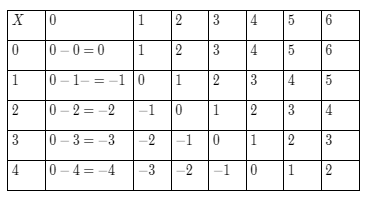
Looking at the above table we can conclude that the possible values of X will be: {−4,−3,−2,−1,0,1,2,3,4,5,6}
The possible values of X are :{−4,−3,−2,−1,0,1,2,3,4,5,6}
Discrete Random Variables Examples From Exercise 3.1 Engineering And Sciences Page 96 Problem 14 Answer
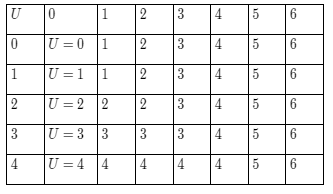
Given – U denote the maximum between pumps at each station.
For 1st station, Number of pumps ∈{1,2,3,4,5,6}
For 2nd station, Number of pumps ∈{1,2,3,4}
We need to give the possible values for the given random variables.We will ta
We will construct a table for maximum pumps when the number of pumps are 6 for the first stations and 4 for the second station.
We obtain : The possible values for the maximum number of pumps at either station is U∈[0,6].
The possible values of U are given below: 0,1,2,3,4,5,6.
Page 96 Problem 15 Answer
Given – The number of pumps at two pump stations are 6 And 4.
Also,Z=number of stations having exactly two pumps in use.
We will find the possible values of Z.
We will assign the values for the two stations.
The number of stations which have exactly two pumps in use :=2
Hence, the possible values for Random Variable Z∈[0,2].
The possible values for stations having exactly two pumps in use are: 0,1,2.