
Probability and Statistics for Engineering and the Sciences 8th Edition Chapter 3 Discrete Random Variables and Probability Distributions
Page 104 Problem 1 Answer
Given -An automobile service facility specializing in engine tune-ups knows that 45% of all tune-ups are done on four-cylinder automobiles,40% on six-cylinder automobiles, and 15% on eight cylinder automobiles.
We assume number of cylinders on the next car to betuned.
We will find the pmf of X.
We note that the probabilities are given in question as percentages.
We will convert it in integers to obtain the pmf.
Hence, the probability mass function is given by
P(X=4)=0.45
P(X=6)=0.4
P(X=8)=0.15 and
P(X=x)=0
for every other x.
We obtain:
P(X=4)=0.45
P(X=6)=0.4
P(X=8)=0.15
For other numbers, the probability is zero.
Chapter 3 Exercise 3.2 Discrete Random Variables Solved Examples Page 104 Problem 2 Answer
Given -An automobile service facility specializing in engine tune-ups knows that 45% of all tune-ups are done on four-cylinder automobiles, 40% on six-cylinder automobiles, and 15% on eight cylinder automobiles.
We suppose number of cylinders on the next car to be tuned.
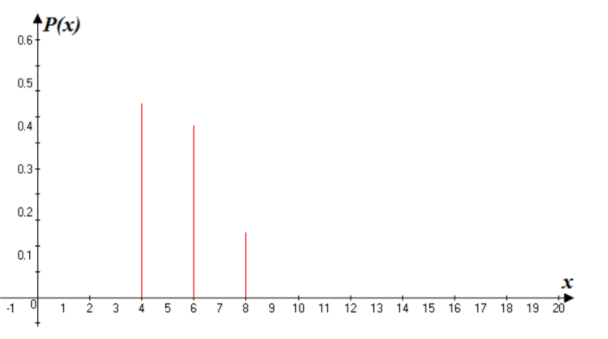
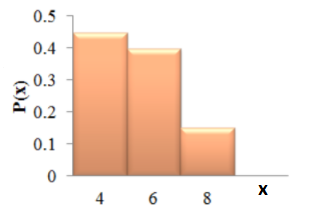
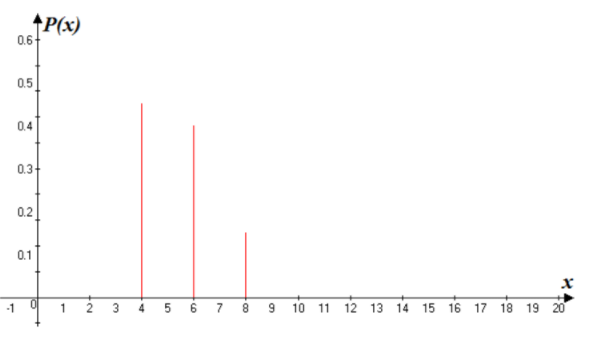
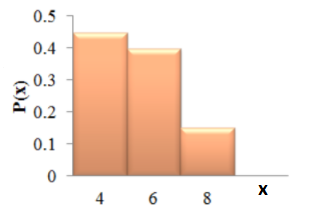
We will draw both a line graph and a probability histogram for the pmf of parta).
From part a), we know the probability values.
We will plot the graph as follows:
We will plot the histogram as follows :
The required graph is:
The required Histogram is:
Page 104 Problem 3 Answer
Given -An automobile service facility specializing in engine tune-ups knows that 45% of all tune-ups are done on four-cylinder automobiles,40% on six-cylinder automobiles, and 15% on eight cylinder automobiles.
We suppose number of cylinders on the next car to be tuned.
We will find the probability that the next car tuned has at least six cylinders and more than six cylinders.
We will obtain the probability that the next car tuned has at least six cylinders as shown below:
P( at least 6)
=P6+P8
=0.4+0.15
=0.55
The probability that the next car tuned has more than six cylinders is given as:
P8=15/100
P8=0.15
We obtain:
P(X≥6)=0.55
P(X>6)=0.15
Probability And Statistics 8th Edition Chapter 3 Exercise 3.2 Walkthrough Page 105 Problem 4 Answer
Given – In some parts of California are particularly earthquake-prone.
We suppose that in one metropolitan area, 25% of all homeowners are insured against earthquake damage.
Four homeowners are to be selected at random; let X denote the number among the four who have earthquake insurance.
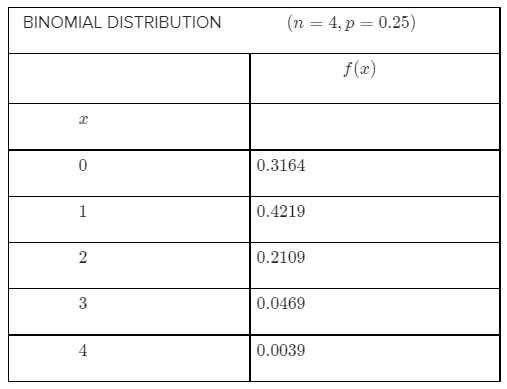
We will find the Probability Distribution of X.
We suppose that S denote a homeowner who has insurance and F one who does not.
Now, one possible outcome is SFSS , with probability (.25)(.75)(.25)(.25) and associated X value 3.
There are 15 other outcomes.
We have:
n=4
p=25%
=0.25
The possible outcomes are {SSSS, SSSF, SSFS, SSFF, SFSS, SFSF, SFFS, SFFF, FSSS, FSSF, FSFS,FSFF, FFSS, FFSF, FFFS, FFFF}
The event SSSS corresponds to X=4.
Also, the events SSSF, SSFS, SFSS, FSSS corresponds toX=3.
The events SSFF , SFSF, SFFS, FSSF, FSFS, FFSS correspond toX=3.
Events FFFS, FFSF,FSFF,SFFF corresponds to X=1 .
Event FFFF corresponds to X=0.
Using “Binomial Probability”, we get:
P(X=k)=4!/k!(4−k)!×0.25k×(1−0.2)4−k
We obtain:
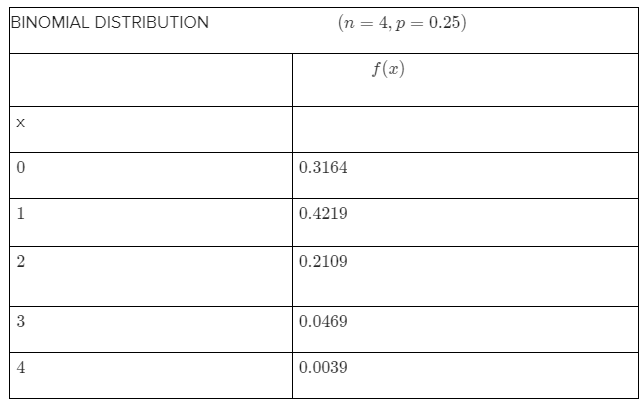
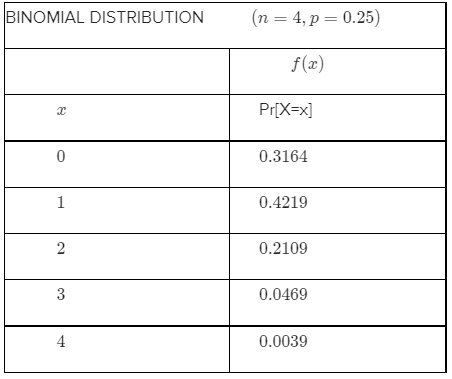
We obtain probability distribution of X as follows:
Page 105 Problem 5 Answer
Given – In some parts of California are particularly earthquake-prone.
We suppose that in one metropolitan area,25% of all homeowners are insured against earthquake damage.
Four homeowners are to be selected at random;X will denote the number among the four who have earthquake insurance.
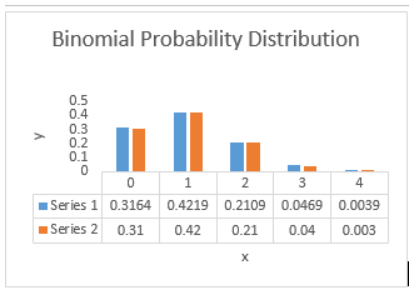
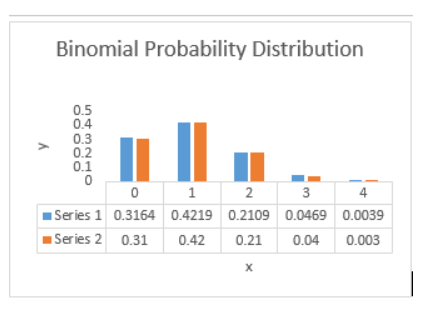
We need to draw the corresponding probability distribution.
We suppose that S denote a homeowner who has insurance and F one who does not.
Then one possible outcome is SFSS , with probability (.25)(.75)(.25)(.25) and associated X value 3.
There are 15 other outcomes.
We note that the width of bars should be same and the length of bars is equal to probability.
We can draw the bars sa follows:
We obtain probability distribution histogram as follows:
Chapter 3 Exercise 3.2 study guide Probability And Statistics Page 105 Problem 6 Answer
Given – In some parts of California are particularly earthquake-prone.
We assume that in one metropolitan area,25% of all homeowners are insured against earthquake damage.
Four homeowners are to be selected at random.
We suppose that X denotes the number among the four who have earthquake insurance.
We will find the most likely value for X.
We note that the most likely value for X is 1.
This is due to the fact that the probability for X=1 is highest.
We can check this by constructing the probability distribution table that X=1:
We conclude that the most likely value for X is 1.
Page 105 Problem 7 Answer
Given that in some parts of California are particularly earthquake-prone.
We assume that in one metropolitan area,25% of all homeowners are insured against earthquake damage.
Four homeowners are to be selected at random; let X denote the number among the four who have earthquake insurance.
We will find the probability that at least two of the four selected have earthquake insurance.
We will use the addition rule.
With the help of the the addition rule for disjoint events, we havet :
P(A or B)=P(A)+P(B) .
Now, adding the possibilities of the corresponding events, we get:
P(X≥2)=P(X=2)+P(X=3)+P(X=4)
P(X≥2) =0.2109+0.0469+0.0039
P(X≥2) =0.2617.
We obtained that the probability that at least two of the four selected have earthquake insurance is 0.2617.
Discrete Random Variables Examples From Exercise 3.2 Engineering and Sciences Page 105 Problem 8 Answer
We note that probability mass function= probability distribution.
We are given in the question thatY= the number of days beyond Wednesday that it takes for both magazines to arrive.
Hence,
P(Wed.) = .3
P(Thurs.) = .4
P(Fri.) = .2
P(Sat.) = .1
In order to get the probability mass function (pmf) of Y
we note that the possible values of Y are0,1,2,3.
We note that the possible outcomes are:
(W,W),(W,T),(W,F),(W,S)
(T,W),(T,T),(T,F),(T,S)
(F,W),(F,T),(F,F),(F,S)
(S,W),(S,T),(S,F),(S,S)
For y=0, we get:
P(Y=0)
=P(W,W)
=P(W)×P(W)
=0.3×0.3
=0.09
Fory=1, we get:
P(Y=1)=P[(W,T),(T,W),(T,T)]
=[P(W)×P(T)]+[P(T)×P(W)]+[P(T)×P(T)]
=[0.3×0.4]×[0.4×0.3]+[0.4×0.4]
=0.12+0.12+0.16
=0.4
Fory=2, we get:
P(Y=2)=P[(W,F),(T,F),(F,W),(F,T),(F,F)]
=[P(W)×P(F)]+[P(T)×P(F)]+[P(F)×P(W)]+[P(F)×P(T)]+[P(F)×P(F)]
=[0.3×0.2]+[0.4×0.2]+[0.2×0.3]+[0.2×0.4]+[0.2×0.2]
=0.06+0.08+0.06+0.08+0.04
=0.32
Fory=3, we get:
P(Y=3)=P[(W,S),(T,S),(F,S),(S,W),(S,T),(S,F),(S,S)]
[P(W)×P(S)]+[P(T)×P(S)]+[P(F)×P(S)]+[P(S)×P(W)]+[P(S)×P(T)]+[P(S)×P(F)]+[P(S)×P(S)]
=[0.3×0.1]+[0.4×0.1]+[0.2×0.1]+[0.1×0.3]+[0.1×0.4]+[0.1×0.2]+[0.1×0.1]
=0.03+0.04+0.02+0.03+0.04+0.02+0.01
=0.19
The probability mass function (pmf) of Y are given below:
P(Y=0)=0.09
P(Y=1)=0.4
P(Y=2)=0.32
P(Y=3)=0.19
Page 105 Problem 9 Answer
We have three couples and two single individuals.We will denote events as:
Ci={ couple i arrives late }
Aj={ individual j arrives late }
Here i:1,2,3 and j:4,5, we are given the probabilities Ci,Aj=0.4.
We assumeX= the number of people who arrive late for the seminar.
We note that the probability mass function (pmf) of a discrete random variable X Is p(x)=P(X:x)
=P(ω∈S:X(ω):x)
It is true for every number x .
When none are late, x=0 , we have
p(0)=P(X=0)
p(0) =P(C1′C2′C3′A4′A5′)
p(0) =P(C1′)⋅P(C2′)⋅P(C3′)⋅P(A4′)⋅P(A5′)
p(0) =(1−0.4)⋅(1−0.4)⋅(1−0.4)⋅(1−0.4)⋅(1−0.4)
p(0) =0.07776
When one individual arrives late, we have x=1.
So we get
p(1)=P(X=1)
p(1) =P[(C1′C2′C3′A4A5′)∪(C1′C2′C3′A4′A5)
p(1) =P(C1′C2′C3′A4A5′)+(C1C2C3′A4′A5)
p(1) =[(1−0.4)⋅(1−0.4)⋅(1−0.4)⋅(0.4)⋅(1−0.4)]+[(1−0.4)⋅(1−0.4)⋅(1−0.4)⋅(1−0.4)⋅(0.4)]
p(1) =0.10368
When x=2, we obtain:
p(2)=P(X:2)
p(2)=P(C1′C2′C3′A4A5)+P(C1C2′C3′A4′A5)+P(C1′C2C3′A4A5′)+P(C1′C2′C3A4′A5)
p(2) =[(1−0.4)⋅(1−0.4)⋅(1−0.4)⋅(0.4)⋅(0.4)]+[(1−0.4)⋅(1−0.4)⋅(1−0.4)⋅(0.4)⋅(0.4)]+[(1−0.4)⋅(1−0.4)⋅(1−0.4)⋅(0.4)⋅(0.4)]+[(1−0.4)⋅(1−0.4)⋅(1−0.4)⋅(0.4)⋅(0.4)]
p(2) =0.19008
When x=3 , we obtain
p(3)=P(X=3)
p(3) =P(C1C2′C3′A4A5′)+P(C1C2′C3′A4′A5)+P(C1′C2C3′A4A5′)+P(C1′C2C3′A4′A5)+P(C1′C2C3A4A5′)+P(C1′C2′C3A4′A5)
p(3) =6⋅(1−0.4)3⋅(0.4)2
p(3) =0.20736
In the same way, we get:
p(4)=P(X=4)=3⋅(1−0.4)3⋅(0.4)2+3⋅(1−0.4)2⋅(0.4)3
p(4) =0.1728
Also, we obtain:
p(5)=P(X=5)=6.(1−0.4)2⋅(0.4)3
p(5) =0.13824
In the same way, we get:
p(6)=P(X=6)=(1−0.4)2⋅(0.4)3+3.(1−0.4)⋅(0.4)4
p(6) =0.06912
p(7)=2.(1−0.4)⋅(0.4)4
p(7) =0.03072
p(8)=(0.4)5
p(8) =0.01024
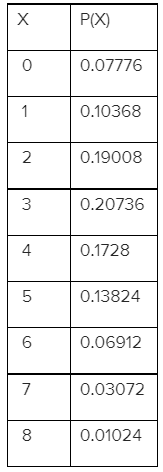
Summing up, we get rhe probability mass function (pmf) of X as follows:
Practice Problems For Exercise 3.2 In Probability And Statistics 8th Edition Page 105 Problem 10 Answer
Using the part a) , we get the pmf of x as :
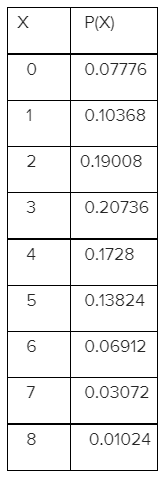
We need to calculate P(2≤X≤6).
Using definition, we get the cumulative distribution function (cdf) of Xas follows:
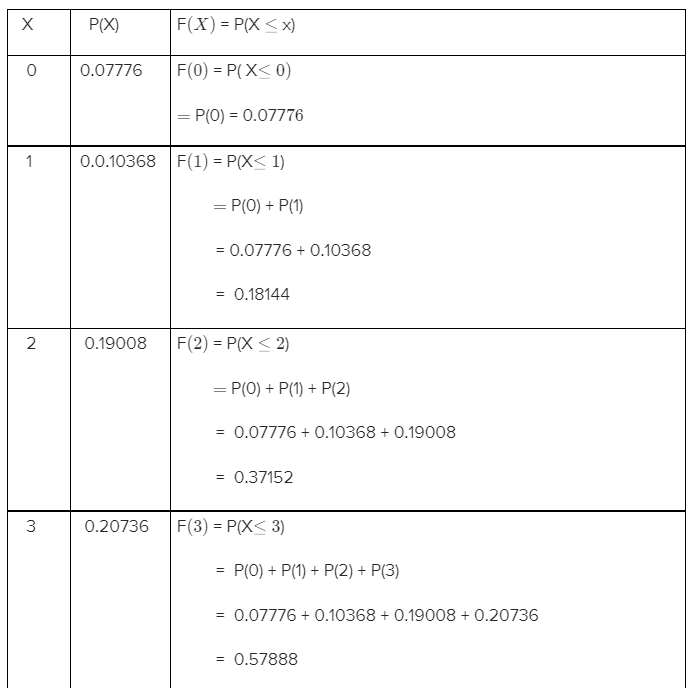
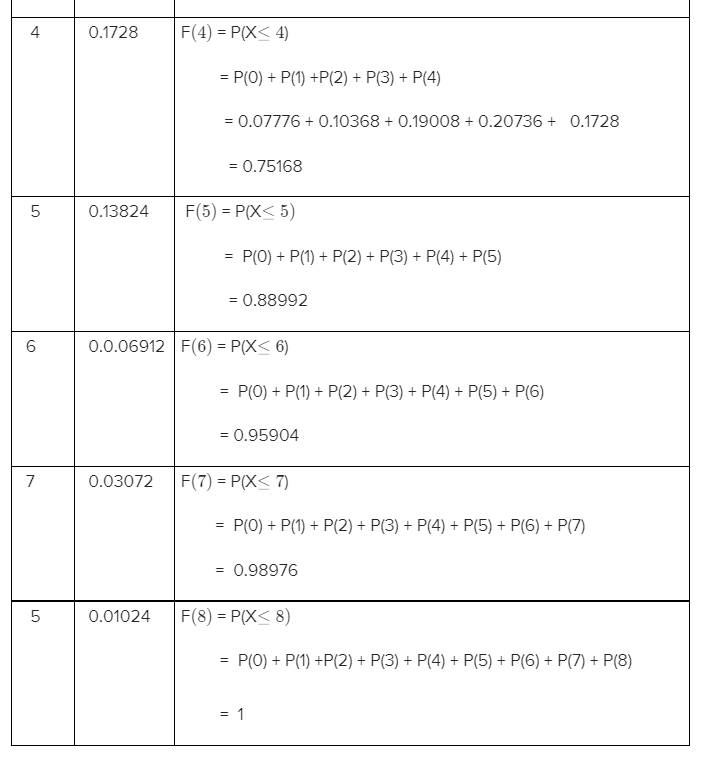
In order to get P(2≤x≤6)
we will use the definition of cdf as follows:
here,P(a≤x≤b)=F(b)−F(a−1)
So P(2≤x≤6)=F(6)−F(2−1)
P(2≤x≤6)=F(6)−F(1)
P(2≤x≤6)=0.95904−0.18144
P(2≤x≤6)=0.7776
We obtain: P(2≤x≤6)=0.7776.
Page 105 Problem 11 Answer
We have:
P(x)=log10(x+1/x)
Here,x:1,2,3,…,9 is termed as Benford’s law.
We are given that:
P(x)=log10
(x+1/x)
x=1,2,3,…,9
Now, summing up both sides, we get:
∑P(x)=1
⇒∑x=1/9log10(x+1/x)=1
Hence, using the logarithmic property, we get:
⇒x=1∑9log10(x+1/x)=log10
(1+1/1)+log10(2+1/2)+….+log10(9+1/9)
=log10(2)+log10(3/2)+log10(4/3)+log10(5/4)+log10(6/5)+log10(7/6)+log10(8/7)+log10(9/8)+log10(10/9)
=log10[2×3/2×43×5/4×6/5×7/6×87×9/8×10/9]
=log10[10]
=1
We proved the legitimate probability mass function.
It is,
∑P(x)=1
⇒∑x=1/9log10(x+1/x)=1
Notes For Exercise 3.2 Discrete Random Variables In Chapter 3 Page 105 Problem 12 Answer
For the given data, we need to find the probability of corresponding to X values.
We need to compare with actual solution.
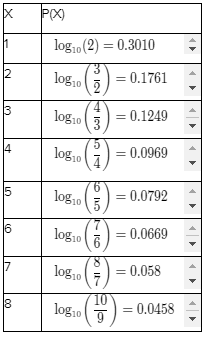
We will use the pdf of uniform distribution.
We will obtain the individual probabilities using the probability distribution function as follows:
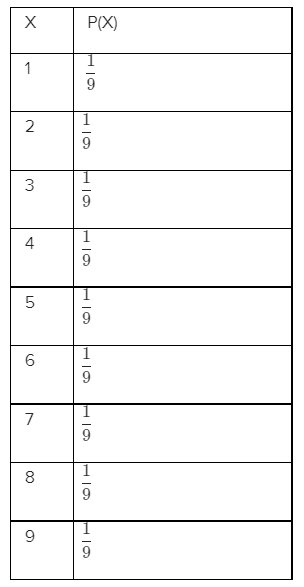
The probability distribution value decreases as the corresponding X values increases and the discrete uniform distribution value is constant the corresponding X values are increasing.
Page 105 Problem 13 Answer
The Benford’s law is given as :
p(x)=log10((x+1)/x)
Here, we note that the leading digits of each number from the given possibilities x=1,2,3…….9.
We need to find the Cumulative Distribution Function (CDF).
We will calculate the probability for each leading digit and by summing up all the probabilities we can arrive at the desired output.
Firstly, we will take the leading number asx=1:
Hence p(1)=log10((1+1)/1)
p(1)=log10(2/1)
Now, taking the leading number x=2 :
p(2)=log10((2+1)/2)
p(2)=log10(3/2)
Taking the leading numbers of3,4,5… up to 9, we can obtain the required values in the similar way.
We get:
p(3)=log10(4/3)
p(4)=log10(5/4)
p(5)=log10(6/5)
Similarly,
p(6)=log10(7/6)
p(7)=log10(8/7)
p(8)=log10(9/8)
p(9)=log10(10/9)
Now, we will determine the CDF of the given leading numbers.
We will sum up the individual probabilities from 0 to 9
to get:cdf(1≤x≤9)=p(1)+p(2)+p(3)+p(4)+p(5)+p(6)+p(7)+p(8)+p(9)
Hence, putting the values, we get:
log10(2/1)+log10(3/2)+log10(4/3)+log10(5/4)+log1(6/5)+log1(7/6)+log10(8/7)+log10(9/8)+log10(10/9)cdf(1≤x≤9)=log10(10)=1
We obtain the Cumulative Distribution Function (CDF) for the given leading numbers as1.
Study Materials For Chapter 3 Exercise 3.2 In Probability Distributions Page 105 Problem 14 Answer
The Benford’s law probability function is given by:p(x)=log10((x+1)/x)
The leading digits of every number from the given possibilities is x=1,2,3….8,9.
We will find the probability that the leading digit will be at most3 or P(x≤3) and at least 5 or P(x≥5).We will use Benford’s law.
The probability that the leading digit will be at most 3 can be calculated as follows:
P(x≤3): p(x≤3)=p(1)+p(2)+p(3)
=log10(2/1)+log10(3/2)+log10(4/3)
=log10(4)
=0.6020
The probability that the leading digit is at least 5 is calculated by P(x≥5) :
We get: p(x≥5)=p(5)+p(6)+p(7)+p(8)+p(9)
=cdf(9)−cdf(5)
=1−log10(5)
=0.3010
The probability that the leading digit is at most 3 is0.6020
The probability that the leading digit is at least 5 will be 0.3010.
Page 106 Problem 15 Answer
Given – In the New York city there are six ATM machines for a certain bank.
We suppose X represents number of ATM’s in use at some of point time in a day.
We have: F(x)=0;x<0
=0.06;0≤x<1
=0.19;1≤x<2
=0.39;2≤x<3
=0.67;3≤x<4
=0.92;4≤x<5
=0.97;5≤x<6
=1.00;6≤x
We will find the respective probability.
We will use the cdf values given above based on the conditions laid.
We will find p(2) as follows:
We will calculate this as follows:
p(2) , that is p(X=2)
p(2)=F(2)−F(1)
=0.39−0.19
=0.20
The cdf forp(2) is 0.20.
Page 106 Problem 16 Answer
Given – In the New York city there are six ATM machines for a certain bank.
We suppose X represents number of ATM’s in use at some of point time during a day.
So, F(x)=0;x<0
=0.06;0≤x<1
=0.19;1≤x<2
=0.39;2≤x<3
=0.67;3≤x<4
=0.92;4≤x<5
=0.97;5≤x<6
=1.00;6≤x
We will find the respective probability .We will use the cdf values given above based on the conditions laid.
Using the definition of cdf, we obtain:
p(X>3)=p(X=4,5,6)
=F(6)−F(3)
=1.00−0.67
=0.33
The probability using the cdf for p(X>3) is 0.33,
Solved Problems For Exercise 3.2 In Probability And Statistics Chapter 3Page 106 Problem 17 Answer
Given – In the New York city there are six ATM machines for a certain bank.
We suppose X represents number of ATMs in use at some of point time in a day.
We have F(x)=0;x<0
=0.06;0≤x<1
=0.19;1≤x<2
=0.39;2≤x<3
=0.67;3≤x<4
=0.92;4≤x<5
=0.97;5≤x<6
=1.00;6≤x
We will find the probability from the cdf values given above based on the conditions required.
We will use the definition of cumulative density function.
We know that p(a≤X≤b)=F(b)−F(a).
Using this, we get:
p(2≤X≤5)=p(X=2,3,4,5)
=F(5)−F(2)
=0.97−0.19
=0.78
We obtain the probabilityp(2≤X≤5) as 0.78.
Page 106 Problem 18 Answer
Given – In a New York city a bank consists of six ATM machines.
We suppose X represents number of ATM’s in use at any instant in a day.
We have F(x)=0;x<0
=0.06;0≤x<1
=0.19;1≤x<2
=0.39;2≤x<3
=0.67;3≤x<4
=0.92;4≤x<5
=0.97;5≤x<6
=1.00;6≤x
We will calculate the respective probability from the cdf values.
We will use the definition of the cumulative density function.
Using the definition of cumulative density function, we get:
p(2<X<5)=p(X=3,4)
=F(4)−F(2)
=0.92−0.39
=0.53
For the given data, the probabilityp(2<X<5) is equal to 0.53.
Page 106 Problem 19 Answer
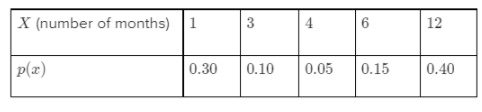
Given -X
represents the number of months between successive payments.
We have :F(x)=0;x<1
=0.30;1≤x<3
=0.40;3≤x<4
=0.45;4≤x<6
=0.60;6≤x<12
=1.00;12≤x
We will find the pmf of X.
We will use the definition of Probability Mass Function to get the pmf of X.
We need to find Probability Mass Function of X:
Here, we know that X= number of months between successive payments can be taken from the data.
X will be 1,3,4,6 and 12.
Using the definition, we get:
p(1)=F(1)−F(0)
p(1) =0.30−0
p(1) =0.30
p(3)=F(3)−F(1)
p(3) =0.40−0.30
p(4)=F(4)−F(3)
p(4) =0.45−0.40
p(4) =0.05
Similarly, we can get the following values:
p(6)=F(6)−F(4)
p(6) =0.60−0.45
p(6) =0.15
p(12)=F(12)−F(6)
p(12) =1.00−0.60
p(12) =0.40
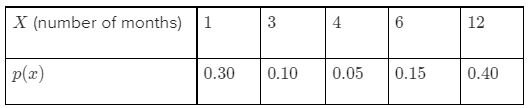
Now, we will sum up the data obtained in the tabular form:
The desired Probability mass function of X is given below:
Page 106 Problem 20 Answer
Given -X represents the number of months between successive payments.
We have: F(x)=0;x<1
=0.30;1≤x<3
=0.40;3≤x<4
=0.45;4≤x<6
=0.60;6≤x<12
=1.00;12≤x
We will find the values of P(3≤X≤6)
We will also find P(4≤X)
We know that:X= number of months between successive payments can be taken from the data.
Now, we note that X∈{1,3,4,6,12}
Using the definitions, we get:
p(3≤x≤6)
p(3≤x≤6) =p(x=3,4,6)
p(3≤x≤6) =F(6)−F(1)
p(3≤x≤6) =0.60−0.30
p(3≤x≤6) =0.30
We will now find P(4≤X) as follows:
P(4≤X)=1−P(X<4)
P(4≤X)=1−(0.40)
P(4≤X)=0.60
The probability for p(3≤x≤6) is 0.30.
The probability for p(4≤x) is 0.60.