
Probability and Statistics for Engineering and the Sciences 8th Edition Chapter 3 Discrete Random Variables and Probability Distributions
Page 120 Problem 1 Answer
Given -n=25, so X∼Bin(25,.05).We will determineP(X≤2).We will use binomial distribution.
Using the definition, we obtain:
=B(2;25,0.05)
2
=∑ b(y;25,0.05)
y=0
(25/0)p/0
P(X≤2) =(1−p)25−0+(25/1)p1
=(1−p)25−1+(25/2)p2
=(1−p)25−2
0.28+0.36+0.23/0.87.
We obtain: P(X≤2)=0.87
Page 120 Problem 2 Answer
Given -n=25,X∼Bin(25,.05).We will determine P(X≥5).We will use Binomial distribution.
Using the definition, we get :
P(X≥5) =1−P(X<5)
1−B(4;25,0.05)=
4
∑ b(y;25,0.05)
y=0
1−[(25/0)p0
=(1−p)25−0+(25/1)p1
= (1−p)25−1+(25/2)p2
=(1−p)25−2+(25/3)p3
=(1−p)25−3+(25/4)p4
(1−p)25−4]
1−0.28−0.36−0.23−0.09−0.03
0.007.
We obtain: P(X>5)=0.007
Probability And Statistics For Engineering 8th Edition Solutions Exercise 3.4 Page 120 Problem 3 Answer
Given -n=25, so X∼Bin(25,.05).We will find P(1≤X≤4).We will use the binomial distribution.
Using the data, we obtain:
P(1≤X≤4)=P(X=1,X=2,X=3,X=4)
=B(4;25,0.05)−P(X=0)
4
∑ b(y;25,0.05)−P(X=0)
y=0
=0.28+0.36+0.23+0.09+0.03−0.28
=0.72.
We obtain: P(1≤X≤4)=0.72
Page 120 Problem 4 Answer
Given -n=25, so X∼Bin(25,.05).
We will find the probability that none of the 25 boards is defective.
We will use the binomial distribution.
Using the binomial probability table, we obtain:
P(X=0)=b(0;25,0.05)
=0.28
The required probability is 0.28.
Page 120 Problem 5 Answer
Given -n=25, X∼Bin(25,..05).
We will calculate the expected value and standard deviation of X.
We will use the binomial distribution.
We will calculate the expected value and standard deviation of the random variableX
as follows:
E(X)=np
=25⋅0.05
=1.25
σX=√np(1−p)
=√25⋅0.05⋅(1−0.05)
=1.09
We obtain: E(X)=1.25
σX=1.09
Chapter 3 Exercise 3.4 Discrete Random Variables Solved Examples Page 120 Problem 6 Answer
Given – A particular telephone number is used to receive both voice calls and fax messages.
We suppose that 25% of the incoming calls involve fax messages, and consider a sample of 25 incoming calls.
We will find the probability that at most 6 of the calls involve a fax message.
We will useb(x;n,p)=(n/x),x=0,1,2,…,n 0px(1−p)n−x, otherwise
We suppose X= number of incoming calls that involve fax messages.
Here,X∼Bin(25,0,25)
So, according to the question, we calculate:
B(6;25,0.25)=P(X≤6)
=0.5611
The probability that at most 6 of the calls involve a fax message is 0.5611
Page 120 Problem 7 Answer
We supposeX= number of incoming calls that involve fax messages.
As 25% of the incoming calls involve fax messages, so p=0.25.
Also, there are n=25 incoming calls. Hence,X∼Bin(25,0,25)
(Binomial Distribution).We will find the probability that exactly 6 of the calls involve a fax message.
We will use the formula:b(x;n,p)={(n/x)px(1−p)n−x/0,x=0,1,2,…,n, otherwise
Using the definition, we calculate:
P(X=6)=b(6;25,0.25)
=(25/6)0.256
(1−0.25)25−6
=0.1828
We obtain the probability of the event that exactly 6 of the calls involve a fax message as:
P(X=6)= 0.1828
Page 120 Problem 8 Answer
Given – A particular telephone number is used to receive both voice calls and fax messages.
Suppose that25% of the incoming calls involve fax messages, and consider a sample of 25 incoming calls.
We suppose X= number of incoming calls that involve fax message.
We will find the probability that least 6 of the calls involve a fax message is given.
Using the formula:
b(x;n,p)={(n/x)px
(1−p)n−x/0,x=0,1,2,…,n, otherwise
We get:
P(X≥6)=1−P(X<6)
=1−P(X≤5)
=1−B(5;25,0.25)
=1−0.3783
=0.6217
Now, the complement of event {X≥6} is event {X<6} ;
So,X takes only non negative values.
We will get the value using Appendix Table A.1.(column 0.25 and row 5).
We obtain the probability that at least 6 of the calls involve a fax message as: 0.6217
Probability And Statistics 8th Edition Chapter 3 Exercise 3.4 Walkthrough Page 120 Problem 9 Answer
We assume X= number of incoming calls that involve fax messages.
Now, given that 25% of the incoming calls involve fax messages, and consider a sample of 25 incoming calls.
We find more than 6 of the calls involve a fax message by,
B(x;n,p)=P(X≤x)
y=0
∑ b(y;n,p),
x
= x:0,1,…,n
Applying the formula for binomial property:
b(x;n,p)={(n/x)px(1−p)n−x/0,x=0,1,2,…,n, otherwise
We get:
P(X>6)=1−P(X≤6)
=1−0.5611
=0.4389
Its complement{X>6} is event {X≤6}
We obtain the probability of more than 6 of the calls involve a fax message :0.4389
Page 121 Problem 10 Answer
Given -90% of all batteries from a certain supplier have acceptable voltages.
A certain type of flashlight requires two type-D batteries, and the flashlight will work only if both its batteries have acceptable voltages.
We will find the probability that at least nine will work? What assumptions did you make in the course of answering the question posed.
We suppose X=the number of working flashlights.
There is 0.9 probability that a battery have acceptable voltage, which indicates that probability of event A={battery with acceptable voltage} is 0.9.
We have:
n=10
p=P(A)∩P(A)
=0.9⋅0.9
=0.81
X≈Bin(25,0.81)
Using the formula:
b(x;n,p)={(n/x)px
(1−p)n−x/0,x=0,1,2,…,n, otherwise
We get:
P(X≥9)=0.407
=P(X=9)+P(X=10)
=b(9;10,0.81)+b(9;10,0.81)
=(10/9)0.819
(1−0.81)10−9+(10/10)0.8110
(1−0.81)10−10
=0.285+0.122
We assume that batteries voltages are independent.
We obtain the probability of the event that at least nine will work is: P(X≥9)=0.407
Chapter 3 Exercise 3.4 Study Guide Probability And Statistics Page 121 Problem 11 Answer
We suppose p= proportion of defective components.
Also X=number of defective components in the sample. Here, n=10 and p is the actual proportion, which implies that X can binomial distribution.
X∼Bin(10,p).Now, we assume A= {the batch is accepted} .
We will find the probability that the batch will be accepted when the actual proportion of defectives is 0.01,0.05,0.10,0.20,0.25.
We know that the batch will be accepted if at most 2 out of 10 are defective.
Hence, the general formula for p is:
P(A)=P(X≤2)
=B(2;10,p)
y=0
∑ b(y;10,p)
2
= When p=0.01
we get: P(X≤2)=B(x;n,p)
=B(2,10,0.01)
=[= BINOM.DIST (2,10,0.01, TRUE )]
≈0.9999
Whenp=0.05, we get:
P(X≤2)=B(x;n,p)
=B(2,10,0.05)
=[=BINOM⋅DIST(2,10,0.05,TRUE)]
=0.9885
Whenp=0.1, we get:
P(X≤2)=B(x;n,p)
=B(2,10,0.10)
=[= BINOM.DIST (2,10,0.1, TRUE )]
=0.9298
Whenp=0.2, we get:
P(X≤2)=B(x;n,p)
=B(2,10,0.20)
=[=BINOM⋅DIST(2,10,0.2,TRUE)]
=0.6778
Whenp=0.25, we get:
P(X≤2)=B(x;n,p)
P(X≤2) =B(2,10,0.25)
P(X≤2) =[= BINOM.DIST (2,10,0.25, TRUE )]
P(X≤2) =0.5256
We obtain:
P(A)=
{0.99988,p=0.01
{0.9885,p=0.05
{0.92981,p=0.1
{0.6778,p=0.2
{0.52559,p=0.25
Page 121 Problem 12 Answer
Given – A graph of P(batch is accepted) as a function of p, with p on the horizontal axis and P(batch is accepted) on the vertical axis, is called the operating characteristic curve for the acceptance sampling plan.
We will use the results of part a) to sketch this curve f.
We will use the graphical utility.
We know that P(A) is a function of p
P(A)=B(2;10,p)
2
∑ b(y;10,p)
y=0
Hence, the exact operating characteristic curve i
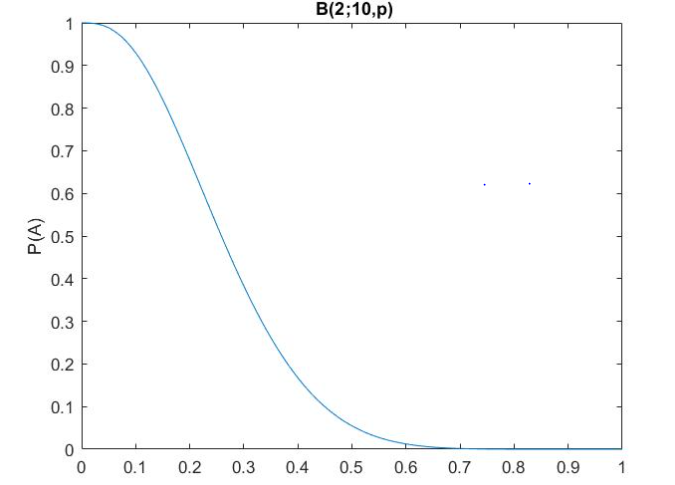
The graph of the dat when 0≤p≤1 is:
Page 121 Problem 13 Answer
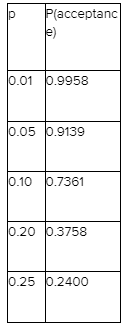
We need to calculate the probability at the different proportion of defective components such asp=0.01,0.05,0.10,0.20,0.25.
We will put different values of p to obtain the probability.
Now, for p=0.01, we get:
P(X≤1)=B(x;n,p)
P(X≤1) =B(1,10,0.01)
P(X≤1) =[=BINOM.DIST(1,10,0.01,TRUE)]
P(X≤1) =0.9957
Now, for p=0.05
we get:
P(X≤1)=B(x;n,p)
P(X≤1) =B(1,10,0.05)
P(X≤1) =[=BINOM⋅DIST(1,10,0.05,TRUE)]
P(X≤1) =0.9139
Now,p=0.10
we get:
P(X≤1)=B(x;n,p)
P(X≤1) =B(1,10,0.10)
P(X≤1) =[=BINOM⋅DIST(1,10,0.10,TRUE)]
P(X≤1) =0.7361
Now, for p=0.20, we get
P(X≤1)=B(x;n,p)
P(X≤1) =B(1,10,0.20)
P(X≤1) =[=BINOM⋅DIST(1,10,0.20,TRUE)]
P(X≤1) =0.3758
Now, ifp=0.25
we get:
P(X≤1)=B(x;n,p)
P(X≤1) =B(1,10,0.25)
P(X≤1) =[=BINOM.DIST(1,10,0.25,TRUE)]
=0.2440
The probability in tabular form is given below :
The required operating characteristic curve obtained is
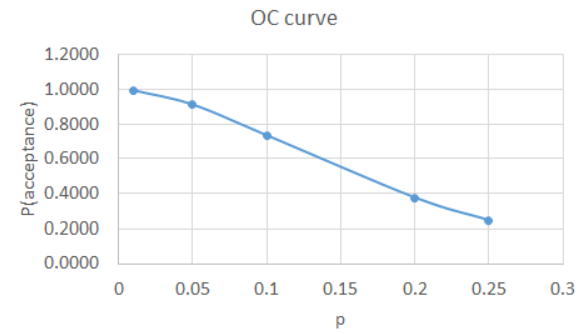
Thus, the given probabilities form a linear curve.
Discrete Random Variables Examples From Exercise 3.4 Engineering And Sciences Page 121 Problem 14 Answer
We suppose X= the number of defective components.
We will use binomial distribution to calculate the probability at different proportion of defective components whenp=0.01,0.05,0.10,0.20,0.25.
We will put different values of p to obtain the probability.
Here,n=15.
Whenp=0.01, we get:
P(X≤2)=B(x;n,p)
=B(2,15,0.01)
=[=BINOM⋅DIST(2,15,0.01,TRUE)]
=0.9996
Whenp=0.05, we get:
P(X≤2)=B(x;n,p)
=B(2,15,0.05)
=[=BINOM⋅DIST(2,15,0.05,TRUE)]
=0.9638
Whenp=0.10, we get
P(X≤2)=B(x;n,p)
=B(2,15,0.10)
=[=BINOM⋅DIST(2,15,0.10,TRUE)]
=0.8159
Whenp=0.20, we get
P(X≤2)=B(x;n,p)
=B(2,15,0.20)
=[=BNOM⋅DIST(2,15,0.20,TRUE)]
=0.3980
Whenp=0.25, we get:
P(X≤2)=B(x;n,p)
=B(2,15,0.25)
=[=BINOM⋅DIST(2,15,0.25,TRUE)]
=0.2361
The probability in tabular form is given below :
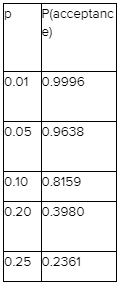
We obtain the operating characteristic curve as follows:
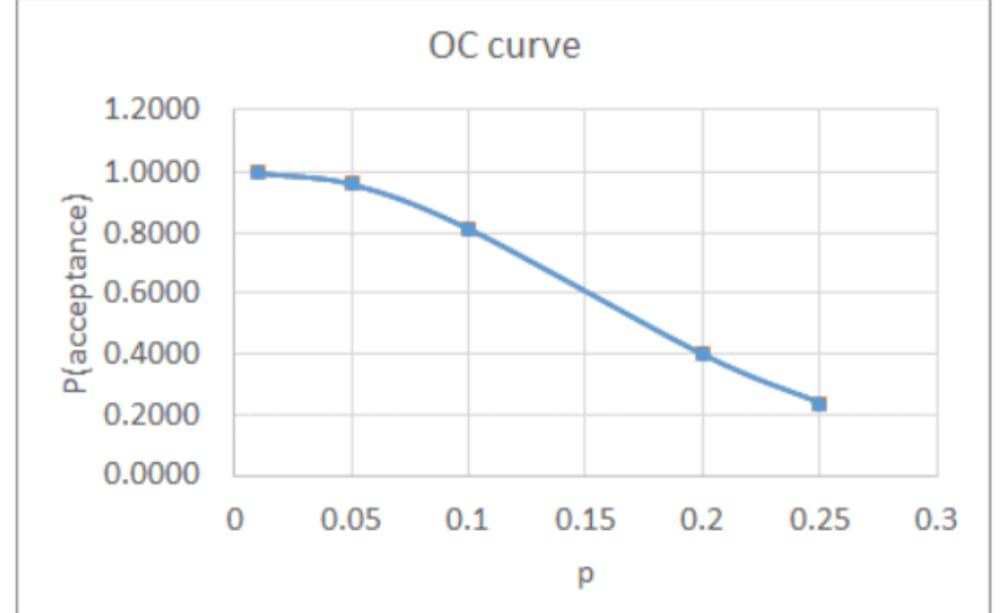
Therefore, the given probability form a polynomial curve.
Page 121 Problem 15 Answer
We need to calculate the probability at different proportion of defective component such asp=0.01,0.05,0.10,0.20,0.25
We will substitute different values of p to obtain the probability and obtain the curve.
We will construct the tables to summarize the data.
We obtain the probability in tabular form of part d as given below:
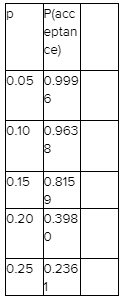
Using the graphical utility, we get:
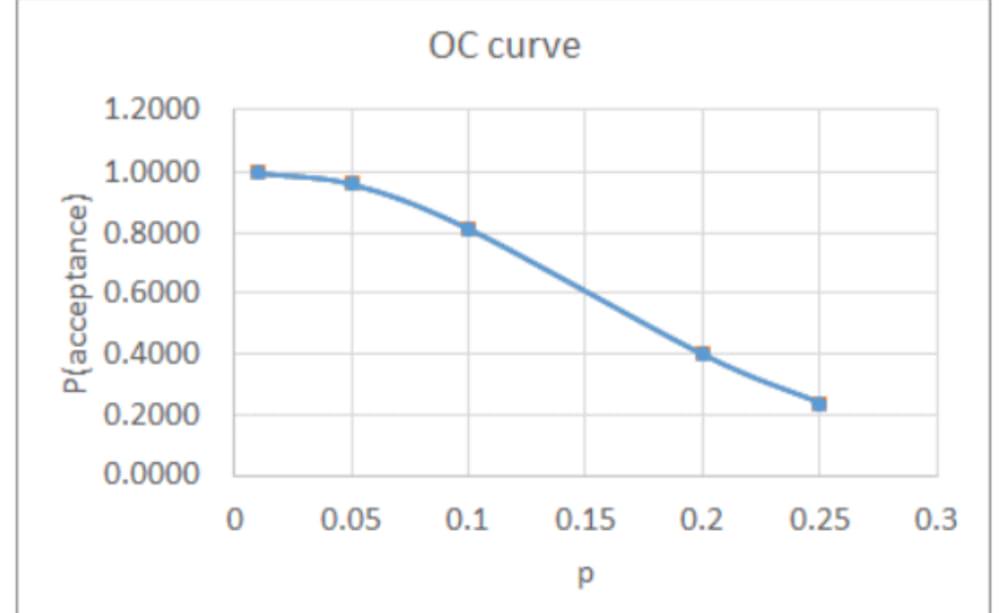
Now, for part c) we have:
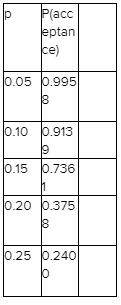
Using the graphical utility, we obtain:
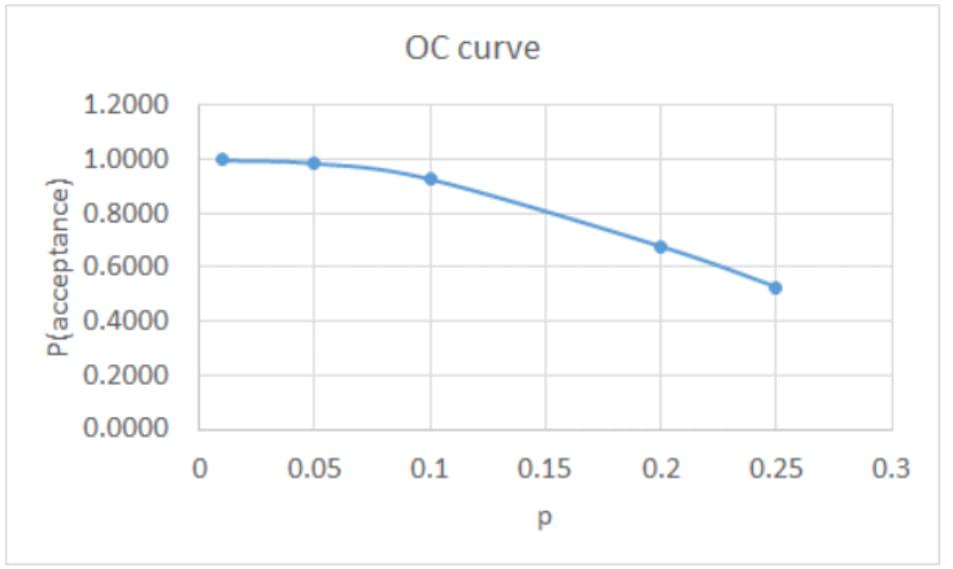
We observe that the sampling plan of part c is more satisfactory as it has a linear relationship between p and P(acceptance).
Notes For Exercise 3.4 Discrete Random Variables In Chapter 3 Page 121 Problem 16 Answer
We assumeX= number of homes with detectors among 25 samples.
We will find the probability that the claim is rejected when the actual value of p=0.8.It follows binomial distribution X∼Bin(25,p)
.Here we considered the decision rule.We reject the claim that p≥0.8 if x≤15.
We calculate the probability of rejecting claim when the actual valuep=0.8 as follows:
P(X≤15 when p=0.8)
P(X≤15 when p=0.8)
x=0
∑ b(x;25,0.8)
15
x=0
∑(25/x)(0.8)x(0.2)25−x
15
Use Excel formula= BINOMDIST (15,25,0.8,1)
0.017 We obtain the probability that the claim is rejected when the actual value of p Is 0.8 =0.017.
Page 121 Problem 17 Answer
We define X= number of houses with a fire detector.
Here,n=25.
Here, we suppose N={ not rejecting claim when p=0.7} .
We will reject the claim p≥0.8 if x≤15.
We will find the probability of not rejecting the claim when p=0.7.
We will denote N={ not rejecting claim whenp:0.7}.
We will reject the claim when x≤15, so we actually need to calculate probability thatX>15
whenp=0.7.
Hence,P(N)
p=0.7)
=1−B(15;25,0.7)
=P(X>15
=1−0.189
=0.811
In the same way, whenp=0.6, we have:
P(N) =1−B(15;25,0.6)
=P(X>15 and p:0.6)
=1−0.575
=0.425
When p is 0.7,
we get P(N)=0.811.
Whenp=0.6, we getP(N)=0.425.
Study Materials For Chapter 3 Exercise 3.4 In Probability Distributions Page 121 Problem 18 Answer
If the value 15 in the decision rule is replaced by 14, the probability that the claim is not rejecting when X:14 and p:0.8 then F(14):0.006.
We will determine how the “error probabilities” of parts (a) and (b) will change if the value 15 in the decision rule is replaced by 14.
We will calculate the following:
P(X>14)=1−P(X≤14 when p=0.7)
=1−x=0
∑ b(x;25,0.7)
15
=1−0.098
=0.902
We obtain the probability as 0.902.
Page 122 Problem 19 Answer
Given – A toll bridge charges $1.00 for passenger cars and $2.50 for other vehicles.
Suppose that during daytime hours 60% of all vehicles are passenger cars.
We also know 25 vehicles cross the bridge during a particular daytime period.
We will find the resulting expected toll revenue.
We suppose X= the number of passenger cars; then the toll revenue h(X) is a linear function of X.
We suppose h(X) denote the total revenue.
We get:
h(X)= Revenue from Passenger Vehicles + Revenue from Other Vehicles =(\) Number of Passenger Vehicles })+(\.50) { Number of Other Vehicles }
=(1)(X)+(2.5)(25−X)
=62.5−1.5⋅X
By the properties of expected value, we will simplify the formula for the expected value of h(X).
So, E[h(X)]
=E(62.5−1.5⋅X)
=E(62.5)−E(1.5⋅X)
=62.5−1.5⋅E(X)
Finally, we will use the general formula for the expected value of a binomial random variable to compute the desired expected value.
We get:
E[h(X)]=62.5−1.5⋅E(X)
=62.5−1.5⋅n⋅p
=62.5−1.5⋅(25)⋅(0.6)
=40
We obtain resulting expected toll revenue as $40.
Solved Problems For Exercise 3.4 In Probability And Statistics Chapter 3 Page 122 Problem 20 Answer
Given – We have a fixed value of n.
We will determine the values of p for which the variance is zero.
We will use the fact that the variance of constant is zero.
We note that the variance is a quadratic equation in terms of p.
Hence, we determine the roots by factoring.
V(x)np(1−p)=0
=0
⇒p=0 or 1−p=0
⇒p=0 or p=1
Hence, these values of p gives zero variance.
Reason : if p=0,1 then the outcome of the of every trial is the same.
Basically, a binomial random variable is supposed to have a positive number of trials, that is n>0.
But, when n is fixed as n=0, the variance will be zero for any value of p.
This makes sense because if n=0 there are no trials to measure the variance of, and hence no variance.
We conclude that the variance of a binomial random variable will be zero whenp=0,1
for fixed values of n>0.If n=0, then the variance is zero for all values of probability p.
Page 122 Problem 21 Answer
To find-value of p is V(X) maximized
The critical values of a function i.e. maximized or minimized values occur where the first derivative is equal to zero.
Firstly, we assume that nis fixed and positive.
Now, we note that variance as a function of p, is:V(p)=np(1−p)(0≤p≤1)
Now, we calculate V′(p):V′(p)
=d/dp[np(1−p)]
=d/dp[np−np2]
=n−2np
We will substitute V′(X)=0 to get p as follows:
V′(p)n−2np
2np/p=0
=0
=n
=0.5
We need to verify that p=0.5 is point of maximum.
We need to find the second derivative V′′(X)-V′′(p)
=d/dp[V′(p)]
=d/dp[n−2np]
=−2n
We will now substitute p=0.5 in V′′(0.5)-V′′(0.5)=−2n<0( since n>0)
Hence, by the second derivative test, p=0.5 is a maximum as the second derivative is negative at the critical point.
The value of V(X) is maximum when p=0.5.