Savvas Learning Co Geometry Student Edition Chapter 4 Congruent Triangles Exercise 4.1 Congruent Figures
Savvas Learning Co Geometry Student Edition Chapter 4 Exercise 4.1 Congruent Figures Solutions Page 221 Exercise 1 Problem 1
Given that,ΔBAT ≅ ΔFOR
⇒ \(\overline{T A} \cong \overline{R O}\)
⇒ ∠R ≅ ∠T
\(\overline{T A} \cong \overline{R O}\) ∠R ≅ ∠T.
Exercise 4.1 Congruent Figures Savvas Geometry Answers Page 221 Exercise 2 Problem 2
1. The relationship between ∠M and ∠T is that ∠M ≅ ∠T , 2. If m ∠ A = 52 and m ∠ P = 36 , then m ∠ T = 92.
Read and Learn More Savvas Learning Co Geometry Student Edition Solutions
Congruent Figures Solutions Chapter 4 Exercise 4.1 Savvas Geometry Page 221 Exercise 3 Problem 3
In our daily life, the apartments have multiple buildings that are congruent, Vehicles of the same company and model are congruent, and classrooms of a school are congruent.
In our daily life, the apartments have multiple buildings that are congruent, Vehicles of the same company and model are congruent, and classrooms of a school are congruent.
Congruent Figures Solutions Chapter 4 Exercise 4.1 Savvas Geometry Page 222 Exercise 4 Problem 4
Given: ΔABC ≅ ΔABD
To find – List the congruent corresponding parts.
Two triangles are congruent if they have equal corresponding sides and equal corresponding angles.
It is given that ΔABC and ΔABD ,so they will have equal corresponding sides and equal corresponding angles.
So, we conclude that vertex A,B,C corresponding to vertex A,B,D respectively.
Thus, we get
⇒ \(\overline{A B} \cong \overline{A B}\)
⇒ \(\overline{A C} \cong \overline{A D}\)
⇒ \(\overline{C B} \cong \overline{D B}\) And
⇒ ∠CAB ≅ ∠DAB
⇒ ∠ABC ≅ ∠ABD
⇒ ∠ACB ≅ ∠ADB
Thus, for ΔABC ≅ ΔABD we get
⇒ \(\overline{A B} \cong \overline{A B}\)
⇒ \(\overline{A C} \cong \overline{A D}\)
⇒ \(\overline{C B} \cong \overline{D B}\)
And
⇒ ∠CAB ≅ ∠DAB
⇒ ∠ABC ≅ ∠ABD
⇒ ∠ACB ≅ ∠ADB
Chapter 4 Exercise 4.1 Congruent Figures Savvas Learning Co Geometry Explanation Page 222 Exercise 5 Problem 5
Given: ΔEFG ≅ ΔHIJ
To find – List the congruent corresponding parts.
Two triangles are congruent if they have equal corresponding sides and equal corresponding angles.
It is given that ΔEFG ≅ ΔHIJ, so they will have equal corresponding sides and equal corresponding angles.
So, we conclude that vertex E,F, G is congruent to vertex H,I ,J respectively
Therefore
⇒ \(\overline{E F} \cong \overline{H I}\)
⇒ \(\overline{F G} \cong \overline{I J}\)
⇒ \(\overline{G E} \cong \overline{J H}\) and
⇒ ∠GEF ≅ ∠JHI
⇒ ∠EFG ≅ ∠HIJ
⇒ ∠FGE ≅ ∠IJH
Thus, for ΔEFG ≅ ΔHIJ we get
⇒ \(\overline{E F} \cong \overline{H I}\)
⇒ \(\overline{F G} \cong \overline{I J}\)
⇒ \(\overline{G E} \cong \overline{J H}\)
And
⇒ ∠GEF ≅ ∠JHI
⇒ ∠EFG ≅ ∠HIJ
⇒ ∠FGE ≅ ∠IJH
Solutions For Congruent Figures Exercise 4.1 In Savvas Geometry Chapter 4 Student Edition Page 222 Exercise 6 Problem 6
Given: ΔLCM ≅ ΔBJK
To find – Complete the congruence statements.
Two triangles are congruent if they have equal corresponding sides and equal corresponding angles.
It is given that ΔLCM ≅ BJK so they will have equal corresponding sides and equal corresponding angles.
SO, we conclude that vertex L,C,M is congruent to vertex B ,J, K respectively.
Thus, \(\overline{K J} \cong \overline{M C}\)
Thus, \(\overline{K J} \cong \overline{M C}\)
Exercise 4.1 Congruent Figures Savvas Learning Co Geometry Detailed Answers Page 222 Exercise 7 Problem 7
Given: \(\overline{J B} \cong \overline{M C}\) ≅ ?
To find – Complete the congruence statements.
Two triangles are congruent if they have equal corresponding sides and equal corresponding angles.
\(\overline{J B} \cong \overline{M L}\)The complete congruence statement will be \(\overline{J B} \cong \overline{M L}\).
Geometry Chapter 4 Congruent Figures Savvas Learning Co Explanation Guide Page 222 Exercise 8 Problem 8
Given: ∠ L ≅?
To find – Complete the congruence statements.
Two triangles are congruent if they have equal corresponding sides and equal corresponding angles.
⇒ ∠L ≅ ∠B
The congruence statement will be ∠L ≅ ∠B.
Geometry Chapter 4 Congruent Figures Savvas Learning Co Explanation Guide Page 222 Exercise 9 Problem 9
Given: ∠ K ≅?
To find – Complete the congruence statements.
Two triangles are congruent if they have equal corresponding sides and equal corresponding angles.
⇒ ∠K ≅ ∠C
The congruence statement will be ∠K ≅ ∠C.
Savvas Learning Co Geometry Student Edition Chapter 4 Page 222 Exercise 10 Problem 10
Given: ∠ M ≅?
To find – Complete the congruence statements.
Two triangles are congruent if they have equal corresponding sides and equal corresponding angles.
⇒ ∠M ≅ ∠J
The congruence statement will be ∠M ≅ ∠J.
Page 222 Exercise 11 Problem 11
Given: ΔCML ≅ ?
To find – Complete the congruence statements.
Two triangles are congruent if they have equal corresponding sides and equal corresponding angles.
⇒ ΔCML ≅ ΔKJB
The congruence statement will be ΔCML ≅ ΔKJB.
Savvas Learning Co Geometry Student Edition Chapter 4 Page 222 Exercise 12 Problem 12
Given: ΔKBJ ≅ ?
To find – Complete the congruence statements.
Two triangles are congruent if they have equal corresponding sides and equal corresponding angles.
⇒ ΔKBJ ≅ ΔCLM
The congruence statement will be ΔKBJ ≅ ΔCLM
Page 222 Exercise 13 Problem 13
Given: ΔMLC ≅ ?
To find – Complete the congruence statements.
Two triangles are congruent if they have equal corresponding sides and equal corresponding angles.
⇒ ΔMLC ≅ ΔJBK
The congruence statement will be ΔMLC ≅ ΔJBK.
Savvas Learning Co Geometry Student Edition Chapter 4 Page 222 Exercise 14 Problem 14
Given: ΔJKB ≅ ?
To find – Complete the congruence statements.
Two triangles are congruent if they have equal corresponding sides and equal corresponding angles.
⇒ ΔJKB ≅ ΔMCL
The congruence statement will be ΔJKB ≅ ΔMCL
Page 222 Exercise 15 Problem 15
Given: POLY ≅ SIDE
To find – List the four pairs of congruent sides.
Two polygons are congruent if they have equal corresponding sides and equal corresponding angles.
⇒ \(\overline{P O} \cong \overline{S I}\)
⇒ \(\overline{O L} \cong \overline{I D}\)
⇒ \(\overline{L Y} \cong \overline{D E}\)
⇒ \(\overline{Y P} \cong \overline{E S}\)
The four pairs of congruent sides are:
⇒ \(\overline{P O} \cong \overline{S I}\)
⇒ \(\overline{O L} \cong \overline{I D}\)
⇒ \(\overline{L Y} \cong \overline{D E}\)
⇒ \(\overline{Y P} \cong \overline{E S}\)
Savvas Learning Co Geometry Student Edition Chapter 4 Page 222 Exercise 16 Problem 16
Given: POLY ≅ SIDE
To find – List the four pairs of congruent angles.
Two polygons are congruent if they have equal corresponding sides and equal corresponding angles.
∠P ≅ ∠S
∠O ≅ ∠I
∠L ≅ ∠D
∠Y ≅ ∠E
The four pairs of congruent angles are:
∠P ≅ ∠S
∠O ≅ ∠I
∠L ≅ ∠D
∠Y ≅ ∠E
Page 222 Exercise 17 Problem 17
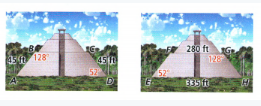
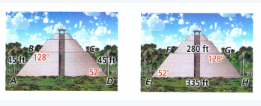
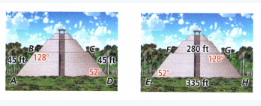
Given that: At an archeological site, the remains of two ancient step pyramids are congruent.
If ABCD ≅ EFGH
To find – Find GH
These two shapes ABCD and FEGH are congruent to each other it means shape and size of ABCD and are same FEGH .
The size of GH = 45ft because GH ≅ CD
Savvas Learning Co Geometry Student Edition Chapter 4 Page 222 Exercise 18 Problem 18
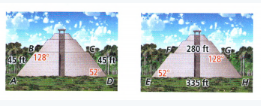
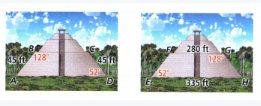
Given that: At an archeological site, the remains of two ancient step pyramids are congruent.
If ABCD ≅ EFGH
To find – Find EF
These two shapes ABCD and EFGH are congruent to each other it means shape and size of ABCD and EFGH are same.
The size of EF = 45 ft because EF ≅ AB.
The size of EF = 45ft because EF ≅ AB for the problem
Page 222 Exercise 19 Problem 19
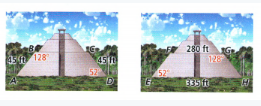
Given that: At an archeological site, the remains of two ancient step pyramids are congruent.
If ABCD ≅ EFGH
To find – Find BC
These two shapes ABCD and EFGH are congruent to each other it means shape and size of ABCD and EFGH are same.
The size of BC = 280ft because BC ≅ FG
The size of BC = 280ft because BC ≅ FG for the problem
Savvas Learning Co Geometry Student Edition Chapter 4 Page 222 Exercise 20 Problem 20
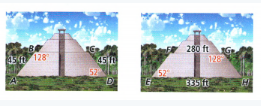
Given that: At an archeological site, the remains of two ancient step pyramids are congruent.
If ABCD ≅ EFGH
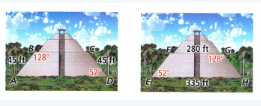
To find – Find m∠DCB
These two shapes ABCD and EFGH are congruent to each other it means shape and size of ABCD and EFGH are same.
The angle m ∠DCB = 128 because m ∠DCB ≅ m∠FGH
The angle m∠ DCB = 128 because m∠ DCB ≅ m∠FGH for the problem.
Page 222 Exercise 21 Problem 21
Given that: At an archeological site, the remains of two ancient step pyramids are congruent.
If ABCD ≅ EFGH
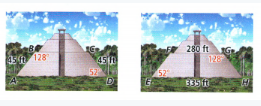
To find – Find m ∠ EFG
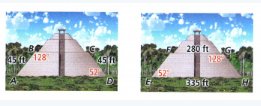
These two shapes ABCD and EFGH are congruent to each other it means they have same shape and size.
The angle m ∠EFG = 128° because m ∠EFG ≅ m∠ABC
The angle m∠EFG = 128° because m ∠EFG ≅ m ∠ABC for the problem
Savvas Learning Co Geometry Student Edition Chapter 4 Page 222 Exercise 22 Problem 22
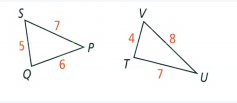
Given that: Δ SPQ and Δ TUV
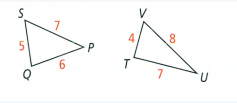
To find – Can you conclude that the triangles are congruent.
The triangle SPQ,TUV are not congruent because shape and size of the triangles are not same.
The sides of triangle SPQ and TUV are not same.
The triangle SPQ, TUV are not congruent because shape and size of triangles are not same for the problem
Page 223 Exercise 23 Problem 23
Given that: Δ DEF ≅ Δ LMN
To find – Which of the following must be a correct congruence statement?
1. DE = LN
2. ∠N ≅ ∠F
3. FE ≅ NL
4. ∠M ≅ ∠F
Let the vertex E of triangle DEF corresponds to vertex N of triangle LMN, the vertex L of triangle LMN corresponds to vertex D of triangle DEF and the vertex M of triangle LMN corresponds to vertex F of triangle DEF.
If the triangle congruent than ED ≅ LN, EF ≅ NM, DF ≅ LM,∠M ≅ ∠F.
The option (4) is correct rest are wrong.
The option (4) ∠M ≅ ∠F is correct when ΔDEF ≅ ΔLMN for the problem
Savvas Learning Co Geometry Student Edition Chapter 4 Page 223 Exercise 24 Problem 24
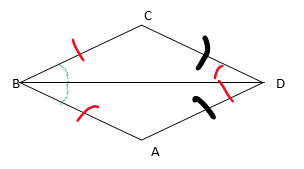
Given that: Randall says he can use the information in the figure to prove ΔBCD ≅ Δ DAB
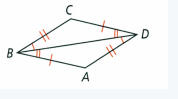
To find – Is he correct? Explain.
If the triangle ΔBCD ≅ ΔDAB then BC ≅ BA, AD ≅ CD, ∠CDB ≅ ∠ADB, ∠CBD ≅ ABD
But Randall says CD ≅ BA, AD ≅ BC, ∠CDB ≅ ∠ABD, ∠CBD ≅ ∠ADB which is incorrect.
The correct explanation of congruence of triangles ΔBCD ≅ ΔDAB is BC ≅ BA,AD ≅ CD, ∠CDB ≅ ∠ADB,∠CBD ≅ ABD for Randall problem
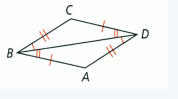
And the diagram shown as
Page 223 Exercise 25 Problem 25
Given that: ΔABC ≅ ΔDEF ,m∠A = x + 10. m∠D = 2x
To find – Find the measures of the given angles or the lengths of the given sides.
If the two triangles are congruent than sides and angles are congruent.
The given m∠A = x + 10. m∠D = 2x and the triangles ΔABC ≅ ΔDEF than
m∠A ≅ m∠D it means
⇒ x + 10 = 2x
⇒ 10 = 2x – x
⇒ 10 = x
⇒ x = 10 and now
⇒ m∠A = x + 10
⇒ m∠A = 20°
⇒ m∠D = 2(10)
⇒ m∠D = 20°
The length x = 10 and angles m∠A = 20 ° and m∠D = 20° for the problem of congruency when ΔABC ≅ ΔDEF and m ∠A = x + 10,m∠D = 2x.
Savvas Learning Co Geometry Student Edition Chapter 4 Page 223 Exercise 26 Problem 26
Given that: ΔABC ≅ ΔDEF , m∠B = 3y, m∠E = 6y − 12
To find – Find the measures of the given angles or the lengths of the given sides.
If the two triangles are congruent than sides and angles are congruent
The given m∠B = 3y, m∠E = 6y − 12 and the triangles ABC ≅ DEF than m ∠B ≅ m∠E it means
⇒ 3y = 6y − 12
⇒ 3y = 12
⇒ y = 4 and now
⇒ m∠B = 3(4)
⇒ m ∠B = 12°
⇒ m∠E = 6(4)−12
⇒ m ∠E = 12°
The length y = 4 and angles m ∠B = 12° and m ∠E = 12° the problem of congruency when ΔABC ≅ ΔDEF and m∠B = 3y,m∠E = 6y − 12
Page 223 Exercise 27 Problem 27
Given: Two triangle s ΔABC ≅ ΔDEF and BC = 3z + 2, EF = z + 6
To find – Measures of the lengths of the given sides.
Since, the triangles are congruent, vertex B of ΔABC corresponds to E of ΔDEFTriangles corresponding sides are equal, i.e. BC = EF
Equating corresponding sides of two triangle.
⇒ BC = EF
⇒ 3z + 2 = z + 6
Bringing one side to one side of equation and constant terms to other side of triangle.
⇒ 3z − z = 6 − 2
⇒ 2z = 4
⇒ z = \(\frac{4}{2}\)
⇒ z = 2
Substituting value of z in lengths BC and EF
⇒ BC = 3 × 2 + 2
⇒ BC = 8 units
⇒ EF= 2 + 6
⇒ EF = 8 units
Measures of the lengths of the given sides are- BC = 8 units EF = 8 units
Savvas Learning Co Geometry Student Edition Chapter 4 Page 223 Exercise 28 Problem 28
Given : Two triangles ΔABC ≅ ΔDEF and AC = 7a + 5, DF = 5a + 9
To find – Measures of the lengths of the given sides.
Since, the triangles are congruent, vertex A of ΔABC corresponds to D of ΔDEF Triangles corresponding sides are equal, i.e. AC = DF
Equating corresponding sides of two triangle.
⇒ AC = DF
⇒ 7a + 5 = 5a + 9
Bringing one side to one side of equation and constant terms to other side of triangle.
⇒ 7a − 5a = 9 − 5
⇒ 2a = 4
⇒ a = \(\frac{4}{2}\)
⇒ a = 2
Substituting value of a in lengths AC and DF
⇒ AC = 7 × 2 + 5
⇒ AC = 19 units
⇒ DF = 5 × 2 + 9
⇒ DF = 19 units
Measures of the lengths of the given sides are- AC = 19 units, DF = 19 units
Page 223 Exercise 29 Problem 29
Given: Two triangles Δ ABC ≅ Δ DBE.
To find – Meaning for two triangles to be congruent.
Two triangles are said to be congruent, if there corresponding sides and angles are equal.
Meaning for two triangles to be congruent is – “Two triangles are said to be congruent, if there corresponding sides and angles are equal”.
Savvas Learning Co Geometry Student Edition Chapter 4 Page 223 Exercise 29 Problem 30
Given: Two triangles ΔABC ≅ ΔDBE.
To find – Which angle measures are already known.The angles known in ΔABC are m∠ CAB = (x + 5)°and m∠ABC = 51°
The angles known in ΔDBE are m∠
BED = 81°
Since, The given triangles are congruent, vertex C of Δ ABC corresponds to vertex E of
Δ DBE m∠DEB = m∠ACB = 81°
The angles known in ΔABC are m∠ CAB = (x + 5)° and m ∠ACB = 51° and m∠ ACB = 81° , The angles known in ΔDBE are m ∠BED = 81°
Page 223 Exercise 29 Problem 31
Given: Two triangles ΔABC ≅ ΔDBE.
To find – The value of x and the missing angle measure in a triangle.
Using Angle sum property of triangle, Sum of angles of triangle is 180°
m∠BAC + m∠BCA+m∠
ABC = 180°
⇒ x + 5 + 81° + 51°
= 180°
⇒ x +137° =180°
⇒ x = 43°
Since, The given triangles are congruent, missing angles can be found out by equating the corresponding angles.
Vertex A of ΔABC corresponds to Vertex D of ΔDBE
∴ m ∠CAB = m ∠EDB = 43 + 5 = 48°
Vertex B is common in both the triangles.
⇒ m ∠ABC = m ∠DBE = 51°
Value of x is 43°
The given triangles ΔABC ≅ ΔDBE are congruent, missing angles can be found out by equating the corresponding angles.m ∠EDB = 48° m ∠DBE = 51° m∠ACB = 81°
Savvas Learning Co Geometry Student Edition Chapter 4 Page 223 Exercise 30 Problem 32
Given: Two triangles ΔABC ≅ ΔKLM.
To Find – The values of the variables.
Since, ΔABC≅ ΔKLM, vertex C of ΔABC corresponds to vertex M of ΔKLM.
Therefore, m ∠ACB = m ∠KML = 3x°
Using angle sum property in ΔABC
⇒ m∠ ACB + m ∠CBA + m ∠BAC = 1800
⇒ 3x + 90° + 45° = 180°
⇒ 3x = 180° − 135°
⇒ 3x = 45°
⇒ x = 15°
The value of the variable x is 15°
Page 223 Exercise 31 Problem 33
Given: Two triangles ΔACD ≅ ΔACB.
To Find – The values of the variables.
Since A is the common vertex of two triangles.
The corresponding angles m ∠BAC = m ∠DAC 6x = 30° which on solving gives
⇒ 6x = 30°
⇒ \(\frac{300}{6}\)
⇒ x = 5°
The value of the variable x is 5°
Savvas Learning Co Geometry Student Edition Chapter 4 Page 223 Exercise 32 Problem 34
Given: Figure of Two triangles ΔMLJ and ΔZRN.
To find – To Complete in two different ways that ΔJLM ≅ Δ NRZ.
Three corresponding angles of ΔJLM and ΔNRZ are equal.
From the figures of two triangles JLM and NRZ
⇒ ∠L = ∠R
⇒ ∠M = ∠Z
⇒ ∠J = ∠N
Three corresponding sides are also equal.
⇒ ML = ZR
⇒ LJ = RN
⇒ JM = NZ
Therefore, ΔJLM ≅ ΔNRZ, since corresponding angles and sides of two triangles are equal.
From the figures of two triangles, ΔJLM and ΔNRZ
Corresponding angles are equal
⇒ ∠L = ∠R
⇒ ∠M = ∠Z
⇒ ∠J = ∠N
Corresponding sides are equal
⇒ ML = ZR
⇒ LJ = RN
⇒ JM = NZ
Therefore, Δ JLM ≅ ΔNRZ
Savvas Learning Co Geometry Student Edition Chapter 4 Page 223 Exercise 33 Problem 35
Given: Terms “congruent sides and angles” and “triangles”.
To find – To write a congruence statement for two triangles and to list the congruent sides and angles.
Let two triangles are congruent ΔABC ≅ ΔXYZ
List of congruent sides of two triangles are
⇒ AB = XY
⇒ BC = YZ
⇒ AC = XZ
List of congruent angles of two triangles are
⇒ ∠A = ∠X
⇒ ∠B = ∠Y
⇒ ∠C = ∠Z
Congruence statement for two triangles is ΔABC ≅ ΔXYZ
List of congruent sides of two triangles are
⇒ AB = XY
⇒ BC = YZ
⇒ AC = XZ
List of congruent angles of two triangles are
⇒ ∠A = ∠X
⇒ ∠B = ∠Y
⇒ ∠C = ∠Z
Page 223 Exercise 34 Problem 36
Given: Two triangles ΔABD and ΔCDB, and AB⊥AD, BC⊥CD, AB ≅ CD, AD≅CB, AB ∥ CD
To find – To prove ΔABD ≅ ΔCDB.
The SAS rule states that If two sides and the included angle of one triangle are equal to two sides and included angle of another triangle, then the triangles are congruent.
In the two triangles given
AD side of ΔABD= BC side of ΔCDB
AB side of ΔABD = CD side of ΔCDB
∠A = ∠C (Since, both are right angles)
Using SAS rule, ΔABD and ΔCDB are congruent.
AD side of ΔABD= BC side of ΔCDB
AB side of ΔABD = CD side of ΔCDB
⇒ ∠A = ∠C
Using SAS rule, ΔABD ≅ ΔCDB
Savvas Learning Co Geometry Student Edition Chapter 4 Page 224 Exercise 35 Problem 37
Given: Two triangle ΔPRS and ΔQTS, PR ∥ TQ , PR ≅ TQ, PS ≅ QS
To find – To prove ΔPRS ≅ ΔQTS
The SAS rule states that If two sides and the included angle of one triangle are equal to two sides and included angle of another triangle, then the triangles are congruent.
In the two triangles given
PR ≅ TQPS ≅QS
Since, PR ∥ TQ and PQ is the transversal.
∠P = ∠Q, because they are alternate interior angles.
Using SAS rule, ΔPRS ≅ ΔQTS
In the two triangles ΔPRS and ΔQTS
⇒ PR ≅ TQ
⇒ PS ≅ QS
⇒ ∠P = ∠Q
Using SAS rule, ΔPRS ≅ ΔQTS
Page 224 Exercise 36 Problem 38
Given The vertices of ΔGHJ are G(−2,−1), H(−2,3),J(1,3).
To find – KL, LM, and KM.
Using distance formula to calculate distance between two points.
Distance = \(\sqrt{\left(x_1-x_2\right)^2+\left(y_1-y_2\right)^2}\)
Where (x1,y1) and (x2,y2) are two points.
Since, ΔKLM ≅ ΔGHJ.
Side KL corresponds to side GH of ΔGHJ
KL = \(\sqrt{(-2+2)^2+(3+1)^2}\)
= \(\sqrt{16}\)
Side KL = 4 units.
Side LM corresponds to side HJ of ΔGHJ
LM = \(\sqrt{(1+2)^2+(3-3)^2}\)
= \(\sqrt{9}\)
Side LM = 3 units.
Side KM corresponds to side GJ of ΔGHJ
KM = \(\sqrt{(1+2)^2+(3+1)^2}\)
= \(\sqrt{9+16}\)
KM = 5 units.
Side KL = 4 units , LM = 3 units , KM = 5 units
Savvas Learning Co Geometry Student Edition Chapter 4 Page 224 Exercise 37 Problem 39
Given: The coordinates of L and M(3,−3),(6,−3)
To find – How many pairs of coordinates are possible for K, find one pair.
Given, L(3,−3) M(6,−3)
Now, let K as(x,y)
Centroid:
\(\frac{3-6+x}{3}\) = \(\frac{-3+(-3)+y}{3}\)
\(\frac{3+x}{3}=\frac{1}{1}\)Now equate the x-coordinates and y-coordinates we get:
⇒ \(\frac{-3+x}{3}=\frac{1}{1}\)
= −3 + 1x = 3
x = 6
⇒ \(\frac{6+y}{3}=\frac{2}{1}\)
= 6 + 1y = 6
⇒ 1y = 6 − 6
⇒ y = 1
The one pair for, k is(6,1)
The pair for, k is(6,1)
Page 224 Exercise 38 Problem 40
Given: ΔHLN ≅ ΔGST and m∠H = 66, m∠S = 42
To find – To find the value of m∠T
Congruent triangles are triangles that have the same size and shape.
We conclude m∠H = m∠G = 66
And we know m∠S = 42
The sum of interior angles of a triangle is180°
In ΔGST
⇒ m ∠G + m ∠S + m ∠T = 180°
⇒ 66 + 42 + m ∠T = 180°
⇒ m∠T = 180° − 108°
⇒ m ∠T = 72°
The value of m ∠T = 72°