Savvas Learning Co Geometry Student Edition Chapter 4 Congruent Triangles Exercise 4.2 Triangles Congruence By SSS And SAS
Savvas Learning Co Geometry Student Edition Chapter 4 Exercise 4.2 Triangles Congruence by SSS and SAS solutions Page 230 Exercise 1 Problem 1
In the given situation, we need to name the angle that is included between the given sides.
Let us draw a figure of the triangle with given information
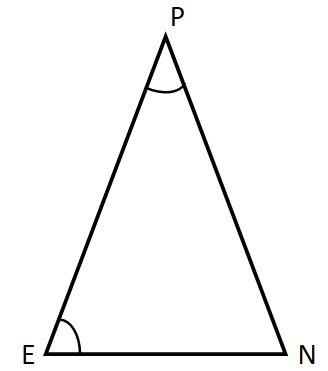
According to the above figure
1. The angle that is included between the sides, \(\overline{\mathrm{PE}} \text { and } \overline{\mathrm{EN}}\) is ∠PEN.
2. The angle that is included between the sides, \(\overline{N P} \text { and } \overline{P E}\) is ∠NPE.
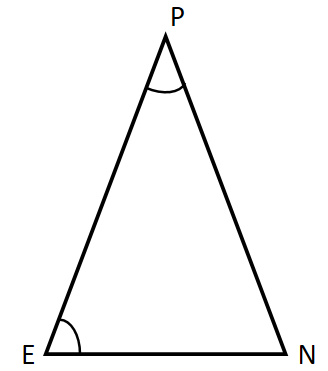
1. The angle that is included between the sides \(\overline{\mathrm{PE}} \text { and } \overline{\mathrm{EN}}\) is ∠PEN.
2. The angle that is included between the sides, \(\overline{N P} \text { and } \overline{P E}\) is ∠NPE.
Read and Learn More Savvas Learning Co Geometry Student Edition Solutions
Exercise 4.2 Triangles Congruence By Side Side Side And Side Angle Side Savvas Geometry Answers
Page 230 Exercise 2 Problem 2
In the given situation, we need to name the sides between which given angles are included.
Let us draw a figure of the triangle with given information,
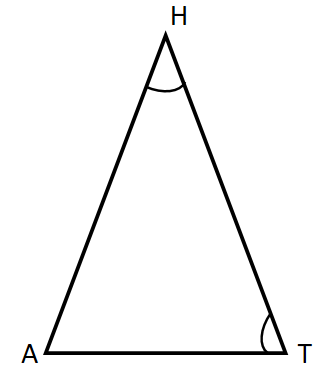
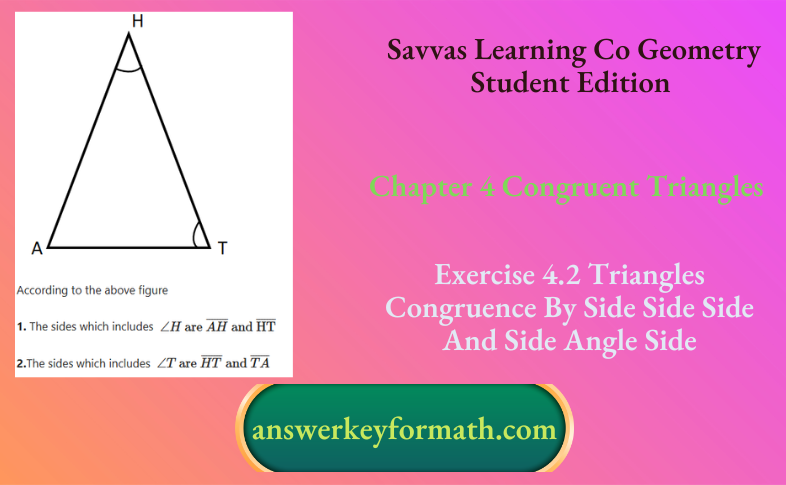
According to the above figure
1. The sides which includes \(\angle H \text { are } \overline{A H} \text { and } \overline{\mathrm{HT}}\)
2.The sides which includes \(\angle T \text { are } \overline{H T} \text { and } \overline{T A}\)
Exercise 4.2 Triangles Congruence By Side Side Side And Side Angle Side Savvas Geometry Answers
Page 230 Exercise 3 Problem 3
In the given situation, we need to name the postulate that will be used to prove the triangles congruent.
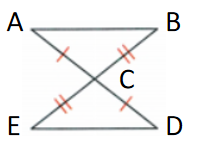
The diagram shows that \(\overline{\mathrm{BC}} \cong \overline{E C}\) and also \(\overline{A C} \cong \overline{D C}\).
As \(\angle A C B \cong \angle D C E\) by vertically opposite angle.
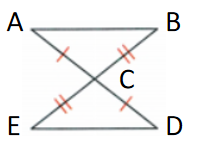
Therefore Δ ABC≅ Δ DEC by using the Side Angle Side postulate (SAS).
Side Angle Side postulate (SAS) postulate would be used to prove the given triangles congruent.
Triangles Congruence By Sss And Sas Solutions Chapter 4 Exercise 4.2 Savvas Geometry Page 230 Exercise 4 Problem 4
In the given situation, we need to find the postulate that would be used to prove the triangles congruent.
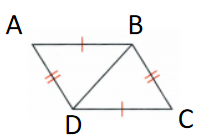
The diagram shows that \(\overline{A B} \cong \overline{C D}\) and \(\overline{A D} \cong \overline{B C}\)
Also by the Reflexive Property of Congruence. \(\overline{B D} \cong \overline{B D}\)
Therefore, the given triangles are congruent by using Side-Side-Side (SSS) theorem.
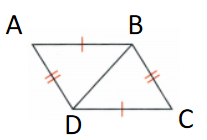
The given triangles are congruent by using Side-Side-Side (SSS) theorem.
Savvas Learning Co Geometry Student Edition Chapter 4 Page 230 Exercise 5 Problem 5
In the given question, we need to find what are the similarities and differences between SAS and SSS postulates.
How are the SAS Postulate and SSS Postulate alike?
1. They both require three congruency statements.
2. They both use two sides and one angle.
3. They both use one side and two angles.
4. They both can be used to prove that triangles are congruent.
5. They both use three sides.
How are the SAS Postulate and SSS Postulate different?
1. They require different numbers of congruency statements.
2. They apply to different kinds of triangles (acute or obtuse).
3. They use different numbers of sides and/or angles.
4. SSS can be used to prove two triangles are congruent, while SAS can be used to prove that corresponding angles are congruent.
The SSS and SAS Postulates are different and alike as well.
Chapter 4 Exercise 4.2 Triangles Congruence By Side Side Side And Side Angle Side Savvas Learning Co Geometry Explanation Page 230 Exercise 6 Problem 6
In the given situation, we need to find that the able triangles are congruent by which theorem.
Let us re-draw the given triangles
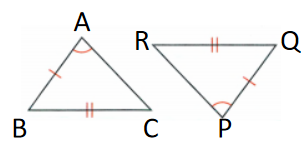
The diagram shows that, \(\overline{A B} \cong \overline{P Q}\) and \(\overline{\mathrm{BC}} \cong \overline{Q R}\)
Also, ∠BAC ≅ ∠QPR
Therefore, the given triangles can be proven right congruent by using the Side Angle Side postulate (SAS).
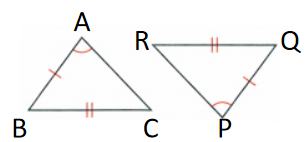
The given triangles can be proven congruent by using the Side Angle Side postulate (SAS).
Solutions For Triangles Congruence By Sss And Sas Exercise 4.2 In Savvas Geometry Chapter 4 Student Edition Page 230 Exercise 7 Problem 7
Given: The side length of the first triangle is 7 ft and the side length of the second triangle is 21 ft.
To Find – If two triangles are congruent.
Proof: According to the question,
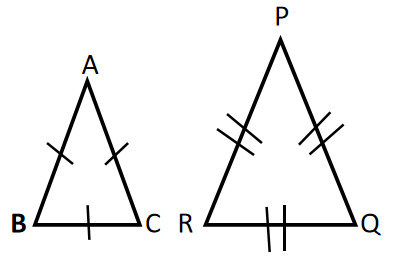
∵ Side length of Δ ABC = 7 ft and side length of Δ PQR = 21 ft
Since, side length if both the triangles are in ratio1:3
Therefore Δ ABC ≅ ΔPQR, by using Side-Side-Side (SSS) theorem.
Triangles with side 7 ft and 21 ft are congruent by SSS theorem.
Exercise 4.2 Triangles Congruence By Side Side Side And Side Angle Side Savvas Learning Co Geometry Detailed Answers Page 230 Exercise 8 Problem 8
Given: \(\overline{J K}\) ≅ \(\overline{L M}\),\(\overline{J M}\) ≅ \(\overline{K K}\)
Proof:
\(\overline{J K}\) ≅ \(\overline{L M}\) (Given)
\(\mathrm{J} \overline{\mathrm{M}} \cong \overline{K K}\) (Given)
\(\overline{K M} \cong \overline{K M}\) (Reflexive property of congruence )
Therefore, ΔJKM≅ m ΔLMK, by SSS theorem.
ΔJKM and ΔLMK are congruent using the SSS theorem.
Savvas Learning Co Geometry Student Edition Chapter 4 Page 230 Exercise 9 Problem 9
Given: \(\overline{I E} \cong \overline{G H}\), \(\overline{E F}\) ≅ \(\overline{H F}\) and F is the midpoint of GI
The figure:
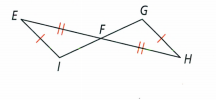
To Find – Prove EFI ≅ HFG
When we compare these two triangles, we get that they have equal corresponding sides as we can see from the figure.
⇒ \(\overline{I E} \cong \overline{G H}\)
⇒ \(\overline{E F} \cong \overline{H F}\)
⇒ \(\overline{F I} \cong \overline{F G}\)
We know, that F is the midpoint of \(\overline{G I}\)
The midpoint divides the side into two equal parts.
Based on the SSS congruence theorem, these two triangles are congruent.
Hence, proved.
By the SSS Congruence theorem, the given triangles are congurent.
Geometry Chapter 4 Triangles Congruence By Side Side Side And Side Angle Side Savvas Learning Co Explanation Guide Page 230 Exercise 10 Problem 10
Given: \(\overline{W Z}\) ≅ \(\overline{S D}\) ≅ \(\overline{D W}\)
The figure:
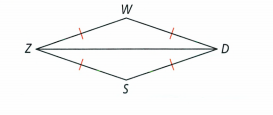
To find – Prove \(\mathrm{WZD} \cong S D Z\)
When we compare these two triangles WZD and SDZ we get that they have equal corresponding sides, as we can see from the given figure
⇒ \(\overline{W Z}\) ≅ \(\overline{S D}\) ≅ \(\overline{D W}\)
⇒ \(\overline{Z D} \cong \overline{Z D}\)
⇒ \(\overline{Z D}\)
Is the common side for both triangles based on the SSS Congruence theorem , these two traiangles are congruent.
Hence , proved
\(\overline{Z D}\) common side for both triangles. Based on the SSS congruence theorem thes two triangles are congruent.
Savvas Learning Co Geometry Student Edition Chapter 4 Page 231 Exercise 11 Problem 11
Given:
The figure
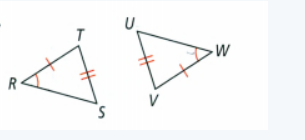
To Find – What other information, if any, do you need to prove the two triangles congruent by SAS? Explain.
When we compare these two triangles RTS and WVU we get that they have equal corresponding sides, as we see that the figure.
⇒ \(T R\) ≅ \(\overline{V W}\)
⇒ \(\angle R \cong \angle W\)
⇒ \(\overline{T S} \cong \overline{V U}\)
∠R are the included angles for sides \(\overline{T R}\), \(\overline{T S}\)
∠W are the included angles for sides \(\overline{V W}\), and \(\overline{V U}\)
Now, we have to find the included angles for the sides.
When we compare these two triangles we get that they have equal corresponding angles, as we can see from the figure.
⇒ \(\angle T \cong \angle V\)
∠T are the included angles for sides \(\overline{T R}\), \(\overline{T S}\)
∠V are the included angles for sides \(\overline{V W}\), and \(\overline{V U}\)
The additional information that we need to prove that these two triangles are congruent using the SAS Congruence theorem is
⇒ ∠T ≅ ∠V
Now, we will find corresponding sides for the included angles R and W.
∠R are the included angles for sides \(\overline{T R}\), \(\overline{T S}\)
∠W are the included angles for sides \(\overline{V W}\), and \(\overline{V U}\)
The additional information that we need to prove that these two triangles are congruent using the SAS Congruence theorem is
⇒ \(R S\) ≅ \(\overline{W U}\).
The additional information we need is ∠T ≅ ∠V, \(R S\) ≅ \(\overline{W U}\)
The additional information we need is ∠T ≅ ∠V, RS ≅ \(\overline{W U}\)
Page 231 Exercise 12 Problem 12
Given:
The figure
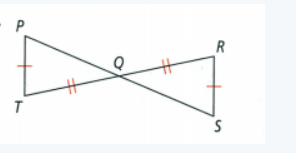
To Find – Would you use SSS or SAS to prove the triangles congruent? If there is not enough information to prove the triangles congruent by SSS or SAS, write not enough information. Explain your answer.
When we compare these two triangles PQT and SQR we get that they have equal corresponding sides, as we see that the figure
⇒ \(P T \cong \overline{S R}\)
⇒ \(Q T \cong \overline{Q R}\)
⇒ ∠PQT and ∠SQR are vertical angles.
So,∠PQT≅∠SQR
∠PQT is not the included for sides \(\overline{P T}\) and \(\overline{Q T}\)
∠SQR is not the included angles for sides \(\overline{S R}\) and \(\overline{Q R}\)
There is not enough information to prove that triangles PQT and SQR are congruent using the SSS and the SAS Congruence Theorem.
There is not enough information to prove that triangles PQT and SQR are congruent using the SSS and the SAS Congruence Theorem.
Savvas Learning Co Geometry Student Edition Chapter 4 Page 231 Exercise 13 Problem 13
Given:
The figure
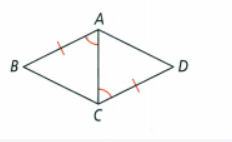
To Find – Would you use SSS or SAS to prove the triangles congruent? If there is not enough information to prove the triangles congruent by SSS or SAS, write not enough information.
Explain your answer. When we compare these two triangles ABC and CDA we get that they have equal corresponding sides, as we see that the figure
⇒ \(A B\) ≅ \(\overline{D C}\)
∠BAC ≅ ∠DCA
⇒ \(A C \cong \overline{A C}\)
∠AC are the common side for both triangles.
∠BAC are the included angles for sides \(\overline{A B} \text { and } \overline{A C}\)
∠DCA are the included angles for the sides \(\overline{D C} \text { and } \overline{A C}\)
Based on SAS Congruence Theorem, these two triangles ABC and CDA are congruent.
We would use the SAS Congruence theorem.
By the SAS Congruence Theorem, these two triangles are congruent.
Savvas Learning Co Geometry Student Edition Chapter 4 Page 231 Exercise 14 Problem 14
Given: Each triangle should have two 5inches sides and an angle of 40degrees
To find – Which postulate, SSS or SAS, are you likely to apply to the given situation?
SAS postulate says that two triangles are congruent if two sides of one triangle are congruent with the corresponding sides of the other triangle and the angle that overlaps those two sides are congruent with the corresponding angle of the other triangle.
These two triangles have two equal corresponding sides of 5 inches and 40 degrees angle.
Based on the SAS congruence theorem, these two triangles are congruent.
Diagram:
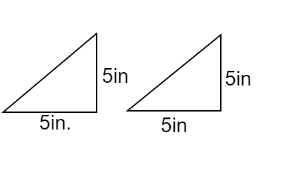
The SAS congruence theorem, prove two triangles are congruent. The diagram
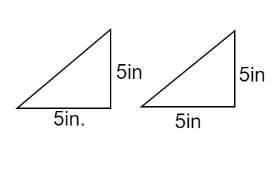
Savvas Learning Co Geometry Student Edition Chapter 4 Page 231 Exercise 15 Problem 15
Given: \(B C \cong \overline{D A}\), \(\angle \bar{C} B \bar{D} \cong \angle A D B\)
The figure
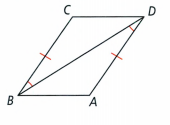
To find – Prove BCD ≅ DAB
When we compare these two triangles BCD and DAB we get that they have equal corresponding sides, as we see that the figure:
⇒ \(B C \cong \overline{D A}\)
⇒ \(\angle C B D \cong \angle A D B\)
⇒ \(B D \cong \overline{B D}\)
∠CBD are the included angles for side \(\overline{B C} \text { and } \overline{B D}\)
∠ADB are the included angles for sides \(\overline{D A} \text { and } \overline{B D}\)
Based on the SAS Congruence Theorem, these two triangles BCD and DAB are congruent.
The SAS Congruence Theorem probe triangle BCD and DAB congruent.
Savvas Learning Co Geometry Student Edition Chapter 4 Page 231 Exercise 16 Problem 16
Given: The pairs A(1,4), B(5,5), C(2,2), D(−5,1), E(−1,0), F(−4,3)
To find – Use the Distance Formula to determine whether ABC and DEF are congruent. Justify your answer.
The distance formula:
AB = \(\sqrt{\left(x_1-x_2\right)^2+\left(y_1-y_2\right)^2}\)
Now, we will calculate the side length of triangles ABC based on this formula
Now calculate for AB, BC, AC
A(1,4) , B(5,4)
⇒ AB = \(\sqrt{(1-5)^2+(4-5)^2}\)
⇒ AB = \(\sqrt{16+7}\)
⇒ AB = \(\sqrt{17}\)
B (5,5), C(2,2)
⇒ BC = \(\sqrt{(5-2)^2+(5-2)^2}\)
⇒ BC = \(\sqrt{9+9}\)
⇒ BC = \(\sqrt{18}\)
A(1,40, C(2,2)
⇒ AC = \(\sqrt{(1-2)^2+(4-2)^2}\)
⇒ AC = \(\sqrt{1+4}\)
⇒ AC = \(\sqrt{5}\)
Now, we know the length of the sides of a triangle DEF.
Now, we will calculate the length of the sides of a triangle DEF.
Calculate for DE, EF, DF.
D (-5, 1), E(-1,0)
⇒ DE = \(\sqrt{(-5-(-1))^2+(1-0)^2}\)
⇒ DE = \(\sqrt(16+1)\)
⇒ DE = \(\sqrt{17}\)
E (-1,0), F (-4,30
⇒ EF = \(\sqrt{\left(-1-(-4)^2+(0-3)^2\right.}\)
⇒ EF = \(\sqrt{9+9}\)
⇒ EF = \(\sqrt{18}\)
D (-5,1), F (-4,3)
⇒ DF = \(\sqrt{\left(-5-(-4)^2+(1-3)^2\right.}\)
⇒ DF = \(\sqrt{1+4}\)
⇒ DF = \(\sqrt{5}\)
When we compare the length of the sides of these two triangles we get that:
⇒ AB = DE
⇒ BC = EF
⇒ AC = DF
Based on SSS Congruence Theorem, these two triangles are congruent.
The SSS Congruence Theorem proves that the two triangles are congruent.
Savvas Learning Co Geometry Student Edition Chapter 4 Page 231 Exercise 17 Problem 17
Given: The A(3,8), B(8,12), C(10,5), D(3,−1), E(7,−7), F(12,−2)
To find – Use the Distance Formula to determine whether ABC and DEF are congruent. Justify your answer.
Given,A(3,8), B(8,12), C(10,5),D(3,−1), E(7,−7)F(12,−2)
Now use the distance formula:
Formula: \(\sqrt{\left(x_1-x_2\right)^2+\left(y_1-y_2\right)^2}\)
Now substitute for AB, BC, CA, DE, EF, FD
⇒ AB = \(\sqrt{(8-3)^2+(12-8)^2}\) = \(\sqrt{41}\)
⇒ BC = \(\sqrt{(10-8)^2+(5-12)^2}\) = \(\sqrt{53}\)
⇒ CA = \(\sqrt{(10-3)^2+(5-8)^2}\)= \(\sqrt{58}\)
⇒ DE = \(\sqrt{(7-3)^2+\left(-7-(-1)^2\right.}\)= \(\sqrt{52}\)
⇒ EF = \(\sqrt{(12-7)^2+\left(-2-(-7)^2\right.}\)= \(\sqrt{50}\)
⇒ FD = \(\sqrt{(12-3)^2+\left(-2-(-1)^2\right.}\)= \(\sqrt{82}\)
We compute the lengths of each triangle’s edges, using the formula of distance.
So, Triangle ABC ≅ DEF
Since the triangles have different lengths of edges, they are not congruent.
The triangle ABC and DEF are not congruent.
Savvas Learning Co Geometry Student Edition Chapter 4 Page 231 Exercise 18 Problem 18
Given: The pairs A(2,9), B(2,4), C(5,4), D(1,−3), E(1,2), F(−2,2)
To find – Use the Distance Formula to determine whether ABC and DEF are congruent. Justify your answer.
The distance formula:
AB = \(\sqrt{\left(x_1-x_2\right)^2+\left(y_1-y_2\right)^2}\)
Now, we will calculate the side length of triangles ABC based on this formula:
Now calculate for AB, BC, AC
A(2,9) , B(2,4)
⇒ AB = \(\sqrt{(2-2)^2+(9-4)^2}=\sqrt{25}\) = 5
⇒ BC = \(\sqrt{(2-5)^2+(4-4)^2}=\sqrt{9}\)= 3
⇒ AC = \(\sqrt{(2-5)^2+(9-4)^2}=\sqrt{34}\)
Now , we caculated for DE, EF, DF
⇒ DE = \(\sqrt{(1-1)^2+\left(-3-2)^2\right.}=\sqrt{25}\) = 5
⇒ EF = \(\sqrt{(1-(-2))^2+\left(-2-2)^2\right.}=\sqrt{9}\)= 3
⇒ DF= \(\sqrt{(-1)-2)^2+\left(-3-2)^2\right.}=\sqrt{34}\).
We compare the lengths of the sides of these triangles we get that
⇒ AB= DE
⇒ BC = EF
⇒ AC= DF
Based on SSS Congruence theorem.. these two triangles are congruent.
The SSS Congruence theorem.. these two triangles are congruent.
Savvas Learning Co Geometry Student Edition Chapter 4 Page 231 Exercise 19 Problem 19
Given: Congruent triangles.
To find – List three real-life uses of congruent triangles.
For each real-life use, describe why you think congruence is necessary.
Two triangles are said to be congruent if they are of the same size and same shape.
Two congruent triangles have the same area and perimeter.
When we consider the application of congruent triangles in real life, the first thing I remember is toys for children can be in the shape of triangles that are congruent.
Congruent triangles are used in the construction to reinforce the structure.
Jewelry can also consist of congruent triangles.
When we consider the application of congruent triangles in real life, toys for children can be in the shape of triangles that are congruent. Congruent triangles are used in the construction to reinforce the structure. Jewelry can also consist of congruent triangles.
Savvas Learning Co Geometry Student Edition Chapter 4 Page 232 Exercise 20 Problem 20
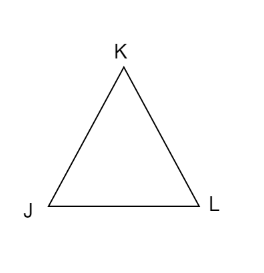
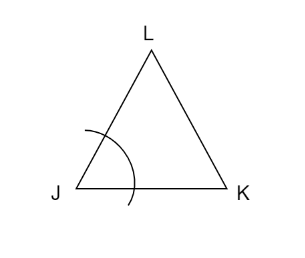
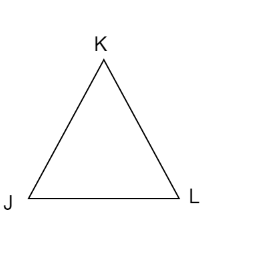
Given: Use a straightedge to draw any triangle JKL
To find – ΔMNP ≅ ΔJKL using SSS and SAS theoremThe SSS theorem states that two triangles are congruent if three sides of one are equal respectively to three sides of the other The SAS theorem states that two triangles are equal if two sides and the angle between those two sides are equal.
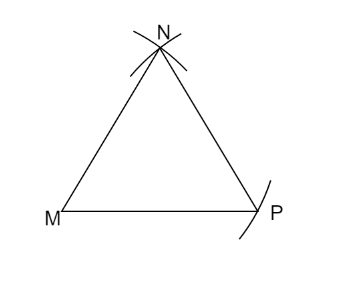
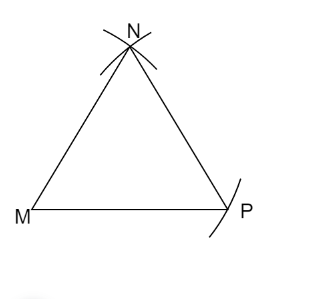
To prove ΔMNP ≅ ΔJKL using SSS theorem
We’ll start by drawing a triangle JKL, then a line adjacent to it with the point M marked on it.
The length of the line JL will then be measured with the opening of the compass and transferred from point M to the line.
The point P is obtained by intersecting the arc with the line.
Then we’ll use a compass to transfer the distance JK from point M to point P, and then we’ll use the compass to transfer the distance LK from point P to point M.
The point N is formed by the intersection of these two arcs.
Finally, we shall connect these points to form the triangle MNP.
We have
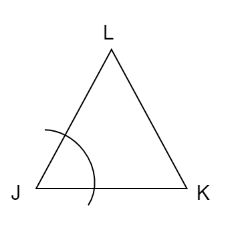
To prove using SAS theorem.
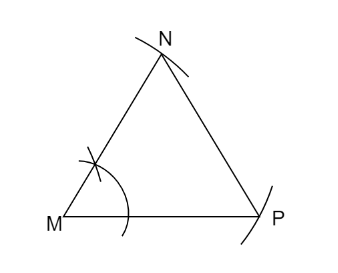
We’ll start by drawing a triangle JKL , then a line adjacent to it with the point M marked on it.
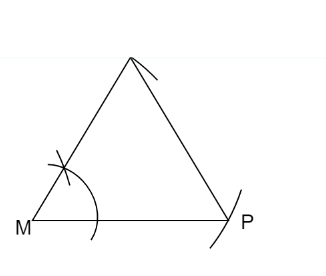
Then, using the opening of the compass, we’ll measure the length of the line JK and transfer it from point M to the line.
The point N is found at the intersection of the arc and the line.
Then, from the point M , we’ll transfer the arc with the angle at the vertex J and its length, and then, from the point M , we’ll transfer the distance JL via the compass’s opening, and finally, from the point M , we’ll transmit the distance JL
The point P is formed by the intersection of these two arcs.
Finally, we’ll connect these points to form the MNP triangle.
We have
By SSS theorem ΔMNP ≅ ΔJKL
By SAS theorem ΔMNP≅ΔJKL
Savvas Learning Co Geometry Student Edition Chapter 4 Page 232 Exercise 21 Problem 21
Given: Two triangle ΔYHD AND ΔKPT
YH = KP
HD = PT
To find – Triangles are congruent to each other.
Equate the corresponding sides of the one triangle to the second triangle.
In the above figure
As Given
YH = KP
HD = PT
As We are missing the third information for congruency criteria to be applied
We need a side to apply SSS or an angle to apply SAS.
NO, We can not.
We need third information to apply congruency criteria which can be a side or an angle to the corresponding sides
Page 232 Exercise 22 Problem 22
Given: Two triangles ΔGJK and ΔGMK
GJ = GM
∠IGK = ∠MGK
To find: Triangles are congruent to each other.
Equate the corresponding sides of the one triangle to the second triangle.
In the above figure
As Given In ΔGJK and ΔGMK
GJ = GM
∠IGK = ∠MGK
GK = GK
Using SAS congruency criterion ΔGJK ≅ ΔGMK
Using SAS congruency criterion ΔGJK ≅ ΔGMK
Savvas Learning Co Geometry Student Edition Chapter 4 Page 232 Exercise 23 Problem 23
Given: Two triangles where AE and BD bisect each other.
To find – Triangles are congruent to each otherEquate the corresponding sides of the one triangle to the second triangle.
In ΔACB and ΔECD
It is given that AE and BD biscet each other so
AC = CE
BC = CD
Also, ∠ACB = ECD (Vertically opposite angle)
By using SAS congruency criterion
ΔACB ≅ ΔECD
Using SAS congruency criterion,ΔACB ≅ ΔECD
Page 232 Exercise 24 Problem 24
Given: Two triangles where AB⊥CM, AB⊥DB, CM = DB
To find – Triangles are congruent to each other.
Equate the corresponding sides of the one triangle to the second triangle.
Mid-pointIn ΔAMC and ΔMBD
It is given that CM = AB
As ∠AMC = ∠MBD
= 90
Also as m is the mid -point AM = MB
By using the SAS congruency criterion ΔAMC ≅ ΔMBD
Using SAS congruency criterion, ΔAMC ≅ ΔMBD
Savvas Learning Co Geometry Student Edition Chapter 4 Page 232 Exercise 25 Problem 25
Given: polygon ABCD whose four sides are congruent.
To find – EFGH and ABCD and EFGH are congruent or not Using the definition of congruent polygons, ABCD and EFGH are congruent of the corresponding angles are also congruent.
A quadrilateral is not rigid because, for the same side lengths, the interior angles can be different
Using the definition of congruent polygons, ABCD and EFGH are congruent of the corresponding angles are also congruent A quadrilateral is not rigid because, for the same side lengths, the interior angles can be different
Page 232 Exercise 26 Problem 26
Given: Two triangles where HK = LG, HF = LJ, FG = JK
To find – Triangles are congruent to each otherEquate the corresponding sides of the one triangle to the second triangle.
In ΔFGH and ΔJKL
It is given that
⇒ HK = LG,HF = LJ,FG = JK
⇒ As HK = LG
Adding both sides GK we get
⇒ HK + GK = LG + GK
⇒ HG = KL
By using SSS congruency criteria We get ΔFGH ≅ ΔJKL
By using SSS congruency Criterion ΔFGH ≅ ΔJKL
Savvas Learning Co Geometry Student Edition Chapter 4 Page 232 Exercise 27 Problem 27
Given: Two triangles where ∠N = ∠L,MN = OL,NO = LM
To find – Prove MN ∥ OL
Equate the corresponding sides of the one triangle to the second triangle.
In ΔONM and ΔMLO
It is given that
⇒ ∠N = ∠L,MN = OL,NO = LM
By using the SAS congruency criterion we can say that, ΔONM ≅ ΔMLO
Also Using CPCT in the congruent triangles
∠NOM = ∠LMO which is a pair of alternate interior angles.
So MN ∥ OL
MN ∥ OL as ∠NOM = ∠LMO is pair of alternate interior angles.
Page 232 Exercise 28 Problem 28
Given: Two Triangles ΔVWY and ΔVWZ where ∠VWY = ∠VWZ
To find – Conditions for the triangles to be congruent by SAS.
As given ∠VWY = ∠VWZ also, we have a common side VW = VW
So we need another side to apply the SAS congruency criterion which can be YW = ZW and no other option can satisfy it
The correct answer is which is YW = ZW to satisfy SAS congruency criterion
Savvas Learning Co Geometry Student Edition Chapter 4 Page 232 Exercise 29 Problem 29
Given: Two angles of a triangle equal to 43 and 38.
To find – Measure of third angle
Let The third angle be ∠A.
Then we know that sum of all interior angles is 180
So, according to question
⇒ 43 + 38 + ∠A = 180
⇒ 81 + ∠A = 180
⇒ ∠A = 180 − 81
⇒ ∠A = 99
The right anser is ∠A = 99
The correct answer is which is equal to 99
Page 232 Exercise 30 Problem 30
Given: ABCD ≅ EFGH
To find – Side 9s de that corresponds to BC
So, given here ABCD ≅ EFGH both are congruent. And the rule for writing congruency is to write the corresponding same angles and sides of shapes.
For eg; if in ΔABC and ΔDEF, ∠A = ∠E, AB = DE, and BC = DF. Then congruency will be written as ΔABC ≅ ΔEDF.
So, according to the given congruency here, we can figure out a few points.
Angles: ∠A = ∠E,∠B = ∠F,∠C = ∠G and ∠D = ∠H
Sides: AB = EF,BC = FG,CD = GH and DA = HE
Side corresponding to BC in congruency relation ABCD ≅ EFGH is FG.
Savvas Learning Co Geometry Student Edition Chapter 4 Page 232 Exercise 3 1 Problem 31
Given: If x = 3, then x2 = 9
To find: Converse of statement and determine if true or false.
Here hypothesis is x = 3 and conclusion is x2 = 9.
So, the converse of the given statement will be “If x2 = 9, then x = 3″.
Simplifying the conclusion in the given statement by taking root both sides, we get x = ±3.
So, there are two solutions for the conclusion.
The statement is true, Converse is false.