
Savvas Learning Co Geometry Student Edition Chapter 6 Polygons And Quadrilaterals Exercise
Savvas Learning Co Geometry Student Edition Chapter 6 Polygons And Quadrilaterals Exercise Solutions Page 349 Exercise 1 Problem 1
Given: The figure as
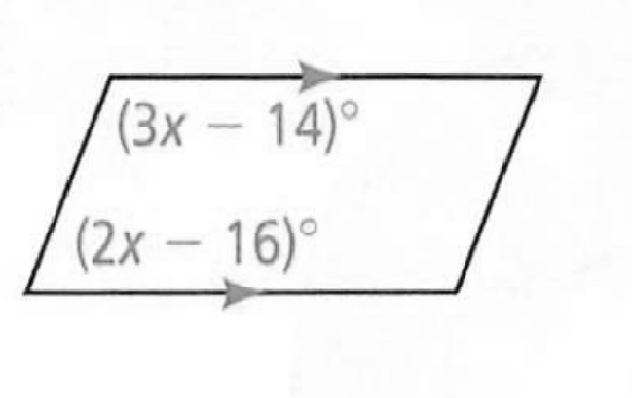
To find – The value of x.
We will be using the concept of co-interior angles to find the value of the unknown variables.
From the given figure, we see that since the opposite sides of the given parallelogram are equal, so the angles formed are co-interior angles.
As co-interior angles are supplementary, so we have:
⇒ (3x − 14) + (2x − 16) = 18
⇒ 5x − 30 = 180
⇒ 5x = 180 + 30
⇒ 5x = 210
⇒ x = \(\frac{210}{5}\)
⇒ x = 42°
The value of x = 42°
Read and Learn More Savvas Learning Co Geometry Student Edition Solutions
Chapter 6 Polygons And Quadrilaterals Exercise Savvas Geometry Answers Page 349 Exercise 2 Problem 2
Given: The figure as
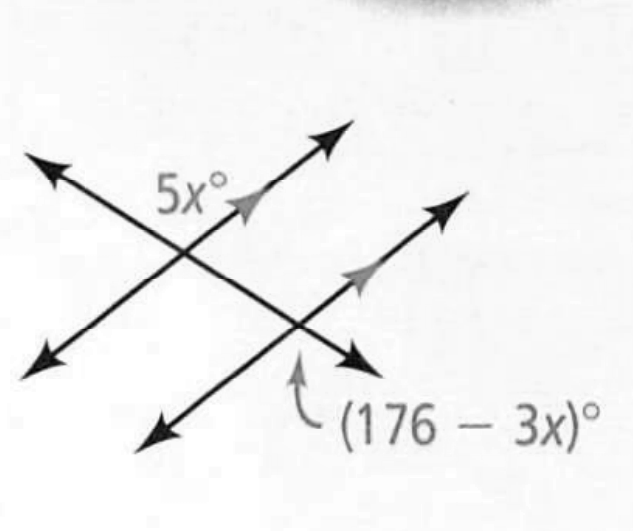
To find – The value of x.
We will be using the concept of corresponding angles to find the value of unknown variable.
From the given figure, we have the lines parallel to each other, so the corresponding angles will be equal.
So, we have
⇒ 5x = 176 − 3x
⇒ 5x + 3x = 176
⇒ 8x = 176
⇒ x = \(\frac{176}{8}\)
⇒ x = 22°
The value of x = 22°.
Polygons And Quadrilaterals Exercises Solutions Chapter 6 Savvas Geometry Page 349 Exercise 3 Problem 3
We have the given figure as
Polygons And Quadrilaterals Exercises Solutions Chapter 6 Savvas Geometry Page 349 Exercise 4 Problem 4
Given: The figure as
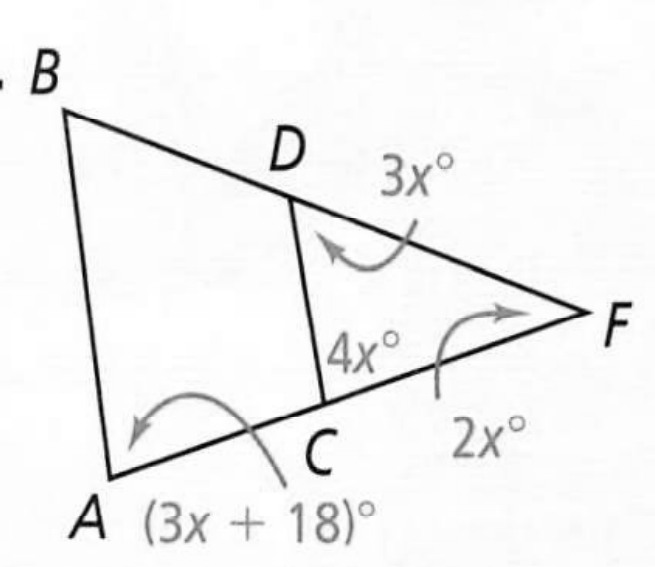
To check – If AB ∥ CD.
We will be using the concept of corresponding angles, to check the above asked.
Now, we know that AB is parallel to CD if the corresponding angles formed by these lines are equal, that is if
∠CDF = ∠FAB
Let us consider the ΔCFD by angles sum property, we have:
⇒ 2x + 4x + 3x = 180
⇒ 9x = 180
⇒ x = \(\frac{180}{9}\)
⇒ x = 20°
So we have
⇒ ∠CDF = 4x
= 4 × 20
= 80°
⇒ ∠FAB = (3x + 18)
= 3 × 20 + 18
= 60 + 18
= 78°
As ∠CDF ≠ ∠FAB, thus the lines are not parallel.
The line AB is not parallel to CD.
Chapter 6 Polygons And Quadrilaterals Explanation Savvas Learning Co Geometry Page 349 Exercise 5 Problem 5
Given: The figure as
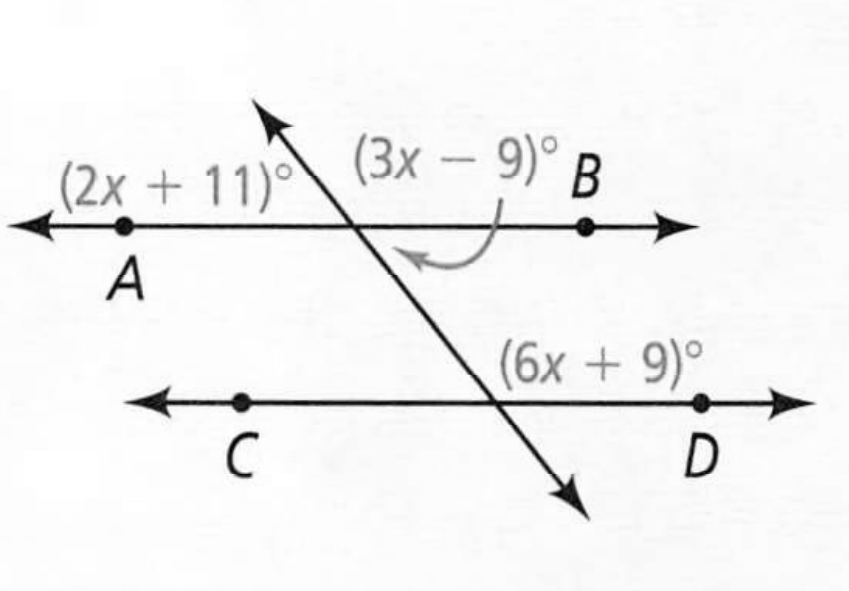
To check: If AB ∥ CD.
We will be using the concept of co-interior angles to check if the two lines are parallel or not.
From the figure, we have the pair of vertically opposite angles as
⇒ 2x + 11 = 3x − 9
⇒ 3x − 2x = 11 + 9
⇒ x = 20°
So, now we know that AB ∥ CD if the co-interior angles are supplementary
⇒ 3x − 9 = 3 × 20 − 9
= 60 − 9
= 51°
⇒ 6x + 9 = 6 × 20 + 9
= 120 + 9
= 129°
This gives
⇒ (3x − 9) + (6x + 9) = 180
⇒ 51°+ 129° = 180°
⇒ 180° = 180°
Which is true.
Thus, the lines are parallel.
The line AB is parallel to CD.
Chapter 6 Polygons And Quadrilaterals Explanation Savvas Learning Co Geometry Page 349 Exercise 6 Problem 6
Given: The lines as
⇒ y = −2x
⇒ y − 2x + 4
To check: Is the lines are parallel, perpendicular or neither.
We will be calculating the slope of each line and check if they are equal than the slopes are parallel and if the product of the slopes is −1 then they are perpendicular.
We have the line as
⇒ y = −2x
Now, comparing the equation with the slope-intercept form y = mx + c gives the slope as:
⇒ m1 = −2
The other line is
⇒ y = −2x + 4
Now, we have the slope for this as
⇒ m2 = −2
This implies
⇒ m1 = m2
Thus, the lines are parallel.
The given lines y = −2x, y = −2x + 4 are parallel.
Solutions For Polygons And Quadrilaterals Exercises In Savvas Geometry Chapter 6 Student Edition Page 349 Exercise 7 Problem 7
Given: The lines as
⇒ y = \(\frac{−3}{5}\) x + 1
⇒ y = \(\frac{5}{3}\) x − 3
To check: Is the lines are parallel, perpendicular or neither.
We will be calculating the slope of each line and check if they are equal than the slopes are parallel and if the product of the slopes is −1 then they are perpendicular
We have the line as
⇒ y = \(\frac{−3}{5}\) x + 1
This gives us the slope as m1 = \(\frac{−3}{5}\)
Now the other line is given as
⇒ y = \(\frac{5}{3}\) x − 3
So we have the slope as m2 = \(\frac{5}{3}\)
Now since the two slopes are not equal this means the lines are not parallel.
Now, we have
m1 m2 = \(\frac{−3}{5}\) × \(\frac{5}{3}\)
= −1
Thus, the lines are perpendicular.
The given lines y = \(\frac{−3}{5}\) x + 1 , y =\(\frac{5}{3}\) x − 3 are perpendicular.
Polygons And Quadrilaterals Exercises Savvas Learning Co Geometry Detailed Answers Page 349 Exercise 8 Problem 8
We are given the following figure as
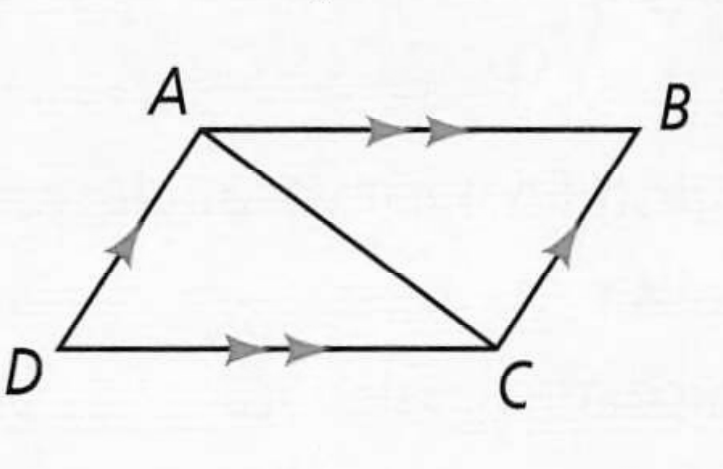
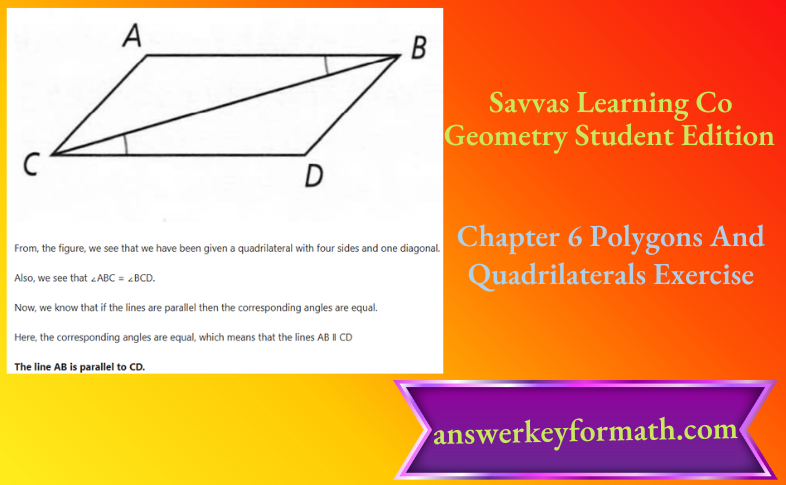
From the given figure, we see that we have a parallelogram with two triangles as ΔABC, ΔADC
Now, in the two triangles we see that the opposite sides of the parallelogram are equal and the one is the diagonal that is common between the two triangles.
That means, the two triangles are congruent using the SSS congruence rule.
The postulate or theorem that makes each pair of triangles congruent in the given figure is the Side-Side-Side (SSS) congruence rule.
Polygons And Quadrilaterals Exercises Savvas Learning Co Geometry Detailed Answers Page 349 Exercise 9 Problem 9
We are given the following figure as
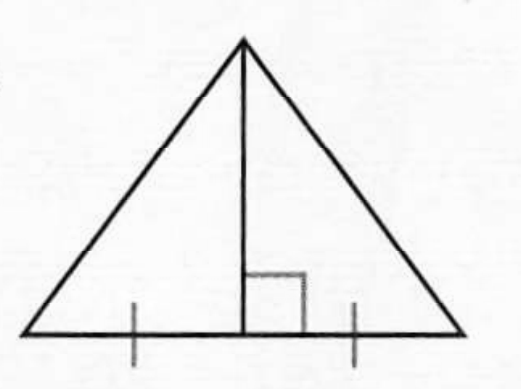
From the given figure, we see that we have two triangles.
The base of both the triangles are given to be equal and the perpendicular is common in both the triangles.
Now, we see that the angle formed by the perpendicular is right angle angle in both the triangles, which gives that hypotenuse must be equal in both the triangles.
Thus, both the triangles are congruent by Right angle-Hypotenuse-Side (RHS) rule.
The postulate or theorem that makes each pair of triangles congruent is Right angle-Hypotenuse-Side (RHS) congruence rule.
Geometry Chapter 6 Polygons And Quadrilaterals Savvas Learning Co Explanation Guide Page 349 Exercise 10 Problem 10
We are given the figure ass
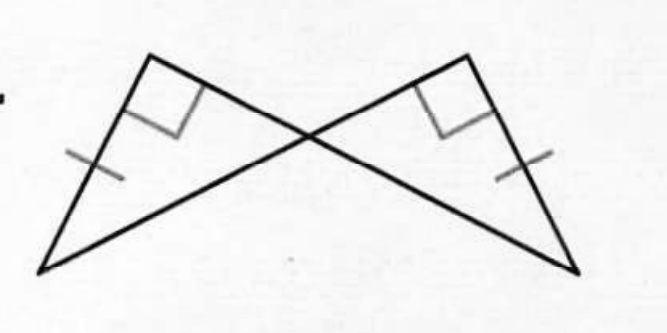
From the given figure, we see that we have two triangles.
The base of both the triangles are given to be equal and the angle formed on the base is right angle.
Since in both the triangles, angles are equal and length of both the angles are equal, this implies that the other leg of the angle must be equal.
Thus, both the triangles are congruent by Side Angle Side (SAS) rule.
The postulate or theorem that makes each pair of triangles congruent is Side-Angle-Side (SAS) congruence rule.
Geometry Chapter 6 Polygons And Quadrilaterals Savvas Learning Co Explanation Guide Page 349 Exercise 11 Problem 11
The word or the term “equilateral” means having all its sides of the same length.
For Example: An equilateral triangle, which means that the triangle where all the sides are of same measure or the same length.
Similarly, if we think about an equilateral polygon, we know that it is such a kind of polygon where all the sides of the it are equal.
Suppose let us take and example of polygon that is – a pentagon. The figure given below have all the sides of same measure, thus forming a pentagon with five equal sides.
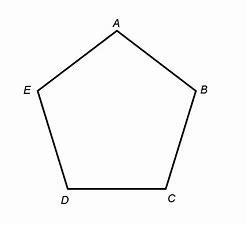
The word “equilateral” means having all its sides of the same length. The equilateral polygon is the polygon where all the sides are of same length or measure.
Chapter 6 Polygons And Quadrilaterals Exercise Savvas Geometry Answers Page 349 Exercise 12 Problem 12
Now, we see that a Kite is a flat shape with straight sides. The kite is a quadrilateral with four sides.
Kite is diamond shape quadrilateral.
The geometrical characteristics of the kite are given below:
⇒ Two pair of adjacent sides are equal
⇒ The intersection of the diagonals of a kite form 90o (right) angles. This means that they are perpendicular.
⇒ The longer diagonal of a kite bisects the shorter one. This means that the longer diagonal cuts the shorter one in half.
⇒ The angles between the two pairs of equal adjacent sides are equal to each other.
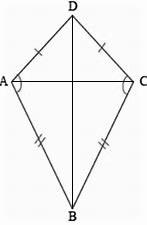
A kite can be defines as a diamond shaped quadrilateral. The geometrical characteristics of the kite are as follows :- there are two pair of adjacent sides that are equal, the diagonals are perpendicular to each other, the longer diagonal bisects the shorter diagonal and the angles between the two pair of adjacent sides are equal.
Chapter 6 Polygons And Quadrilaterals Exercise Savvas Geometry Answers Page 349 Exercise 13 Problem 13
We know that when a team wins two consecutive gold medals, it means they have won two gold medals in a row.
This gives us the meaning of the term or the word “consecutive” as following each other continuously without interruption.
If we talk about a quadrilateral, then two consecutive angle will be one after the other, which means if one angle is ∠A, then the consecutive angle can be given by its adjacent angle ∠B
and so on.
Thus, the consecutive angle in a quadrilateral are the angles following each other without the interruption of any other angle.
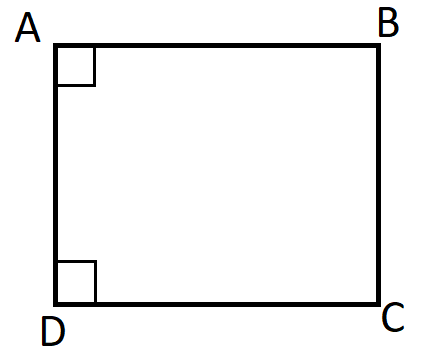
The consecutive angle in a quadrilateral are the angles following each other without the interruption of any other angle.