
Linear Algebra 5th Edition Chapter 1 Vector Spaces
Page 6 Problem 1 Answer
Given: (3,−2,4) and (−5,7,1).
To find: the equation of the line that passes through the mentioned points in space.
Assume A=(3,−2,4) and B=(−5,7,1) .
Then calculate c=B−A, and find the equation of line using the formula,
⇒ x=A+tc .
Calculate the endpoint c,
⇒ c=B−A
⇒ c=(−5,7,1)−(3,−2,4)
⇒ c=(−8,9,−3)
Find the equation of line,
⇒ x=A+tc
⇒ x=(3,−2,4)+t(−8,9,−3)
The equation of the line through vectors A and B will be,
⇒ x=(3,−2,4)+t(−8,9,−3) .
Read and Learn More Stephen Friedberg Linear Algebra 5th Edition Solutions
Vector spaces in Linear Algebra Stephen Friedberg 5th Edition Chapter 1 Exercises Page 6 Problem 2 Answer
Given: (2,4,0) and (−3,−6,0).
To find: the equation of the line that passes through the mentioned points in space.
Assume A=(2,4,0) and B=(−3,−6,0) .
Then find c=B−A, and calculate the equation of line using the formula,
Calculate the endpoint c,
⇒ c=B−A
⇒ c=(−3,−6,0)−(2,4,0)
⇒ c=(−5,−10,0)
Calculate the equation of line,
⇒ x=A+tc
⇒ x=(2,4,0)+t(−5,−10,0)
The equation of the line through vectors A and B will be x=(2,4,0)+t(−5,−10,0).
Linear Algebra 5th Edition Chapter 1 Page 6 Problem 3 Answer
Page 6 Problem 4 Answer
Given points: (−2,−1,5) and (3,9,7).
To find: the equation of the line that passes through the given points in space.
Assume A=(−2,−1,5) and B=(3,9,7) .
Then find c=B−A, and calculate the equation of line using the formula,
Calculate the endpoint c,
⇒ c=B−A
⇒ c=(3,9,7)−(−2,−1,5)
⇒ c=(5,10,2)
The equation of line,
⇒ x=A+tc
⇒ x=(−2,−1,5)+t(5,10,2)
The equation of the line through vectors A and B will be x=(−2,−1,5)+t(5,10,2).
Linear Algebra 5th Edition Stephen Friedberg Chapter 1.1 Vector Spaces Explanation Chapter 1 Page 6 Problem 5 Answer
Given points: (2,−5,−1),(0,4,6),(−3,7,1)
To find: the equation of the plane which contains the given points.
Assume A=(2,−5,−1) B=(0,4,6) C=(−3,7,1)
and then calculate the endpoints originating from A and terminating at C and B as v and u respectively to calculate the equation of plane as x=A+su+tv
Calculate the endpoint u,
⇒ u=B−A
⇒ u=(0,4,6)−(2,−5,−1)
⇒ u=(−2,9,7)
Similarly, the endpoint v,
⇒ v=C−A
⇒ v=(−3,7,1)−(2,−5,−1)
⇒ v=(−5,12,2)
The equation of the plane containing the given points will be,
⇒ x=A+su+tv
⇒ x=(2,−5,−1)+s(−2,9,7)+t(−5,12,2)
The equation of the plane containing the mentioned points will be,
⇒ x=(2,−5,−1)+s(−2,9,7)+t(−5,12,2) .
Page 6 Problem 6 Answer
Points are given in the question that(3,−6,7),(−2,0,−4),(5,−9,2).
To find: the equation of the plane containing the given points.
Assume
⇒ A=(3,−6,7)
⇒ B=(−2,0,−4)
C=(5,−9,−2) and calculate the endpoints originating from A and terminating at C and B as v and u respectively to calculate the equation of plane as x=A+su+tv
Calculate the endpoint u,
⇒ u=B−A
⇒ u=(−2,0,−4)−(3,−6,7)
⇒ u=(−5,6,−11)
Similarly calculate the endpoint v,
⇒ v=C−A
⇒ v=(5,−9,−2)−(3,−6,7)
⇒ v=(2,−3,−9)
Calculate the equation of the plane containing the given points,
⇒ x=A+su+tv
⇒ x=(3,−6,7)+s(−5,6,−11)+t(2,−3,−9)
The equation of the plane which contains the given points will be x=(3,−6,7)+s(−5,6,−11)+t(2,−3,−9).
Key Concepts Vector Spaces Chapter 1 Friedberg Linear Algebra 5th Edition Page 6 Problem 7 Answer
Points given are (−8,2,0),(1,3,0),(6,−5,0) .
To find the equation of the plane containing the given points.
Assume
⇒ A=(−8,2,0)
⇒ B=(1,3,0)
C=(6,−5,0) and then calculate the endpoints originating from A and terminating at C and B as v and u respectively to calculate the equation of plane as x=A+su+tv
Calculate the endpoint u,
⇒ u=B−A
⇒ u=(1,3,0)−(−8,2,0)
⇒ u=(9,1,0)
Similarly calculate the endpoint v,
⇒ v=C−A
⇒ v=(6,−5,0)−(−8,2,0)
⇒ v=(14,−7,0)
Calculate the equation of the plane containing the given points,
⇒ x=A+su+tv
⇒ x=(−8,2,0)+s(9,1,0)+t(14,−7,0)
The equation of the plane containing the given points will be,
⇒ x=(−8,2,0)+s(9,1,0)+t(14,−7,0) .
Page 6 Problem 8 Answer
Given points: (1,1,1),(5,5,5),(−6,4,2)
To find: the equation of the plane containing the given points.
Assume
⇒ A=(1,1,1)
⇒ B=(5,5,5)
C=(−6,4,2) and then calculate the endpoints originating from A and terminating at C and B as v and u respectively to find the equation of plane as x=A+su+tv
Calculate the endpoint u,
⇒ u=B−A
⇒ u=(5,5,5)−(1,1,1)
⇒ u=(4,4,4)
Calculate the endpoint v,
⇒ v=C−A
⇒ v=(−6,4,2)−(1,1,1)
⇒ v=(−7,3,1)
Calculate the equation of the plane containing the mentioned points,
⇒ x=A+su+tv
⇒ x=(1,1,1)+s(4,4,4)+t(−7,3,1)
The equation of the plane containing the given points will be x=(1,1,1)+s(4,4,4)+t(−7,3,1).
Linear Algebra Vector Spaces Solved Examples Stephen Friedberg Chapter 1 Page 6 Problem 9 Answer
It has been given a property that ‘There exists a vector denoted 0 such that x+0=x for each vector x.
To find: the coordinates of the vector 0 in the Euclidean plane that is satisfying the given property
To calculate that, the vector will be satisfying the vector rules of addition.
Vector law of addition will be,
⇒ (x1,x2)+(01+02)=(x1,x2)
Where (x1,x2)∈R
After following the rules of vector addition,
⇒ (x1+01,x2+02)=(x1,x2)
⇒ x1+01=x1
⇒ 01=x1−x1
⇒ 01=0
In the same way, 02=0
The coordinates of the vector 0 in the Euclidean plane that satisfies the mentioned property will be (0,0).
Page 6 Problem 10 Answer
We have to prove that the vector x emanates from the origin of the Euclidean plane and terminates at the point with coordinates (a1,a2).
Then the vector tx that emanates from the origin terminates at the point with coordinates (ta1,ta2).
Vector x⃗ will be emanating from the origin and terminates at (a1,a2) :x⃗=(a1,a2)−(0,0)
x⃗=(a1,a2)Assume tx⃗ is then,tx⃗=t(a1,a2)
tx⃗=(ta1,ta2)
As we know, tx⃗ emanates from the origin, so,
(ta1,ta2)+(0,0)=(ta1,ta2)
The vector x emanates from the origin of the Euclidean plane and terminates at the point with coordinates (a1,a2), then the vector tx that emanates from the origin terminates at the point with coordinates (ta1,ta2).
Linear Algebra 5th Edition Chapter 1 Page 6 Problem 11 Answer
We need to prove that the diagonals of the parallelogram bisect each other.
For proving this, we have to assume a parallelogram ABCD and diagonals intersect each other at O.
And further by the use of congruent triangles, the given will be proved.
Sketch a parallelogram ABCD and diagonals intersect each other at O,
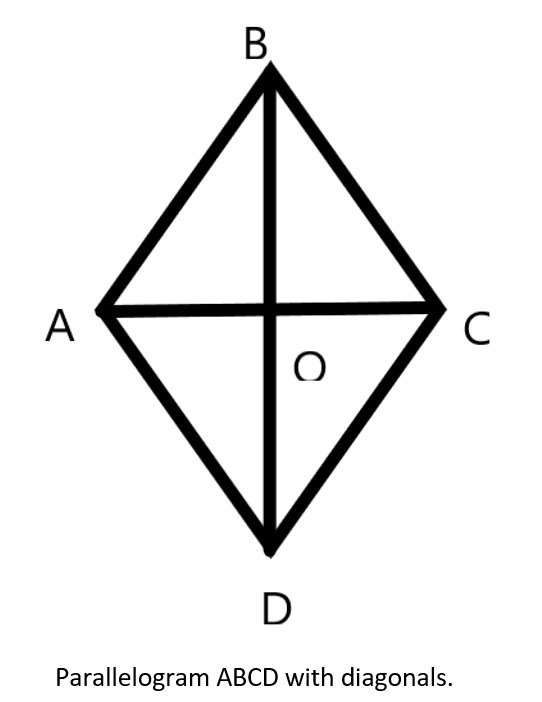
Assume △AOB and △DOC,
⇒ ∠AOC=∠DOC ..(opposite angles)
⇒ AB=DC ..(opposite parallel sides)
⇒ ∠ABO=∠ODC (alternate interior angles)
So, △AOD≅△DOC
Therefore, we can conclude by saying
⇒ AO=OC
⇒ DO=BO
The diagonals of the parallelogram will be bisecting each other.