
Linear Algebra 5th Edition Chapter 1 Vector Spaces
Page 33 Problem 1 Answer
Here we have to state whether the statement “The zero vector is a linear combination of any nonempty set of vectors” is true or false.
Zero vector will be a unique vector of length zero. It can be represented as 0=0v1+0v2….+0vn.
From the above definition, we can say that a zero vector will be a linear combination of any set of vectors, empty or not.
Therefore, the given statement will be true.
An empty sum, which means, the sum of no vectors, will be usually defined to be zero.
Therefore, the given statement is justified and cannot be false.
The given statement “The zero vector is a linear combination of any nonempty set of vectors” is true.
Stephen Friedberg Linear Algebra 5th Edition Solutions For Exercise 1.4 Linear Algebra 5th Edition Chapter 1 Page 33 Problem 2 Answer
Here we have to state whether the statement “The span of ϕ is ϕ ” is true or false.
The span of a set of vectors will be the smallest vector space that includes all of them.
An empty set, that is, the smallest vector space will include the zero vector.
From the above explanation, we can say that an empty set contains the zero vector, so it is not empty in essence.
Therefore, the given statement is false.
An empty set will be the one which only contains the zero vector.
If the only component of ϕ will be the zero vector, it becomes a non-zero set.
Therefore, the given statement cannot be true.
The statement given is, “The span of ϕ is ϕ ” is false.
Read and Learn More Stephen Friedberg Linear Algebra 5th Edition Solutions
Linear Algebra 5th Edition Chapter 1 Page 33 Problem 3 Answer
We have to state whether the statement “If S is a subset of a vector space V, then span ( S ) equals the intersection of all subspaces of V that contain S ” is true or false.
The span of S includes all the vectors in that set, which in turn is a subset of V .
Therefore, the span of V already contains all those vectors that appear in S .
From the above explanation, we can say that the span ( S ) which will be equal to the intersection of all subspaces of V that contain S .
Therefore, the given statement will be true.
As S is a subset of V , all its vectors are derived from it.
Therefore, any vector appearing in S is by default, a part of V .
So the span of S intersects the part of the span of V that includes all vectors of S .
Hence, the statement given is justified and cannot be false.
The statement “If S is a subset of a vector space V, then span ( S ) equals the intersection of all subspaces of V that contain S ” is true.
Linear Algebra 5th Edition Chapter 1 Page 33 Problem 4 Answer
We have to state whether the statement “In solving a system of linear equations, it is permissible to multiply an equation by any constant” is true or false.
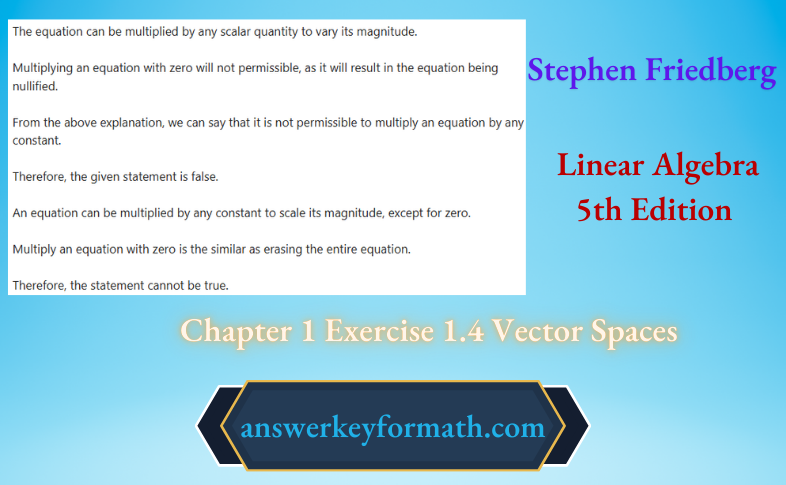
The statement “In solving a system of linear equations, it is permissible to multiply an equation by any constant” will not false.
Linear Algebra 5th Edition Chapter 1 Page 33 Problem 5 Answer
Here we have to state whether the statement “In solving a system of linear equations, it is permissible to add any multiple of one equation to another” is true or false.
Here add any multiple of one equation to the other, it is permissible.
Adding an arbitrary multiple of an equation to another equation will be still yielding an equivalent system.
Therefore, the given statement is true.
When solving a system of linear equations, it is permissible to add any multiple of one equation to another.
It is mathematically permissible to perform these operations on a system of linear equations.
However, the only exception is that you cannot multiply an equation with its multiplicative inverse, as it will vary the value of the equation.
Therefore, the statement cannot be false.
The statement “In solving a system of linear equations, it is permissible to add any multiple of one equation to another” is true.
Chapter 1 Exercise 1.4 Vector Spaces Problem Set Page 33 Problem 6 Answer
Here we have to state whether the statement “Every system of linear equations has a solution” is true or false.
All systems of linear equation may not necessarily have a solution, they might be inconsistent also.
Only homogeneous equations have solutions, one of which will be always the zero vector.
From the explanation given above, we can say that it is not necessary for every system of equations to have a solution.
Therefore, the given statement is false.
Some non-homogeneous systems of linear equations will be existing.
If and only if its determinant is non-zero, these equations have a unique solution.
When its determinant will be zero, they do not have any solution.
Therefore we can say that every system of linear equations may not have a solution.
The given statement “Every system of linear equations has a solution” is false.
Linear Algebra 5th Edition Chapter 1 Page 34 Problem 7 Answer
Given: x3−3x+5,×3+2×2−x+1,×3+3×2−1
We need to determine whether the first polynomial can be expressed as a linear combination of the other two.
Make use of the definition of linear combination for solving the given question.
Assume a and b are scalar, then find a and b such that.
⇒ x3−3x+5=a(x3+2×2−x+1)+b(x3+3×2−1)
=(a+b)x3+(2a+3b)x2+(−a)x+(a−b) ..(1)
Thus we are led to the following system of linear equations:
⇒ a+b=1
⇒ 2a+3b=0
⇒ −a=−3
⇒ a−b=5
From the equation −a=−3, we find that,a=3.
Adding equations to the others in order to eliminate a, we find that
⇒ a+b−a=1−3
⇒ b=−2
Put values of a and b in the equation (1), we find that
(a+b)x3+(2a+3b)x2+(−a)x+(a−b)=(3+(−2))x3+(2(3)+3(−2))x2+(−3)x+(3−(−2)) =x3−3x+5
Hence x3−3x+5=3(x3+2×2−x+1)−2(x3+3×2−1) .
The first polynomial x3−3x+5 is the linear combination of x3+2×2−x+1 and x3+3×2−1.
Linear Algebra 5th Edition Chapter 1 Page 34 Problem 8 Answer
Given: 4×3+2×2−6,×3−2×2+4x+1,3×3−6×2+x+4
We need to determine whether the first polynomial can be expressed as a linear combination of the other two.
Use the definition of linear combination to solve the given question.
Let a and b are scalar, then find a and b such that.
4×3+2×2−6=a(x3−2×2+4x+1)+b(3×3−6×2+x+4)
=(a+3b)x3+(−2a−6b)x2+(4a+b)x+(a+4b) ..(1)
Thus we are led to the following system of linear equations:
⇒ a+3b=4
⇒ −2a−6b=2
⇒ 4a+b=0
⇒ a+4b=−6
Adding equations to the others in order to eliminate a, we find that
⇒ a+3b+a+4b−2a−6b=4−6+2
⇒ b=0
Again, substitute value of b in any of the equation and solve for a.
⇒ a+3(0)=4
⇒ a=4
Put values of a and b in the equation (1), we find that
(a+3b)x3+(−2a−6b)x2+(4a+b)x+(a+4b)=((4)+3(0))x3+(−2(4)−6(0))x2+(4(4)+0)x+(4+4(0)) =4×3−8×2+16x+4
Hence
4×3+2×2−6≠4(x3−2×2+4x+1)+0(3×3−6×2+x+4)
The first polynomial 4×3+2×2−6 is not the linear combination of x3−2×2+4x+1 and 3×3−6×2+x+4.
Friedberg Chapter 1 Exercise 1.4 Vector Spaces Explanation Page 34 Problem 9 Answer
Given: −2×3−11×2+3x+2,×3−2×2+3x−1,2×3+x2+3x−2 We need to determine whether the first polynomial can be expressed as a linear combination of the other two.
Make use of linear combination for solving the given question.
Assume a and b are scalar, then calculate a and b such that.
−2×3−11×2+3x+2=a(x3−2×2+3x−1)+b(2×3+x2+3x−2)
=(a+2b)x3+(−2a+b)x2+(3a+3b)x+(−a−2b) ..(1)
Thus we are led to the following system of linear equations:
⇒ a+2b=−2
⇒ −2a+b=−11
⇒ 3a+3b=3
⇒ −a−2b=2
Adding equations to the others in order to eliminate a, we find that
−a−2b−2a+b+3a+3b=2−11+3
⇒ 2 b=6
⇒ 3 b=3
Again, substitute value of b in any of the equation and solve for a .
⇒ a+2(3)=−2
⇒ a=−8
Put values of a and b in the equation (1), we find that
(a+2b)x3+(−2a+b)x2+(3a+3b)x+(−a−2b)=(−8+2(3))x3+(−2(−8)+3)x2+(3(−8)+3(3))x+(−(−8)−2(3))
=−2×3+16×2−15x+2
Hence −2×3−11×2+3x+2≠−8(x3−2×2+3x−1)+3(2×3+x2+3x−2) .
Hence, the first polynomial −2×3−11×2+3x+2 is not the linear combination of x3−2×2+3x−1 and 2×3+x2+3x−2.
Linear Algebra 5th Edition Chapter 1 Page 34 Problem 10 Answer
Here, x3+x2+2x+13,2×3−3×2+4x+1,×3−x2+2x+3 is given a
We have to find whether the first polynomial can be expressed as a linear combination of the other two
Make use of the definition of linear combination to solve the given question.
Let a and b are scalar, then find a and b such that.
x3+x2+2x+13=a(2×3−3×2+4x+1)+b(x3−x2+2x+3)
=(2a+b)x3+(−3a−b)x2+(4a+2b)x+(a+3b) ..(1)
Thus we are led to the following system of linear equations:
⇒ 2a+b=1
⇒ −3a−b=1
⇒ 4a+2b=2
⇒ a+3b=13
Adding equations to the others in order to eliminate a, we find that
2a+b+a+3b−3a−b=1+13+1
⇒ 3 b=15
⇒ b=5
Again, substitute value of b in any of the equation and solve for a.
⇒ 2a+5=1
⇒ a=−2
Put values of a and b in the equation (1), we find that
x3+x2+2x+13=(2a+b)x3+(−3a−b)x2+(4a+2b)x+(a+3b) =(2(−2)+5)x3+(−3(−2)−5)x2+(4(−2)+2(5))x+(−2+3(5)) =x3+x2+2x+13
Hence x3+x2+2x+13=−2(2×3−3×2+4x+1)+5(x3−x2+2x+3) .
Hence , the first polynomial x3+x2+2x+13 is the linear combination of 2×3−3×2+4x+1 and x3−x2+2x+3 .
Linear Algebra 5th Edition Chapter 1 Page 34 Problem 11 Answer
Here, x3−8×2+4x,x3−2×2+3x−1,×3−2x+3 is given We have to determine whether the first polynomial can be expressed as a linear combination of the other two.
Make use of the definition of linear combination to solve the given question.
Assume a and b are scalar, then find a and b such that.
x3−8×2+4x=a(x3−2×2+3x−1)+b(x3−2x+3)
=(a+b)x3+(2a+2b)x2+(3a)x+(−a+3b) ..(1)
Thus we are led to the following system of linear equations:
⇒ a+b=1
⇒ 2a+2b=−8
⇒ 3a=4
⇒ −a+3b=0
Adding equations to the others in order to eliminate a, we find that
a+b−a+3b=1+0
4b=1
b=1/4
Again, substitute value of b in any of the equation and solve for a.
a+1/4=1
a=1−1/3
a=2/3
Put values of a and b in the equation (1), we find that
(a+b)x3+(2a+2b)x2+(3a)x+(−a+3b)=((2/3)+(1/4))x3+(2(2/3)+2(1/4))x2+3(2/3)x+(−(2/3)+3(1/4))
=11/12×3+11/6×2+2x+1/12
Hence x3−8×2+4x≠2/3(x3−2×2+3x−1)+1/4(x3−2x+3) .
Hence, the first polynomial x3−8×2+4x is not the linear combination of x3−2×2+3x−1 and x3−2x+3.
Understanding Exercise 1.4 In Friedberg Linear Algebra Chapter 1 Page 34 Problem 12 Answer
Here, 6×3−3×2+x+2,×3−x2+2x+3,2×3−3x+1 is given We have to calculate whether the first polynomial can be expressed as a linear combination of the other two.
Make use of the definition of linear combination to solve the given question.
Let a and b are scalar, then find a and b such that.
6×3−3×2+x+2=a(x3−x2+2x+3)+b(2×3−3x+1)
=(a+2b)x3+(−a)x2+(2a−3b)x+(3a+b) ..(1)
Thus we are led to the following system of linear equations:
⇒ a+2b=6
⇒ −a=−3
⇒ 2a−3b=1
⇒ 3a+b=2
From the above equation −a=−3 , we find that ,a=3
Adding equations to the others in order to eliminate a, we find that
⇒ a+2b−a=6−3
⇒ 2b=3
⇒ b=3/2
Put values of a and b in the equation (1), we find that
(a+2b)x3+(−a)x2+(2a−3b)x+(3a+b)=(3+2(3/2))x3+(−3)x2+(2(3)−3(3/2))x+(3(3)+3/2)
=6×3−3×2+3/2x+21/2
Hence 6×3−3×2+x+2=3(x3−x2+2x+3)+3/2(2×3−3x+1) .
Hence, the first polynomial 6×3−3×2+x+2 is not the linear combination of x3−x2+2x+3 and 2×3−3x+1.
Linear Algebra 5th Edition Chapter 1 Page 34 Problem 13 Answer
Here, (2,−1,1),S={(1,0,2),(−1,1,1)} is given We have to calculate whether the given vector is in the span of S.
Check whether the given vector can be shown as a linear combination of vectors in S
to solve the given question.
Check whether the given vector can be shown as a linear combination of vectors in S .
Let a and b are scalars .
⇒ (2,−1,1)=a(1,0,2)+b(−1,1,1)
⇒ (2,−1,1)=(a,0,2a)+(−b,b,b)
⇒ (2,−1,1)=(a−b,b,2a+b) ……(1)
⇒ a−b=2
⇒ b=−1
⇒ 2a+b=1
Add equation first and second to eliminate b.
⇒ a−b+b=2−1
⇒ a=1
Substitute value of b in first equation, we get
⇒ 1−b=2
⇒ b=−1
Substitute values of a and b in the equation (1), we get
⇒ (2,−1,1)=(a−b,b,2a+b)
=(1−(−1),−1,2(1)−1)
=(2,−1,1)
Hence, vector (2,−1,1) can be expressed as a linear combination of (1,0,2) and (−1,1,1), so that (2,−1,1) is in the span of S.
Linear Algebra 5th Edition Chapter 1 Page 34 Problem 14 Answer
Given: (−1,2,1), S={(1,0,2),(−1,1,1)} is given and we have to determine whether the given vector is in the span of S.
We have to verify whether the given vector can be represented as a linear combination of vectors in S to solve the given question.
Verify whether the given vector can be shown as a linear combination of vectors in S.
Let a and b are scalars .
(−1,2,1)=a(1,0,2)+b(−1,1,1)
(−1,2,1)=(a,0,2a)+(−b,b,b)
(−1,2,1)=(a−b,b,2a+b) ……(1)
⇒ a−b=−1
⇒ b=2
⇒ 2a+b=1
Add equation first and second to eliminate b.
⇒ a−b+b=−1+2
⇒ a=1
Substitute value of b in first equation , we get
⇒ 1−b=−1
⇒ b=2
Substitute values of a and b in the equation (1), we get
⇒ (a−b,b,2a+b)=(1−2,2,2(1)+2)
=(−1,2,4)
Hence,vector (−1,2,1) can not be expressed as a linear combination of (1,0,2) and (−1,1,1) , so that (2,−1,1) is not in the span of S.
Linear Algebra 5th Edition Chapter 1 Page 34 Problem 15 Answer
Given: (−1,1,1,2), S={(1,0,1,−1),(0,1,1,1)} is given and we have to determine whether the given vector is in the span of S.
We have to check whether the given vector can be shown as a linear combination of vectors in S for solving the given question.
Analyse whether the given vector can be shown as a linear combination of vectors in S.
Let a and b are scalars .
(−1,1,1,2)=a(1,0,1,−1)+b(0,1,1,1)
(−1,1,1,2)=(a,0,a,−a)+(0,b,b,b)
(−1,1,1,2)=(a,b,a+b,−a+b) ……(1)
⇒ a=−1
⇒ b=1
⇒ a+b=1
⇒ −a+b=2
Apply results from the first two equations to the other two, we get
⇒ a=−1
⇒ b=1
⇒ 0≠1
⇒ 2=2
Hence,vector (−1,1,1,2) can not be expressed as a linear combination of (1,0,1,−1) and (0,1,1,1), so that (−1,1,1,2) is not in the span of S.
Exercise 1.4 Notes From Friedberg Linear Algebra 5th Edition Chapter 1 Page 34 Problem 16 Answer
Given, (2,−1,1,−3), S={(1,0,1,−1),(0,1,1,1)} is given and we have to calculate whether the given vector is in the span of S.
Verify whether the given vector can be shown as a linear combination of vectors in Sto solve the given question.
Verify whether the given vector can be shown as a linear combination of vectors in S.
Let a and b are scalars .
(2,−1,1,−3)=a(1,0,1,−1)+b(0,1,1,1)
(2,−1,1,−3)=(a,0,a,−a)+(0,b,b,b)
(2,−1,1,−3)=(a,b,a+b,−a+b) ……(1)
That is
⇒ a=2
⇒ b=−1
⇒ a+b=1
⇒ −a+b=−3
Apply results from the first two equations to the other two, we get
⇒ a=2
⇒ b=−1
⇒ 1=1
⇒ −3=−3
Hence,vector (2,−1,1,−3) can be expressed as a linear combination of (1,0,1,−1) and (0,1,1,1), so that (2,−1,1,−3) is in the span of S.
Linear Algebra 5th Edition Chapter 1 Page 34 Problem 17 Answer
Given, −x3+2×2+3x+3,S={x3+x2+x+1,×2+x+1,x+1} is given and we have to determine whether the given vector is in the span of S.
Verify whether the given vector can be represented vas a linear combination of vectors in Sto solve the given question.
Check whether the given vector can be shown as a linear combination of vectors in S.
Let a,b and c are scalars .
−x3+2×2+3x+3=a(x3+x2+x+1)+b(x2+x+1)+c(x+1)−x3+2×2+3x+3=(ax3+ax2+ax+a)+(bx2+bx+b)+(cx+c)
−x3+2×2+3x+3=ax3+(a+b)x2+(a+b+c)x+a+b+c ……(1)
Compare like terms of above equation , we get
⇒ a=−1
⇒ a+b=2
⇒ a+b+c=3
⇒ a+b+c=3
Subtract equation second to the first to eliminate a.
⇒ a+b−a=2−(−1)
⇒ b=3
Substitute value of b in second equation, we get
⇒ a+3=2
⇒ a=−1
Substitute value of a and b in third equation, we get
⇒ −1+3+c=3
⇒ c=1
Substitute values of a,b and c in the equation (1), we get
ax3+(a+b)x2+(a+b+c)x+a+b+c=2×3+2×2+3x−1+3+1 =2×3+2×2+3x+3
Hence,vector x3+2×2+3x+3 can be expressed as a linear combination of x3+x2+x+1, x2+x+1 and x+1, so that x3+2×2+3x+3 is in the span of S.
Linear Algebra 5th Edition Chapter 1 Page 34 Problem 18 Answer
Given: 2×3−x2+x+3,S={x3+x2+x+1,×2+x+1,x+1} is given and we have to determine whether the given vector is in the span of S.
Verify whether the given vector can be shown as a linear combination of vector in S to solve the given question.
Check whether the given vector can be shown as a linear combination of vector in S.
Let a,b and c are scalars .
2×3−x2+x+3=a(x3+x2+x+1)+b(x2+x+1)+c(x+1)2×3−x2+x+3=(ax3+ax2+ax+a)+(bx2+bx+b)+(cx+c)
2×3−x2+x+3=ax3+(a+b)x2+(a+b+c)x+a+b+c ……(1)
Compare like terms of above equation , we get
⇒ a=2
⇒ a+b=−1
⇒ a+b+c=1
⇒ a+b+c=3
Substitute a in the second equation , we get
⇒ 2+b=−1
⇒ b=−3
Substitute value of a and b in third equation, we get
⇒ 2−3+c=1
⇒ c=2
Substitute values of a,b and c in the equation (1), we get
ax3+(a+b)x2+(a+b+c)x+a+b+c=2×3+x2+x+2−3+2 =2×3+x2+x+1
Hence ,vector 2×3−x2+x+3 can not be expressed as a linear combination of x3+x2+x+1 , x2+x+1 and x+1 , so that 2×3−x2+x+3 is not in the span of S .
Friedberg 5th Edition Exercise 1.4 Guide For Vector Spaces Chapter 1 Page 35 Problem 19 Answer
Given,Fn in which ej denote the vector whose jth coordinate is 1 and whose other coordinates are 0.
We have to prove that {e1,e2,…….en} generates Fn.
Find whether the given vector can be shown as a linear combination of vectors in Fn for solving the question.
Using statement given in the question, ej denote the vector whose jth coordinate is 1 and whose other coordinates are 0, we get
⇒ e1=(1,0,…………,0)
⇒ e2=(0,1,…………,0) .
.
.
.
⇒ en=(0,0,………….,1)
Let us take an arbitrary vector (h1,h2,…………hn) in Fn is a linear combination of the given vectors and scalars (a1,a2,……….,an).
⇒ (h1,h2,……….,hn)=a1
⇒ (1,0,….,0)+a2
⇒ (0,1,…..,0)+……+an
⇒ (0,0,….,1)
=(a1,0,….,0)+(0,a2,…..,0)+……+(0,0,….,an)
=(a1,a2,……,an)h1
=a1h2
=a2
.
.
hn=an
Hence (h1,h2,…………hn) can be expressed as a linear combination of {e1,e2,…….en} and {e1,e2,…….en} generates Fn .
Hence proved that {e1,e2,…….en} generates Fn,where in Fn, ej denote the vector whose jth coordinate is 1 and whose other coordinates are 0.
Linear Algebra 5th Edition Chapter 1 Page 35 Problem 20 Answer
Given: A set {1,x,x2,−−−,xn}Pn(F) is generated by {1,x,x2,−−−,xn}.To find: We need to show that Pn
(F) is generated by {1,x,x2,−−−,xn}.Let us assume a linear combination that belongs to Pn(F)
and then prove that Pn(F) is generated by {1,x,x2,−−−,xn}.
To prove that {1,x,x2,−−−,xn} generated Pn(F), we need to show that an arbitrary polynomial in Pn(F)
is a linear combination of the polynomials in set.
So, let us assume, P(x)=a0+a1x+−−−+anxn∈Pn(F) and scalars α0,α1,−−−,αn∈F
As α0,α1,−−−,αn∈F, we can write the linear combination of P(x) in terms of α0,α1,−−−,αn
as,P(x)=a0+a1x+α2×2+−−−+anxn
From Step 1 P(x)=a0+a1x+a2x2+−−−+anxn
So, a0+a1x+a2x2+−−−+anxn=α0+α1x+−−−+αnxn
On comparing the coefficients of 1,x,x2,−−−,xn
a0=α0
⇒ a1=α1
⇒ a2=α2
⋅
⋅
⋅
⇒ an=αn
⇒P(x)=a0.1+a1x+−−−+anxn is true.So, Pn(F) is generated by {1,x,−−−,xn}
Hence showed that Pn(F) is generated by {1,x,−−−,xn}.