
Linear Algebra 5th Edition Chapter 1 Vector Spaces
Page 41 Problem 1 Answer
For correct answer
In the problem, the given statement is, “If S is a linearly dependent set, then each vector in S is a linear combination of other vectors in S”.
We need to tell, whether the statement is true or false.We will solve this problem by using definition and properties of vector space.For example, let us take S={(1,0),(2,0),(0,1)}
Taking linear combination of S,
α(1,0)+β(2,0)+γ(0,1)=0
⇒ (α+2β+γ)=(0,0)
⇒ α+2β=0,
⇒ γ=0
If β=t,
for all t∈R
⇒α=−2t,
⇒ β=t,
⇒ γ=0
⇒S is linearly independent set.
If S is linearly dependent, we can assume
α(1,0)+β(2,0)=(0,1)
⇒(α+2β,0)=(0,1)
⇒α+2β=0
0=1
As, “0=1” is not possible, a contradiction.
For all other options of at least one vector.
Read and Learn More Stephen Friedberg Linear Algebra 5th Edition Solutions
In the set, S={(1,0),(2,0),(0,1)}, we can see that (0,1) is not a linear combination of other two vectors (1,0),(2,0).
So, The given statement is not true for every set S
Hence the given statement, “If S is a linearly dependent set, then each vector in S is a linear combination of other vectors in S” is False.
Stephen Friedberg Linear Algebra 5th Edition Solutions For Exercise 1.5 Page 41 Problem 2 Answer
For correct answer
In the problem, the given statement is, “Any set containing the zero vector is linearly dependent”.
We need to tell, whether the statement is true or false.Let us assume a set with zero vector.
⇒ S={0}
Taking linear combination of vectors in S,
⇒ α.0=0
The above, which is true for every α∈R.
For all other options
If a set contains a zero vector, then the set will be linearly dependent.If the set contains zero vector along with any other vector, then we can’t say that it is linearly dependent.
Hence, the given statement, “Any set containing the zero vector is linearly dependent”. is True.
Linear Algebra 5th Edition Chapter 1 Page 41 Problem 3 Answer
For correct answer
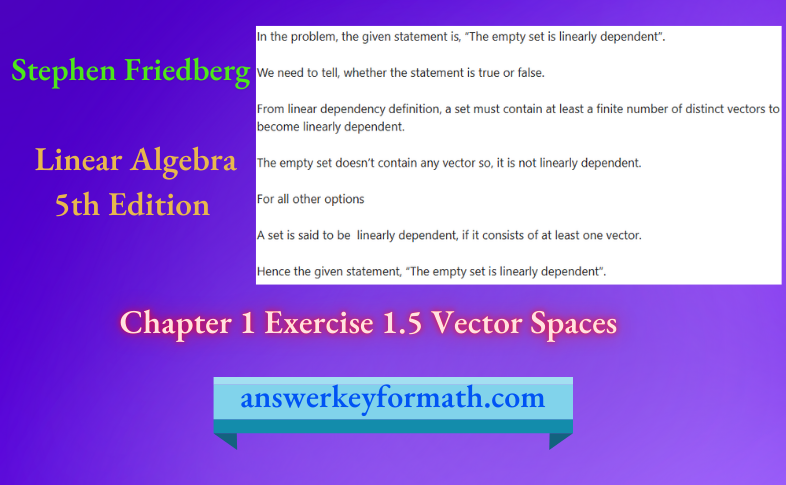
Linear Algebra 5th Edition Chapter 1 Page 41 Problem 4 Answer
In the problem, the given statement is, “subsets of linearly dependent sets are linearly dependent”.
We need to tell, whether the statement is true or false.Let us take a set
S={(1,0)(2,0)(0,1)} and assume C={(1,0)(0,1)} is subset of S.
The linear combination of Vector in S,
α(1,0)+β(2,0)+γ(0,1)=0
⇒(α+2β+γ)=(0,0)
⇒α+2β=0,
⇒ γ=0
Let B=t
⇒α=−2t,
⇒ β=t,
r=0 for all t∈R.
So, we can say that S is linearly dependent.
The linear combination of vector in C,
α(0,1)+β(0,1)=0
⇒(α,β)=(0,0)
⇒α=0,
⇒ β=0.
These are trivial representations, so C is linearly independent.
It is not possible that all subsets of linearly dependent sets are linearly dependent.
So, the given statement is not true every time.
Hence the given statement, “subsets of linearly dependent sets are linearly dependent”, is False.
Linear Algebra 5th Edition Chapter 1 Page 41 Problem 5 Answer
In the given problem, the statement is, “Subsets of linearly independent sets are linearly independent”.
We need to tell whether the statement is true or false.
Using theorem 1.6 corollary, we can solve this problem.
By theorem 1.6 corollary, we have, if V is a vector space and, then S2 is linearly independent, if S1 is linearly independent.
If a set is not linearly independent, then we cannot say that the subsets of that set are linearly independent.
From the proof of corollary of theorem 1.6, the given statement is true.
Hence, the given statement, “Subsets of linearly independent sets are linearly independent”, is True.
Page 41 Problem 6 Answer
In the given problem, the statement is,
“If a1x1+……..+an
xn=0 and x1,x2………,xn are linearly independent, then all teh scalars ai are zero.
We need to tell whether the statement is true or false.From the definition given in the tip section, we can solve this problem.
If a set {x1,x2,……,xn} is linearly independent, then the coefficient of a linear combination of vectors in that set must be zero.
That is, if a1x1+a2x2……..+anxn=0, all the scalars ai. must be zero, if the set is linearly independent.
If the coefficient of a linear combination of vectors in a set are not equal to zero then we cannot say that the set is linearly independent.
So, it is not always possible that the coefficient of a linear combination of vectors are zero.
Hence, the given statement,
“If a1x1+……..+anxn=0 and x1,x2………,xn are linearly independent, then all the scalars ai are zero” is True.
Chapter 1 Exercise 1.5 Vector Spaces Solved Problems Page 41 Problem 7 Answer
In the question, we are asked to determine that whether the given set {x3+2×2,−x2+3x+1,×3−x2+2x−1} in P3(R) is linearly dependent or linearly independent.
If we can find scalars a1,a2&a3 (not all zero) for a1(x3+2×2)+a2(−x2+3x+1)+a3(x3−x2+2x−1)=0, then the given set is linearly dependent or else it is linearly independent (a1=a2=a3=0).
Consider equation a1(x3+2×2)+a2(−x2+3x+1)+a3(x3−x2+2x−1)=0 ,
By grouping terms we get,
(a1+a3)x3+(2a1−a2−a3)x2+(3a2+2a3)x+(a2−a3)=0
For the polynomial to be zero, the coefficients must be zero
Hence we have equations,
⇒ a1+a3=0
⇒ 2a1−a2−a3=0
⇒ 3a2+2a3=0
⇒ a2−a3=0
Subtracting equation 3a2+2a3 and 3×(a2−a3=0) ,
We get, a3=0 .
Substituting a3=0 in a1+a3=0 ,
We get a1=0
Substituting a1=0&a3=0 in 2a1−a2−a3=0 ,
We get a2=0
This implies the vector set is linearly independent.
Therefore, the given vector set {x3+2×2,−x2+3x+1,×3−x2+2x−1} in P3(R) is linearly independent.
Linear Algebra 5th Edition Chapter 1 Page 41 Problem 8 Answer
Here, we are asked to determine whether the given set {x3−x,2×2+4,−2×3+3×2+2x+6} in P3(R) is linearly dependent or linearly independent.
If we find scalars a1,a2&a3 (not all zero) for a1(x3−x)+a2(2×2+4)+a3(−2×3+3×2+2x+6)=0 then the given set is linearly dependent or else it is linearly independent (a1=a2=a3=0).
Consider equation a1(x3−x)+a2(2×2+4)+a3(−2×3+3×2+2x+6)=0 ,
By grouping terms we get,(a1−2a3)x3+(2a2+3a3)x2+(−a1+2a3)x+(4a2+6a3)=0
For the polynomial to be zero, the coefficients must be zero
Hence we have equations,
⇒ a1−2a3=0
⇒ 2a2+3a3=0
⇒ −a1+2a3=0
⇒ 4a2+6a3=0
Consider equation a1−2a3=0 and 2a2+3a3=0 ,
We get, a1=2a3 and a2=−3a3/2 .
So when we pick a3=t ,
We have a1=2t and a2=−3t/2 .
So we got a non-zero solution set for the equation a1(x3−x)+a2(2×2+4)+a3(−2×3+3×2+2x+6)=0 .
This implies the vector set is linearly dependent.
Therefore, the vector set {x3−x,2×2+4,−2×3+3×2+2x+6} in P3(R) is linearly dependent.
Linear Algebra 5th Edition Chapter 1 Page 41 Problem 9 Answer
Here, we are asked to determine whether the set {(1,−1,2),(1,−2,1),(1,1,4)} in R3 is linearly dependent or linearly independent.
If we find scalars a1,a2&a3 (not all zero) for a1(1,−1,2)+a2(1,−2,1)+a3(1,1,4)=0, then the given set is linearly dependent or else it is linearly independent (a1=a2=a3=0).
Consider equation a1(1,−1,2)+a2(1,−2,1)+a3(1,1,4)=0 ,
Multiplying the constants,
(a1,−a1,2a1)+(a2,−2a2,a2)+(a3,a3,4a3)=0
(a1+a2+a3,−a1−2a2+a3,2a1+a2+4a3)=0
We have equations,
⇒ a1+a2+a3=0
⇒ −a1−2a2+a3=0
⇒ 2a1+a2+4a3=0
Adding equations a1+a2+a3=0 and −a1−2a2+a3=0 ,
We get −a2+2a3=0 .
Adding equations 2×(a1+a2+a3=0) and 2a1+a2+4a3=0 ,
We get −a2+2a3=0 .
This gives a non-zero solution set. Like when a3=t we have a1=−3t and a2=2t .
This implies the vector set is linearly dependent.
Therefore, the vector set {(1,−1,2),(1,−2,1),(1,1,4)} in R3 is linearly dependent.
Linear Algebra 5th Edition Chapter 1 Page 41 Problem 10 Answer
Here, we are asked to determine whether the given set {(1,−1,2),(2,0,1),(−1,2,−1)} in R3 is linearly dependent or linearly independent.
If we find scalars a1,a2&a3 (not all zero) for a1(1,−1,2)+a2(2,0,1)+a3(−1,2,−1)=0, then the given set is linearly dependent or else it is linearly independent (a1=a2=a3=0).
Consider equation a1(1,−1,2)+a2(2,0,1)+a3(−1,2,−1)=0 ,
Multiplying the constants,
(a1,−a1,2a1)+(2a2,0,a2)+(−a3,2a3,−a3)=0(a1+2a2−a3,−a1+2a3,2a1+a2−a3)=0
We have equations,
⇒ a1+2a2−a3=0−a1+2a3=0
⇒ 2a1+a2−a3=0
Adding equations a1+2a2−a3=0 and −a1+2a3=0 ,
We get 2a2+a3=0 .
Adding equations −2×(a1+2a2−a3=0) and 2a1+a2−a3=0 ,
We get −3a2+a3=0 .
Adding equations −1×(2a2+a3=0) and −3a2+a3=0 ,
We get a3=0 .
Hence we get a1=a2=a3=0 .
This implies the vector set is linearly independent.
Therefore, the vector set {(1,−1,2),(2,0,1),(−1,2,−1)} in R3 is linearly independent.
Linear Algebra Friedberg Exercise 1.5 Step-By-Step Guide Chapter 1 Page 41 Problem 11 Answer
We are asked to determine whether the set
{x4−x3+5×2−8x+6,−x4+x3−5×2+5x−3,×4+3×2−3x+5,2×4+3×3+4×2−x+1,×3−x+2} in P4(R) is linearly dependent or linearly independent.
So for
a1(x4−x3+5×2−8x+6)+a2(−x4+x3−5×2+5x−3)+a3(x4+3×2−3x+5)+a4(2×4+3×3+4×2−x+1)+a5(x3−x+2)=0
if we find scalars a1,a2,a3,a4&a5 (not all zero) than the given set is linearly dependent or else it is linearly independent (a1=a2=a3=a4=a5=0).
Consider equation
a1(x4−x3+5×2−8x+6)+a2(−x4+x3−5×2+5x−3)+a3(x4+3×2−3x+5)+a4(2×4+3×3+4×2−x+1)+a5(x3−x+2)=0 ,
By grouping terms we get,
(a1−a2+a3+2a4)x4+(−a1+a2+3a3+a4)x3+(5a1−5a2+3a3+4a4)x2+(−8a1+5a2−3a3−a4−a5)x+(6a1−3a2+5a3+a4+2a5)=0
For the polynomial to be zero, the coefficients must be zero
Hence we have equations,
a1−a2+a3+2a4=0 −a1+a2+3a3+a4=0
5a1−5a2+3a3+4a4=0
−8a1+5a2−3a3−a4−a5=0
6a1−3a2+5a3+a4+2a5=0
Now we have four equations and four variables,
solving it we get,
⇒ a1−a2+a3+2a4=0
⇒ −3a2+5a3+15a4−a5=0
⇒ a3+5a4+a5=0
⇒ 4a4+2a5=0
⇒ 5a5=0
we can see that a1=a2=a3=a4=0 is the only solution.
This implies the vector set is linearly independent.
The vector set in P4(R) is linearly independent.
{x4−x3+5×2−8x+6,−x4+x3−5×2+5x−3,×4+3×2−3x+5,2×4+3×3+4×2−x+1,×3−x+2}
Linear Algebra 5th Edition Chapter 1 Page 41 Problem 12 Answer
Determine whether the set
{x4−x3+5×2−8x+6,−x4+x3−5×2+5x−3,×4+3×2−3x+5,2×4+x3+4×2+8x} in P4(R) is linearly dependent or linearly independent.
So for
a1(x4−x3+5×2−8x+6)+a2(−x4+x3−5×2+5x−3)+a3(x4+3×2−3x+5)+a4(2×4+x3+4×2+8x)=0
if we find scalars a1,a2,a3&a4 (not all zero) than the given set is linearly dependent or else it is linearly independent (a1=a2=a3=a4=0).
Consider equation
a1(x4−x3+5×2−8x+6)+a2(−x4+x3−5×2+5x−3)+a3(x4+3×2−3x+5)+a4(2×4+x3+4×2+8x)=0 ,
By grouping terms we get,
(a1−a2+a3+2a4)x4+(−a1+a2+a4)x3+(5a1−5a2+3a3+4a4)x2+(−8a1+5a2−3a3+4a4)x+(6a1−3a2+5a3)=0
For the polynomial to be zero, the coefficients must be zero
Hence we have equations,
⇒ a1−a2+a3+2a4=0
⇒ −a1+a2+a4=0
⇒ 5a1−5a2+3a3+4a4=0
⇒ −8a1+5a2−3a3+5a4=0
⇒ 6a1−3a2+5a3=0
Now we have four equations and four variables,
solving it we get,
⇒ a1−a2−a4=0
⇒ −3a2+9a4=0
⇒ a3+3a4=0
Hence the equation has non-zero solution set,
like when a4=t ,
a1=4ta2=3ta3=−3t
This implies the vector set is linearly independent.
Therefore, the given vector set
{x4−x3+5×2−8x+6,−x4+x3−5×2+5x−3,×4+3×2−3x+5,2×4+x3+4×2+8x} in P4(R) is linearly independent.
Linear Algebra 5th Edition Chapter 1 Page 41 Problem 13 Answer
Given, Fn in which ej denotes the jth vector whose coordinate is 1 and whose other coordinates are 0.
We have to prove that the given set {e1,e2,…,en} in Fn is linearly independent, where en denote a vector whose nth coordinate is 1 and other coordinates are zero.
Show that the scalars a1,a2,…,an for a1e1+a2e2+…+anen=0 are all zero. then the given set is linearly independent.
First lets write down the vectors of the set,
e1=(1,0,0,0,0,….)
e2=(0,1,0,0,0,….)
.
.
en=(0,0,…,0,0,1)
So the equation a1e1+a2e2+…+anen=0 turns out as,a1(1,0,0,0,0,….)+a2(0,1,0,0,0,….)+…+an(0,0,…,0,0,1)=0
Now lets try to find the solution set of the above equation,
a1(1,0,0,0,0,….)+a2(0,1,0,0,0,….)+…+an(0,0,…,0,0,1)=0
(a1,0,0,0,0,….)+(0,a2,0,0,0,….)+…+(0,0,…,0,0,an)=0
This implies,
a1=a2,…,an=0
Hence the given set is linearly independent.
Therefore, the given vector set {e1,e2,…,en} in Fn is linearly independent.
Vector spaces Chapter 1 Exercise 1.5 Explained Friedberg Page 41 Problem 14 Answer
Here, we have to prove that the given set S={(1,1,0),(1,0,1),(0,1,1)} in F3 is linearly independent for F=R .
So for F=R , if we show that the scalars for a1(1,1,0)+a2(1,0,1)+a3(0,1,1)=0 are all zero (a1
=a2=a3=0) , then the given set is linearly independent.
Consider equation a1(1,1,0)+a2(1,0,1)+a3(0,1,1)=0 ,
Multiplying the constants,
(a1,a1,0)+(a2,0,a2)+(0,a3,a3)=0(a1+a2,a1+a3,a2+a3)=0
We have equations,
⇒ a1+a2=0
⇒ a1+a3=0
⇒ a2+a3=0
Adding equations −1×(a1+a2=0) and a1+a3=0 ,
We get −a2+a3=0 .
Adding equations −a2+a3=0 and a2+a3=0 ,
We get a3=0 .
This implies a1=a2=a3=0 .
Hence the vector set is linearly independent.
Therefore, the given vector set S={(1,1,0),(1,0,1),(0,1,1)} in F3 for F=R is linearly independent.
Friedberg 5th Edition Chapter 1 Exercise 1.5 Examples Page 42 Problem 15 Answer
Here, we have to prove that the given set S={(1,1,0),(1,0,1),(0,1,1)} in F3 is linearly dependent if F has characteristic 2.
Since F is a field with characteristic 2 we have 1+1=0 .
Therefore we consider the linear combination of the vectors of S where scalars belong to F .
So we have the equation,
⇒ a1(1,1,0)+a2(1,0,1)+a3(0,1,1)=0
Let us try a1=a2=a3=1 ,
=(1,1,0)+(1,0,1)+(0,1,1)
=(1+1,1+1,1+1)
=(0,0,0)
So we found that a1=a2=a3=1 is a solution of equation a1
⇒ (1,1,0)+a2
⇒ (1,0,1)+a3
⇒ (0,1,1)=0
Hence it is a finite linear combination of vectors of S whose coefficients are not all equals to 0.
Hence the vector set is linearly dependent.
Hence it is proved that the given vector set S={(1,1,0),(1,0,1),(0,1,1)} in F3 is linearly dependent if F has characteristic 2.
Page 42 Problem 16 Answer
Given in the question, u,v as distinct vectors in a vector space V.
We have to show that {u,v} is linearly dependent if and only if u or v is a multiple of each other.
Let {u,v} be linearly dependent such that αu+βv=0 where α,β≠0 and α,β∈R
αu+βv=0
αu=−βv
u=−βv
α ..u is a multiple of v
Let u be the multiple of v, such that u=λv, λ∈R
u−λv=0
u×1+(−λ)v=0 ..{u,v} is linearly dependent.
Therefore,{u,v} is linearly dependent if and only if u or v is a multiple of each other.
Linear Algebra 5th Edition Chapter 1 Page 41 Problem 17 Answer
The question asks to give an example of three linearly dependent vectors in R3 such that none of them is multiple of another.
Consider three different vectors v1,v2,v3 and then we would further check for their linear dependency.
Considering vectors v1,v2,v3 which are not multiples of another.
Let,v1=(1,0,0)
⇒ v2=(0,1,1)
⇒ v3=(1,1,1)
Considering
⇒ v1=αv2
⇒ (1,0,0)=α(0,1,1)
⇒ α=0
Considering
⇒ v2=βv3
⇒ (0,1,1)=β(1,1,1)
⇒ β=0,1
Considering
⇒ v3=γv1
⇒ (1,1,1)=γ(1,0,0)
⇒ γ=1
To show that v1,v2,v3 is linearly dependent,
⇒ αv1+βv2+γv3=0
⇒ α(1,0,0)+β(0,1,1)+γ(1,1,1)=(0,0,0)
⇒ (α,0,0)+(0,β,β)+(γ,γ,γ)=(0,0,0)
So,α+γ=0
⇒ β+γ=0
⇒ β+γ=0
⇒ α,β=−a
⇒ γ=a,∀a∈R
Therefore,{(1,0,0),(0,1,1),(1,1,1)} are three linearly dependent vectors in R3 such that none of them is multiple of another.