
Linear Algebra 5th Edition Chapter 2 Linear Transformations and Matrices
Page 74 Problem 1 Answer
Given: If T is linear, then T preserves sums and scalar products.
To determine whether the given statement is correct or not.
According to the definition of Linear Transformation Form, the function must preserve the sums and the scalar products in order to be linear.
And, the given statement is same as the definition of Linear Transformation.
Hence, the given statement is True.
The given statement is True i.e., If T is linear, then T preserves sums and scalar products.
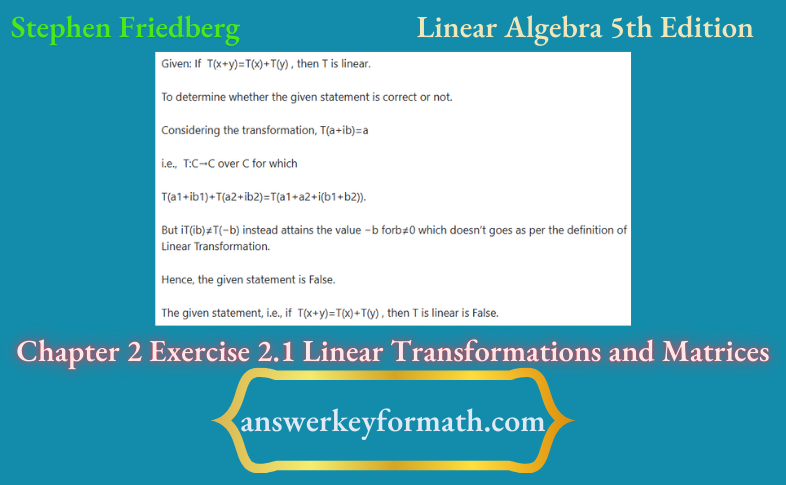
Linear Algebra 5th Edition Chapter 2 Page 74 Problem 2 Answer
Read and Learn More Stephen Friedberg Linear Algebra 5th Edition Solutions
Linear Algebra 5th Edition Chapter 2 Page 74 Problem 3 Answer
Given: T is one-to-one if and only if the only vector x such that T(x)=0 is x=0.
To determine whether the given statement is correct or not.
Consider a function f(x2)=x2 on R.
The only number x such that the value of function is zero is x=0.
But, function, f is not one-one. The given statement would be true only when T is linear.
So, the given statement is False.
The given statement i.e., T is one-to-one if and only if the only vector x such that T(x)=0 is x=0is False.
Page 74 Problem 4 Answer
Given: If T is linear, then T(0v)=0w.
To determine whether the given statement is correct or not.
The given function preserves the scalar product as per the definition of Linear Transformation i.e.,
T(0V)=0⋅T(0V)⇒T(0V)=0W.
Hence, the given statement is True.
The given statement, i.e., if T is linear, then T(0v)=0w, is True.
Linear Algebra 5th Edition Chapter 2 Page 74 Problem 5 Answer
Given: If T is linear, then nullity(T)+rank(T)=dim(W).
To determine whether the given statement is correct or not.
Consider T:R2→R as T(a,b)=a which is a linear transformation over R.
Null space and Rank of T is Null(T)=1 and
Rank(T)=1 respectively.
Null(T)+Rank(T)=2 but here the dimension of W is 1. This violates the Dimension Theorem.
So, the given statement is False.
The given statement, i.e., If T is linear, thennullity(T)+rank(T)=dim(W), is False.
Page 74 Problem 6 Answer
Given: If T is linear, then T carries linearly independent subsets of V onto linearly independent subsets of W.
To determine whether the given statement is correct or not.
Considering T: R2→R as T(a,b)=a for every y∈R which is a linear transformation over R.
So, the given statement is False.
The given statement i.e., If T is linear, then T carries linearly independent subsets of V onto linearly independent subsets of W, is False.
Linear Algebra 5th Edition Chapter 2 Page 74 Problem 7 Answer
Given: If T,U: V→W are both linear and agree on a basis for V, then T=U.
To determine whether the given statement is correct or not.
Any element x∈V can be written as x=c1x1+c2x2…+cnxn.
As both U and V agrees on the basis for V, and then T and U can be written as T(x)=c1
T(x1)+c2T(x2)…+cnT(xn) andU(x)=c1U(x1)+c2U(x2)…+cnU(xn).
So, the given statement is True.
The given statement i.e., If T,U: V→W are both linear and agree on a basis for V, then T=U, is True.
Page 74 Problem 8 Answer
Given: x1,x2∈V and y1,y2∈W , there exists a linear transformation T:V→W such that T(x1)=y1 and T(x2)=y2.
To determine whether the given statement is correct or not.
Consider T:R2→R2 , linear transformation over R and x2=cx1 for c≠0.
Also, y1=(1,0) and y2=(0,1).
If T(x1)=(1,0) then by linearity T(x2)=(c,0) andT(x2)≠0.
So, the given statement is False.
The given statement i.e., x1,x2∈V and y1,y2∈W , there exists a linear transformation T:V→W such that T(x1)=y1 and T(x2)=y2, is False.
Exercise 2.1 Linear Transformations Solved Examples Linear Algebra 5th Edition Chapter 2 Page 74 Problem 9 Answer
Given: T: R3→R2,T(a1,a2,a3)=(a1−a2,2a3) To prove the given transformation is linear, find the bases and compute the nullity and rank of T.
Also, we need to verify the Dimension Theorem and determine whether the T is one-one or onto.
First, prove the given transformation is linear and then find the bases for N(T) and R(T).
Then, find the nullity and rank of T and verify the Dimension Theorem.
Check whether given transformation is one-one or onto.
Given T:R3→R2,T(a1,a2,a3)=(a1−a2,2a3).
Consider a=(a1,a2,a3) and b=(b1,b2,b3) where a,b,α,β∈R.
Checking for Linearity of the given transformation, we get
T(αa+βb)=T(αa1+βb1,αa2+βb2,αa3+βb3)
⇒T(αa+βb)=(αa1+βb1−αa2−βb2,2αa3+2βb3)
⇒T(αa+βb)=α(a1−a2,2a3)+β(b1−b2,2b3)
⇒T(αa+βb)=αT(a)+βT(b)
The given transformation is linear.
Solving for the bases of N(T) ,we get
T(a1,a2,a3)=(0,0)⇒(a1−a2,2a3)=(0,0)
Comparing both sides of the equation, we get
a1−a2=0
⇒a1,a2=0
2a3=0
⇒a3=0
⇒N(T)={(1,1,0)}
Solving for the bases of R(T),we get
T(a1,a2,a3)=(a1−a2,2a3)
⇒(a1−a2,2a3)=(1,0)a1+(−1,0)a2+(0,2)a3
⇒R(T)={(1,0),(0,2)}
Nullity for the given transformation T is nullity(T)=1 and Rank for the given transformation is Rank(T)=2. Dimension of R3 is 3.
Substituting these values in the Dimension Theorem, we get nullity(T)+rank(T)=dim(V)
⇒1+2=3
⇒3=3
⇒L.H.S.=R.H.S.
Checking for the one-one and onto,we get
Since, nullity(T)≠0 the given transformation is not one-one and
Rank(T)=dimR2 so the transformation is onto.
Given linear transformation is linear, onto and also satisfies the Dimension Theorem.
Linear Algebra 5th Edition Chapter 2 Page 74 Problem 10 Answer
In this question, we need to prove the given transformation is linear, find the bases and compute the nullity and rank of T.
Also, need to verify the Dimension Theorem and determine whether the T is one-one or onto.
Firstly, prove the given transformation is linear and then find the bases for N(T) and R(T).
Then, nullity and rank of T and verify the Dimension Theorem.
Check whether given transformation is one-one or onto.
Given T:R2→R3,T(a1,a2)=(a1+a2,0,2a1−a2).
Consider a=(a1,a2) and b=(b1,b2) where a,b,α,β∈R.
Checking for Linearity of the given transformation, we get
T(αa+βb)=T(αa1+βb1,αa2+βb2)
⇒T(αa+βb)=(αa1+βb1+αa2+βb2,0,2αa1+2βb1−αa2−βb2)
⇒T(αa+βb)=α(a1+a2,0,2a1−a2)+β(b1+b2,0,2b1−b2)
⇒T(αa+βb)=αT(a)+βT(b)
The given transformation is linear.
Solving for the bases of N(T),we get
T(a1,a2)=(0,0,0)
⇒(a1+a2,0,2a1−a2)=(0,0,0)
Comparing both sides of the equation, we get
⇒ a1+a2=0
⇒ 2a1−a2=0
⇒a1,a2=0
⇒N(T)={(0,0)}
Solving for the bases of R(T), we get
T(a1,a2)=(a1+a2,2a1−a2)⇒(a1+a2,2a1−a2)=(1,0,2)a1+(1,0,−1)a2
⇒R(T)={(1,0,2),(1,0,−1)}
Nullity for the given transformation nullity(T)=0 and
Rank for the given transformation is Rank(T)=2.
Dimension of R2 is 2.
Substituting these values in the Dimension Theorem, we get
nullity(T)+rank(T)=dim(R2)
⇒0+2=2
⇒2=2
⇒L.H.S.=R.H.S.
Checking for the one-one and onto,we get
Since, nullity(T)=0 the given transformation is one-one and
Rank(T)≠dimR3 so the transformation is not onto.
Given linear transformation is linear, one-one and also satisfies the Dimension Theorem.
Linear Algebra Friedberg Exercise 2.1 Matrices Explained Chapter 2 Page 74 Problem 11 Answer
In this question, we need to prove the given transformation is linear, find the bases, and compute the nullity and rank of T.
Also, need to verify the Dimension Theorem and determine whether the T is one-one or onto.
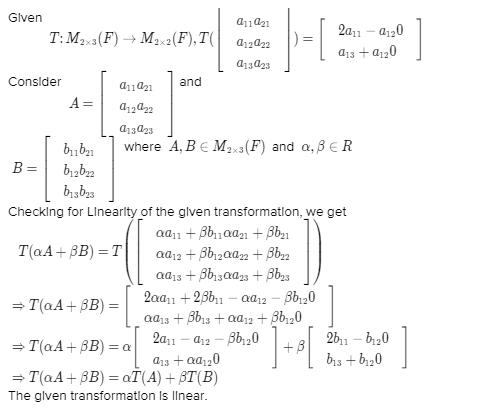
Firstly, prove the given transformation is linear and then find the bases for N(T)and R(T).
Then, nullity and rank of T and verify the Dimension Theorem.
Check whether given transformation is one-one or onto.
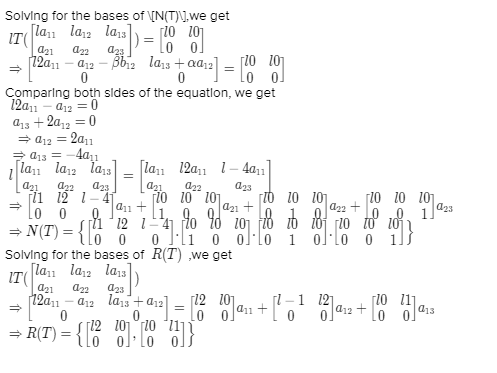
Nullity for the given transformation T is nullity(T)=4 and
Rank for the given transformation is Rank(T)=2. Dimension of M2×3(F) is 2×3=6.
Substituting these values in the Dimension Theorem, we get
lnullity(T)+rank(T)=dim(M2×3(F))
⇒4+2=6
⇒6=6
⇒L.H.S.=R.H.S.
Checking for the one-one and onto,we get
Since, nullity(T)≠0 the given transformation is not one-one and
Rank(T)≠dimM2×3(F) so the transformation is not onto also.
Given linear transformation is linear, neither one-one nor onto and also satisfies the Dimension Theorem.
Linear Algebra 5th Edition Chapter 2 Page 74 Problem 12 Answer
Given: T:P2(R)→P3(R),T(f(x))=xf(x)+f′(x)
To prove the given transformation is linear, find the bases and compute the nullity and rank of T .
Also, we need to verify the Dimension Theorem and determine whether the T is one-one or onto.
First, prove the given transformation is linear and then find the bases for N(T) and R(T).
Then, find the nullity and rank of T and verify the Dimension Theorem.
Check whether given transformation is one-one or onto.
Given T:P2(R)→P3(R),T(f(x))=xf(x)+f′(x).
Consider f,g∈P2(R) and α,β∈R.
Checking for Linearity of the given transformation, we get
T((αf+βg)(x))=x(αf+βg)(x)+(αf+βg)′
(x)⇒T((αf+βg)(x))=αxf(x)+βxg(x)+αf′(x)+βg′(x)
⇒T((αf+βg)(x))=α(xf(x)+f′(x))+β(xg(x)+g′(x))
⇒T((αf+βg)(x))=αT(f(x))+βT(g(x))
The given transformation is linear.
Solving for the bases of N(T),we get
T(f(x))=0
⇒xf(x)+f′(x)=0
⇒x(ax2+bx+c)+2ax+b=0
⇒ax3+bx2+(c+2a)x+b=0
Comparing both sides of the equation, we get
⇒ a=0
⇒ b=0
⇒ c+2a=0
⇒a,b,c=0
⇒N(T)={0}
Solving for the bases of R(T),we get
T(f(x))=xf(x)+f′(x)
⇒T(f(x))=(x3+2x)a+(x2+1)b+xc
⇒R(T)={x3+2x,x2+1,x}
Nullity for the given transformation T is nullity(T)=0 and
Rank for the given transformation is Rank(T)=3.
Dimension of P2(R)=3 is 3.
Substituting these values in the Dimension Theorem, we get
nullity(T)+rank(T)=dim(P2(R))
⇒0+3=3
⇒3=3
⇒L.H.S.=R.H.S.
Checking for the one-one and onto,we get
Since, nullity(T)=0 the given transformation is one-one and
Rank(T)≠dim(P2(R)) so the transformation is not onto.
Given linear transformation is linear and one-one and also satisfies the Dimension Theorem.
Exercise 2.1 Linear Transformations Examples Friedberg Chapter 2 Page 75 Problem 13 Answer
Given: T:Mn×n(F)→F,T(A)=tr(A)
To prove the given transformation is linear, find the bases and compute the nullity and rank of T .
Also, need to verify the Dimension Theorem and determine whether the T is one-one or onto.
Firstly, prove the given transformation is linear and then find the bases for N(T) and R(T).
Then, nullity and rank of T and verify the Dimension Theorem.
Check whether given transformation is one-one or onto.
Given T:Mn×n
(F)→F,T(A)=tr(A).
Checking for Linearity of the given transformation, we get
⇒ T(cA+B)=i=1
∑ (cAii+Bii)
n
⇒T(cA+B)=ci=1
∑ Aii+i=1
n
∑ Bii
n
⇒T(cA+B)=cT(A)+T(B)
The given transformation is linear.
Each of the given matrices in the basis of N(T) have trace equal to zero and can generate any matrix with trace equal to zero,we get
⇒N(T)={Eij}i≠j∪{Eii−Ei+1,i+1},For i=1,…,n.
Solving for the bases of R(T) ,we get⇒R(T)={1}
Nullity for the given transformation T is nullity(T)=n2−1 and
Rank for the given transformation is Rank(T)=1. Dimension of Mn×n(F) is n2.
Substituting these values in the Dimension Theorem, we get
nullity(T)+rank(T)=dim(Mn×n(F))
⇒n2−1+1=n2
⇒n2
=n2
⇒L.H.S.=R.H.S.
Checking for the one-one and onto,we get
Since, nullity(T)≠0 the given transformation is one-one and
The given transformation is also onto as a matrix can be generated using any desired trace.
Given linear transformation is linear and one-one and also satisfies the Dimension Theorem.
Linear Algebra 5th Edition Chapter 2 Page 75 Problem 14 Answer
Given is a linear operator T.We have to prove that that T(0)=0.
For a linear transformation T, we know that T(x)+T(y)=T(x+y).
Hence, T(0)+T(0)=T(0).It implies that T(0)=0.
Hence, it is shown above that T(0)=0 if T is a linear operator.
Page 75 Problem 15 Answer
Given is a linear operator T.We have to prove that T(cx+y)=cT(x)+T(y) for all x,y∈V and c∈F.
Using the properties of a linear operator, we have T(cx+y)=T(cx)+T(y).Since, T(cx)=cT(x),T(cx+y)=cT(x)+T(y)
Hence, it is shown above that T(cx+y)=cT(x)+T(y) for all x,y∈V and c∈F.
Linear Algebra 5th Edition Chapter 2 Page 75 Problem 16 Answer
n the previous part, we have proved that T(cx+y)=cT(x)+T(y).
Replace x with y and y with x.Then substitute c=−1 to get T(−y+x)=−T(y)+T(x).
Hence, we have T(x−y)=T(x)−T(y).
Hence, it is shown above that T(x−y)=T(x)−T(y) for all x,y∈V.
Page 75 Problem 17 Answer
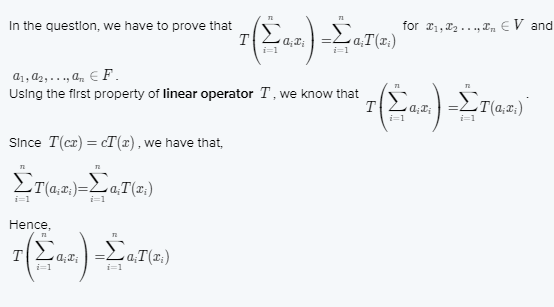
Hence, it is shown above that T(cx+y)=cT(x)+T(y) for all x,y∈V and c∈F.
Linear Algebra 5th Edition Chapter 2 Page 75 Problem 18 Answer
In the given question, we are asked to prove that the transformations in Examples 2 and 3 are linear.
Use the formula Tθ
(a1,a2)=(a1cosθ−a2sinθ,a1sinθ+a2cosθ) and apply addition and scalar multiplication in R2 , to prove the transformation in Example 2 as linear.
Using known properties of addition and scalar multiplication in R2 , the transformation in Example 3 can be proved as linear.
Using the formula Tθ
(a1,a2)=(a1cosθ−a2sinθ,a1sinθ+a2cosθ) and applying scalar addition and multiplication in Example 2 ,
T(c(a1,a2)+(b1,b2))=T((ca1+ca2)⋅(cb1+cb2))
=((ca1)cosθ−(ca2)sinθ,(ca1)sinθ+(ca2)cosθ+(b1)cosθ−(b2)sinθ,(b1)sinθ+(b2)cosθ)
=c(a1cosθ−a2sinθ,a1sinθ+a2cosθ)+(b1cosθ−b2sinθ,b1sinθ+b2cosθ)
=cT(a1,a2)+T(b1,b2)
So, the transformation is linear.
Using known properties of addition and scalar multiplication in R2 in Example 3,
T(c(a1,a2)+(b1,b2))=T(ca1+b1,ca2+b2)
=(ca1+b1,−(ca2+b2))
=(ca1,−ca2)+(b1,−b2)
=cT(a1,a2)+T(b1,b2)
So, the transformation is linear.
Hence, the transformation in Examples 2 and 3 are proved to be linear.
Exercise 2.1 Notes From Friedberg Linear Algebra 5th Edition Chapter 2 Page 75 Problem 19 Answer
Given that T:R2→R2 is a function defined by T(a1,a2)=(1,a2).
To show: T is not-linear.First, we will verify the properties of a function to be linear.
Finally, if T(x+y)≠T(x)+T(y) then T will not be linear.
Let a=(a1,a2),b=(b1,b2)∈R2 and α,β∈R.
⇒ T(αa+βb)=T(α(a1,a2)+β(b1,b2))
⇒ T(αa+βb)=T(αa1+βb1,αa2+βb2)
⇒ T(αa+βb)=(1,αa2+βb2)
Now,
⇒ αT(a)+βT(b)=αT(a1,a2)+βT(b1,b2)
⇒ αT(a)+βT(b)=α(1,a2)+β(1,b2)
⇒ αT(a)+βT(b)=(α+β,αa2+βb2)
⇒ T(αa+βb)≠αT(a)+βT(b)
Hence, T is not linear.
Page 75 Problem 20 Answer
Given that T:R2→R2 is a function defined by T(a1,a2)=(a1,a12).
To show: T is not-linear.
First, we will verify the properties of a function to be linear.
Finally, if T(x+y)≠T(x)+T(y) then T will not be linear.
Let a=(a1,a2),b=(b1,b2)∈R2 and α,β∈R.
⇒ T(αa+βb)=T(α(a1,a2)+β(b1,b2))
⇒ T(αa+βb)=T(αa1+βb1,αa2+βb2)
⇒ T(αa+βb)=(αa1+βb1,(αa2+βb2)2)
Now,
⇒ αT(a)+βT(b)=αT(a1,a2)+βT(b1,b2)
⇒ αT(a)+βT(b)=α(a1,a22)+β(b1,b22)
⇒ αT(a)+βT(b)=(αa1+βb1,αa22+βb22)
⇒ T(αa+βb)≠αT(a)+βT(b)
Hence, T is not linear.
Linear Algebra 5th Edition Chapter 2 Page 75 Problem 21 Answer
Given that T:R2→R2 is a function defined by T(a1,a2)=(sina1,0).
To show:T is not-linear.
First, we will verify the properties of a function to be linear.
Finally, if T(x+y)≠T(x)+T(y) then T will not be linear.
Let a=(a1,a2),b=(b1,b2)∈R2 and α,β∈R.
⇒ T(αa+βb)=T(α(a1,a2)+β(b1,b2))
⇒ T(αa+βb)=T(αa1+βb1,αa2+βb2)
⇒ T(αa+βb)=(sin(αa1+βb1),0)
Now,
⇒ αT(a)+βT(b)=αT(a1,a2)+βT(b1,b2)
⇒ αT(a)+βT(b)=α(sin(a1),0)+β(sin(b1),0)
⇒ αT(a)+βT(b)=(αsin(a1)+βsin(b1),0)
⇒ T(αa+βb)≠αT(a)+βT(b)
Hence, T is not linear.
Page 75 Problem 22 Answer
Given that T:R2→R2 is a function defined by T(a1,a2)=(∣a1∣,a2).
To show: T is not-linear.
First, we will verify the properties of a function to be linear.
Finally, if T(x+y)≠T(x)+T(y) then T will not be linear.
Let a=(a1,a2),b=(b1,b2)∈R2 and α,β∈R.
⇒ T(αa+βb)=T(α(a1,a2)+β(b1,b2))
⇒ T(αa+βb)=T(αa1+βb1,αa2+βb2)
⇒ T(αa+βb)=(∣αa1+βb1∣,αa2+βb2)
Now,
⇒ αT(a)+βT(b)=αT(a1,a2)+βT(b1,b2)
⇒ αT(a)+βT(b)=α(∣a1∣,a2)+β(∣b1∣,b2)
⇒ αT(a)+βT(b)=(α∣a1∣+β∣b1∣,αa2+βb2)
⇒ T(αa+βb)≠αT(a)+βT(b)
Hence, T is not linear.
Examples Of Exercise 2.1 In Friedberg Linear Algebra Chapter 2 Page 75 Problem 23 Answer
Given that T:R2→R2 is a function defined by T(a1,a2)=(a1+1,a2).
To show: T is not-linear. First, we will verify the properties of a function to be linear.
Finally, if T(x+y)≠T(x)+T(y) then T will not be linear.
Let a=(a1,a2),b=(b1,b2)∈R2 and α,β∈R.
⇒ T(αa+βb)=T(α(a1,a2)+β(b1,b2))
⇒ T(αa+βb)=T(αa1+βb1,αa2+βb2)
⇒ T(αa+βb)=(αa1+βb1+1,αa2+βb2)
Now,
⇒ αT(a)+βT(b)=αT(a1,a2)+βT(b1,b2)
⇒ αT(a)+βT(b)=α(a1+1,a2)+β(b1+1,b2)
⇒ αT(a)+βT(b)=(αa1+βb1+α+β,αa2+βb2)
⇒ T(αa+βb)≠αT(a)+βT(b)
Hence, T is not linear.
Linear Algebra 5th Edition Chapter 2 Page 75 Problem 24 Answer
Given: T:R2→R2 is a function is a linear; T(1,0)=(1,4); T(1,1)=(2,5).To find: T(2,3). Whether T is one-to-one.
First, we will find T(2,3).
Finally, we will determine whether T is one-to-one or not.
Since T is linear, we can write cT(x+y)=T(cx)+T(cy).
Need to write T(2,3)as a linear combination of T(1,0)and T(1,1).
⇒ a(1,0)+b(1,1)=(2,3)
⇒ (a+b,b)=(2,3)
So,
⇒ a=−1
⇒ b=3
⇒ T(2,3)=(−1)(T(1,0))+(3)(T(1,1))
⇒ T(2,3)=(−1)(1,4)+3(2,5)
⇒ T(2,3)=(−1,−4)+(6,15)
⇒ T(2,3)=(5,11)
Need to write T(v,w)as a linear combination of T(1,0)and T(1,1).
⇒ (v,w)=a(1,0)+b(1,1)
⇒ (v,w)=(a+b,b)
⇒ v=a+b and
⇒ w=b
So,
⇒ a=v−w
⇒ b=w
⇒ T(v,w)=(v−w)(T(1,0))+(w)(T(1,1))
⇒ T(v,w)=(v−w)(1,4)+w(2,5)
⇒ T(v,w)=(v−w+2w,4v−4w+5w)
⇒ T(v,w)=(v+w,4v+w)
⇒ v+w,4v+w)=(0,0)
⇒v,w=0
So only T(0,0)=(0,0)
Thus, N(T)=(0,0)and T is one-to-one
Hence, T(2,3)=(5,11)and T is one-to-one.