
Linear Algebra 5th Edition Chapter 2 Linear Transformations and Matrices
Page 107 Problem 1 Answer
Given in the question is a statement, ([T]βα)−1=[T−1]αβ.
To determine whether the given statement is correct or not.
When T is invertible, we have ([T]αβ)−1=[T−1]βα which is not equal or the same as given in the statement.
Hence, the given statement is False.
The given statement i.e., ([T]αβ)−1=[T−1]αβ is false.
Page 107 Problem 2 Answer
Given in the question is a statement, T is invertible if and only if T is one-to-one and onto.
To determine whether the given statement is correct or not.
We know that any linear transformation T is invertible if and only if it is a bijection i.e., both one-to-one and onto.
Hence, the given statement is True.
The given statement i.e., T is invertible if and only if T is one-to-one and onto is true
Read and Learn More Stephen Friedberg Linear Algebra 5th Edition Solutions
Page 107 Problem 3 Answer
Given in the question is a statement,T=LA , where A=[T]αβ. To determine whether the given statement is correct or not.
We know that for a linear transformation T:V→W exists a unique matrix M, such that T=LM, and in that case we have M=[T]αβ, where α and β are ordered bases of V and W,respectively.
Hence, the given statement is True.
The given statement i.e., T=LA , where A=[T]αβ is true
Stephen Friedberg Linear Algebra 5th Edition Solutions For Exercise 2.4 Page 107 Problem 4 Answer
Page 107 Problem 5 Answer
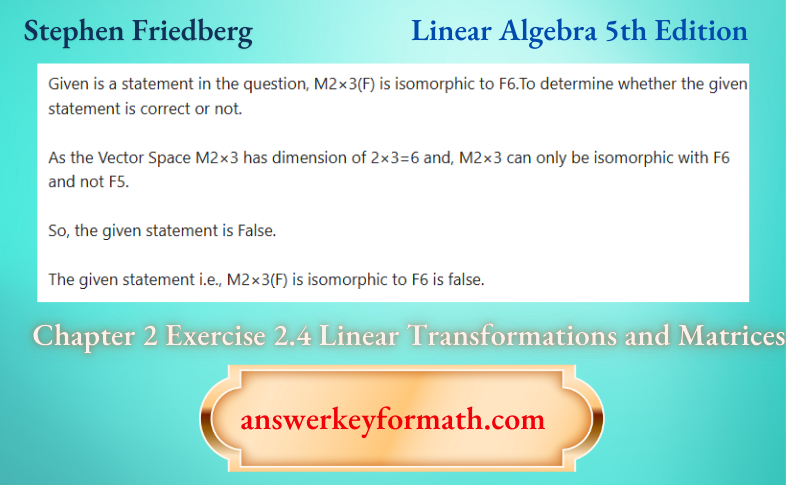
Given in the question is a statement,Pn(F) is isomorphic to Pm(F) if and only if n=m.
To determine whether the given statement is correct or not.
As the Vector Spaces PN and PM have dimensions n+1 and m+1, but they can only be isomorphic if and only if their dimensions are equal.
And this is only possible when n=m.
So, the given statement is True.
The given statement i.e., Pn(F) is isomorphic to Pm(F) if and only if n=m true.
Page 107 Problem 6 Answer
Given in the question is a statement, AB=I implies that A and B are invertible.
To determine whether the given statement is correct or not.
As per the definition of Invertible Matrix, BA should also be equal to I in order to have A and B as invertible.
So, the given statement is False.
The given statement i.e., AB=I implies that A and B are invertible is false.
Page 107 Problem 7 Answer
Given in the question is a statement, If A is invertible, then (A−1)−1=A are invertible.
To determine whether the given statement is correct or not.
As per the definition of Invertible Matrix, inverse of matrix A is denoted by A−1 and inverse of this is again A.
So, the given statement is True.
The given statement i.e., If A is invertible , then (A−1)−1=A are invertible is true.
Page 107 Problem 8 Answer
Given in the question is a statement,A is invertible if and only if LA is invertible.
To determine whether the given statement is correct or not.
We know that when LA is invertible then A is invertible.
So, the given statement is True.
The given statement i.e., A is invertible if and only if LA is invertible is true.
Page 107 Problem 9 Answer
Given in the question is a statement, A must be square in order to possess an inverse.
To determine whether the given statement is correct or not.
As per the definition of Invertible Matrix, If Bn×m is inverse of matrix Am×n then AB=BA which means m=n.
This implies that the matrix A must be a square.
So, the given statement is True.
The given statement i.e., A must be square in order to possess an inverse is true.
Page 107 Problem 10 Answer
Given that , T:R2→R3,T(a1,a2)=(a1−2a2,a2,3a1+4a2) .
To determine whether given transformation is invertible or not.
Solve as per the conditions and the definition of Invertible Transformation.
Given that , T:R2→R3,T(a1,a2)=(a1−2a2,a2,3a1+4a2) .
Dimensions of the vector spaces R2 and R3 are 2 and 3 respectively.
As per the definition, for given transformation to be invertible, dimensions of the two vector spaces must be equal.
As the dimensions of the two given vector spaces of transformation are not equal the transformation is not invertible.
The given transformation is not invertible because dimensions of the vector spaces R2 and R3 are not equal.
Chapter 2 Exercise 2.4 Linear Transformations Solved Problems Page 107 Problem 11 Answer
Given that T:R2→R3,T(a1,a2)=(3a1−a2,a2,4a1).To determine whether the given transformation is invertible or not.
Solve as per the conditions and the definition of Invertible Transformation.
Given that, T:R2→R3,T(a1,a2)=(3a1−a2,a2,4a1).
Dimensions of the vector spaces R2 and R3 are 2 and 3 respectively.
According to the definition, for a given transformation to be invertible, dimensions of the two vector spaces must be equal.
As we can see that the dimensions of the two given vector spaces of transformation are not equal, this implies that the transformation is not invertible.
The given transformation is not invertible because dimensions of the vector spaces R2 and R3 are not equal.
Page 107 Problem 12 Answer
Given that, T:R3→R3,T(a1,a2,a3)=(3a1−2a3,a2,3a1+4a2) .To determine whether given transformation is invertible or not.
Solve as per the conditions and the definition of Invertible Transformation.
Given that, T:R3→R3,T(a1,a2,a3)=(3a1−2a3,a2,3a1+4a2) .
Now , checking for injectivity of the transformation, we get
T(a1,a2,a3)=(3a1−2a3,a2,3a1+4a2)
⇒T(0,0,0)=(3⋅0−2⋅0,0,3⋅0+4⋅0)
⇒T(0,0,0)=(0,0,0)
So , the given transformation is injective.
Similarly, checking for surjection of the transformation, we get
⇒T(a1,a2,a3)=a1(3,0,3)+a2(0,1,4)+a3(−2,0,0)
Where, (3,0,3),(0,1,4) and (−2,0,0) are independent which implies that the transformation is surjective.
As the given transformation is both injective and surjective , the transformation is invertible.
The given transformation is invertible because the transformation is both injective and surjective.
Page 107 Problem 13 Answer
Given that, T:P3
⇒ (R)→P2
⇒ (R),T(p(x))=p′(x) .
Dimensions of the vector spaces P2(R) and P3(R) are 2 and 3 respectively.
As per the definition, for given transformation to be invertible, dimensions of the two vector spaces must be equal.
As the dimensions of the two given vector spaces of transformation are not equal the transformation is not invertible.
The given transformation is not invertible because dimensions of the vector spaces P2(R) and P3(R) are not equal.
Page 107 Problem 14 Answer
Given that,
T:M2×2(R)→P2(R),T(20cac&bd)=a+2bx+(c+d)x2, we need to determine whether given transformation is invertible or not.
Solve as per the conditions and the definition of Invertible Transformation .
Given that,
T:M2×2(R)→P2(R),T(20cac&bd)=a+2bx+(c+d)x2.
Dimensions of the vector spaces P2(R) and M2×2(R) are 3 and 4 respectively.
As per the definition, for given transformation to be invertible, dimensions of the two vector spaces must be equal.
As the dimensions of the two given vector spaces of transformation are not equal the transformation is not invertible.
The given transformation is not invertible because dimensions of the vector spaces P2
(R) and M2×2(R) are not equal.
Page 107 Problem 15 Answer
To determine whether given transformation is invertible or not.not.
Solve as per the conditions and the definition of Invertible Transformation.
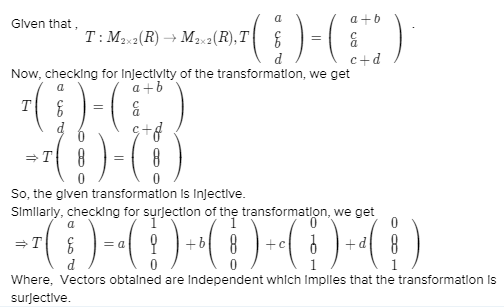
As the given transformation is both injective and surjective, the transformation is invertible.
The given transformation is invertible because the transformation is both injective and surjective.
Page 107 Problem 16 Answer
Given in the question are two vector spaces, F3 and P3(F).In this question, determine if these two vector spaces are isomorphic.
For the two vector spaces to be isomorphic, they must have the same dimension.
The vector space F3 has dimension 3 and P3(F) has dimension 4.
So , they are not isomorphic they don’t have same dimension.
The two vector spaces F3 and P3(F) are not isomorphic.
Linear Algebra Friedberg Exercise 2.4 Step By Step Guide Page 107 Problem 17 Answer
Given in the question are two vector spaces, F4 and P3(F).
In this question, determine if these two vector spaces are isomorphic.
For the two vector spacesspaces to be isomorphic, they must have the same dimension.
The vector space F4 has dimension 4 and P3(F) has dimension 4 too.
So , they are isomorphic as they have same dimension.
The two vector spaces F4 and P3(F) are isomorphic.
Page 107 Problem 18 Answer
Given in the question are two vector spaces , M2×2(R) and P3(R).
In this question, determine if these two vector spaces are isomorphic.
For two vector spaces to be isomorphic, they must have the same dimension.
The vector space M2×2(R) has dimension 4 as it is a 2×2 matrix.
The vector space P3(R) has dimension 4.
So, they are isomorphic as they have same dimension.
The two vector spaces M2×2(R) and P3(R) are isomorphic.
Page 107 Problem 19 Answer
Given in the question are two vector spaces, V={A∈M2×2(R): tr(A)=0} and R4.
In this question, determine if these two vector spaces are isomorphic.
For two vector spaces to be isomorphic, they must have the same dimension.
The vector space V={A∈M2×2(R):tr(A)=0} has dimension 3 .
The vector space R4 has dimension 4.
So, they are not isomorphic they don’t have same dimension.
The two vector spaces V={A∈M2×2(R):tr(A)A=0} and R4 are not isomorphic as they do not have the same dimension.
Page 107 Problem 20 Answer
Given in the question aren×n invertible matrices,A and B .To prove that AB is invertible and (AB)−1
=B−1
⇒ A−1 .
Find a matrix for A such that their product equals the identity matrix.
Consider the matrix B−1
⇒A−1 .
Note that:
(B−1A−1)(AB)=B−1A−1AB
=B−1B
Again:
⇒(AB)(B−1A−1)=ABB−1A−1
=AA−1
=In
Hence, (B−1A−1)(AB)=(AB)(B−1A−1) and both of them are equal to In .
Therefore, AB is invertible. .
Also, it follows that
⇒(AB)−1=B−1A−1
It was proved that AB is invertible and (AB)−1=B−1A−1.
Page 107 Problem 21 Answer
Given that A is an invertible matrix.To prove that At is invertible and (At)−1=(A−1)t.
Find a matrix for At such that their product is the identity matrix.
Note that A is invertible, that is A−1 exists.
Then it follows that:
⇒(A−1)tAt=(AA−1)t
=(I)t
=I
Similarly
⇒At(A−1)t=(A−1A)t
=(I)t
=I
Hence, (A−1)tAt=At(A−1)t; that means that At is invertible and its inverse is (A−1)t.
Again ,(At)−1=(A−1)t
=I
It is proved that At is invertible and (At)−1=(A−1)t.
Page 107 Problem 22 Answer
Given that A is an invertible matrix and AB=O. Prove that, then B=O Consider the fact that A is invertible. , A−1 exists and A−1
A=I. Then,
B=IB
=(A−1A)B
=A−1(AB)
As AB=O, it follows that:
⇒B=A−1O
⇒B=O
It was proved that if A is invertible and AB=O.then B=O.
Exercise 2.4 Matrices Examples Friedberg Chapter 2 Page 108 Problem 23 Answer
Given that A is an n×n matrix.Prove that if A2=O, then A is not invertible.
Begin with the assumption that, A is an invertible matrix and proceed.
This will gives us a contradiction which suggests that the assumption was wrong.
Suppose that A is an invertible matrix and A−1 exists. Then,A=IA
=(A−1A)A
=A−1(AA)
As A2=O is given , it follows that:
⇒A=A−1O
⇒A=O
As it was assumed that A is an invertible matrix and we showed that A=O , it follows that, O is also invertible. has no inverse, and is not invertible.
But the null matrix O has no inverse , and is not invertible.
This is a contradiction.
Hence, A is not invertible.
It was proved that if A2=O, A is not invertible.
Page 108 Problem 24 Answer
Given that A is an n×n matrix, and AB=0 for some nonzero n×n matrix B.
To find if A could be invertible and explain.Begin with the assumption that A is invertible.
Then, A−1 exists and AA−1=In .From Exercise 6, it follows that then,but it is given that B is nonzero; our assumption is incorrect an thus a contradiction holds.
So, A is not invertible.
If AB=0 for some nonzero n×n matrix B, A cannot be invertible as it would suggest that B is the zero matrix.
Page 108 Problem 25 Answer
In the question we need to prove the two corollaries of theorem 2.18 on page 101.
First corollary: Let V be a finite-dimensional vector space with ordered basis β. Let T:V→V be linear.
Then T is invertible if and only if [T]β is invertible, and [T−1]β=([T]β)−1.
Second corollary: Let A be an n×n matrix.
Then A is invertible if and only if LA is invertible.
Furthermore, (LA)−1=LA−1 .
The first corollary follows by taking V=W The second corollary follows by taking V=Fn and using the first corollary.
To prove the first corollary, take V=W.
As the ordered basis is β , the matrix representation is [T]β.
It follows from theorem 2.18 that T is invertible if and only if [T]β is invertible, and [T]β
=([T]β)−1 .
To prove the second corollary, let V=Fn.
Then the left-hand multiplication transformation LA is linear, according to theorem 2.15 on page 93, and [LA]β=A .
Using corollary 1, it follows that A is invertible if and only if LA is invertible and,(LA)−1=LA−1 .
Corollaries 1 and 2 of theorem 2.18 was proved.
Exercise 2.4 Notes From Friedberg Linear Algebra 5th Edition Page 108 Problem 26 Answer
Given data: Let A and B be n×n matrices such that AB is invertible.
To prove: That A and B are invertible.
Observe that as AB is invertible ∃ a matrix Cas shown below.
ThereforeNow, use the associativity of matrix multiplication to obtain as shown below, C(AB)=I……(1)A(BC)=I……(2)And therefore according to the definition of inverse A,B are invertible from equations (1) and (2) with the inverse being BC,CA respectively.
Thus, it can be clearly proved that A and B are invertible if Aand B be n×n matrices such that AB is invertible.
Page 108 Problem 27 Answer
Given data: Let A and B be n×n matrices such thatABis invertible.
To give: An example to show that a product of nonsquare matrices can beinvertible even though the factors, by definition, are not.
Consider the two matrices as shown below,
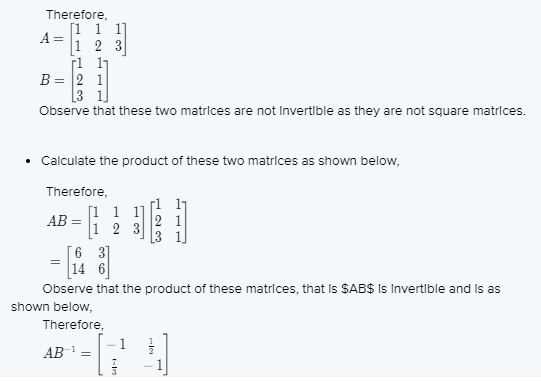
Thus, it can be clearly shown using an example that a product of nonsquare matrices can be invertible even though the factors, by definition, are not.
Page 108 Problem 28 Answer
It is stated in the question that A and B are two n×n matrices, where AB=In
It is required to demonstrate that A and B are invertible.
As AB=In , as a result AB is invertible in the same way as the identity matrix In .
As seen in Exercise 9, if the given requirements are met and if AB is invertible, then A,B are also invertible too.
Therefore, A and B are invertible.
It was determined that if A and B are n×n matrices in which AB=In ,as a result A and B are invertible.
Page 108 Problem 29 Answer
It is stated in the question that A and B are two n×n matrices, where AB=In .
It is required to demonstrate that A=B−1 are Invertible.
Therefore, B=A−1 too.It can be seen from Exercise 10.(a) that A is invertible, and A−1 exists and AA−1=In
The matrix A−1can be written as:
⇒ A−1=A−1In
=A−1(AB)
=(A−1A)B
=InB
Thus, A−1=B
By taking the inverse on both sides, we get that A and B are n×n matrices, then
AB=In, therefore
A=B−1,and hence, B=A−1
Examples Of Exercise 2.4 in Friedberg Linear Algebra Page 108 Problem 30 Answer
It is stated in the question that A and B are two n×n matrices, where AB=In.
The goal is to show comparable findings for linear transformations defined on finite-dimensional vector spaces.
Consider Exercises 10(a) and 10(b) and come up with an analogous argument for finite-dimensional vector spaces.
Then use isomorphism properties to back up your assertion.
On finite-dimensional vector spaces, the following claim is made based on the results of Exercises 10.(a) and 10.(b).
Claim:Let V becomes n-dimensional vector space is a type of vector space that has a number of dimensions.
If S and T on which linear transformations are defined, then V results in, ST:V→V
If both are isomorphisms, then S and T are isomorphisms.
Let us look at some proof to support our claim:
Let β={β1,β2,….βn} be a logical foundation for V.
If A,B are the matrices representation for S,T respectively, then:A=[S]β
B=[T]β
As a result, AB=[ST]β
As ST is an isomorphism, AB is a matrx that can be inverted As a result of them from Exercise 10.
(a), A,B both can be inverted.
This implies that the transformations are related S, T both are isomorphisms. This brings the claim to a close.
For linear transformations defined on finite-dimensional vector spaces, a similar conclusion is:
For an n-dimensional vector space V, if S and T are linear transformations in the sense that ST: V→V is isomorphisms, then S and T are isomorphisms.
The outcome was established.