
Linear Algebra 5th Edition Chapter 2 Linear Transformations and Matrices
Page 140 Problem 1 Answer
Given: The set of solutions to an nth-order homogeneous linear differential equation with constant coefficients is an -dimensional subspace of C∞ .
To determine: Whether the given statement is true or false.
An n-th order homogeneous linear differential equation with constant coefficients is indeed a differential operator of order.
Hence its solution set, or the null space is an dimensional subspace of C∞ , according to the theorem 2.32 on page 135.
The statement is true.
The statement, that the set of solutions to an nth-order homogeneous linear differential equation with constant coefficients is an n-dimensional subspace of C∞ , is true.
Linear Algebra 5th Edition Chapter 2 Page 140 Problem 2 Answer
In the question, a statement is given that the solution space of a homogeneous linear differential equation with constant coefficients is the null space of a differential operator.
The task is to determine if this statement is true or false.
The statement given is indeed the theorem 2.28 given on page 132.
Therefore, the statement is true.
The statement, that the solution space of a homogeneous linear differential equation with constant coefficients is the null space of a differential operator, is true.
Read and Learn More Stephen Friedberg Linear Algebra 5th Edition Solutions
Linear Algebra 5th Edition Chapter 2 Page 140 Problem 3 Answer
In the question, a statement is given that the auxiliary polynomial of a homogeneous linear differential equation with constant coefficients is a solution to the differential equation.
The task is to determine if this statement is true or false.
Consider the equation y=0.
It has the auxiliary polynomial p(t)=1 , but
y=1 is not a solution.
Based on this counter-example, it is concluded that the statement is false.
The statement, that the auxiliary polynomial of a homogeneous linear differential equation with constant coefficients is a solution to the differential equation, is false.
Stephen Friedberg Linear Algebra 5th Edition Solutions For Exercise 2.7 Linear Algebra 5th Edition Chapter 2 Page 140 Problem 4 Answer
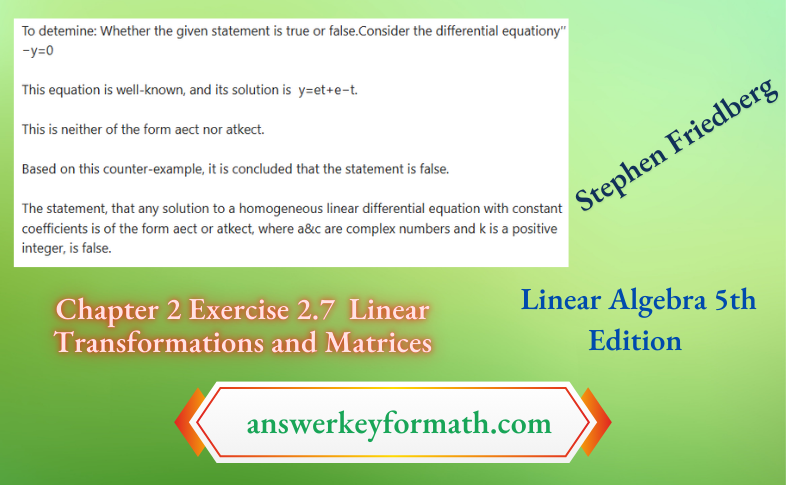
Given: Any solution to a homogeneous linear differential equation with constant coefficients is of the form aect or atkect, where a&c are complex numbers and k is a positive integer.
Linear Algebra 5th Edition Chapter 2 Page 140 Problem 5 Answer
In the question, a statement is given that any linear combination of solutions to a given homogeneous linear differential equation with constant coefficients is also a solution to the given equation.
The task is to determine if this statement is true or false.
The differential operator is linear.
Hence, if et1,et2 are two of its solutions, then C1 et1+C2et2 is a solution too.
Therefore, the statement is true.
The statement, that any linear combination of solutions to a given homogeneous linear differential equation with constant coefficients is also a solution to the given equation, is true.
Linear Algebra 5th Edition Chapter 2 Page 140 Problem 6 Answer
In the question, a statement is given that for any homogeneous linear differential equation with constant coefficients having auxiliary polynomial p(t), if c1,c2,…,ck are the distinct zeros of , then {ec1t,ec2t,…,eckt} is a basis for the solution space of the given differential equation.
The task is to determine if this statement is true or false.
Consider the differential equation y′′+2y′+y=0.
Its auxiliary polynomial is (t+1)2.
A basis for this equation is te−t, which is not in the form eckt.
Based on this counter-example, it is concluded that the statement is false.
The statement, that for any homogeneous linear differential equation with constant coefficients having auxiliary polynomial p(t), if c1,c2,…,ck are the distinct zeros of p(t) , then {ec1t,ec2t,…,eckt} is a basis for the solution space of the given differential equation, is false.
Linear Algebra 5th Edition Chapter 2 Page 140 Problem 7 Answer
Given: Given any polynomial p(t)∈P(C), there exists a homogeneous linear differential equation with constant coefficients whose auxiliary polynomial is p(t).
To determine: Whether the given statement is true or false.
Consider the differential equation p(D)(y)=0.
Its auxiliary polynomial is p(t).
The statement is true.
The statement, that given any polynomial p(t)∈P(C), there exists a homogeneous linear differential equation with constant coefficients whose auxiliary polynomial is p(t), is true.
Linear Algebra 5th Edition Chapter 2 Page 141 Problem 8 Answer
In the question, a statement is given that any finite-dimensional subspace of C∞ is the solution space of a homogeneous linear differential equation with constant coefficients.
The task is to determine if the statement is true or false.
Consider the finite-dimensional subspace generated by the function y=t.
Note that,
⇒ y′=1
⇒ y′′=0 and so on. Hence, fork≥2.
⇒ y(k)=0.
Therefore, the equation,
ay′+by=0 does not hold for non-zero a .
As W is not the solution space, the statement is false.
The statement that, any finite-dimensional subspace of C∞ is the solution space of a homogeneous linear differential equation with constant coefficients, is false.
As a counterexample, consider the function y=t which generates the finite-dimensional subspace W, but W is not the solution space.
Linear Algebra 5th Edition Chapter 2 Page 141 Problem 9 Answer
In the question, a statement is given that there exists a homogeneous linear differential equation with constant coefficients whose solution space has the basis {t,t2}.
The task is to determine if the statement is true or false.
Consider the function y=t.
As observed in Exercise 2.(a), y(k)=0 for greater than or equal to 2.
Hence, y is infinitely differentiable, and the solution space is C∞ .
Thus, the basis cannot be {t,t2}.
The statement is false.
The statement that, there exists a homogeneous linear differential equation with constant coefficients whose solution space has the basis {t,t2}, is false.
A counterexample is given by the equation y=t, whose solution space is C∞.
Linear Algebra 5th Edition Chapter 2 Page 141 Problem 10 Answer
Given: For any homogeneous linear differential equation with constant coefficients, if x is a solution to the equation, so is its derivative x′.
To determine: Whether the given statement is true or false.
Let the auxiliary polynomial be p(t).
Then, p(D)(x′)=D(p(D)(x)) .
As p(D)(x) is zero, p(D)(x′)=0 .
The statement is true.
The statement that, for any homogeneous linear differential equation with constant coefficients, if is a solution to the equation, so is its derivative x′, is true.
Linear Algebra 5th Edition Chapter 2 Page 141 Problem 11 Answer
It is given that for two polynomials p(t) and q(t) in P(C) , if
⇒ x∈N(p(D))
⇒ y∈N(q(D)) then,
⇒ x+y∈N(p(D)q(D))
The task is to determine if the statement is true or false.
Note hatp(D)q(D)(x+y)=q(D)p(D)(x)+p(D)q(D)(y).As x,y belongs to the null space of p(D),q(D) respectively, hence p(D)(x) and q(D)(y) are both zero.Hence, p(D)q(D)(x+y)=0 .
It means that x+y∈N(p(D)q(D)).
The statement is true.
The statement that, for two polynomials p(t),q(t)in P(C)if,
⇒ x∈N(p(D))
⇒ y∈N(q(D))
then,x+y∈N(p(D)q(D)) is true. It is true because, p(D)q(D)(x+y)=0
Solutions For Chapter 2 Exercise 2.7 Linear Transformations Page 141 Problem 12 Answer
It is given that for two polynomials in p(t),q(t) , ifP(C)
x∈N(p(D))
y∈N(q(D)) then, xy∈N(p(D)q(D))
The task is to determine if the statement is true or false.
Consider the two well-known differential equations:
⇒ x′−x=0
⇒ y′+y=0
The solutions for these equations are et,e−t respectively.
Then xy=ete−t, which is.
Although xy=1, is not a solution for y′′−y=0 .
Thus xy∉N(p(D)q(D)) .
The given statement is false.
The statement that, for two polynomials p(t),q(t) if,
⇒ x∈N(p(D))
⇒ y∈N(q(D)) then,xy∈N(p(D)q(D)) is false.
Linear Algebra 5th Edition Chapter 2 Page 141 Problem 13 Answer
Given: y′′+2y′+y=0
To find: A basis for the solution space for the given differential equation.
The auxiliary polynomial for the given differential equation is written and its zeros are identified.
The basis of the auxiliary equation is written based on the theorem which is also the basis of the given differential equation.
Given differential equation is
⇒ y′′+2y′+y=0
The auxiliary polynomial associated with the differential equation is
⇒ p(t)=t2+2t+1
The zeros of the auxiliary polynomial is
⇒ t2+2t+1=(t+1)(t+1)
⇒t=−1,−1
Using the theorem, the basis for the solution space is {e−t,te−t}
The basis for the solution space for the given differential equation is {e−t,te−t}
Linear Algebra 5th Edition Chapter 2 Page 141 Problem 14 Answer
In the question, we are asked to find a basis for the solution space for the given differential equation.
The auxiliary polynomial for the given differential equation is written and its zeros are identified.
The basis of the auxiliary equation is written based on the theorem which is also the basis of the given differential equation.
Given differential equation is
⇒ y′′′=y′
The auxiliary polynomial associated with the differential equation is
⇒ p(t)=t3−t
The zeros o Using the theorem, the basis for the solution space is
⇒ {e(0)t,e−t,et}={1,e−t,et}
The basis for the solution space for the given differential equation is {1,e−t, et}
Linear Algebra 5th Edition Chapter 2 Page 141 Problem 15 Answer
In the question, we are asked to find a basis for the solution space for the given differential equation.
The auxiliary polynomial for the given differential equation is written and its zeros are identified.
The basis of the auxiliary equation is written based on the theorem which is also the basis of the given differential equation.
Given differential equation is y4−2y2+y=0
The auxiliary polynomial associated with the differential equation is p(t)=t4−2t2+1
The zeros of the auxiliary polynomial is
⇒ t4−2t2+1=(t2−1)(t2−1)=(t2−1)2
=[(t−1)(t+1)]2
=(t−1)2(t+1)2
⇒t=−1,−1,1,1
Using the theorem, the basis for the solution space is
⇒ n=2
⇒ c=−1,1
⇒{e−t,text, et,tet}
The basis for the solution space for the given differential equation is
⇒ {e−t,te−t, et,tet}
Exercise 2.7 Matrices Examples Friedberg Linear Algebra 5th Edition Chapter 2 Page 141 Problem 16 Answer
Given: y′′+2y′+y=0
To find: A basis for the solution space for the given differential equation.
The auxiliary polynomial for the given differential equation is written and its zeros are identified.
The basis of the auxiliary equation is written based on the theorem which is also the basis of the given differential equation.
Given differential equation isy′′+2y′+y=0
The auxiliary polynomial associated with the differential equation isp(t)=t2+2t+1
The zeros of the auxiliary polynomial is t2+2t+1=(t+1)2
⇒t=−1,−1
Using the theorem, the basis for the solution space is
⇒ n=2
⇒ c=−1,
⇒{e−t,te−t}
The basis for the solution space for the given differential equation is {e−t,te−t}
Linear Algebra 5th Edition Chapter 2 Page 141 Problem 17 Answer
In the question, we are asked to show that C∞ is a subspace of ℑ(R,C)
Let f&g be two elements of C∞.
So there exists k-th derivative of the sum of the two functions
⇒ (f+k)k=fk+gk
So the sum of the two elements belongs to C∞
The k-th derivative of an element multiplied with a scalar is (cf)k=cfk
Naturally, the element f=0 belongs C∞.
Hence it can be said that C∞ is a subspace of .ℑ(R,C)
It is proven that C∞is a subspace of ℑ(R,C)
Linear Algebra 5th Edition Chapter 2 Page 142 Problem 18 Answer
To show: {eatcosbt,eatsinbt} is a basis for the solution space.
Given: A second-order homogeneous linear differential equation with constant coefficients for which the auxiliary polynomial has the roots
⇒ a±ib
Evaluating e(a±ib)t
⇒ e(a±ib)t=eat×eibt
=eat(cosbt+isinbt)
=eatcosbt+ieatsinbt
So the solution set is{eatcosbt,eatsinbt} which forms the basis for the solution space.
It is proven that{eatcosbt,eatsinbt} is a basis for the solution space.
Exercise 2.7 Notes From Friedberg Linear Algebra 5th Edition
Linear Algebra 5th Edition Chapter 2 Page 142 Problem 19 Answer
In the question, we are asked to prove that
N(Ui)⊆N(U1U2…Un) for any 1≤i≤n where {U1U2…Un}is a collection of pairwise commutative linear operators on a vector space V.
Operating the given operator onx∈N(Ui) and solving to prove the given condition.
Consider x∈N(Ui)
Given that the operators are commutative
⇒UiUj=UjUi
Since1≤i≤n
⇒Ui
(x)=0
Considering(U1U2…Ui…Un)(x)
(U1U2…Ui…Un)(x)=(U1U2…Ui−1Ui…Un)(x)
(U1U2…Ui…Un)(x)=(U1U2…Ui−1…UnUi)(x)
(U1U2…Ui…Un)(x)=(U1U2…Ui−1…Un)Ui(x)
since (Ui)(x)=0
⇒(U1U2…Ui…Un)(x)=(U1U2…Ui…Un)(0)
⇒(U1U2…Ui…Un)(0)=0
⇒(U1U2…Ui…Un)(x)=0
Thenx∈N(U1U2…Un)
⇒N(Ui)⊆N(U1U2…Un)
It is proven that
N(Ui)⊆N(U1U2…Un) for anyi,1≤i≤n
Linear Algebra 5th Edition Chapter 2 Page 142 Problem 20 Answer
To prove Theorem 2.33 and its corollary.First consider b1ec1t+b2ec2t+…+bnecnt=0
Then apply the induction on n.
Then verify the theorem for n=1.
Then assume that it is true n−1 functions, apply the operator D−cnI to establish the theorem for distinct exponential functions.
Whenn=1 in the equation
⇒ b1ec1t+b2ec2t+…+bnecnt=0
⇒b1ec1t=0
Since exponential function is never zero, ⇒b1=0
Applying in the case of n−1 functions, b1ec1t+b2ec2t+…+bn−1ecn−1t=0
⇒b1=0
⇒ b2=0
⇒ bn−1=0
Using the operator D−cnI on the equation
⇒ b1ec1t+b2ec2t+…+bnecnt=0
⇒ (D−cnI)(b1ec1t+b2ec2t+…+bnecnt)=(D−cnI)0(b1c1ec1t+b2
⇒ c2ec2t+…+bncnecnt)−cn(b1ec1t+b2ec2t+…+bnecnt)=0
⇒ b1ec1t(c1−cn)+b2ec2t(c2−cn)+…+bn−1ecn−1t(cn−1−cn)=0
On assuming that the assumption is true for n−1 functions,
⇒b1(c1−cn)=0b2(c2−cn)=0bn−1(cn−1−cn)=0
Since exponential functions are not zero;
⇒b1,b2,…bn−1=0
So the equation becomes
⇒ 0+0+…+bnecnt=0
⇒ bn=0
The set {ec1t,ec2t,…,ecnt} is linearly independent.
If c is the zero of the auxiliary polynomial for a homogenous linear differential equation with constant coefficients.
Then {ect} is a solution of the differential equation.
Then for an auxiliary polynomial with n distinct zeros c1,c2,…,cn, then {ec1t,ec2t,…,ecnt} is a solution of the differential equation.
Since it is also linearly independent, then the set{ec1t,ec2t,…,ecnt} forms a basis for the solution space of the differential equation.
Theorem 2.33 and its corollary is proven.