
Linear Algebra 5th Edition Chapter 3 Elementary Matrix Operations and Systems of Linear Equations
Page 150 Problem 1 Answer
Provided statement is “An elementary matrix is always square”.
We are to check if the statement is true or false.
We generate an elementary matrix starting from identity matrix by performing any elementary operation.
As the identity matrix is a square, an elementary matrix must be also be a square.
Thus, the statement “An elementary matrix is always square” is true.
The statement ‘An elementary matrix is not always a square matrix’ is incorrect because it is made up of an identity matrix which is always square in nature.
Thus, the statement “An elementary matrix is always square” is true.
Linear Algebra 5th Edition Chapter 3 Page 150 Problem 2 Answer
Provided – statement “the only entries of an elementary matrix are zero and ones.”
To check– the statement is true or false Multiplying any row of the identity matrix by a nonzero scalar refers to one of elementary operation.
So, we can multiply first row by five times, for instance. In this way, we get an elementary matrix:
(5 0)
(0 1)
with an item equal to five.
Thus, the statement “the only entries of an elementary matrix are zero and ones” is false.
The only entries of an elementary matrix are not zero and ones since the identity matrix could be multiplied with any scalar quantity.
Thus, the statement “the only entries of an elementary matrix are zero and ones” is false.
Read and Learn More Stephen Friedberg Linear Algebra 5th Edition Solutions
Stephen Friedberg Linear Algebra 5th Edition Solutions For Exercise 3.1 Linear Algebra 5th Edition Chapter 3 Page 150 Problem 3 Answer
Linear Algebra 5th Edition Chapter 3 Page 150 Problem 4 Answer
Provided – statement “the product of two n×n elementary matrices is an elementary matrix.”
To check – the statement is true or false.
For example, matrices
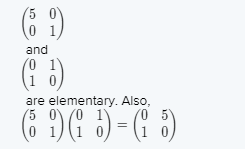
There is no way to obtain the product matrix as elementary from I2 by a single elementary operation.
Thus, the statement “the product of two n×n elementary matrices is an elementary matrix.” is false.
The product of two n×n elementary matrices is not elementary matrix because the product matrix couldn’t be obtained as elementary from the identity matrix in just one operation.
Thus, the statement “the product of two n×n elementary matrices is an elementary matrix” is false.
Page 150 Problem 5 Answer
Provided – statement “the inverse of an elementary matrix is an elementary matrix.”
To check – the statement is true or false
We know that the inverse corresponds to the inverse elementary operation.
Clearly, the statement “the inverse of an elementary matrix is an elementary matrix” is true.
The inverse of an elementary matrix is not an elementary matrix because it corresponds to the inverse elementary operations.
Thus, the statement “the inverse of an elementary matrix is an elementary matrix” is true.
Linear Algebra 5th Edition Chapter 3 Page 150 Problem 6 Answer
Provided – statement “the sum of two n×n elementary matrices is an elementary matrix.”
To check – the statement is true or false
Consider
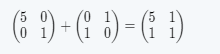
Clearly, there is no way to obtain elementary matrix from I2 by a single elementary operation.
Thus, the statement “the sum of two n×n elementary matrices is an elementary matrix.” is false.
The sum of two n×n elementary matrices is not an elementary matrix because the sum matrix cannot be generated from the identity matrix in one operation.
Thus, the statement “the sum of two n×n elementary matrices is an elementary matrix” is false.
Exercise 3.1 Elementary Matrix Operations Solved Problems Linear Algebra 5th Edition Chapter 3 Page 150 Problem 7 Answer
Provided – statement “the transpose of an elementary matrix is an elementary matrix.”
To check – the statement is true or false
If the original matrix corresponds to elementary on rows, the transpose corresponds to the same operation on columns.
Thus, the statement “the transpose of an elementary matrix is an elementary matrix” is true.
The transpose of an elementary matrix is not an elementary matrix because the transpose corresponds to the same operation on columns.
Therefore, the statement “the transpose of an elementary matrix is an elementary matrix” is true.
Linear Algebra 5th Edition Chapter 3 Page 150 Problem 8 Answer
Provided – statement “If B is a matrix that can be obtained by performing an elementary row operation on a matrix A, then B can also be obtained by performing an elementary column operation on A.”
To check – the statement is true or false
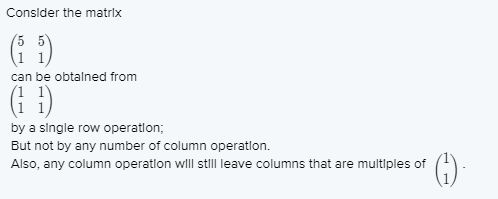
Thus, the statement “If B is a matrix that can be obtained by performing an elementary row operation on a matrix A, then B can also be obtained by performing an elementary column operation on A” is false.
If B is a matrix that can be generated by performing an elementary row operation on a matrix A, then B cannot be generated by performing an elementary column operation on A because the column multiplication cannot simply operate on their own in one step.
Thus, the statement “If B is a matrix that can be obtained by performing an elementary row
operation on a matrix A , then B can also be obtained by performing an elementary column operation on A” is false.
Linear Algebra 5th Edition Chapter 3 Page 150 Problem 9 Answer
Provided – statement “If B is a matrix that can be obtained by performing an elementary row operation on a matrix A, then A can be obtained by performing an elementary row operation on B .”
To check – the statement is true or false
We know that matrix A can be obtained by performing the inverse elementary row operation.
Thus, the statement “If B is a matrix that can be obtained by performing an elementary row operation on a matrix A, then A can be obtained by performing an elementary row operation on B ” is true.
If B is a matrix that can be generated by performing an elementary row operation on a matrix A, then A cannot be generated by performing an elementary row operation on B because A can be generated by performing the inverse elementary row operation.
Thus, the statement “If B is a matrix that can be obtained by performing an elementary row operation on a matrix A, then A can be obtained by performing an elementary row operation on B ” is true.
Linear Algebra 5th Edition Chapter 3
Page 151 Problem 10 Answer
Provided are the matrices,
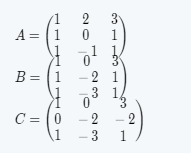
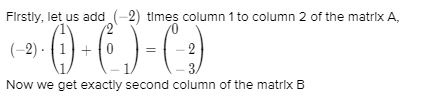
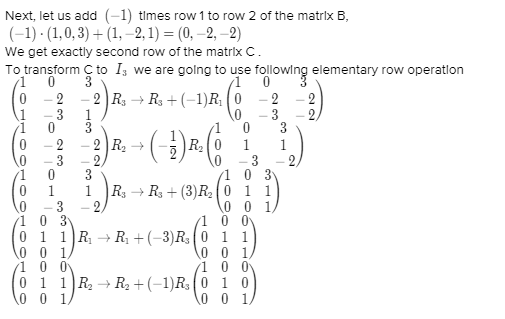
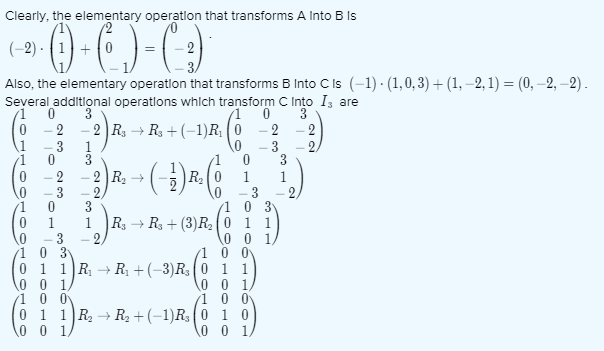
We are to determine the elementary operation that transforms A into B; elementary operation that transforms B into C and several additional operations which transform C into I3.
Note that matrices A and B have different second columns.
Linear Algebra Friedberg Exercise 3.1 Systems Of Linear Equations Chapter 3 Page 151 Problem 11 Answer
We are to show that E is an elementary matrix if and only if Et is elementary.
Consider E to be an n×n elementary matrix.
There are three types of an elementary matrix:
If matrix E is type (1), matrix E is generated by interchange two rows (or two columns) i and j of In, i,j∈{1,….,n}.
This means that E is a matrix with all entries are same as in In, except items on a position (i,j) and (j,i) in matrix, which is equal to 1, and items on a position (i,i) and (j,j) in matrix, which is equal to 0.
Here, we can note that the generated matrix is symmetrical. So, Et=E.
Hence, Et is an elementary matrix.
If matrix E is type (2), matrix E is generated by multiplication a row i (or a column i) of In, i∈{1,….,n} by a nonzero scalar a.
This means that E is a matrix with all entries are same as in In, except an item on a position (i,i), which is equal to a. Here, we can note that the obtain matrix is symmetrical.
So, Et=E. Hence, Et is an elementary matrix.
Now, we assume that E is type (3) and that an elementary operation is performed on this way: row i multiply by a nonzero scalar a and added to row j, where i,j∈{1,….,n}.
Then E is a matrix with all entries are same as in In, except an item on a position (j,i) in matrix, which is equal a.
Then, the transpose matrix Et is a matrix with all entries are same as in In, except an item on a position (i,j) in matrix, which is equal a.
The same matrix we can get if we multiply a column i by a nonzero scalar a and add to a column j. So, Et is an elementary matrix. Otherwise, let Et is an n×n elementary matrix.
As (Et)t=E, we come to the conclusion that E is an elementary matrix as we can apply the previous procedure on Et.
E is an n×n elementary matrix if and only if Et is an elementary matrix.
When a matrix E is type (1) or (2), then the matrix is symmetrical, so Et=E.
When a matrix E is type (3), then, if the matrix is generated by performing an elementary operation type (3) on rows (columns), the transpose corresponds to the same operation on columns (rows).
Thus, E is an elementary matrix if and only if Et is an elementary matrix.
Linear Algebra 5th Edition Chapter 3 Page 151 Problem 12 Answer
Theorem 3.1 states that:
Let A∈Mm×n(F), and suppose that B is generated from A by performing an elementary row [column] operation.
Then there exists an m×m[n×n] elementary matrix E such that B=EA[B=AE].
In fact, E is obtained from Im[In] by performing the same elementary row [column] operation as that which was performed on A to obtain B.
Conversely, if E is an elementary m×m[n×n]
matrix, then EA[AE] is the matrix obtained from A by performing the same elementary row [column] operation as that which produces E from Im[In].
We can judge the following matrix multiplication is right. Let {u1,u2,…,un} and {v1,v2,…,vn} be the row and column vectors of A respectively.
Row operations are as follows:
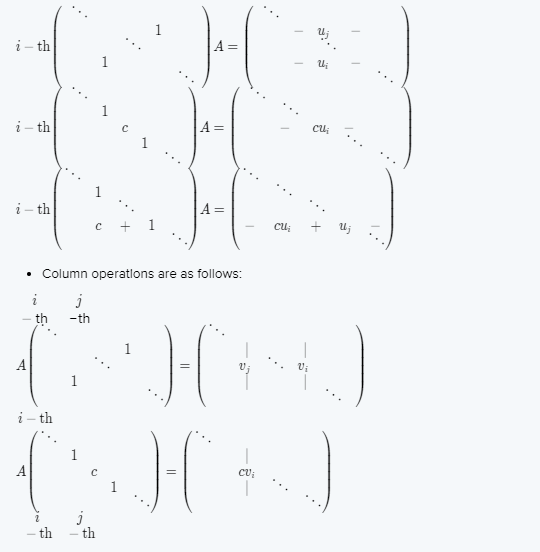
Therefore, the given theorem 3.1 is proved.
Exercise 3.1 Matrix Operations Examples Friedberg Chapter 3 Linear Algebra 5th Edition Page 151 Problem 13 Answer
Consider A to be a m×n matrix.
Using the theorem, E−1 is an elementary matrix of the same type if E is.
So, if Q can be obtained from P, we can write Q=EP and hence E−1Q=P.
This suggests that P can be obtained from Q.
Thus, it is proved above that then P can be generated from Q by an elementary matrix of the same type
Page 151 Problem 14 Answer
Here, we are to show that any elementary row [column] operation of type 2 can be obtained by dividing some row [column] by a nonzero scalar.
It is known that the operation of multiplying one row by a scalar c refers dividing the same row by a scalar 1/c.
Thus, it is shown that any elementary row [column] operation of type 2 can be generated by dividing some row [column] by a nonzero scalar.
Linear Algebra 5th Edition Chapter 3 Page 151 Problem 15 Answer
We are to show that any elementary row [column] operation of type 1 can be generated by a succession of three elementary row [column] operations of type 3 followed by one elementary row [column] operation of type 2.
Interchanging the ith and the j -th row can be generated by the following steps:
multiply the i -th row by −1;add −1 time the i -th row to the j -th row;add 1 time the j -th row to the i -th row;add −1 time the i -th row to the j -th row.
Thus, it is proved above that prove that any elementary row [column] operation of type 1 can be generated by a succession of three elementary row [column] operations of type 3 followed by one elementary row [column] operation of type 2.
Page 152 Problem 16 Answer
Here, we are to show that any elementary row [column] operation of type 3 can be obtained by subtracting a multiple of some row [column] from another row [column].
It is known that the operation of adding c times of the i -th row to the j -th row refers subtracting c times of the i -th row to the j -th row.
Thus, it is shown that any elementary row [column] operation of type 3 can be generated by subtracting a multiple of some row [column] from another row [column].
Linear Algebra 5th Edition Chapter 3 Page 152 Problem 17 Answer
Here, we are to show that any elementary row [column] operation of type 3 can be generated by subtracting a multiple of some row [column] from another row [column].
Firstly, let us assume k=min{m,n}.
Also, set j be a integer variable and do repeatedly the following processes:
When Aij=0 for all j, take i=i+1 and omit following steps and repeat process directly.
When Aij≠0 for some j, interchange the i -th and the j -th row.Now, add −Aij
Aji times the i-th row to the j-th row for all j>i.Then, set i=i+1 and repeat the process.
Thus, it is shown that any elementary row [column] operation of type 3 can be generated by subtracting a multiple of some row [column] from another row [column].