
The Cone
Theorems Related To Cones With Proofs And Examples
Definition. The surface generated by a straight line that which passes through a fixed point and intersecting a given curve or touches a given surface, is called a cone.
The fixed point is called the vertex and the given curve the guiding curve of the cone.
An individual straight line on the surface of a cone is called a generator.
Thus a cone is the set of lines called generators through a given point.
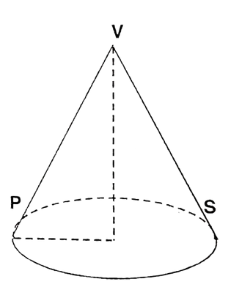
Another Definition. Let S be a set of points in space. It there exists a point V in S such that P ∈ S ⇒ \(\overleftrightarrow{V P}\) ⊂ S then S is called the cone and V is said to be the vertex of the cone.
⇒\(\overleftrightarrow{V P}\) is called a generator of a cone.
Note 1. If V is the vertex of the cone S and P is a point on ‘S’ the \(\overleftrightarrow{V P}\) is a generator.
2. If L is a generator of the cone S then every point of L lies on S.
Example. (1) The equation 2×2 + 3y2 – z2 = 0 represents a cone with vertex as origin.
(2) Intersection pairs of planes form a cone with every point on the common line as a vertex.
(3) A plane is a cone with every point on it as a vertex.
Theorem.1 If f(x, y, z) is a homogeneous polynomial of nth degree then the surface S represented by f(x, y, z) = 0 is a cone with a vertex at the origin.
Proof. Since f(x, y, z) is a homogeneous polynomial of degree n, for a real number λ.
f(λx, λy, λz) = λn f(x, y, z).
⇒ λnf(x, y, z) = 0 ⇒ f(λx, λy, λz) = 0
⇒ every point on \(\overleftrightarrow{O P}\) lies on the surface S.
∴ P ∈ S ⇒ \(\overleftrightarrow{O P}\) ⊂ S.
Hence the homogeneous equation f(x, y, z) = 0, represents a cone with a vertex at the origin.
Corollary. The line \(\frac{x}{l}=\frac{y}{m}=\frac{z}{n}\) is (λl, λm, λn) where λ is a real number.
∴ \(\frac{x}{l}=\frac{y}{m}=\frac{z}{n}\) is a generator of the cone <=> f(l,m,n) = 0
<=> Any point on the generator ∈ cone <=> (λl, λm, λn) ∈ cone
<=> f(λl, λm, λn) = 0 <=> λn f(l, m, n) = 0 <=> f(l, m, n) = 0
NOTE. If f(x, y, z) is a homogeneous polynomial of degree n then the cone f(x, y, z) = 0 is called a cone of nth degree.
example (1) 2x3 – y3 + 3x2z + 2z3 = 0 is a cone of third degree.
(2) x2 + y2 – z2 = 0 is a cone of 2nd degree.
Cones of second degree are also called Quadric cones. In this chapter, we deal with quadric cones only.
It will be seen that the degree of equation of a cone whose generators intersect a given conic or touch a given sphere is of the second degree.
Quadric Cones With Vertex At The Origin
Theorem.2 The equation of a cone with vertex at the origin is a homogeneous equation.
Proof. Let the general equation of second degree
ax2 + by2 + cz2 + 2fyz + 2gzx + 2hxy + 2ux + 2vy + 2wz + d = 0 represent cone S with vertex at (0, 0, 0).
Let P (x1, y1, z1) be a point on the cone
∴ The equation of generator \(\overleftrightarrow{O P}\) is \(\frac{x}{x_1}=\frac{y}{y_1}=\frac{z}{z_1}\) (=λ)
Any point (λx1, λy1, λz1) on \(\overleftrightarrow{O P}\) lies on the cone S.
<=> λ2(ax12 + by12 + cz12 + 2fy1z1 + 2gz1x1 + 2hx1y1) + 2λ(ux1 + vy1 + wz1) + d = 0
This is true for all real values of λ.
<=> ax12 + by12 + cz12 + 2fy1z1 + 2gz1x1 + 2hx1y1 …..(1)
ux1 + vy1 + wz1 …..(2)
d = 0 …..(3)
The relation (3) is obvious as the origin lies on the cone.
If u, v, w are not all zero, equation(2)
⇒ (λx1, λy1, λz1) lies on the plane ux + vy + wz = 0
Which is a contradiction. Thus we have u = v = w = 0, d = 0
Hence the equation to the cone S with vertex at the origin is given by the homogeneous equation ax2 + by2 + cz2 + 2fyz + 2gzx + 2hxy = 0 …..(1)
Conversely. Every homogeneous equation of the second degree represents a cone with its vertex at the origin.
Let the homogeneous equation of second degree be
S ≡ ax2 + by2 + cz2 + 2fyz + 2gzx + 2hxy = 0
Let P(x1, y1, z1) be a point on the cone.
Then ax12 + by12 + cz12 + 2fy1z1 + 2gz1x1 + 2hx1y1 …..(1)
Multiplying by a real number λ2 we have
aλ2x12 + bλ2y12 + cλ2z12 + 2fλ2y1z1 + 2hλ2x1y1 = 0
⇒ (λx1, λy1, λz1) lies on the surface.
Thus P lies on the surface ⇒ Every point on OP lies on it.
∴ The surface is generated by lines through O and hence, by definition is a cone with its vertex at O.
Note.1. Let △ = abc + 2fgh – af2 – bg2 – ch2 = \(\left|\begin{array}{lll}
a & h & g \\
h & b & f \\
g & f & c
\end{array}\right|\)
(1) If △ = 0, equation I represents a pair of planes, and S is called a degenerate cone.
(2) If △ ≠ 0, then the surface S is called a Quadric cone or a non-degenerate cone.
2. The equation ax2 + by2 + cz2 + 2fyz + 2gzx + 2hxy = 0 always represents a cone of second degree with its vertex at the origin.
3. As the above equation of the cone contains five arbitrary constants, we need five conditions to determine the cone.
4. The general equation of the cone with vertex at (α, β, γ) is
a(x−α)2+b(y−β)2+c(z−γ)2+2f(y−β)(z−γ)+2g(z−γ)(x−α)+2h(x−α)(γ−β)=0
This is a homogeneous equation in (x-α),(y-β), and (z-γ).
The Cone Solved Problems
Example. 1. Find the equation of the cone whose generators pass through the point (α, β, γ) and have their direction cosines satisfying the relation al2 + bm2 + cn2 = 0.
Solution. Equation to the generator passing through (α, β, γ)
and having directions cosines (l, m, n) is \(\frac{x-\alpha}{l}=\frac{y-\beta}{m}=\frac{z-\gamma}{n}=k \text { (say) }\)
⇒ \(l=\frac{x-\alpha}{k}, m=\frac{y-\beta}{k} \text { and } n=\frac{z-\gamma}{k}\)
But l, m, n satisfy al2 + bm2 + cn2 = 0 <=> \(\frac{1}{k}\left[(x-\alpha)^2+(y-\beta)^2+(z-\gamma)^2\right]=0\)
Hence the required to the cone is \((x-\alpha)^2+(y-\beta)^2+(z-\gamma)^2=0\)
Homogeneous Cone With Vertex At The Origin Examples
Example. 2. Show that x = -y = -z is a generator of the cone 5yz + 8zx – 3xy = 0.
Solution. \(\frac{x}{1}=\frac{y}{-1}=\frac{z}{-1}\)
is a generator of the cone 5yz + 8zx – 3xy = 0 …..(1)
<=> 5(-1)(-1)+8(-1)(1)-3(1)(-1) ⇒ 5 – 8 + 3 = 0
Hence the given line is a generator of the cone (1)
Theorem.3 shows that the general equation of the cone of the second degree which passes through the co-ordinate axes is fyz + gzx + hxy = 0
Proof. The equation of the cone of the second degree is ax2 + by2 + cz2 + 2fyz + 2gzx + 2hxy = 0 …..(1)
X – axis is a generator of the cone.
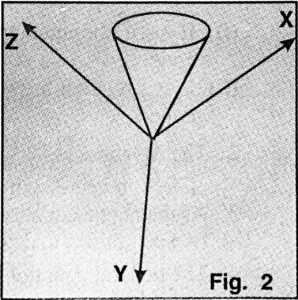
⇒ the direction cosines (1, 0, 0) of the x-axis satisfies (1)
⇒ a = 0.
Similarly, the y-axis is a generator ⇒ b = 0.
Similarly, the z-axis is a generator ⇒ c = 0.
Hence the general equation of the cone containing the three axes is fyz + gzx + hxy = 0
The Cone Solved Problems
Example. 1. Show that a cone can be found so as to contain any two given sets of three mutually perpendicular concurrent lines as generators.
solution. Let one set of three mutually perpendicular concurrent lines be taken as co-ordinate axes.
∴ The general equation of the cone through the coordinate axes is fyz + gzx + hxy = 0 …..(1)
Let the other set of perpendicular lines be OA, OB, OC given by the equations
Let the other set of lines be OA, OB, OC given by the equations
⇒\(\frac{x}{l_1}=\frac{y}{m_1}=\frac{z}{n_1} ; \frac{x}{l_2}=\frac{y}{m_2}=\frac{z}{n_2} ; \frac{x}{l_3}=\frac{y}{m_3}=\frac{z}{n_3}\)
Then m1n1 + m2n2 + m3n3 = 0 …..(1)
n1l1 + n2l2 + n3l3 = 0 …..(2)
l1m1 + l2m2 + l3n3 = 0 …..(3)
OA, OB, OC are the generators of cone
⇒ fm1n1 + gn1l1 + hl1m1 = 0 …..(2)
fm2n2 + gn2l2 + hl2m2 = 0 …..(3)
Adding (2) and (3) we get f(m1n1 + m2n2) + g(n1l1 + n2l2) + h(l1m1 + l2m2) = 0
i.e. f(-m3n3) + g(-n3l3) = 0 …by(3)
i.e. fm3n3 + gn3l3 + hl3m3 = 0
⇒ the line OC with directions ratio (l3, m3, n3) lies on the cone fyz + gzx + hxy = 0.
Hence cone (1) contains two sets of mutually perpendicular generators.
Step-By-Step Guide To Solving Cone Geometry Problems
Example. 2. Find the equation to the cone which passes through the three coordinate axes as well as the three lines \(\frac{1}{2} x=y=-z, x=\frac{1}{3} y=\frac{1}{5} z \text { and } \frac{1}{8} x=-\frac{1}{11} y=\frac{1}{5} z\).
Solution. The equation to the cone passing through the three coordinate axes can be taken in the form fyz + gzx + hxy = 0 …..(1)
The line \(\frac{x}{2}=\frac{y}{1}=\frac{z}{-1}\) lies on (1)
<=> f(1)(-1)+g(-1)(2)+h(2)(1) = 0 ⇒ f + 2g – 2h = 0 …..(2)
The line \(\frac{x}{1}=\frac{y}{3}=\frac{z}{5}\) lies on (1)
<=> f(3)(5) + g(5)(1) + h(1)(3) = 0 ⇒ 15f + 5g + 3h = 0 …..(3)
Solving (2) and (3) : \(\frac{f}{6+10}=\frac{g}{-30-3}=\frac{h}{5-30} \Rightarrow \frac{f}{16}=\frac{g}{-33}=\frac{h}{-25}\)
Hence the equation of the cone (1) is 16yz – 33zx – 25xy = 0
Clearly, the line with d.r’s (8, -11, 5) lies on it.
Example. 3. Find the equation of the cone which contains the three coordinate axes and the two lines through the origin with direction cosines (l1, m1, n1) and (l2, m2, n2)
Solution. The equation to the cone containing the coordinate axes can be taken as fyz + gzx + hxy = 0 …..(1)
The two lines with d.c.’s (l1, m1, n1) and (l2, m2, n2) lie on cone (1)
<=> fm1n1 + gn1l1 + hl1m1 = 0 …..(2)
and f(m2n2) + gn2l2 + hl2m2 = 0 …..(3)
Solving (2) and (3):
⇒ \(\frac{f}{l_1 l_2 m_2 n_1-l_1 l_2 m_1 n_2}=\frac{g}{m_1 m_2\left(n_2 l_1\right)-m_1 m_2 n_1 l_2}=\frac{h}{n_1 n_2 l_2 m_1-n_1 n_2 l_1 m_2}\)
⇒ \(\frac{f}{l_1 l_2\left(m_2 n_1-m_1 n_2\right)}=\frac{g}{m_1 m_2\left(n_2 l_0-n_1 l_2\right)}=\frac{h}{n_1 n_2\left(l_2 m_1-l_1 m_2\right)}\)
Substituting in (1) the required equation of the cone is
⇒ \(l_1 l_2\left(m_2 n_1-m_1 n_2\right) y z+m_1 m_2\left(n_2 l_1-n_1 l_2\right) z x+n_1 n_2\left(l_2 m_1-l_1 m_2\right) x y=0\)
⇒ \(\sum l_1 l_2\left(m_1 n_2-m_2 n_1\right) y z=0\)
The Cone Cone And A Plane Through Its Vertex.
Find the angle between the lines of intersection of the plane px + qy + rz = 0 and the cone F(x, y, z) ≡ ax2 + by2 + cz2+ 2fyz + 2gzx + 2hxy = 0
Solution. Let a line of intersection of the plane with the cone be \(\frac{x}{l}=\frac{y}{m}=\frac{z}{n}\).
∴ The line lies in the given plane as well as on the cone <=> pl + qm + rn = 0
and al2 + bm2 + cn2 + 2fmn + 2gnl + 2hlm = 0 …..(2)
Now substituting \(n=-\frac{p l+q m}{r}\) in (2) we have
⇒ \(a l^2+b m^2+c\left(\frac{p l+q m}{r}\right)^2+(2 f m+2 g l)\left(\frac{-p l+q m}{r}\right)+2 h l m=0\)
⇒ \(l^2\left(c p^2+a r^2-2 g r p\right)+2 l m\left(c p q+h r^2-g p r-f r p\right)+m^2\left(b r^2+c q^2-2 f q r\right)=0\)
⇒ \(\frac{l^2}{m^2}\left(c p^2+a r^2-2 g r p\right)+\frac{2 l}{m}\left(c p q+h r^2-g p r-f r p\right)+\left(b r^2+c q^2-2 f q r\right)=0\) …..(3)
This is a quadratic equation in \(\frac{l}{m}\) and shows that the plane cuts the cone in two times. If (l1, m1, n1) and (l2, m2, n2) are the d.c’s of the two lines then
⇒ \(\frac{l_1}{m_1}, \frac{l_2}{m_2}\) are the roots of (3)
⇒ \(\frac{l_1}{m_1} \cdot \frac{l_2}{m_2}=\frac{b r^2+c q^2-2 f q r}{c p^2+a r^2-2 g r p}\)
⇒ \(\frac{l_1 l_2}{b r^2+c q^2-2 f q r}=\frac{m_1 m_2}{c p^2+a r^2-2 g r p}=\frac{n_1 n_2}{a q^2+b p^2-2 h p q}\) by symmetry
each = \(\frac{l_1 l_2+m_1 m_2+n_1 n_2}{(b+c) p^2+(c+a) q^2+(a+b) r^2-2 f q r-2 g r p-2 h p q}\)
Also sum of the roots of (3) is \(\frac{l_1}{m_1}+\frac{l_2}{m_2}=-\frac{2\left(c p q+h r^2-g p r-f r p\right)}{c p^2+a r^2-2 g r p}\)
⇒ \(\frac{l_1 m_2+l_2 m_1}{-2\left(c p q+h r^2-g p r-f r p\right)}=\frac{m_1 m_2}{c p^2+a r^2-2 g r p}=\frac{l_1 l_2}{b r^2+c q^2-2 f q r}=\frac{n_1 n_2}{a q^2+b p^2-2 h p q}\)
each = \(\frac{\left[\left(l_1 m_2+l_2 m_1\right)^2-4 l_1 l_2 m_1 m_2\right]^{1 / 2}}{\left[4\left(c p q-g p r-f r p+h r^2\right)-4\left(b r^2+c q^2-2 f q r\right)\left(c p^2+a r^2-2 g r p\right)\right]^{1 / 2}}\)
⇒ \(\frac{l_1 m_2-l_2 m_1}{\pm 2 r \mathrm{D}} \text { where } \mathrm{D}^2=\left|\begin{array}{cccc}
a & h & g & p \\
h & b & f & q \\
g & f & c & r \\
p & q & r & 0
\end{array}\right|\)
By symmetry \(\frac{l_1 m_2-l_2 m_1}{\pm 2 r \mathrm{D}}=\frac{m_1 n_2-m_2 n_1}{\pm 2 p \mathrm{D}}=\frac{n_1 l_2-n_2 l_1}{\pm 2 q \mathrm{D}}=\frac{\sqrt{\sum\left(m_1 n_2-m_2 n_1\right)^2}}{\pm 2 \mathrm{D} \sqrt{p^2+q^2+r^2}}\)
Let θ be the angle between the lines then tanθ = =\(\frac{\sqrt{\sum\left(m_1 n_2-m_2 n_1\right)^2}}{l_1 l_2+m_1 m_2+n_1 n_2}\)
⇒ \(\tan \theta=\frac{2 \mathrm{D} \sqrt{\left(p^2+q^2+r^2\right)}}{(a+b+c)\left(p^2+q^2+r^2\right)-\mathrm{F}(p, q, r)}\)
Cor. Condition of perpendicularity.
If the lines of intersection of the plane px + qy + rz = 0 and the cone
ax2 + by2 + cz2 + 2fyz + 2gzx + 2hxy = 0 is a right angle then
θ = 90° ⇒ tanθ = tan90° = ∞’
⇒ (a + b + c)(p2 + q2 + r2)-F(p, q, r) = 0 which is the required condition.
The Cone Solved Problems
Example. 1. Find the equation of the lines of intersection of the plane 2x + y – z = 0 and the cone 4x2 – y2 + 3z2 = 0
Solution.
Given
The plane 2x + y – z = 0 and the cone 4x2 – y2 + 3z2 = 0
Let a line intersection of the plane with cone be \(\frac{x}{l}=\frac{y}{m}=\frac{z}{n}\) …..(1)
The line (1) lies on the plane and the cone <=> 2l + m – n = 0 …..(2)
and 4l2 – m2 + 3n2 = 0 …..(3)
∴ n = 2l + m
Substituting the value of n in (3): 4l2 – m2 + 3(2l+m)2 = 0 ⇒ 8l2 + 6lm + m2 = 0
⇒ (2l + m)(4l + m) = 0 ⇒ 2l + m = 0 …..(4)
and 4l + m = 0 …..(5)
(1) when 2l + m = 0, we have from (2): n = 0
⇒ \(\frac{l}{1}=\frac{m}{-2}=\frac{n}{0}\)
(2) Solving 2l + m – n = 0 …..(2)
and 4l + m + 0.n = 0 …..(3)
⇒ \(\frac{l}{0+1}=\frac{m}{-4-0}=\frac{n}{2-4} \Rightarrow \frac{l}{1}=\frac{m}{-4}=\frac{n}{-2}\)
Hence the two lines are \(\frac{x}{1}=\frac{y}{-2}=\frac{z}{0} \text { and } \frac{x}{1}=\frac{y}{-4}=\frac{z}{-2}\)
Solved Exercise Problems On Cone Geometry Step-By-Step
Example. 2. Find the equations of the lines of intersection of the plane 3x + 4y + z = 0 and the cone 15x2 – 32y2 – 7z2 = 0= 0.
Solution.
Given
The plane 3x + 4y + z = 0 and the cone 15x2 – 32y2 – 7z2 = 0= 0
Let a line of intersection be \(\frac{x}{l}=\frac{y}{m}=\frac{z}{n}\)
The line belongs to 3x + 4y + z = 0 <=> 3l + 4m + n = 0 …..(1)
⇒ n = -(3l + 4m)
Also, the line lies on the given cone 15x2 – 32y2 – 7z2 = 0
<=> 15l2 – 32m2 – 7n2 = 0 = 0 …..(2)
Substituting the value of n in (2): 15l2 – 32m2 – 7(3l + 4m)2 = 0
⇒ 2l2 – 7lm + 6m2 = 0 ⇒ (l+2m)(2l+3m)=0
⇒ l + 2m = 0 …..(3)
and 2l + 3m = 0 …..(4)
(1) solving 3l + 4m + n = 0 …..(1)
and l + 2m + 0.n = 0 …..(4)
(2) Again solving 3l + 4m + n = 0 …..(1)
and 2l + 3m + 0.n = 0 …..(4)
⇒ \(\frac{l}{0-3}=\frac{m}{2-0}=\frac{n}{9-8} \Rightarrow \frac{l}{-3}=\frac{m}{2}=\frac{n}{1}\)
∴ The two lines of intersection are \(\frac{x}{-2}=\frac{y}{1}=\frac{z}{-2} \text { and } \frac{x}{-3}=\frac{y}{2}=\frac{z}{1}\)
Example.3. Find the angle between the lines of intersection of the plane x – 3y + z = 0 and the cone x2 – 5y2 + z2 = 0.
Solution.
Given cone x2 – 5y2 + z2 = 0 and the plane x – 3y + z = 0.
Let \(\frac{x}{l}=\frac{y}{m}=\frac{z}{n}\) be one of the common lines of the cone and the plane.
∴ l2 – 5m2 + n2 = 0 …..(1)
and \(l-3 m+n=0 \Rightarrow \frac{l+n}{3}=m\) …..(2)
Substituting (2) in (1) \(l^2-5\left(\frac{l+n}{3}\right)^2+n^2=0\)
⇒ 2l2 – 5ln + 2n2 = 0 ⇒ (2l – n)(l – 2n) = 0
⇒ 2l – n = 0 …..(3) and l – 2n = 0 …..(4)
Now solving (2) and (3) i.e. l – 3m + n = 0
2l + 0.m – n = 0
we have \(\frac{l}{3-0}=\frac{m}{2+1}=\frac{n}{0+6} \Rightarrow \frac{l}{1}=\frac{m}{1}=\frac{n}{2}\)
Again solving (2) and (4) i.e. l – 3m + n = 0, l + 0.m – 2n = 0
We have \(\frac{l}{6-0}=\frac{m}{1+2}=\frac{n}{0+3} \Rightarrow \frac{l}{2}=\frac{m}{1}=\frac{n}{1}\)
Hence the direction ratios of the two lines of intersection are (1, 1, 2) and (2, 1,1).
∴ The equations of the lies of intersection are \(\frac{x}{1}=\frac{y}{1}=\frac{z}{2} \quad \text { and } \quad \frac{x}{2}=\frac{y}{1}=\frac{z}{1}\)
If θ is the angle between the lines, the cosθ = \(\frac{1(2)+1(1)+2(1)}{\sqrt{(1+1+4)} \cdot \sqrt{(4+1+1)}}=\frac{5}{6}\)
⇒ \(\theta=\cos ^{-1} \frac{5}{6}\)
Properties Of Cones With Solved Examples And Exercises
Example.4. Show that the equation of the quadric cone which contains the three coordinate axes and the lines in which the plane x – 5y – 3z = 0 cuts the cone 7x2 + 5y2 – 3z2 = 0 is yz + 10zx + 18xy = 0.
Solution. Let the plane x – 5y – 3z = 0 cut the cone 7x2 + 5y2 – 3z2 = 0
along the line \(\frac{x}{l}=\frac{y}{m}=\frac{z}{n}\)
⇒ l 5m – 3n = 0 …..(1)
and 7l2 + 5m2 – 3n2 = 0 …..(2)
Eliminating l from (1) and (2): 7(5m + 3n)2 + 5m2 – 3n2 = 0
⇒ 6m2 + 7mn + 2n2 = 0 ⇒ (2m + n)(3m + 2n) = 0
⇒ 2m + n = 0 …..(3) and 3m + 2n = 0 …..(4)
(1) Solving l – 5m – 3n = 0 …..(1)
and l.0 + 2m + n = 0 …..(3)
⇒ \(\frac{l}{-5+6}=\frac{m}{0-1}=\frac{n}{2-0} \Rightarrow \frac{l}{1}=\frac{m}{-1}=\frac{n}{2}\)
(2) Solving l – 5m – 3n = 0 …..(1)
and l.0 + 3m + 2n = 0 …..(4)
⇒ \(\frac{l}{-10+9}=\frac{m}{0-2}=\frac{n}{3-0} \Rightarrow \frac{l}{-1}=\frac{m}{-2}=\frac{n}{3}\)
∴ The two lines of intersection are \(\frac{x}{1}=\frac{y}{-1}=\frac{z}{2} \text { and } \frac{x}{1}=\frac{y}{2}=\frac{z}{-3}\)
Let the cone containing the coordinate axes be fyz + gzx + hxy = 0 …..(5)
<=> f(2)(-1) + g(2)(1) + h(1)(-1) = 0 ⇒ 2f – 2g + h = 0 …..(6)
and f(2)(-3) + g(-3)(1) + h(1)(2) = 0 ⇒ 6f + 3g – 2h = 0 …..(7)
Solving (6) and (7) : \(\frac{f}{4-3}=\frac{g}{6+4}=\frac{h}{6+12} \Rightarrow \frac{f}{1}=\frac{g}{10}=\frac{h}{18}\)
Hence the required cone is yz + 10zx + 18xy = 0
Example.5. Prove that the angle between the lines of intersection of the plane x + y + z = 0 with the cone ayz + bzx + cxy = 0 is π/3 if \(\frac{1}{a}+\frac{1}{b}+\frac{1}{c}=0\).
Solution. Let a line of intersection be \(\frac{x}{l}=\frac{y}{m}=\frac{z}{n}\) …..(1)
(1) lies on the given plane and cone
<=> l + m + n = 0 …..(2) and amn + bnl + clm = 0 …..(3)
Eliminating n from (2) and (3)
-am(l + m)-bl(l + m) + clm = 0 ⇒ bl2 + (a + b – c)lm + am2 = 0
This is a quadratic in \(\frac{l}{m}\). Let the roots be \(\frac{l_1}{m_1}, \frac{l_2}{m_2}\)
∴ \(\frac{l_1}{m_1} \cdot \frac{l_2}{m_2}=\frac{a}{b} \Rightarrow \frac{l_1 l_2}{a}=\frac{m_1 m_2}{b}=\frac{n_1 n_2}{c}\) by symmetry
each =\(\frac{l_1 l_2+m_1 m_2+n_1 n_2}{a+b+c}=k\)
Again \(\frac{l_1}{m_1}+\frac{l_2}{m_2}=\frac{c-b-a}{b} \Rightarrow \frac{l_1 m_2+l_2 m_1}{c-b-a}=\frac{m_1 m_2}{b}=k \text { (say) }\)
Now (l1m2 – l2m1)2 = (l1m2 + l2m1)2 – 4l1l2m1m2
= \(k^2(c-b-a)^2-4(a k)(b k)=k^2\left[(c-b-a)^2-4 a b\right]\)
= \(k^2\left(a^2+b^2+c^2-2 a b-2 b c-2 c a\right)\)
Now tanθ = \(\frac{\sqrt{\sum\left(l_1 m_2-l_2 m_1\right)^2}}{l_1 l_2+m_1 m_2+n_1 n_2}=\frac{\sqrt{3 k^2\left(a^2+b^2+c^2-2 b c-2 c a-2 a b\right)}}{k(a+b+c)}\)
If \(\theta=\frac{\pi}{3}, \tan ^2 \frac{\pi}{3}=(\sqrt{3})^2=\frac{3\left(a^2+b^2+c^2-2 b c-2 a c-2 a b\right)}{(a+b+c)^2}\)
⇒ (a + b + c)2 = a2 + b2 + c2 – 2bc – 2ca – 2ab
⇒ 4(bc + ca + ab) = 0 ⇒ \(\frac{1}{a}+\frac{1}{b}+\frac{1}{c}=0\)
Worked Examples Of Cones With The Vertex At The Origin
Example. 6. Prove that if the angle between the lines of intersection of the plane x + y + z = 0 and the cone ayz + bzx + cxy = 0 is \(\frac{\pi}{2}\) then a + b + c = 0.
Solution. Let a line of intersection be \(\frac{x}{l}=\frac{y}{m}=\frac{z}{n}\) …..(1)
(1) lies on the cone and the plane <=> l + m + n = 0 …..(2)
amn + bnl + clm = 0 …..(3)
Substituting n = -l – m in (3)
-am(l+m) – bl(l+m) + clm = 0 ⇒ -alm – am2 – bl2 – blm + clm = 0
⇒ bl2 + (a + b – c) lm + am2 = 0 ⇒ \(b\left(\frac{l}{m}\right)^2+(a+b-c) \frac{l}{m}+a=0\)
This is a quadratic in \(\frac{l}{m}\). Let the roots be \(\frac{l_1}{m_1}, \frac{l_2}{m_2}\)
∴\(\left(\frac{l_1}{m_1}\right)\left(\frac{l_1}{m_2}\right)=\frac{a}{b} \Rightarrow \frac{l_1 l_2}{a}=\frac{m_1 m_2}{b}\)
By symmetry: \(\frac{l_1 l_2}{a}=\frac{m_1 m_2}{b}=\frac{n_1 n_2}{c}=K \text { (say) }\)
the angle between the lines with dcs (l1, m1, n1) and (l2, m2, n2) is \(\frac{\pi}{2}\)
<=>l1l2 + m1m2 + n1n2 = 0
⇒ ka + kb + kc = 0
⇒ a + b + c = 0.
The Cone Cone With A Base Curve
Definition. Let S be the set of lies concurrent at V and C be a curve not containing V.
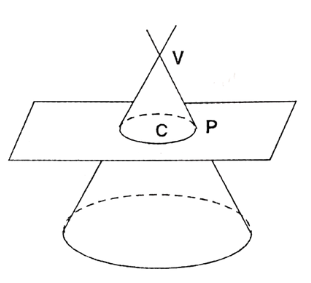
If P ∈ C ⇒ \(\overleftrightarrow{V P}\) ⊂ S then S is called the base curve or guiding curve. \(\overleftrightarrow{V P}\) is called a generator of the cone.
Theorem.4 The equation of a cone with vertex at (α, β, γ) ∉ XY plane and the guiding curve f(x,y)=0, z=0 is \((z-\gamma)^2 \cdot f\left(\alpha-\gamma \frac{X-\alpha}{z-\gamma}, \beta-\gamma \frac{y-\beta}{z-\gamma}\right)=0\)
Proof. Let the equation to a line through (α, β, γ) with directions ratios (l, m, n) be
⇒ \(\frac{x-\alpha}{l}=\frac{y-\beta}{m}=\frac{z-\gamma}{n} \quad(=r)\) …..(1)
A point on the line is (lr + α, mr + β, nr + γ).
Let the equation to the curve be f(x,y) = ax2 + 2hxy + by2 + 2gx + 2fy + c = 0, z = 0
The line passes through the conic.
<=> The point P(lr + α, mr + β, nr + γ) lies on the f(x,y) = 0 and on the plane z = 0.
⇒ \(z=0 \Rightarrow n r+\gamma \Rightarrow r=-\frac{\gamma}{n}\)
Hence the point P =\(\left(\alpha-\frac{l \gamma}{n}, \beta-\frac{m \gamma}{n}, 0\right)\) which will lie on the given conic,
<=> \(a\left(\alpha-\frac{l \gamma}{n}\right)^2+2 h\left(\alpha-\frac{l \gamma}{n}\right)\left(\beta-\frac{m \gamma}{n}\right)+b\left(\beta-\frac{m \gamma}{n}\right)^2+2 g\left(\alpha-\frac{l \gamma}{n}\right)+2 f\left(\beta-\frac{m \gamma}{n}\right)+c=0\) …..(3)
This is the condition for the line to intersect the conic.
Now eliminating l, m, n between (1) and (3)
⇒ \(a\left(\alpha-\frac{x-\alpha}{z-\gamma} \cdot \gamma\right)^2+2 h\left(\alpha-\frac{x-\alpha}{z-\gamma} \cdot \gamma\right)\left(\beta-\frac{y-\alpha}{z-\gamma} \cdot \gamma\right)+b\left(\beta-\frac{y-\beta}{z-\gamma} \cdot \gamma\right)^2\)
⇒ \(+2 g\left(\alpha-\frac{x-\alpha}{z-\gamma} \cdot \gamma\right)+2 f\left(\beta-\frac{y-\beta}{z-\gamma} \cdot \gamma\right)+c=0\)
⇒ \(a(\alpha z-x \gamma)^2+2 h(\alpha z-x \gamma)(\beta z-\gamma y)+b(\beta z-\gamma y)^2\)
⇒ \(+2 g(\alpha z-\gamma x)(z-\gamma)+2 f(\beta z-\gamma y)(z-\gamma)+c(z-\gamma)^2=0\)
⇒ \((z-\gamma)^2 \cdot f\left(\alpha-\frac{x-\alpha}{z-\gamma} \cdot \gamma, \beta-\frac{y-\beta}{z-\gamma} \cdot \gamma\right)=0\) which is the required equation of the conic.
Note. The guiding curve of the cone may be f(y,z) = 0, x = 0 or f(z,x) = 0, y = 0
The Cone Solved Problems
Example. 1. Find the equation of the cone whose vertex is the origin and whose base curve is x2 + y2 + z2 + 2ux + d = 0 px + qy + rz = k.
Solution.
Given
x2 + y2 + z2 + 2ux + d = 0 px + qy + rz = k
Let P(x1, y1, z1) be a point on the cone.
∴ The equation to \(\overleftrightarrow{O P}\) is \(\frac{x}{x_1}=\frac{y}{y_1}=\frac{z}{z_1}(=r)\). A point on \(\overleftrightarrow{O P}\) is (λx1, λy1, λz1).
⇒ \(\overleftrightarrow{O P}\) intersects the base curve C ⇒ (λx1, λy1, λz1) ∈ C
<=> λ2(λx12, λy12, λz12) + 2uλx1 + d = 0 and λ(px1 + qy1 + rz1) = k.
Eliminating λ from the above two relations.
We have k2(x12 + y12 + z12) + 2ukx1(px1 + qy1 + rz1) + d(px1 + qy1 + rz1)2 = 0
Hence the equation to the locus of p is the curve
k2(x2 + y2 + z2) + 2ukx (px + qy + rz) + d(px + qy + rz)2 = 0
Alternative method:
Solution. The given curve is x2 + y2 + z2 + 2ux + d = 0 …..(1)
px + qy + rz = k …..(2)
The required equation is the homogeneous equation of second degree satisfied by the points common to the two equations.
∴ p x+q y+r z=k. \(\quad \frac{p x+q y+r z}{k}=1\) …..(3)
Now homogeneuising the equation of (1) by (3) we have the homogeneous equation
⇒ \(x^2+y^2+z^2+2 u x\left(\frac{p x+q y+r z}{k}\right)+d\left(\frac{p x+q y+r z}{k}\right)^2=0\)
Thus the equation to the homogeneous cone is
⇒ \(k^2\left(x^2+y^2+z^2\right)+2 u k x(p x+q y+r z)+d(p x+q y+r z)^2=0\)
Example. 2. Find the equation of the cone whose vertex is (1, 1, 0) and whose guiding curve is y = 0, x2 + z2 = 4
Solution. Let the equation to the generator through the vertex (1, 1, 0) be
⇒ \(\frac{x-1}{l}=\frac{y-1}{m}=\frac{z}{n}(=r)\) …..(1)
A point on the generator is (lr + 1, mr + 1, nr)
If this point lies on the curve y = 0, x2 + z2 = 4, then
mr+1=0, (lr + 1)2 + (nr)2 = 4
i.e., \(r=-\frac{1}{m},(l r+1)^2+n^2 r^2=4\)
Eliminating r \(\left(1-\frac{l}{m}\right)^2+\frac{n^2}{m^2}=4 \Rightarrow(m-l)^2+n^2=4 m^2\) …..(2)
Eliminating l, m, n from (2) by using (1)
[(y – 1)+(x – 1)]2 + z2 = 4(y – 1)2 ⇒ x2 – 3y2 + z2 – 2xy + 8y – 4 = 0
which is the equation to the required cone.
Classification Of Cones And Their Equations With Solved Problems
Example. 3. Find the equation of the cone with vertex (5, 4, 3) and 3x2 + 2y2 = 6, y + z = 0 as base.
Solution. Let the equation to the generator be \(\frac{x-5}{l}=\frac{y-4}{m}=\frac{z-3}{n}=k\) …..(1)
Any point on (1) is (lk + 5, mk + 4, nk + 4)
This point lies on the base <=> 3(lk + 5)2 + 2(mk + 4)2 = 6 …..(2)
and mk + 4 + nk 3 = 0 ⇒ k(m + n) = -7 …..(3)
Substituting (3) in (2) : \(3\left(5-\frac{7 l}{m+n}\right)^2+2\left(4-\frac{7 m}{m+n}\right)^2=6\)
⇒ \(3(5 m+5 n-7 l)^2+2(4 m+4 n-7 m)^2=6(m+n)^2\)
⇒\(3[5(y-4)+5(z-3)-7(x-5)]^2+2[4(z-3)-3(y-4)]^2=6(y-4+z-3)^2\)
⇒ \(3(-7 x+5 y+5 z)^2+2(-3 y+4 z)^2=6(y+z-3)^2\)
⇒ \(147 x^2+87 y^2+101 z^2-210 x y+90 y z-210 x y-294=0\)
Example.4. Obtain the locus of the lines that pass through a point (α, β, γ) and through the points of the conic \(\frac{x^2}{a^2}+\frac{y^2}{b^2}=1, z=0\)
Solution. Let the equation line through (α, β, γ) be \(\frac{x-\alpha}{l}=\frac{y-\beta}{m}=\frac{z-\gamma}{n}=k\) …..(1)
Any point on the line is (α+lk, β+mk, γ+nk)
The point lies on the conic \(\frac{x^2}{a^2}+\frac{y^2}{b^2}=1, z=0\)
<=> \(\frac{(\alpha+l k)^2}{a^2}+\frac{(\beta+m k)^2}{b^2}=1 \text { and } \gamma+n k=0 \Rightarrow k=-\frac{\gamma}{n}\)
Substituting the value k we have
⇒ \(\frac{1}{a^2}\left(\alpha-\frac{l \gamma}{n}\right)^2+\frac{1}{b^2}\left(\beta-\frac{m \gamma}{n}\right)^2=1 \Rightarrow \frac{(\alpha n-\gamma l)^2}{a^2 n^2}+\frac{(\beta n-m \gamma)^2}{b^2 n^2}=1\)
Eliminating l, m, n using (1)
⇒ \(\frac{1}{n^2 a^2 k^2}[\alpha(z-\gamma)-\gamma(x-\alpha)]^2+\frac{1}{n^2 b^2 k^2}[\beta(z-\gamma)-\gamma(y-\beta)]^2=1\)
⇒ \(\frac{(\alpha z-\gamma x)^2}{a^2}+\frac{(\beta z-\gamma y)^2}{b^2}=(z-\gamma)^2\)
Example. 5. Find the equation of the cone whose vertex is (1, 2, 3) and base y2 = 4ax, z = 0.
Solution. Let a line through (1, 2, 3) be \(\frac{x-1}{l}=\frac{y-2}{m}=\frac{z-3}{n}=k\) …..(1)
Any point on the line is (1+lk, 2+mk, 3+nk)
It lies on the given conic <=> (2+mk)2= 4a(1+lk) and 3 + nk = 0 ⇒ k = -3/n
Eliminating k we have \(\left(2-\frac{3 m}{n}\right)^2=4 a\left(1-\frac{3 l}{n}\right) \Rightarrow(2 n-3 m)^2=4 a(n-3 l) n\)
using (1) we get [2(z-3)-3(y-2)]2 = 4a[z-3-3(x-1)](z-3)
⇒ (2z-3y)2 = 4a(y-3x)2(z-3)
Homogeneous Cone Equations With Proofs And Applications
Example. 6. The section of a cone whose vertex is P and guiding curve the ellipse \(\frac{x^2}{a^2}+\frac{y^2}{b^2}=1, z=0\) by the plane z=0 is a rectangular hyperbola. Show that the locus of P is \(\frac{x^2}{a^2}+\frac{y^2+z^2}{b^2}=1\)
Solution.
Given
The section of a cone whose vertex is P and guiding curve the ellipse \(\frac{x^2}{a^2}+\frac{y^2}{b^2}=1, z=0\) by the plane z=0 is a rectangular hyperbola.
Let the point p(x1, y1, z1)
Equation to a line through P be \(\frac{x-x_1}{l}=\frac{y-y_1}{m}=\frac{z-z_1}{n}=k\)
Any point on the lien is (x1 + lk, y1 + mk, z1 + nk)
This lies on the conic
<=> \(\frac{\left(x_1+l k\right)^2}{a^2}+\frac{\left(y_1+m k\right)^2}{b^2}=1, z_1+n k=0 \Rightarrow k=-\frac{z_1}{n}\)
Eliminating k we have
⇒ \(\frac{1}{a^2}\left[x_1-\frac{l z_1}{n}\right]^2+\frac{1}{b^2}\left[y_1-\frac{m z_1}{n}\right]^2=1 \Rightarrow \frac{\left(n x_1-l z_1\right)^2}{a^2}+\frac{\left(n y_1-m z_1\right)^2}{b^2}=n^2\)
⇒\(\frac{1}{a^2}\left[x_1\left(z-z_1\right)-z_1\left(x-x_1\right)\right]^2+\frac{1}{b^2}\left[y_1\left(z-z_1\right)-z_1\left(y-y_1\right)\right]^2=\left(z-z_1\right)^2\)
⇒ \(\frac{\left(z x_1-x z_1\right)^2}{a^2}+\frac{\left(z y_1-y z_1\right)^2}{b^2}=\left(z-z_1\right)^2\)
Now this meets x = 0 in a curve \(\frac{z^2 x_1^2}{a^2}+\frac{\left(z y_1-y z_1\right)^2}{b^2}=\left(z-z_1\right)^2, x=0\)
This will be a rectangular hyperbola <=> coefficient of y2+ coefficient of z2 = 0
⇒\(\frac{z_1^2}{b^2}+\left(\frac{x_1^2}{a^2}+\frac{y_1^2}{b^2}-1\right)=0\).
Hence the locus P is \(\frac{x^2}{a^2}+\frac{y^2+z^2}{b^2}=1\)
Example.7. A cone has as base the circle x2 + y2 + 2ax + 2by = 0, z = 0 and passes through the fixed point (0, 0, c). If the section of the cone by ZX plane is a rectangular hyperbola, Prove that the vertex lies on a fixed circle.
Solution.
Given
A cone has as base the circle x2 + y2 + 2ax + 2by = 0, z = 0 and passes through the fixed point (0, 0, c). If the section of the cone by ZX plane is a rectangular hyperbola,
Let P(x1, y1, z1) be the vertex of the cone and base curve
x2 + y2 + 2ax + 2by = 0, z = 0
The line through P, \(\frac{x-x_1}{l}=\frac{y-y_1}{m}=\frac{z-z_1}{n}\) …..(1)
meets the plane z = 0 at the point given by
⇒ \(\frac{x-x_1}{l}=\frac{y-y_1}{m}=\frac{z-z_1}{n} \Rightarrow \text { at }\left(x_1-\frac{l z_1}{n}, y_1-\frac{m z_1}{n}, 0\right)\)
This point lies on the circle
<=> \(\left(x_1-\frac{l z_1}{n}\right)^2+\left(y_1-\frac{m z_1}{n}\right)+2 a\left(x_1-\frac{l z_1}{n}\right)+2 b\left(y_1-\frac{m z_1}{n}\right)=0\)
Eliminating (l, m, n) using (1)
⇒ \(\left(x_1-\frac{x-x_1}{z-z_1} \cdot z_1\right)^2+\left(y_1-\frac{y-y_1}{z-z_1} \cdot z_1\right)^2+2 a\left(x_1-\frac{x-x_1}{z-z_1} \cdot z_1\right)+2 b\left(y_1-\frac{y-y_1}{z-z_1} \cdot z_1\right)=0\)
⇒ \(\left(x_1 z-x z_1\right)^2+\left(y_1 z-y z_1\right)^2+2 a\left(x_1 z-x z_1\right)\left(z-z_1\right)+2 b\left(y_1 z-y z_1\right)\left(z-z_1\right)=0\) …..(1)
This cone passes through (0, 0, c)
<=> \(\left(x_1 c\right)^2+\left(y_1 c\right)^2+2 a\left(x_1 c\right)\left(c-z_1\right)+2 b\left(y_1 c\right)\left(c-z_1\right)=0\)
<=> \(\left(x_1^2+y_1^2\right) c+\left(2 a x_1+2 b y_1\right)\left(c-z_1\right)=0\) …..(2)
Again the section of the cone (1) by the plane y = 0 is
⇒ \(\left(x_1 z-x z_1\right)^2+\left(y_1 z\right)^2+2 a\left(x_1 z-x z_1\right)\left(z-z_1\right)+2 b y_1 z\left(z-z_1\right)=0\) …..(3)
(3) represents a rectangular hyperbola
<=> coefficient of z2 + coefficient of y2 = 0 ⇒ x12 + y12 + 2ax1 + 2by1 + z12 = 0 …..(4)
Locus of P is given by (2) and (4) as \(\left(x^2+y^2\right) c+(2 ax+2 b y)(c-z)=0\) …..(5)
and x2 + y2 + z2 + 2ax + 2by = 0 …..(6)
Multiplying (6) by c and subtracting from (5), we get
cz2 + 2azx + 2byz = 0 ⇒ 2ax + 2by + 2cz = 0 …..(7)
Hence x2 + y2 + z2 + 2ax + 2by = 0 and 2ax + 2by + cz = together represent a circle.
The Cone Enveloping Cone
Definition. Let S be a surface and P be a point not on the surface. The set of tangent lines to the surface S and passing through P form a cone with vertex at P. This is called the enveloping cone or the tangent cone of the given surface.
Theorem.5. The enveloping cone of the sphere x2 + y2 + z2 = a2 with vertex at (x1, y1, z1) is (xx1 + yy1 + zz1 – a2)2 = (x2 + y2 + z2 – a2)(x12 + y12 + z12 – a2).
Proof. Let S = x2 + y2 + z2 – a2 = 0
P(x1, y1, z1) ∉ S = 0
⇒ x12 + y12 + z12 – a2 ≠ 0
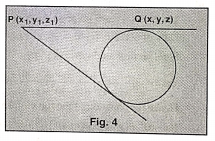
Let Q(x, y, z) be a point on the enveloping cone C.
∴ \(\overleftrightarrow{\mathrm{PQ}}\) is a tangent line to the sphere S = 0.
Let R ∈ \(\overleftrightarrow{\mathrm{PQ}}\) and (R, P, Q) = λ : 1
∴ \(\mathrm{R}=\left[\frac{\lambda x+x_1}{\lambda+1}, \frac{\lambda y+y_1}{\lambda+1}, \frac{\lambda z+z_1}{\lambda+1}\right]\)
R ∈ S = 0
⇒ \(\left(\frac{\lambda x+x_1}{\lambda+1}\right)^2+\left(\frac{\lambda y+y_1}{\lambda+1}\right)^2+\left(\frac{\lambda z+z_1}{\lambda+1}\right)^2=a^2\)
⇒ \(\left(\lambda x+x_1\right)^2+\left(\lambda y+y_1\right)^2+\left(\lambda z+z_1\right)^2=a^2(\lambda+1)^2\)
⇒ \(\lambda^2\left(x^2+y^2+z^2-a^2\right)+2 \lambda\left(x x_1+y y_1+z z_1-a^2\right)+\left(x_1^2+y_1^2+z_1^2-a^2\right)=0\)
⇒ \(\lambda^2 S+2 \lambda S_1+S_{11}=0\)
If \(\overleftrightarrow{\mathrm{PQ}}\) is a tangent line to the sphere then the two roots of the equation (1) are equal
⇒ 4S12 – 4SS11 = 0 ⇒ s12 = SS11
Hence the equation to the enveloping cone C is s12 = SS11
i.e., (xx1 + yy1 + zz1 – a2)2 = (x2 + y2 + z2 – a2)(x12 + y12 + z12 – a2)
The Cone Right Circular Cone
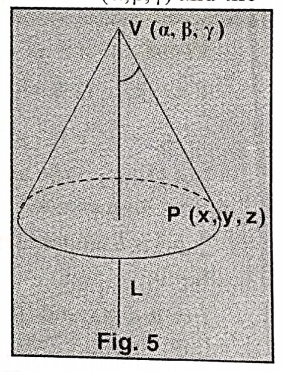
Definition. A right circular cone is a surface generator by a line that passes through a fixed point and makes a constant angle with a fixed line through the fixed point.
Let S be a set of concurrent lines, concurrent at V. If there exists a line L passing through V such that for a line M, M ∈ S ⇒ (L, M) = θ the S is called a right circular cone with vertex at V.
The line L is called the axis is θ the semi-vertical angle of the cone.
Note. The section of a right circular cone by any plane perpendicular to the axis is a circle.
Theorem.6. The equation of a right circular cone with vertex at (α, β, γ), semi-vertical angle θ and axis having direction ratios (l, m, n) is [l(x – α) + m(y – β) + n(z – γ)]2 = (l2 + m2 + n2)[(x – α)2 + (y – β)2 + (z – γ)2]cos2θ
Proof. Let V be the vertex and VL be the axis of the cone. V = (α, β, γ) and the direction ratios of the axis VL are (l, m, n).
Let P(x, y, z) be a point on the cone.
D.r’s of V.P are (x – α, y – β, z – γ)
Semi vertical angle θ = \((\overleftrightarrow{\mathrm{VL}}, \overleftrightarrow{\mathrm{VP}})\)
⇒ \(\cos \theta=\frac{l(x-\alpha)+m(y-\beta)+n(z-\gamma)}{\sqrt{\left[(x-\alpha)^2+(y-\beta)^2+(z-\gamma)^2\right]} \sqrt{\left(l^2+m^2+n^2\right)}}\)
Hence the equation of the right circular cone is
⇒ \(\left[(x-\alpha)^2+(y-\beta)^2+(z-\gamma)^2\right]\left(l^2+m^2+n^2\right) \cos ^2 \theta\)
⇒ \([l(x-\alpha)+m(y-\beta)+n(z-\gamma)]^2\)
Corollary 1. If the vertex be the origin then the equation of the cone becomes (lx + my + nz)2 = (l2 + m2 + n2)(x2 + y2 + z2)cos2θ
Corollary 2. The equation of the right circular cone with vertex at (0, 0, 0) and whose axis is the z-axis and semi-vertical angle α is x2 + y2 = z2 tan2α
Proof. Since d.r’s of the z-axis are (0, 0, 1)
l = 0, m = 0, n = 1
∴ The equation to the right circular cone is (x2 + y2 + z2 ) cos2α = z2
⇒ (x2 + y2) = z2 (sec2α – 1) ⇒ (x2 + y2) = z2 (tan2α)
The Cone Solved Problems
Example.1. Find the enveloping cone of the sphere x2 + y2 + z2 + 2x – 2y = 2, with its vertex at (1, 1, 1).
Solution. Given Vertex = (1, 1, 1).
Equation to the given sphere is S = x2 + y2 + z2 + 2x – 2y – 2 = 0
Now s1 = x.1 + y.1 + z.1 + (x + 1) – (y + 1) – 2 = 0 = 2x + z – 2
S11 = 1 + 1 + 1 + 2 – 2 – 2 = 1
∴ The equation to the enveloping cone is s12 = SS11
(2x + z – 2)2 = (x2 + y2 + z2 + 2x – 2y – 2)(1) ⇒ 3x2 – y2 + 4zx – 10x + 2y – 4z + 6 = 0
Example.2. Find the equation to the right circular cone whose vertex is P(2, -3, 5), axis PQ which makes equal angles with the axis and which passes through A(1, -2, 3).
Solution. The axis of the cone makes equal angles θ with the coordinate axes
∴ d.r’s of the axis are (cosθ, cosθ, cosθ) ⇒ d.r’s of the axis are (1, 1, 1)
Let α be the semi-vertical angle of the cone with vertex P(2, -3, 5)
∴ The equation to the required cone is
[(x – 2)2 + (y + 3)2 + (z – 5)2] (1 + 1 + 1)cos2α = [1.(x – 2) + 1.(y + 3) + 1(z – 5)]2
The point A(1, -2, 3) lies on the cone
<=> \(\left[(1-2)^2+(-2+3)^2+(3-5)^2\right] 3 \cos ^2 \alpha=[(1-2)+(-2+3)+(3-5)]^2\) <=> [/latex]\cos \alpha=\frac{\sqrt{2}}{3}[/latex]
∴ The equation to the required cone is
⇒ \(\left[(x-2)^2+(y+3)^2+(z-5)^2\right] \times \frac{2}{3}=[(x-2)+(y+3)+(z-5)]^2\)
Simplifying the equation x2 + y2 + z2 + 6(yz + zx + xy) – 16x – 36y – 4z – 28 = 0
Example.3. Find the equation of the right circular cone with vertex at (2, 1, -3) and whose axis is parallel to OY and whose semi-vertical angle is 45°.
Solution. Axis is parallel OY ⇒ d.cs. of axis are (0, 1, 0)
Given semi vertical angle α = 45°, vertex = (2, 1, -3).
∴ Equation to the cone is [(x – 2)2 + (y – 1)2 + (z + 3)2] =(y – 1)2 + (z + 3)2](0 + 1 + 0)cos245
= [0.(x – 2) + 1.(y – 1) + 0.(z + 3)]2
⇒ \(\frac{1}{2}\left[(x-2)^2+(y-1)^2+(z+3)^2\right]=(y-1)^2 \Rightarrow(x-2)^2-(y-1)^2+(z+3)^2=0\)
⇒ x2 – y2 + z2 – 4x + 2y + 6z + 12 = 0
Example.4. Find the equation of the right circular cone whose vertex is the origin, axis as the line x = t, y = 2t, z = 3t and whose semi-vertical angle is 60°.
Solution. Vertex (α, β, γ) = (0, 0, 0)
Equation to the axis \(\frac{x}{1}=\frac{y}{2}=\frac{z}{3}=t\)
⇒ D.r’s of the axis (l, m, n) = (1, 2, 2)
Semi vertical angle = 60°
∴ Equation to the required cone is
[(x – 0)2 + (y – 0)2 + (z – 0)2][12 + 22 + 32]cos260° = [1.(x – 0) + 2.(y – 0) + 3.(z – 0)]2
⇒ \(\frac{14}{4}\left(x^2+y^2+z^2\right)=(x+2 y+3 z)^2\)
⇒ 7(x2 + y2 + z2) = 2(x2 + 4y2 + 9z2 + 4xy + 12yz + 6zx)
⇒ 5x2 – y2 – 11z2 – 24yz – 12zx – 8xy = 0
Example.5. Show that the plane z = 0 cuts the enveloping cone of the sphere x2 + y2 + z2 = 11 which has its vertex at (2, 4, 1) in a rectangular hyperbola.
Solution. Let S ≡ x2 + y2 + z2 – 11 = 0
Given point P = (2, 4, 1) = (x1, y1, z1)
S1 ≡ xx1 + yy1 + zz1 – 11 ≡ x(2) + y(4) + z(1) – 11 = 2x + 4y + z – 11
S11 ≡ x12 + y12 + z12 – 11 ≡ (2)2 + (4)2 + (1)2 – 11 = 10
∴ Equation to the enveloping cone is SS11 = S12
⇒ (x2 + y2 + z2 – 11)(10) = (2x + 4y + z – 11)2
Where the plane z = 0 cuts the cone, then the equation to the conic is
10(x2 + y2 – 11) = (2x + 4y – 11)2 ⇒ 6x2 – 6y2 – 16xy + 88y + 44x – 331
In this equation coefficient of x2 + coefficient of y2 = 6 – 6 = 0
⇒ The conic is a rectangular hyperbola
Example.6. Find the equation of the cone generated by rotating the line \(\frac{x}{l}=\frac{y}{m}=\frac{z}{n}\) about the line \(\frac{x}{a}=\frac{y}{b}=\frac{z}{c}\) as axis.
Solution. Given lines pass through the origin ⇒ vertex is the origin.
D.r’s of an axis are (a, b, c)
Semi-vertical angle = angle between the generator and the axis
⇒ \(\cos \theta=\frac{a l+b m+c n}{\sqrt{a^2+b^2+c^2} \sqrt{l^2+m^2+n^2}}\) …..(1)
∴ Equation to the cone is [(x – 0)2 + (y – 0)2 + (z – 0)2](a2 + b2 + c2).cos2θ
= [a(x – 0) + b(y – 0) + c(z – 0)]2
Using (1) we have ⇒ (x2 + y2 + z2)(al + bm + cn)2 = (l2 + m2 + n2)(ax + by + cz)2
Example.7. If α is the semi-vertical angle of a right circular cone which passes through the lines OY, OZ, and x = y = z. Show that cosα = (9 – 4√3)-1/2.
Solution. Let (l, m, n) be d.r’s of the axis of the cone
D.r.’s of OY are (0, 1, 0)
D.r.’s of OZ are (0, 0, 1)
α is the angle between the axis and OY
⇒ \(\cos \alpha=\frac{0 . l+1 \cdot m+0 . n}{\sqrt{0+1+0} \sqrt{l^2+m^2+n^2}}=\frac{m}{\sqrt{l^2+m^2+n^2}}\) …..(1)
Also α is the angle between the axis and OZ
⇒ \(\cos \alpha=\frac{0 . l+0 . m+1 . n}{\sqrt{0+0+1} \sqrt{l^2+m^2+n^2}}=\frac{n}{\sqrt{l^2+m^2+n^2}}\) …..(2)
From (1) and (2) m = n
Similarly angle between the axis and \(\frac{x}{1}=\frac{y}{1}=\frac{z}{1}\)is
⇒ \(\cos \alpha=\frac{1 . l+1 \cdot m+1 \cdot n}{\sqrt{1+1+1} \sqrt{l^2+m^2+n^2}}=\frac{l+m+n}{\sqrt{3\left(l^2+m^2+n^2\right)}}\) …..(3)
Equating (1) and (3) \(m=\frac{l+m+n}{\sqrt{3}}\)
⇒ \(l+m(1-\sqrt{3})+n=0 \Rightarrow l+m(1-\sqrt{3})+m=0\) (∵ m = u)
⇒ \(l=m(\sqrt{3}-2) \Rightarrow \frac{l}{\sqrt{3}-2}=\frac{m}{1}=\frac{n}{1}\)
∴ From (1) \(\cos \alpha=\frac{1}{\sqrt{(\sqrt{3}-2)^2+1+1}}=\frac{1}{\sqrt{9-4 \sqrt{3}}}=(9-4 \sqrt{3})^{-1 / 2}\)
Example.8. Lines are drawn through the origin with direction ratios (1, 2, 2), (2, 3, 6) and (3, 4, 12). Find the direction ratios of the axis of the right circular cone and hence show that its semi-vertical angle is cos-1(1/√3). Also, find the equation of the cone.
Solution.
Given
Lines are drawn through the origin with direction ratios (1, 2, 2), (2, 3, 6) and (3, 4, 12).
Let (l, m, n) be the direction ratios of the axis of the right circular cone
Let α be the semi-vertical angle of cone
∴ Each given line is at α with the axis
(1) \(\cos \alpha=\frac{1 . l+2 \cdot m+2 \cdot n}{\sqrt{1+4+4} \sqrt{l^2+m^2+n^2}}\) …..(1)
(2) \(\cos \alpha=\frac{2 \cdot l+3 \cdot m+6 \cdot n}{\sqrt{4+9+36} \sqrt{l^2+m^2+n^2}}\) …..(2)
(3) \(\cos \alpha=\frac{3 \cdot l+4 \cdot m+12 \cdot n}{\sqrt{9+16+144} \sqrt{l^2+m^2+n^2}}\) …..(3)
From (1) and (2) : \(\frac{l+2 m+2 n}{3}=\frac{2 l+3 m+6 n}{7} \Rightarrow l+5 m-4 n=0\) …..1
From (1) and (3): \(\frac{1}{3}(l+2 m+2 n)=\frac{1}{13}(3 l+4 m+12 n) \Rightarrow 2 l+7 m-5 n=0\) …..2
Solving 1 and 2: \(\frac{l}{-25+28}=\frac{m}{-8+5}=\frac{n}{7-10} \Rightarrow \frac{l}{3}=\frac{m}{-3}=\frac{n}{-3} \Rightarrow \frac{l}{1}=\frac{m}{-1}=\frac{n}{-1}\)
∴ Direction cosines of the axis are \(\left(\frac{1}{\sqrt{3}},-\frac{1}{\sqrt{3}},-\frac{1}{\sqrt{3}}\right)\)
∴ The semi-vertical angle is given by
From (1) \(\cos \alpha=\frac{1(1)+2(-1)+2(-1)}{\sqrt{1+4+4} \sqrt{1+1+1}}=\frac{1}{\sqrt{3}} \Rightarrow \alpha=\cos ^{-1}\left(\frac{1}{\sqrt{3}}\right)\)
Equation the cone is \(\cos \alpha=\frac{1}{\sqrt{3}}=\frac{1(x-0)-1(y-0)-1(z-0)}{\sqrt{1+1+1} \sqrt{x^2+y^2+z^2}}\)
⇒ (x – y – z)2 = x2 + y2 + z2 ⇒ yz – zx – xy = 0
Example.9. find the equation of the cone formed by rotating the line 2x + 3y = 6, z = 0 about the y – axis.
Solution. The direction cosines of the axis are (0, 1, 0)
Given equation to the generator is 2x + 3y = 6, z = 0
2x = -3(y – 2), z = 0
⇒ \(\frac{x}{3}=\frac{y-2}{-2}=\frac{z}{0}\) …..(1)
Also Y-axis meets the line 2x + 3y = 6, z = 0 at (0, 2, 0)
⇒ vertex of the plane = (0, 2, 0)
∴ Semi-vertical angle = Angle between the line (1) and Y – axis.
⇒ \(\cos \alpha=\frac{0.3+1(-2)+0.0}{\sqrt{0+1+0} \sqrt{9+4+0}}=\frac{-2}{\sqrt{13}}\)
∴ The equation to the right circular cone with vertex (0, 2, 0) and axis d.r.’s (0, 1, 0) is
[0(x – 0) + 1(y – 2) + 0.z]2 (0 + 1 + 0)cos2α = (0.x + 1(y – 2) + 0.z)2
⇒ \([x+(y-2)+z]^2 \frac{4}{13}=(y-2)^2 \Rightarrow 4 x^2-9(y-2)^2+4 z^2=0\)
The Cone Notation
Let S represent the second-degree general equation in x, y, z. The following notation is used in this chapter.
i.e. S ≡ ax2 + by2 + cz2+ 2fyz + 2gzx + 2hxy + 2ux + 2vy + 2wz + d
E = E(x, y, z) = ax2 + by2 + cz2 + 2fyz + 2gzx + 2hxy
U = ax + hy + gz + u; V = hx + by + fz + v;
W = gx + fy + cz + w; D = ux + vy + wz + d and
U1 = ax1 + hy1 + gz1 + u; V1 = hx1 + by1 + fz1 + v;
W1 = gx1 + fy1 + cz1 + w; D1 = ux1 + vy1 + wz1 + d
Then S1 = axx1 + byy1 + czz1 + f(yz1 + y1z) + g(zx1 + z1x) + h(xy1 + x1y) + u(x + x1) + v(y + y1) + w(z + z1) + d
= (ax1 + hy1 + gz1 + u)x + (hx1 + by1 + fz1 + v)y + (gx1 + fy1 + cz1 + w) + ux1 + vy1 + wz1 + d = U1x + V1y + W1z + D1
S11 = U1x1 + V1y1 + W1z1 + D1
Theorem.7. If (x1, y1, z1) is the vertex of the cone S = 0 then U1 = V1 = W1 = D1 = 0
Proof. Let the equation to the cone be
S = ax2 + by2 + cz2 + 2fyz + 2gzx + 2hxy + 2ux + 2vy + 2wz + d = 0
Given vertex of the cone, P = (x1, y1, z1)
Shifting the origin to the point P the new equation of the cone referred to vertex P as the new origin is
a(x + x1)2 + b(y + y1)2 + c(z + z1)2 + 2f(y + y1)(z + z1) + 2g(x + x1)(z + z1) + 2h(x + x1)(y + y1) + 2u(x + x1) + 2v(y + y1) + d = 0
⇒ ax2 + by2 + cz2 + 2fyz + 2gzx + 2hxy + 2x(ax1 + hy1 + gz1 + u) + 2y(hx1 + by1 + fz1 + v) + 2z(gx1 + fy1 + cz1 + w) + ax12 + by12 + cz12 + 2fy1z1 + 2gz1x1 + 2hx1y1 + 2ux1 + 2vy1 + 2wz1 + d = 0.
⇒ E(x, y, z) +2U1x + 2V1y + 2W1z + S11 = 0
This must be a homogeneous equation
⇒ U1 = 0, V1 = 0, W1 = 0 and S11 = 0.
But S11 = U1x1 + V1y1 + W1z1 + D1 = 0 ⇒ D1 = 0 ⇒ U1 = V1 = W1 = D1 = 0
Corollary 1. If the equation S = 0 represents a cone then the condition is
⇒ \(\left|\begin{array}{llll}
a & h & g & u \\
h & b & f & v \\
g & f & c & w \\
u & v & w & d
\end{array}\right|=0\)
Proof. Eliminating x1, y1, z1 in the equations
U1 = ax1 + hy1 + gz1 + u = 0; V1 = hx1 + by1 + fz1 + v = 0;
W1 =gx1 + fy1 + cz1 + w= 0
D1 = ux1 + vy1 + wz1 + d = 0
We get \(\left|\begin{array}{llll}
a & h & g & u \\
h & b & f & v \\
g & f & c & w \\
u & v & w & d
\end{array}\right|=0\)
This is the required condition that the equation S = 0 represents a cone.
Corollary 2. The vertex ( x1, y1, z1 ) satisfies the equations
U ≡ ax + hy + bz + u = 0 …..(1) V ≡ hx + by + fz + v = 0 …..(2)
W ≡ gx + fy + cz + w = 0 …..(3) D ≡ ux + vy + wz + d = 0 …..(4)
Thus the vertex is obtained by solving any three of the above four equations
Note. Consider the homogeneous polynomial
S(x, y, z, t) = ax2 + by2 + cz2 + 2fyz + 2gzx + 2hxy + 2uxt + 2vyt + 2wzt + dt2
Now \(\frac{\partial \mathrm{S}}{\partial x}=2(a x+h y+g z+u t)\)
⇒ \(\frac{\partial \mathrm{S}}{\partial y}=2(h x+b y+f z+v t) ; \quad \frac{\partial \mathrm{S}}{\partial z}=2(g x+f y+c z+w t) ; \quad \frac{\partial \mathrm{S}}{\partial t}=2(u x+v y+w z+d t)\)
Now equating \(\frac{\partial S}{\partial x}, \frac{\partial S}{\partial y}, \frac{\partial S}{\partial z}, \frac{\partial S}{\partial t}\) each to zero and putting t = 1, we get
U = V = W = D = 0.
The Cone Solved Problems
Example.1. If ax2 + by2 + cz2 + 2ux + 2vy + 2wz + d = 0 represents a cone prove that \(\frac{u^2}{a}+\frac{v^2}{b}+\frac{w^2}{c}=d\).
Solution. Let ( x1, y1, z1 ) be the vertex of the given cone.
The given equation represents a cone if
⇒ \(\mathrm{U}_1=0 \Rightarrow a x_1+u=0 \quad \Rightarrow x_1=\frac{-u}{a}\);
⇒ \(\mathrm{V}_{\mathrm{I}}=0 \quad \Rightarrow b y_1+v=0 \Rightarrow y_1=\frac{-v}{b}\)
⇒ \(\mathrm{W}_1=0 \Rightarrow c z_1+w=0 \Rightarrow z_1=\frac{-w}{c}\) and
D1 = 0 ⇒ ux1 + vy1 + wz1 + d = 0
Substituting in D1 = 0 the values of x1 + y1 + z1 we get
⇒ \(u\left(\frac{-u}{a}\right)+v\left(\frac{-v}{b}\right)+w\left(\frac{-w}{c}\right)+d=0\)
⇒ \(\frac{u^2}{a}+\frac{v^2}{b}+\frac{w^2}{c}=d\)
Example.2. Find the vertex of the cone 7x2 + 2y2 + 2z2 – 10zx + 10xy + 26x – 2y + 2z – 17 = 0
Solution. Consider the homogeneous equation
S(x, y, z,t) = 7x2 + 2y2 + 2z2 – 10zx + 10xy + 26xt – 2yt + 2zt – 17t2 = 0
∴ \(\frac{\partial \mathrm{S}}{\partial x}=14 x-10 z+10 y+26 t=14 x+10 y-10 z+26\) (∵ t = 1)
⇒ \(\frac{\partial S}{\partial y}=4 y+10 x-2 t=10 x+4 y-2\)
⇒ \(\frac{\partial \mathrm{S}}{\partial z}=4 z-10 x+2 t=-10 x+4 z+2\);
⇒ \(\frac{\partial \mathrm{S}}{\partial t}=26 x-2 y+2 z-34 t=26 x-2 y+2 z-34\)
Coordinates of vertex satisfy the equations
14x + 10y – 10z + 26 = 0 …..(1) 10x + 4y – 2 = 0 …..(2)
-10x + 4z + 2 =0 …..(3) 26x – 2y + 2z – 34 = 0 …..(4)
Solving (1), (2), and (3) we get x = 1, y = -2, z = 2
Substituting (1, -2, 2) in (4) 26 + 4 + 4 + – 34 = 0
Hence the vertex of the cone is (1, -2, 2)
Example.3. Show that the equation 2y2 – 8yz – 4zx – 8xy + 6x – 4y – 2z + 5 = 0 represents a cone whose vertex is \(\left(-\frac{7}{6}, \frac{1}{3}, \frac{5}{6}\right)\)
Solution. Making the given equation homogeneous, we get
S(x, y, z, t) = 2y2 – 8yz – 4zx – 8xy + 6xt – 4yt – 2zt + 5t2 = 0
⇒ \(\frac{\partial \mathrm{S}}{\partial x}=-4 z-8 y+6 t ; \quad \frac{\partial \mathrm{S}}{\partial y}=4 y-8 z-8 x-4 t\)
⇒ \(\frac{\partial \mathrm{S}}{\partial z}=-8 y-4 x-2 t ; \quad \frac{\partial \mathrm{S}}{\partial t}=6 x-4 y-2 z+10 t\)
Equating t = 1 coordinates of the vertex satisfy the equations
4y + 2z – 3 = 0 …..(1) 2x – y + 2z + 1 = 0 …..(2)
2x + 4y + 1 = 0 …..(3) 3x – 2y – z + 5 = 0 …..(4)
Solving (1),(2) and (3) we get \(x=-\frac{7}{6}, y=\frac{1}{3}, z=\frac{5}{6}\)
Substituting in (4): \(3\left(-\frac{7}{6}\right)-2\left(\frac{1}{3}\right)-\frac{5}{6}+5=0 \Rightarrow-21-4-5+30=0\)
Hence the vertex of the cone is \(\left(-\frac{7}{6}, \frac{1}{3}, \frac{5}{6}\right)\)
Theorem.8. The cone E(x, y, z) = 0 will have three mutually perpendicular generators <=> a + b + c = 0.
Proof. Given the equation of the cone
E(x, y, z) = ax2 + by2 + cz2 + 2fyz + 2gzx + 2hxy = 0
Let \(\frac{x}{p}=\frac{y}{q}=\frac{z}{r}\) …..(1) be a generator of the cone,
∴ E(p, q, r) = 0 ⇒ ap2 + bq2 + cr2 + 2fqr + 2grp + 2hpq = 0 …..(2)
The equation to the plane ⊥er to (1) and passing through the vertex is px + qy + rz = 0 …..(3)
Let this plane intersect the cone along two real generators and (l, m, n) be the d.c’s of one of the generators.
∴ al2 + bm2 + cn2 + 2fmn + 2gnl + 2hlm = 0 …..(4)
pl + qm + rn = 0 …..(5)
Eliminating n between (4) and (5), we get
⇒ \(l^2\left(a r^2+c p^2-2 g r p\right)+2 l m\left(c p q+h r^2-g q r-f r p\right)+m^2\left(b r^2+c q^2-2 f q r\right)=0\)
⇒ \(\frac{l^2}{m^2}\left(a r^2+c p^2-2 g r p\right)+2 \frac{l}{m}\left(c p q+h r^2-g q r-f r p\right)+\left(b r^2+c q^2-2 f q r\right)=0\) …..(6)
If (l1, m1, n1) and (l2, m2, n2) are the direction cosines of the two generators of intersection then \(\frac{l_1}{m_1}, \frac{l_2}{m_2}\) are the roots of (6).
∴ \(\frac{l_1 l_2}{m_1 m_2}=\frac{b r^2+c q^2-2 f q r}{a r^2+c p^2-2 g r p}\)
⇒ \(\frac{l_1 l_2}{b r^2+c q^2-2 f g r}=\frac{m_1 m_2}{a r^2+c p^2-2 g r p}=\frac{n_1 n_2}{a q^2+b p^2-2 h p q}=k\), by symmetry.
∴ l1l2 + m1m2 + n1n2 = k[a(q2 + r2) + b(r2 + p2) + c(p2 + q2) – 2fqr – 2grp – 2hpq]
= k(a + b + c)(p2 + q2 + r2) …..(2)
The two generators of intersection of the plane (3) with the cone are at right angles.
<=> l1l2 + m1m2 + n1n2 = 0
<=> a + b + c = 0 [(∵ (p, q, r) ≠ (0, 0, 0)
Since plane (3) is perpendicular to generator (1), the two generators of intersection of the plane (3) with the cone are perpendicular to generator (1).
∴ These three generators are mutually perpendicular
<=> Two generators of intersection are perpendicular <=> a + b + c = 0.
Note. 1. Above condition is satisfied whatever is the direction of the generator. From this, we get if three mutually perpendicular lines are generators to the cone, then a + b + c = 0
Note. 2. Let F(x, y, z) = ax2 + by2 + cz2 + 2fyz + 2gzx + 2hxy + 2ux + 2vy + 2wz + d = 0 be a cone.
Shifting the origin to the vertex the transformed equation is
E(x, y, z) = ax2 + by2 + cz2 + 2fyz + 2gzx + 2hxy = 0.
the cone F(x, y, z) = 0, has three mutually perpendicular generators
<=> E(x, y, z) = 0 has three mutually perpendicular generators <=> a + b + c = 0
The Cone Solved Problems
Example.1. Show that the two lines of intersection of the plane ax + by + cz = 0 with the cone yz + zx + xy = 0 will be perpendicular if \(\frac{1}{a}+\frac{1}{b}+\frac{1}{c}=0\).
Solution. Given cone is yz + zx + xy = 0.
In this equation Coefficient of x2 + Coefficient of y2 + Coefficient of z2 = 0
∴ The cone contains sets of three mutually perpendicular generators.
The plane ax + by + cz = 0 cuts the cone in perpendicular generators if it’s a normal line through the vertex (0, 0, 0).
i.e., \(\frac{x}{a}=\frac{y}{b}=\frac{z}{c}\) is a generator of the cone.
⇒ bc + ca + ab = 0 ⇒ \(\frac{1}{a}+\frac{1}{b}+\frac{1}{c}=0\)
Example.2. If the line \(x=\frac{1}{2} y=z\) represents one of the three mutually perpendicular generators of the cone 11yz + 6zx – 14xy = 0, find the equations of the other two.
Solution. The given cone is 11yz + 6zx – 14xy = 0
The plane through the vertex of the cone and perpendicular to the generator.
⇒ \(\frac{x}{1}=\frac{y}{2}=\frac{z}{1}\) …..(1) is x + 2y + z = 0 the other two generators perpendicular to (1) are the lines of intersection of 11yz + 6zx – 14xy = 0 and x + 2y + z = 0.
Let l, m, n be the direction ratios of one of the common lines.
Then 11mn + 6nl – 14lm = 0 …..(2)
and l + 2m + n = 0 ⇒ n = -1-2m
Substituting in (2) 11m(-l-2m) + 6l(-l -2m)-14lm = 0
⇒ 6l2 + 37lm + 22m2 = 0 ⇒ (2l + 11m)(3l + 2m) = 0
⇒ 2l + 11m = 0 or 3l + 2m = 0
(1) solving l + 2m + n = 0
2l + 11m + 0.n = 0
we get \(\frac{l}{-11}=\frac{m}{2}=\frac{n}{7}\)
(2) solving 1 + 2m + n = 0
3l + 2m + 0.n = 0
we get \(\frac{1}{-2}=\frac{m}{3}=\frac{n}{-4}\)
∴ the other two perpendicular generators are \(\frac{x}{-11}=\frac{y}{2}=\frac{z}{7} \text { and } \frac{x}{2}=\frac{y}{-3}=\frac{z}{4}\)
Example.3. Show that if a right circular cone has sets of three mutually perpendicular generators, its semi vertical angle must be tan-1√2.
Solution. Let the origin be the vertex, l, m, n be direction cosines of the axis of the cone and α be its semi-vertical angle
Then the equation to cone is (lx + my + nz)2 = (l2 + m2 + n2)(x2 + y2 + z2)cos2α
∵ the cone contains three mutually perpendicular generators, then
i.e., Coefficient of x2 + Coefficient of y2 + Coefficient of z2 = 0.
Coefficient of x2 = l2-(l2 + m2 + n2)cos2α
Coefficient of y2 = m2-(l2 + m2 + n2)cos2α
Coefficient of z2 = n2-(l2 + m2 + n2)cos2α
Adding, we have by (1) (l2 + m2 + n2)-3(l2 + m2 + n2)cos2α = 0
⇒ 1 – 3cos2α = 0 ⇒ tan2α = 2 ⇒ tanα = √2 ⇒ α = tan-1 √2
Example.4. Show that cone whose vertex is the origin and which passes through the curve of intersection of the surface 2x2 – y2 + 2z2 = 3d2 any plane a distance d, from the origin has three mutually perpendicular generators.
Solution. The equation to any plane at a distance d from the origin is lx + my + nz = d …..(1)
where l, m, n are the actual d.c’s of normal to the plane.
Homogenizing the equation of the sphere with that of the plane, we have
⇒ \(2 x^2-y^2+2 z^2=3 d^2\left(\frac{l x+m y+n z}{d}\right)^2\)
Now Coefficient of x2 + Coefficient of y2 + Coefficient of z2
= (2 – 3l2) – l – 3m2 + (2 – 3n2) = 3 – 3(l2 + m2 + n2) = 3 – 3(1) = 0
Hence plane (1) cuts the cone into three mutually perpendicular generators.
Example.5. If the plane 2x – y + cz = 0 cuts the cone yz + zx + xy = 0 in perpendicular lines find c.
Solution. Given cone yz + zx + xy = 0 …..(1)
contains sets of three mutually perpendicular generators.
2x – y + cz = 0 cuts (1) in perpendicular lines
⇒ the normal of the plane lies on it.
⇒ (2, -1, c) must satisfy the cone equation
⇒ (-1)(c) + c(2) + (2)(-1) = 0 ⇒ c = 2
Example.6. Find the locus of the point from which three mutually perpendicular lines can be drawn to intersection the central conic ax2 + by2 = 1, z = 0.
Solution. Let the point P be (x1, y1, z1)
Any line through P is \(\frac{x-x_1}{l}=\frac{y-y_1}{m}=\frac{z-z_1}{n}=k\) …..(1)
Any point on the line is (x1 + lk, y1 + mk, z1 + nk)
the point lies on the base curve ax2 + by2 = 1, z = 0
<=> a(x1 + lk)2 + b(y1 + mk)2 = 1, z1 + nk = 0
Eliminating k, we have \(a\left(x_1-\frac{l z_1}{n}\right)^2+b\left(y_1-\frac{m z_1}{n}\right)^2=1\)
⇒ a(nx1 – lz1)2 + b(ny1 – mz1) = n2
using (1), to the cone is
a[x1(z – z1) – z1(x – x1)]2 + b[y1(z – z1) – z1(y – y1)]2 = (z – z1)2
This contains three mutually perpendicular generators
<=> Coefficient of x2 + coefficient of y2+ Coefficient of z2 = 0 ⇒ az12 + bz12 + ax12 + by12 – 1 = 0.
∴ Locus of P is a(x2 + z2) + b(y2 + z2) = 1
The Cone Intersection Of A Line With A Cone
Let the equation to the cone S be
S(x, y, z) ≡ ax2 + by2 + cz2 + 2fyz + 2gzx + 2hxy + 2ux + 2vu + 2wz + d = 0
Let the equation to a line be \(\frac{x-x_1}{l}=\frac{y-y_1}{m}=\frac{z-z_1}{n}(=r)\)
Let P be a point on this line
∴ p = (lr + x1, mr + y1, nr + z1) = 0
∴ P ∈ s <=> S(lr + x1, mr + y1, nr + z1) = 0
<=> \(a\left(l r+x_1\right)^2+b\left(m r+y_1\right)^2+c\left(n r+z_1\right)^2+2 f\left(m r+y_1\right)\left(n r+z_1\right)+2 g\left(n r+z_1\right)\left(l r+x_1\right)\)
⇒ \(+2 h\left(l r+x_1\right)\left(m r+y_1\right)+2 u\left(l r+x_1\right)+2 v\left(m r+y_1\right)+2 w\left(n r+z_1\right)+d=0\).
<=> \(r^2\left(a l^2+b m^2+c n^2+2 f m n+2 g m l+2 h l m\right)+2 r\left[l\left(a x_1+h y_1+g z_1+u\right)\right.\)
⇒ \(\left.+m\left(h x_1+b y_1+f z_1+v\right)+n\left(g x_1+f y_1+c z_1+w\right)\right]+\mathrm{S}\left(x_1, y_1, z_1\right)=0\)
<=> \(r^2 \mathrm{E}(l, m, n)+2 r\left[l \mathrm{U}_1+m \mathrm{~V}_1+n \mathrm{~W}_1\right]+\mathrm{S}_{11}=0\)
(1) This will be a quadratic equation in r <=> E(l, m, n) ≠ 0
The equation will have two real and distinctive roots.
<=> (lU1 + mV1 + nW1)2 – E(l, m, n) S11 > 0
Then there will be two real points of the line common with the cone. The line segment joining the two point is called the chord of the cone.
(2) If E(l, m, n) ≠ 0 and (lU1 + mV1 + nW1)2 – E(l, m, n) S11 > 0 then there are no common points.
(3) If E(l, m, n) ≠ 0 and (lU1 + mV1 + nW1)2 = E(l, m, n) S11 then the two roots of the equation are real and equal. Hence the line meets the curve in two coincident points. Then the line is called the tangent line at that common point.
(4) If E(l, m, n) = lU1 + mV1 + nW1 = S11 = 0, then the line becomes a generator of the cone.
The Cone Tangent Plane
Definition. Let S = 0, be the cone and L be a tangent line to the cone at P on it. The locus of the line L is called the tangent plane to the cone at P.
Theorem.9. If P(x1, y1, z1) is a point on the cone S = 0, then the equation of the tangent plane to the cone at P is S1 = 0.
Proof. Given equation to the cone S = S(x, y, z) = 0
Let the equation to the line passing through P(x1, y1, z1) be
⇒ \(\frac{x-x_1}{l}=\frac{y-y_1}{m}=\frac{z-z_1}{n}(=r)\) …..(1)
P(x1, y1, z1) ∈ S = 0 ⇒ S11 = 0
The point (lr + x1, mr + y1, nr + z1) of the line (1) lies on S = 0
<=> S(lr + x1, mr + y1, nr + z1) = 0
<=> r2E(l, m, n)0 + 2r[lU1 + mV1 + nW1] + S11 < 0
The line is a tangent line to the cone
<=> (lU1 + mV1 + nW1)2 – E(l, m, n).S11 = 0
<=> lU1 + mV1 + nW1 = 0 …..(2)
Eliminating l, m, n in (1) and (2), the locus of the tangent line is
(x – x1)U1 + (y – y1)V1 + (z – z1)W1 = 0
i.e. U1x + V1y + W1z = U1x1 + V1y1 + W1z1
i.e. S1 = S11 i.e. S1 = 0 [∵ S11 = 0]
∴ The equation to the tangent plane at P(x1, y1, z1) to the cone S = 0 is S1 = 0
Corollary. If the equation of the cone
E(x, y, z) = ax2 + by2 + cz2 + 2fyz + 2gzx + 2hxy = 0
then the equation to the tangent plane at (x1, y1, z1) on the cone is U1x + V1y + W1z = 0
i.e. x(ax1 + hy1 + gz1 ) + y(hx1 + by1 + fz1) + z[gx1 + fy1 + cz1 ] = 0
i.e. axx1 + byy1 + czz1 + f(y1z + yz1) + g(z1x + zx1) + h(x1y + xy1) = 0
Note 1. The tangent plane at a point P to the cone is also the tangent plane at every point on the generator.
2. The tangent plane at point P to the cone contains the generator through P.
3. The equation to the normal line to the tangent plane at P(x1, y1, z1) is \(\frac{x-x_1}{\mathrm{U}_1}=\frac{y-y_1}{\mathrm{~V}_1}=\frac{z-z_1}{\mathrm{~W}_1}\)
Theorem.10. The necessary and sufficient condition for the plane π = lx + my + nz = 0 to be a tangent plane to the cone E(x, y, z) = ax2 + by2 + cz2 + 2fyz + 2gzx + 2hxy = 0 is \(\rho=\left|\begin{array}{llll}
a & h & g & l \\
h & b & f & m \\
g & f & c & n \\
l & m & n & o
\end{array}\right|=0\)
(1) Necessary Condition
Let P(x1, y1, z1) be the point of contact of the given tangent plane π with the cone
E(x, y, z) = ax2 + by2 + cz2 + 2fyz + 2gzx + 2hxy = 0
∴ The equation to the tangent plane is U1x + V1y + W1z = 0
⇒ (ax1 + hy1 + gz1)x + (hx1 + by1 + fz1 )y + (gx1 + fy1 + cz1 )z = 0
Comparing with the given tangent plane π i.e. lx + my + nz = 0
We have \(\frac{\mathrm{U}_1}{l}=\frac{\mathrm{V}_1}{m}=\frac{\mathrm{W}_1}{n}\) (= -k, where k ≠ 0)
⇒ \(\frac{a x_1+h y_1+g z_1}{l}=\frac{h x_1+b y_1+f z_1}{m}=\frac{g x_1+f y_1+c z_1}{n}=-k\)
⇒ ax1 + hy1 + gz1 + lk = 0; hx1 + by1 + fz1 + mk = 0; gx1 + fy1 + cz1 + nk = 0
Also lx1 + my1 + nz1 = 0.
The non-zero solution (x1, y1, z1, k) satisfy the equations
ax + hy + gz + lt = 0; hx + by + fz + mt = 0 …..(1)
gx + fy + cz + nt = 0; lx + my + nz = 0.
Hence =\(\left|\begin{array}{lllc}
a & h & g & l \\
h & b & f & m \\
g & f & c & n \\
l & m & n & o
\end{array}\right|=0 \Rightarrow p=\mathrm{A} l^2+\mathrm{B} m^2+\mathrm{C} n^2+2 \mathrm{Fmn}+2 \mathrm{G} n l+2 \mathrm{H} l m=0\)
where A, B, C, F, G, H are the cofactors of a, b, c, f, g, h in the determinant.
⇒ \(\Delta=\left|\begin{array}{lll}
a & h & g \\
h & b & f \\
g & f & c
\end{array}\right|\)
(2) Sufficiency of the Condition. Given ρ = 0, to prove the plane π is a tangent plane to the cone E(x, y, z) = 0.
Proof. If ρ = 0, there exists a non-zero solution (x1, y1, z1, k) to I.
If k = 0, then U1 = 0, V1 = 0, W1 = 0 ⇒ (x1, y1, z1) is the vertex of the cone.
This contradicts the fact that (x1, y1, z1) ≠ (0, 0, 0). Hence k ≠ 0.
Corresponding to the non-zero solution (x1, y1, z1, k) of the equation I, we have
U1 = -kl, V1 = -km, W1 = -kn …..(1) and lx1 + my1 + nz1 = 0 …..(2)
(2) ⇒ P ∈ π
and E(x1, y1, z1) = U1x1 + V1y1 + W1z1 = -k(lx1 + my1 + nz1) = 0.
∴ (x1, y1, z1) is a point on the cone.
∴ P(x1, y1, z1) is a common point of the plane π and the cone.
∴ The equation to the tangent plane at P to the cone is U1x + V1y + W1z = 0
Since l:m:n = U1 : V1 : W1, lx + my + nz = 0 is the tangent plane P(x1, y1, z1) to the cone.
The Cone Reciprocal Cone
Theorem.11. The locus of the lines perpendicular to the tangent planes of the cone E(x, y, z) = ax2 + by2 + cz2 + 2fyz + 2gzx + 2hxy = 0 and passing through its vertex is the cone.
⇒ \(\left|\begin{array}{llll}
a & b & g & x \\
h & b & f & y \\
g & f & c & z \\
x & y & z & o
\end{array}\right|=0\)
Proof. Let \(\frac{x}{l}=\frac{y}{m}=\frac{z}{n}\) be a line perpendicular to a tangent plane of the cone and passing through the vertex (0, 0, 0).
The cone is E(x, y, z) ≡ ax2 + by2 + cz2 + 2fyz + 2gzx + 2hxy = 0 …..(1)
∴ lx + my + nz = 0 is the tangent plane to (1).
<=> Al2 + Bm2 + Cn2+ 2Fmn + 2Gnl + 2Hlm = 0
where A, B, C, F, G, H are the cofactors of a, b, c, f, g, h in the determinant.
⇒ \(\Delta=\left|\begin{array}{lll}
a & h & g \\
h & b & f \\
g & f & c
\end{array}\right|\)
Hence the locus of the normal line is
Ax2 + By2 + Cz2 + 2Fyz + 2Gzx + 2Hxy = 0
i.e. \(\left|\begin{array}{llll}
a & b & g & x \\
h & b & f & y \\
g & f & c & z \\
x & y & z & 0
\end{array}\right|=0\)
This equation represents a cone called the reciprocal cone of (1).
Corollary. The reciprocal cone of
Ax2 + By2 + Cz2 + 2Fyz + 2Gzx + 2Hxy = 0 …..(2)
is the cone E(x, y, z) = 0
Proof. By the above theorem, the reciprocal cone of (2) is
A’x2 + B’y2 + C’z2+ 2F’yz + 2G’zx + 2H’xy = 0 …..(3)
Where A’, B’, C’, F’, G’, H’ are the cofactors of A, B, C, F, G, H in determinant
⇒ \(\Delta=\left|\begin{array}{lll}
\mathrm{A} & \mathrm{H} & \mathrm{G} \\
\mathrm{H} & \mathrm{B} & \mathrm{F} \\
\mathrm{G} & \mathrm{F} & \mathrm{C}
\end{array}\right|\)
∴ A’ = BC – F2 = (ca – g2)(ab – h2) – (gh – af)2
= a(abc + 2fgh – af2 – bg2 – ch2) = aΔ,
where Δ = abc + 2fgh – af2 – bg2 – ch2
Similarly B’ = bΔ, C’ = cΔ, F’ = fΔ, G’ = gΔ, H’ = hΔ
Then the equation (3) reduces to ax2 + by2 + cz2 + 2fyz + 2gzx + 2hxy = 0
i.e. E(x, y, z) = 0
Thus cones (1) and (2) are Reciprocal cones to each other.
Note 1. A cone and its reciprocal cone will have the same vertex.
2. Corresponding to each tangent plane of a cone there exists a generator of the reciprocal cone which is perpendicular to the tangent plane and vice versa.
3. A cone E(x, y, z) = 0 has three mutually perpendicular tangent planes
<=> the reciprocal cone of E(x, y, z) = 0 has three mutually perpendicular generators
<=> (bc – f2) – (ca – g2) – (ab – h2) = 0
<=> bc + ca + ab = f2 + g2 + h2
The Cone Solved Problems
Example.1. The semi-vertical angle of a right circular cone having three mutually perpendicular (1) generators is tan-1√2
(2) tangent plane is \(\tan ^{-1} \frac{1}{\sqrt{2}}\)
Solution. Let the equations to the right circular cone be x2 + y2 = z2 tan2α
(1) If the cone contains three mutually perpendicular generators then a + b + c = 0
(2) The given cone contains three mutually perpendicular tangent planes
<=> its reciprocal cone contains three mutually perpendicular generators
∴ Equations to the reciprocal cone of (1) is
-tan2αx2 – tan2αy2 + 1.z2 = 0 …..(2)
Equation (2) will have three mutually perpendicular generators if
-tan2α – tan2α + 1 = 0 ⇒ \(\alpha=\tan ^{-1} \frac{1}{\sqrt{2}}\).
Example 2. Show that the general equation to a cone that touches the three coordinate planes is \(\sqrt{a x}+\sqrt{b y}+\sqrt{c z}=0\).
Solution. The general equation of the cone containing the three coordinates axes is ayz + bzx + cxy = 0
The reciprocal cone of (1) will have the coordinate planes.
∴ The equation to the reciprocal cone of (1) is
Ax2 + By2 + Cz2 + 2Fyz + 2Gzx + 2Hxy = 0
Where A = -a2; B = -b2; C = -c2
F = bc; G = ca; H = ab
∴ The equation to the required cone is
-a2x2 – b2y2 – c2z2 + 2bcyz + 2cazx + 2abxy = 0
⇒ (ax + by – cz)2 = 4abxy ⇒ ax + by – cz = ±2√abxy
⇒ ax + by ± 2√abxy = cz ⇒ (√ax ± √by)2= cz
⇒ √ax ± √by = ±√cz ⇒ √ax ± √by ± √cz = 0
Example.3. Show that the reciprocal cone of ax2 + by2 + cz2 = 0 is the cone \(\frac{x^2}{a}+\frac{y^2}{b}+\frac{z^2}{c}=0\).
Solution. Given cone is ax2 + by2 + cz2 = 0
∴ The equation to the reciprocal cone is
Ax2 + By2 + Cz2 + 2Fyz + 2Gzx + 2Hxy = 0
Where A = bc, B = ca, C = ab, F = 0, G = 0, H = 0
∴ The equation to the reciprocal cone is
bcx2 + cay2 + abz2 = 0 ⇒ \(\frac{x^2}{a}+\frac{y^2}{b}+\frac{z^2}{c}=0\)
Example.4. Find the equation of the tangent planes to the cone 9x2 – 4y2 + 16z2 = 0, which contains the line \(\frac{x}{32}=\frac{y}{72}=\frac{z}{27}\).
Solution. The given line \(\frac{x}{32}=\frac{y}{72}=\frac{z}{27}\) is the line of intersection of the planes
72x – 32y = 0 and 27y – 72x = 0
i.e., 9x – 4y = 0 and 3y – 8z = 0 …..(1)
∴ The plane passing through line (1) is 9x – 4y + λ(3y – 8z) = 0
i.e., 9x + y(3λ – 4) – 8λz = 0 …..(2)
∴ The equation to the normal line of (2) is\(\frac{x}{9}=\frac{y}{3 \lambda-4}=\frac{z}{-8 \lambda}\) …..(3)
Now plane (2) is a tangent plane to the cone 9x2 – 4y2 + 16z2 = 0 …..(4)
<=> The normal line(3) is a generator of the reciprocal cone of the cone (4)
∴ The equation of the reciprocal cone of (4) is \(\frac{x^2}{9}-\frac{y^2}{4}+\frac{z^2}{16}=0\) …..(5)
Since (3) is a generator of (5)
⇒ \(\frac{9^2}{9}-\frac{(3 \lambda-4)^2}{4}+\frac{(-8 \lambda)^2}{16}=0 \text { i.e. } 7 \lambda^2+24 \lambda+20=0 \Rightarrow \lambda=-2 \text { or } \frac{-10}{7}\)
Hence the equations of tangent planes from (2) are 9x – 10y + 16z = 0 and 63x – 58y + 80z = 0
Example.5. Prove that the equation \(\sqrt{f x} \pm \sqrt{g y} \pm \sqrt{h z}=0\) represents a cone that touches the coordinate planes and find its reciprocal cone.
Solution. The given equation is \(\sqrt{f x} \pm \sqrt{g y} \pm \sqrt{h z}=0\)
⇒ \(f x+g y \pm 2 \sqrt{f g x y}=h z\)
⇒ \((f x+g y-h z)^2=4 f g x y\)
⇒ \(f^2 x^2+g^2 y^2+h^2 z^2-2 g h y z-2 h f x x-2 f g x y=0\) …..(1)
This being a homogenous equation of the second degree, represents a quadric cone
The coordinate plane x = 0 meets (1) in \(g^2 y^2+h^2 z^2-2 g h y z=0 \Rightarrow(g y-h z)^2=0\)
⇒ which is a perfect square
⇒ x = 0 touches it similarly we can show that y = 0, z = 0 also touch(1).
Again from the cone(1).
⇒ \(a^{\prime}=f^2, b^{\prime}=g^2, c^{\prime}=h^2, f^{\prime}=-g h,^{\prime} g^{\prime}=-h f,^{\prime} h^{\prime}=-f g\)
∴ \(\mathrm{A}=b c-f^2=g^2 h^2-(-g h)^2=0\)
Similarly \(\mathrm{B}=0, \mathrm{C}=0, \mathrm{~F}=g h-a f=(-h f)(-f g)-f^2(-g h)=2 f^2 g h\)
Similarly \(\mathrm{G}=2 g^2 h f, \mathrm{H}=2 h^2 f g\)
∴ Reciprocal cone is Ax2 + By2 + Cz2 + 2Fyz + 2Gzx + 2Hxy = 0
⇒ \(2 f^2 g h y z+2 g^2 h f z x+2 h^2 f g x y=0 \Rightarrow f y z+g z x+h x y=0\)
Example.6. Find the condition that one plane ux + vy + wz = 0 may touch the cone ax2 + by2 + cz2 = 0
Solution. Equation to the normal to the given plane is \(\frac{x}{u}=\frac{y}{v}=\frac{z}{w}\) …..(1)
The equation to the reciprocal cone of
⇒ \(a x^2+b y^2+c z^2=0 \text { is } \frac{x^2}{a}+\frac{y^2}{b}+\frac{z^2}{c}=0\) …..(2)
Now the plane touches the cone (2)
<=> The normal of the plane lies on cone (2)
<=> \(\frac{u^2}{a}+\frac{v^2}{b}+\frac{w^2}{c}=0\) which is the required condition.
Example.7. Find the equation of the cone that touches the three coordinate planes and the planes x + 2y + 3z = 0, 2x + 3y + 4z = 0.
Solution. The equation to the cone touching the three axes can be taken as \(\sqrt{f x} \pm \sqrt{g y} \pm \sqrt{h z}=0\)
Its reciprocal cone is fyz + gzx + hxy = 0 …..(2)
The planes x + 2y + 3z = 0 and 2x + 3y + 4z = 0
touch the cone (1) <=> their normals lies on (2)
⇒ D.r’s of the normal (1, 2, 3) and (2, 3, 4) satisfy (2)
(1) f(2)(3) + g(3)(1) + h(1)(2) = 0 ⇒ 6f + 3g + 2h = 0 …..(3)
(2) f(3)(4) + g(4)(2) + h(2)(3) = 0 ⇒ 6f + 4g + 3h = 0 …..(4)
Solving (3) and (4): \(\frac{f}{9-8}=\frac{g}{12-18}=\frac{h}{24-18}\)
Hence (1) becomes \(\sqrt{x}+\sqrt{-6 y}+\sqrt{6 z}=0\)
The Cone Intersection Of Two Cones With A Common Vertex
In general two cones with a common vertex intersect along four common generators.
Let S = 0 and S’ = 0 be two cones with origin as the common vertex, then S + λS’ = 0 represents the general equation of a cone whose vertex is at the origin and which passes through the four common generators of the two cones.
Cor. Let λ be so chosen that S + λS’ = 0 becomes the product of two linear factors the two linear factors equated to zero represent the equations to a pair of planes through the common generators.
In that case the values of λ are the roots of the λ – cubic eqution
⇒ \(\left|\begin{array}{lll}
a+\lambda a^{\prime} & h+\lambda h^{\prime} & g+\lambda g^{\prime} \\
h+\lambda h^{\prime} & b+b^{\prime} \lambda & f+\lambda f^{\prime} \\
g+\lambda g^{\prime} & f+\lambda f^{\prime} & c+\lambda c^{\prime}
\end{array}\right|=0\)
The three values of λ give the three pairs of planes through the four common generators.
The Cone Solved Problems
Example.1. Find the equation of the cone which passes through the common generators of the cones 2x2 – 4y2 – z2 = 0 and 10xy – 2yz + 5zx = 0 may the line with direction ratios (1, 2, 3).
Solution.
Given
2x2 – 4y2 – z2 = 0 and 10xy – 2yz + 5zx = 0
Let the required cone be 2x2 – 4y2 – z2 + λ(10xy – 2yz + 5zx) = 0 …..(1)
This is a quadric cone with a vertex at the origin.
The line with d.r.’s (1, 2, 3) lies on (1)
<=> 2(1)2 – 4(2)2 – (3)2 + λ[10(1)(2) – 2(2)(3) + 5(3)(1)] = 0
⇒ – 23 + 23λ = 0 ⇒ λ = 1
∴ Required cone is 2x2 – 4y2 – z2 + 10xy – 2yz + 5zx = 0
Example 2. Find the condition that the lines of the section of the plane lx + my + nz = 0 and the cones ax2 + by2 + cz2 = 0 and fyz + gzx + hxy = 0 should be concident.
Solution. Any cone through the intersection of the two given cones is ax2 + by2 + cz2 + λ(fyz + gzx + hxy) = 0 …..(1)
Given that the plane lx + my + nz = 0 cuts (1) in coincident lines
⇒ for some value of λ(1) must represent a pair of planes.
Let l1x + m1y + n1z = 0 …..(2) be the other plane.
Then ax2 + by2 + cz2 + λ(fyz + gzx + hxy) = (lx + my + nz)(l1x + m1y + n1z)
⇒ ll1 = a, mm1 = b, nn1 = c
⇒ l1 = a/1, m1 = b/m, n1 = c/n
Again \(\lambda f=m n_1+m_1 n=\frac{c m}{n}+\frac{b n}{m}=\frac{c m^2+b n^2}{m n}\)
Similarly \(\lambda g=\frac{a n^2+c l^2}{n l} \text { and } \lambda h=\frac{a m^2+b l^2}{l m}\)
⇒ \(\frac{c m^2+b n^2}{f m n}=\frac{a n^2+c l^2}{g n l}=\frac{a m^2+b l^2}{h l m}\) which is the required condition.